The NEW Tesla Roadster: My Honest Reaction
In a Nutshell
Tesla's new Roadster is a fan-assisted car with cold gas thrusters that can achieve 0.6-second 0-60 mph, drive up walls, and do kickflips, but the flying/rocket versions are purely demo-only and will never be sold. The car comes in four versions from a street-legal base model to the invite-only rocket spec, with the fan system providing actual performance benefits while the thrusters are mostly marketing gimmicks that last 3-5 seconds before needing hours to refill. Tesla has pushed delivery to 2028 with a reservation agreement that guarantees nothing, and the Roadster remains the company's lowest-priority product that likely won't significantly impact their business.
These notes were generated by AI and may contain inaccuracies.
Last night Tesla held one of the most insane product demos of all time. The event featured a completely redesigned Cybertruck-looking car, a car driving up a wall, an upside-down car, a flying car, a car that jumps and does a kick flip, and a 0.6-second 0-60 mph acceleration. However, a lot of this was distraction from the facts and figures about the actual Tesla Roadster itself. The original 2020 Roadster will be missed even though it never existed.
A lot of people were freaking out after the event, and rightfully so because it was pretty insane. Many were also very skeptical for the same reason. There was nuance to the event - a good amount of what was seen was really cool engineering that car people are interested in, while other parts were completely insane that may never be seen in person.
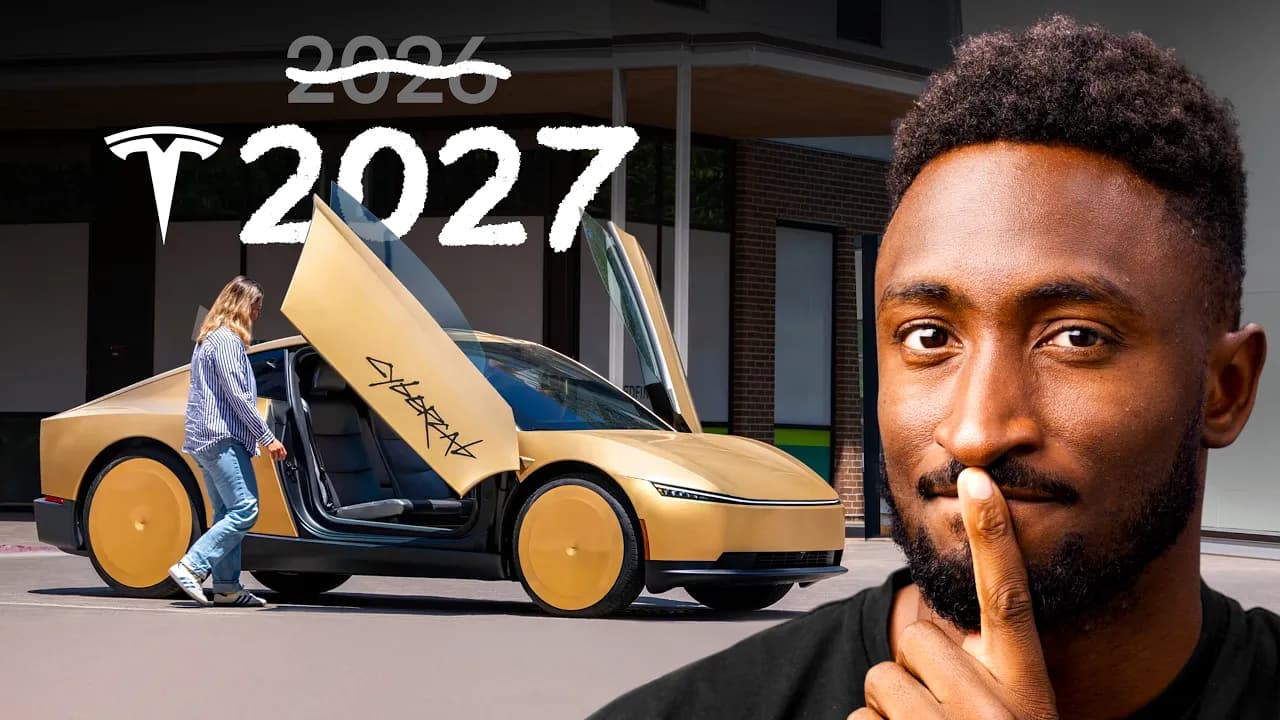
The car started by re-unveiling the completely redesigned Tesla Roadster that looks nothing like the 2017 version. The new design is described as a cyberified interpretation of a Lamborghini, possibly a Murcielago. It features minimal, angular styling with triangle shapes, slot headlights, doors that go up instead of out, a headlight bar at the front, and a tail light bar at the back. The back has a huge moving wing and exhaust tips. The presenter personally doesn't love the new design and thought the old car was quite pretty.
The car drove up a wall slowly, approaching an increasingly impossible angle until it drove straight up the wall and became completely upside down, stuck to a ramp 60 feet in the air while producing over 4,000 kg of downforce while stationary. This revealed it was a fan car. The car then went up the ramp again and vaulted off the top, doing an insane flip maneuver and landing on its wheels. There are clearly thrusters all around the car pointed in all directions powerful enough to move the entire car in space, with enough compressed air to flip and land softly.
This was an autonomous demo with no real human in the car - a pre-scripted robotic demo probably for safety purposes, similar to a Boston Dynamics robot in its best-case scenario. The flying car demo left many questions unanswered. The event didn't answer most important questions about the product.
The next morning, videos from Motor Trend, Hagerty, and Top Gear combined with the refreshed Tesla website helped understand more about the car. There are four versions: base, performance, thrust, and rocket specs. The base car has none of the extra stuff and isn't mentioned on the website.
The performance version has a fan system for downforce but no cold gas thrusters yet. This concept has been seen before in the McMurtry Speirling, a single-seater fully electric car with a fan system underneath and behind it. The fan system creates a low-pressure zone under the car to generate downforce at lower speeds, unlike traditional aerodynamics that only work at high speeds. The McMurtry Speirling drops a skirt underneath to create a vacuum-sealed area and spins a fan at the back at high RPM, generating more downforce than the car's actual weight.
The fan system makes the biggest difference at lowest speeds. The McMurtry Speirling achieves 0-60 mph in 1.4 seconds with over 1,000 horsepower. It has demolished lap records at tracks worldwide because it finds grip in places other cars don't. The Tesla Roadster inherits this fan system and achieves 1.66-second 0-60 mph.
The presenter is on the fence about whether the fan system could be street legal. The skirts on both the Speirling and Roadster are made from flexible rubber and are easily replaceable when worn from dragging along the ground. The car needs filters so large items don't get caught in the fans, but smaller debris makes it through and shoots out the back. The McMurtry Speirling isn't street legal with fans running, though they're working on a street-legal version. Tesla calls this performance trim "road ready," suggesting they intend it to be street legal.
The Thrust version adds thrusters to the back of the car in addition to the fan system. Four fans at the bottom are the suction system, while four bigger exhaust pipes at the top are the thrust system. These pipes are attached to a 200L carbon-overlaid pressure vessel carrying 100+ kilograms of pressurized nitrogen at 10,000 PSI behind the driver's head. This enables sub-1-second 0-60 mph because the car exceeds the limit of tire traction. Demo videos showed tons of compressed nitrogen coming out the back, pulling a couple of G's and hitting 60 mph before going the length of a driveway.
Three lateral G's is crazy to experience in a car - most cars have a grip limit of 1.2-1.3 G's. While roller coasters do 3Gs and it's not dangerous to the body, holding arms up to the steering wheel becomes three times harder. The demo was conducted hundreds of feet away from people with hearing protection because the thrusters are incredibly loud on top of the already loud fans. There are laws about how loud cars can be to pass regulations.
The presenter is most concerned about crash test safety with cold gas thrusters and massive carbon-overlaid compressed air canisters. Rockets don't get crash safety tested like cars because if a rocket crashes, that's essentially it. There's uncertainty about what happens in a safety incident with a massive 10,000 PSI compressed air balloon next to the driver's head.
The rocket spec adds six more thrusters around the car facing various directions and one massive 400L compressed air tank in the passenger seat area, making it a one-seater. This enables the party tricks seen at the event like jumping or doing a massive kick flip over a 40ft section of road. It achieves 0-60 mph in 0.6 seconds. This version is clearly never going to be street legal and is invite-only.
The new Roadster is supposed to ship in 2028. The presenter would have preferred seeing more engineering details instead of spending so much time on party tricks. The event felt like smoke and mirrors in front of abandoning the old Roadster that spent unknown development time and is now never coming out. At one point they claimed it would go half the speed of sound, which the presenter doubts. The thrust mode lasts 3-5 seconds before the tank is empty, requiring 6-7 hours to refill.
The new Roadster is supposed to have all carbon fiber body panels and weigh under 1,700 kg. It will have just rear-wheel drive for driving engagement, with all 1,300 horsepower and 1,400 Nm of torque coming from new dual motors at the rear that are smaller and more power-dense than Plaid motors. Range went down from 600 miles to 300+ miles promised. It will have 500 kW supercharging at V4 superchargers, achieving 15-80% charge in 10 minutes.
The Roadster promises 25-30 minutes of full-on maximum power, max attack, track mode driving. This is rare for an EV as thermal management typically limits this capability. The car could do multiple laps before recharging, then recharge quickly. It has active aero bits, a charging port behind the rear wing, a movable pedal box, double wishbone suspension, brake-by-wire, steer-by-wire, and windows tinted with gold accent color to mimic a spacesuit visor.
The kick flip and jumping don't have real-world performance benefits. The fan system provides actual benefits through more downforce and grip for better cornering and faster lap times. The thrusters could be seen as a cool straight-line drag race gimmick. The presenter questions whether people want highway commuters with cars that can jump without pilot's licenses.
The Roadster is Tesla's least important product. Tesla recently killed the Model S and Model X because they weren't selling enough to matter to the bottom line. The company has priorities like Model 3, Model Y, and humanoid robots. The presenter won't hold their breath for this to become a priority. The flying/rocket version will never be available for purchase. The base and fan car versions might be possible, but it doesn't matter because the Roadster doesn't make a difference to Tesla's bottom line - it's so low volume.
Tesla's Roadster reservation agreement states that the Roadster is still under development and they cannot guarantee when or if the vehicle will be delivered. Henry Catchpole from Hagerty noted that Tesla realized a really fast electric car doesn't do it for people anymore since they've already made Plaid, so they swapped it for the dream of a flying car that makes more headlines.
Even if they never ship the thing, the successful engineering exercise is at least a spectacle that can be talked about as a marketing success. The event was a successful engineering exercise and marketing stunt with months of incredible engineering and a demo no one has ever seen before.
Keep Marques Brownlee in your library
Save the videos and channels worth coming back to, and find them again in one place.