The Path from The Soviet Union to Building Multi-Billion Dollar Companies — Max Levchin
In a Nutshell
Max Levchin built PayPal and Affirm by applying a simple rule—"when there's any doubt, there's no doubt"—to hiring, co-founders, and tough decisions, while crediting his wife Nelly's complementary strengths and daily effort to impress each other as the foundation for both his marriage and his companies. He rejects socialism from direct Soviet experience, arguing it breeds corruption and stagnation because it removes the competitive pressure to create efficiency, and instead champions pro-consumer capitalism that makes slightly less money to earn lasting trust. Affirm succeeded by replacing revolving credit-card debt with transparent fixed-term loans, proving that underwriting discipline plus a brand built on honesty can attract both customers who hate banks and elite technical talent who want meaningful work.
These notes were generated by AI and may contain inaccuracies.
The relationship quality between co-founders mirrors marriage dynamics. The speaker examined what makes his marriage successful and identified a core principle: he continues trying to impress his wife daily. Every morning he wakes thinking about how fortunate he is in the relationship and how he got something better than expected. This ongoing effort to impress one's partner serves as the foundation for maintaining the best marriages. The same approach applies to co-founding companies.
The quote originates from the movie Ronin. The speaker has watched the film repeatedly and returns to this line frequently. The quote's meaning operates across multiple layers: first, don't doubt yourself because you already know the answer even if fear, embarrassment, or lack of preparation prevents embracing it. Second, make the decision already. Third, even if the decision is unpleasant, it must be made anyway, so don't delay.
The speaker loves leadership-related lessons and cites Ronin and Seven Samurai as two key films for leadership content. Ronin provides quotable English lines while Seven Samurai requires translation.
The quote translates practically to hiring decisions: when you aren't sure about a key employee or co-founder, the odds are exceedingly low that your mind will change for the better. The speaker modified the principle slightly for personal use: if there is any doubt, there is no doubt. When analytically trying to convince yourself of something that doesn't feel right, you likely already know the answer, particularly with employees and hires. The common retrospective is always "I should have done that a lot sooner."
The speaker discussed Paprika (2006 anime) involving a device called the DC Mini that allows therapists to enter and record patients' dreams. Researchers in Kyoto are using fMRI and machine learning to correlate brain activity to dream content with low-resolution but surprising progress.
The speaker has examined fMRI and brain-computer interfaces extensively. The cranium's density makes getting signal beyond superficial connectivity difficult, and experiments require shaving one's head. The speaker finds newer approaches using ultrasound more exciting because they penetrate inches into the brain rather than just scanning the skull's surface. Focused ultrasound neuromodulation could target areas like the nucleus accumbens for substance abuse and addiction issues.
Luke Nosek recommended discussing Cryptonomicon by Neal Stephenson. The book was required reading among the early PayPal team. The question concerns how close the group came to solving the same problem Bitcoin later addressed.
The speaker and Luke Nosek were classmates at the University of Illinois and worked on failed startups together. The speaker graduated in 1997 and wanted to pursue cryptography research. He was obsessed with David Chaum's work on anonymizing signatures. DigiCash, considered the first attempt at real digital currency using cryptography, went bankrupt in summer 1998.
At a party following DigiCash's failure, the conversation centered on how the world wasn't ready for digital currency. The speaker argued the user interface was the problem—the slow RSA computation on 1990s laptops made paying for coffee impractical. Others dismissed this concern in favor of non-repudiation principles.
Within days of the DigiCash party, the speaker met Peter Thiel at Stanford through Luke Nosek's introduction. The speaker was still attending scientific conferences including Financial Cryptography held in Anguilla. He believes Satoshi Nakamoto likely attended the same conference. After PayPal launched, the speaker presented there, arguing PayPal succeeded because of its user interface while DigiCash failed for the opposite reason.
As the PayPal team coded 24/7, they read Cryptonomicon. The book's early chapters described developing digital currency using cryptography and referenced DigiCash while noting the user interface problem. The team felt the book was describing their exact situation. They ran out of pages before the book was fully published and wondered how they would know what to build next.
Snow Crash shaped the speaker's software engineering perspective during college. Neuromancer was the first book read upon arriving in the United States. The speaker contrasts Neuromancer's dark dystopian future with Snow Crash's consumerist, satirical version. Snow Crash coined the term "metaverse."
The speaker arrived in the US on July 16, 1991, six weeks before the Soviet Union collapsed. His passport became that of a country that no longer existed, making him a man with no state. Upon starting public high school in Chicago, he connected with friends through shared interest in science fiction. They introduced him to Neuromancer and Akira, friendships that continue 30 years later with daily communication.
The speaker has given away The Master and Margarita by Mikhail Bulgakov in batches of five copies. He keeps copies on his desk at work for borrowing. Bulgakov is considered the greatest 20th-century Russian-language writer. The book was written in Russian; the Pevear and Volokhonsky translation is considered canonical.
The novel is set in 1920s Moscow after the Russian Revolution and civil war, during the building of socialist bureaucracy. The devil visits socialist Moscow in summer 1925 with companions and wreaks havoc. The book contains a book-within-a-book structure: the anonymous master wrote a book about Christ's last days and crucifixion. Bulgakov was persecuted by Stalin despite being his favorite author and died before permitted to leave the country.
The novel portrays Homo Sovieticus—what happens to the human mind under rampant socialism. The speaker finds it both tragic and funny, having lived 16 years under that system. The book includes supernatural elements: flights, witches, and devil's sabbath.
The speaker met his wife through a random accident. Both were initially skeptical of each other. He thought she was quoting The Master and Margarita and tested this by quoting the next line. She responded that it was her favorite book. They've been married 27 years with two children.
The speaker's wife deserves credit for identifying the "whenever there is any doubt, there is no doubt" quote from Ronin as the best movie line.
Sami Inkinen, an investor connection and endurance athlete, noted that when cycling with the speaker, he goes all out for the first 90 minutes regardless of who he's riding with.
Max Levchin emphasizes that marrying the right person is essential for a successful partnership, both personally and professionally. He describes his relationship with his wife Nelly as exceptionally strong and reflects on the parallels between co-founding companies and building a family through marriage.
Levchin realized that the secret to his marriage is his daily effort to impress his wife. He wakes up thinking he has done better than he deserves and works constantly to ensure she does not feel she married down. He believes the best marriages occur when both partners secretly feel they have lucked out and are constantly trying to grow together.
Since meeting Nelly in mid-1999 during the early days of PayPal, she has been central to Levchin's success. She witnessed the entire PayPal experience from its founding. After the company's acquisition by eBay, Levchin initially wanted to avoid financial services for his next venture, but Nelly encouraged him to pursue what he was naturally good at, ultimately leading to the founding of Affirm seven years later.
Nelly has been instrumental in calling out Levchin's BS when needed and pushing him to trust his gut and make decisions. Levchin states that everything he has accomplished since meeting her has been modulated by her influence.
Levchin notes that working with a spouse can become complicated if not handled thoughtfully. He and Nelly succeed because their strengths are non-overlapping and complementary. Levchin focuses on technical depth while Nelly brings a strong finance background and business model understanding.
Their conversations avoid micromanaging or nitpicking each other's work. Nelly's exceptional empathy helps Levchin navigate interpersonal challenges at work. They maintain clear boundaries around professional domains, with Levchin noting that Nelly does not ask about token budgets and he does not question her hiring or investment decisions.
Levchin and Nelly adopted a family motto from Nelly: "Don't go to bed angry. Stay up and fight." They prioritize addressing disagreements immediately rather than letting issues fester. Levchin warns that overlapping family and professional relationships accelerates the accumulation of negative overlap, making rapid conflict resolution essential.
Levchin has extensively experimented with self-quantification throughout his life. A 2018 Men's Journal article documented his tracking of food through photographing meals, sleep optimization by reducing sleep by five minutes per night as a parent of young children, and grading business and personal meetings on usefulness, intellectual stimulation, and social stimulation.
Over time, Levchin has become more selective about what to track. He has shifted from tracking numerous metrics to focusing on those with proven value. He now prioritizes sleep tracking, particularly resting heart rate and heart rate variability as key indicators of recovery and cognitive capacity.
Levchin has relaxed constraints around nutrition after extensive travel made strict macro tracking impractical. He discovered that gut health remained stable with adequate fermented foods regardless of specific selections. He continues obsessive tracking of cycling metrics while expanding his training to include weight lifting on strategic days.
Levchin's introduction to cycling traces back to his childhood in Soviet Ukraine. Born to a family of physicists, he suffered life-threatening respiratory diseases as a child. His parents encouraged him to play clarinet to build lung capacity rather than the more stereotypical violin.
Living in an apartment overlooking Kiev's only outdoor velodrome, young Levchin watched cyclists training and aspired to that image of vitality. He would sneak into the velodrome when closed, once suffering a significant injury from a wooden splinter after crashing while attempting loops on the wooden boards.
After leaving PayPal following the eBay acquisition, Levchin experienced a low point with nothing compelling enough to stay up all night working on. Nelly encouraged him to return to cycling using the bike he had kept since college. During a group ride, despite riding a relatively basic bike compared to others' equipment, he dropped the group on the first hill, reigniting his passion for the sport.
Levchin describes cycling as a low-impact sport that allows extended rides without destructive physical consequences. The sport provides mental clarity by forcing focus on physical effort rather than work-related thoughts. It serves as a healthy outlet that clears mental space during long rides.
Beyond physical benefits, cycling functions as a lifestyle sport connecting CEOs and leaders who share similar interests. Levchin notes it provides community engagement without requiring extensive time commitments to clubs, conferences, or social events. Group rides include both intense efforts and coffee shop stops that facilitate conversation.
Levchin references legendary cyclist Jens Voigt's quotes including "When my legs hurt, I say, 'Shut up legs. Do what I tell you to do'" and "If it hurts me, it must hurt the other ones twice as much." Levchin had the opportunity to ride with Voigt in Northern California and describes him as embodying the endurance culture of experiencing pain with a smile.
Levchin expressed concern about growing interest in socialist ideas, drawing from his experience growing up in the Soviet Union. He argues that socialist concepts sound appealing in theory—emphasizing sharing and doing the right thing without financial incentives—but fail due to human nature.
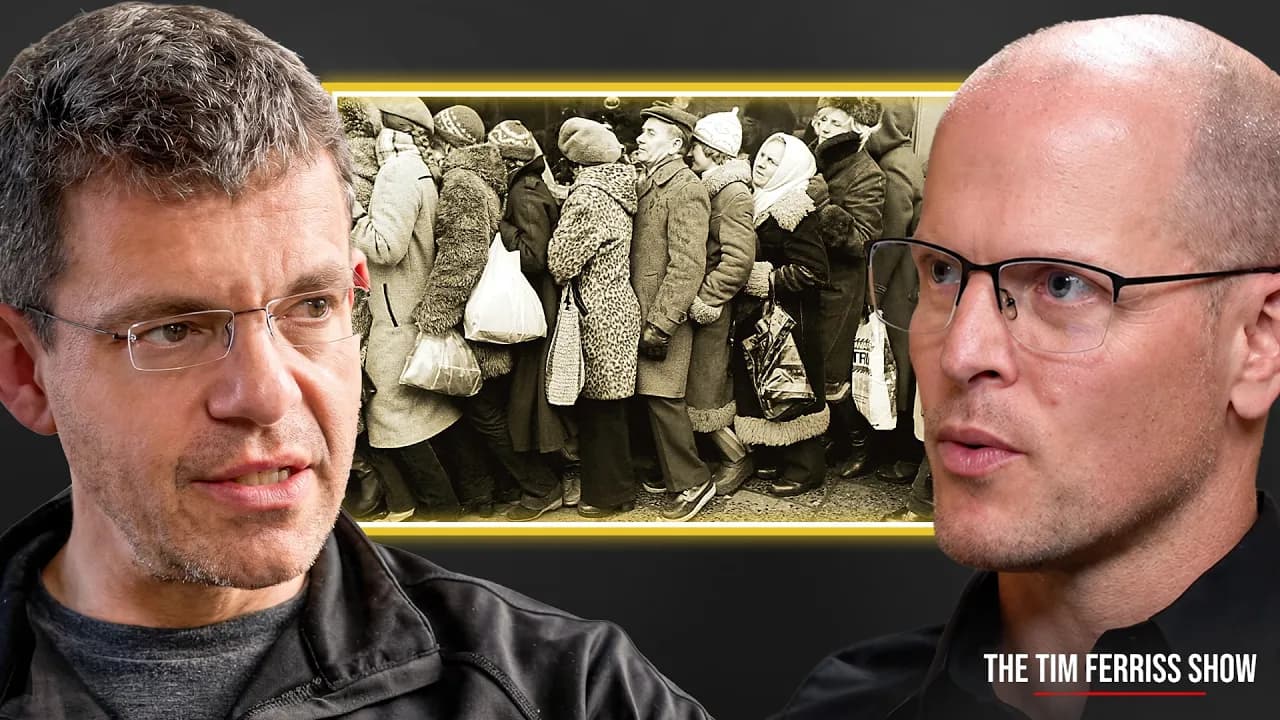
He recalls a vivid image from Soviet stores where government employees working behind food counters were consistently overweight while the general population remained thin, illustrating how corruption and theft emerged within the system. Levchin notes that socialist systems require structural changes that inevitably conflict with fundamental aspects of human behavior.
The transcript opens with an explanation of the socialist/communist principle of redistributing work product from each according to their abilities to each according to their need. While this notion appears appealing, the redistribution process inevitably leads to corruption as those controlling allocation keep substantial resources for themselves regardless of initial honesty. Once real power is attained, the system becomes profoundly corrupt. This represents an inherent indictment of socialism that cannot be circumvented.
Free markets and capitalism inherently force competition. When someone believes they can sell something at a lower price, they capture market attention and business, then work to create margins by lowering production costs and finding efficiencies. These competitive pressures and efficiency incentives do not exist in socialism because everything is centrally planned—authorities determine production quantities and redistribution with no mechanism for improvement. The result is natural stagnation where the system rewards graft, empowers those most likely to become graft-driven, and prevents talented individuals from innovating or improving system efficiency.
The concern extends to current headlines promoting a world where everyone is fed and receives a baseline of good living. While this vision is compelling and easy to agree with, capitalism remains the best recipe humanity has discovered—a force for constant creative destruction where each new thing is built better than competitors. Though competing businesses may fail, the beneficiary is the buyer or user through continuous efficiency improvements. Eliminating the need to create efficiencies leads to stagnation.
The Soviet Union's collapse surprised no one who lived there, as nothing ever changed for the better. Everything sold at government-mandated prices, and technology remained frozen—phones looked like they were made in the 1950s. Upon moving to the US, the speaker encountered push-button phones for the first time, having previously used only clicky rotary phones. The seductive story of socialism appeals broadly, but represents a surefire path to no progress.
When asked about the apparent wellspring of attraction to socialism in the United States, the speaker acknowledges not knowing every strand of this complicated issue. The brochure and storytelling look great—asking whether you know someone poor who deserves better, or someone laid off. Capitalism can be profoundly unfair to individuals even as it works amazingly well as a system for improving the world overall. People get thrown off the bus when their work becomes outmoded or outcompeted, which hurts whether you're an entrepreneur experiencing failure, a worker being laid off, or someone who misinvested.
The idea of a social safety net and welfare is natural because seeing fellow humans starve or struggle is painful. Income inequality is very real, as witnessed firsthand in Silicon Valley. Every disruptive change from the industrial revolution to the AI revolution leaves someone on the receiving end of efficiency gains. Socialism offers a compelling story of protecting those displaced and preventing them from ending up on society's outskirts.
There is significant work needed to ensure people are not left behind. Love of capitalism and free markets does not obviate humanity or caring about people. The question must be asked: can better social safety nets be provided as efficiency and value creation increase? Concentrating everything in government hands for redistribution by a handful of people does not work, based on lived experience from the Soviet Union.
Philanthropy becomes profoundly important during periods of disruption. Religion provides useful frameworks around philanthropic thinking, with every organized religion containing versions of what it means to be philanthropic. The aggregated thought over thousands of years that most religions represent deserves respect.
Capitalism has created opportunities where optimizing for maximum profit at lowest cost produces products deviating from both economic and societal ideals. There is no need to compromise by accepting harmful products simply because they are most profitable. Products—particularly financial services—can be optimized for both profitability and societal benefit. The speaker's long-held theory is that making slightly less money to create something more societally successful leads to better long-term consumer retention, as customers will not switch to cheaper, less societally beneficial alternatives.
Affirm represents an answer to questions about predatory practices. The company optimizes products beyond maximum profitability, embracing pro-social product and engineering strictly through capitalism's lens.
Early Affirm faced skepticism similar to PayPal's fundraising difficulties. Many believed credit cards were sufficient and late fees too profitable. The question of what gave confidence to continue despite rejection applies to other investments like Yelp as well.
Affirm invented the BNPL (buy now, pay later) genre approximately 15 years ago. At point of sale, debit card users are generally financially responsible and won't buy what they cannot afford. Credit card users fall into two categories: the independently wealthy who pay off balances monthly for float, and the majority who add to revolving debt, pay interest without understanding calculations, and have no timeline for becoming debt-free.
The core idea was creating a third option with debit card transparency, responsibility, and clarity combined with pay-over-time flexibility. Customers could pay for purchases over a fixed period—such as a baby pram over six months at $100 monthly—without revolving balances or confusion about payoff dates. The design eliminated revolving entirely with fixed schedules only. Every transaction is pre-priced so interest amounts are known in advance. Late payments carry no fees; instead, repeated lateness simply means future lending may not be available.
This model is now available at three-quarters of all e-commerce checkouts in the US and Canada, expanding rapidly into the UK with announced European expansion. While competitors exist, Affirm was first in purifying the concept to no fees, no revolving, simple schedules, pre-priced everything, and complete transparency. The company will process nearly $50 billion in transactions this year and is publicly traded and profitable. The last 10 quarters showed 30%+ year-over-year growth. No late fees or revolving interest have ever been charged.
Banking professionals laughed at the model, claiming half of profits come from late fees and that eliminating revolving would destroy profitability. Silicon Valley professionals who don't need these services fail to grasp the cost burden on regular consumers without seven-digit salaries. VCs questioned why people couldn't simply use platinum American Express cards.
Raising money proved difficult because convincing investors that normal people would use this service was challenging, unlike PayPal where the use case was more obvious.
The idea originated from a colorful personal experience shortly after PayPal went public. The speaker and Luke flew to Los Angeles to purchase identical Mercedes hardtop convertibles—the first model with mechanical folding hardtops. At the dealership, Luke received an auto loan and keys immediately, but the speaker was told his credit was too poor despite having just taken PayPal public and paid off student loans. The entire purchase amount had to be wired, causing embarrassment with then-girlfriend Nelly.
The wire arrived as the dealership closed, and the pair raced back to San Francisco on I-5 at high speeds, getting pulled over at 2:00 AM. The story stuck because despite being financially independent and wealthy in his mid-20s, the credit score failed to reflect this reality. The speaker had immigrated as a teenager with no record and $600 for a family of five, then became a wealthy Silicon Valley entrepreneur within a five-to-seven-year window after earning a computer science degree and starting companies.
This experience prompted building a better credit score using publicly available data plus proprietary elements. The initial plan was to have banks lend using this new score, but bankers refused, arguing no one would lend against an unproven score. The entrepreneurial response was to enter the lending business directly to test the concept.
Studying how credit cards actually work revealed profound anti-customer practices: revolving $1,000 draws becoming $3,000 debts within years with no explanation, or 0% loans retroactively compounding interest from the original date if even a dollar short or a minute late. The lending industry uniquely operates by betting customers will fail or be late, preferring minimum payments that keep principal large so interest compounds. Fine print hides unfavorable terms.
The question became: what if steps were taken back to the branching point and the more consumer-friendly path was chosen repeatedly? The result was Affirm.
The speaker self-funded initially while becoming obsessed with the idea. Repeated pitches to bank CEOs and credit card portfolio managers elicited the same response that all money comes from late fees and delinquencies. Two ideas proved amazingly correct despite uncertainty at the time.
A study showed millennials hate banks, with 70% ranking them as the number one thing they hate.
70% of millennials hated banks according to a study. When Levchin asked bankers why a lending product couldn't exist that didn't exploit people's unwillingness to read fine print and do exponential math, bankers responded that banking is the stickiest thing in the world—people bank where they live, where their parents banked, and they like the marble hall and vault. Levchin countered with data showing 78% of millennials think banks are terrible.
Levchin realized that if he built something slightly better than the existing options, there would be a ready-made audience of people predisposed to try it because they already hated the alternatives. He didn't need to convince people to trust a new thing—they just needed to believe a better option existed.
Millennials were early teens during the great financial crisis. Many witnessed their parents getting booted out of their houses in 2008 and being told the bank took the money and the house away. The embarrassment of having to tell children the family was moving to a smaller house, a rental, or potentially living on the streets left a deep impression during their most impressionable years. Levchin believes this created genuine willingness among many people to try anything except the institution that caused their parents such pain.
This generational experience meant that if Affirm built something good, people wouldn't need extensive marketing to trust it—they were already predisposed against traditional banks.
If a company is unwilling to profit from the wacky externalities of financial services, it must be exceptionally good at underwriting. When someone requests to borrow money, the system must respond in real time using machine learning models to decide yes or no. Beyond a binary decision, the goal is to determine a price of risk—the expected value or expected loss if money is lent today, including the probability of repayment with appropriate interest.
Underwriting discipline at scale, done completely in real time, was the foundation Affirm built. The credit score they developed became central to operations.
Levchin observed that credit scoring is a hard, mathematical problem, yet the people working on underwriting and credit scoring were generally not as impressive as the talent pool he encountered elsewhere in Silicon Valley. The reason, he concluded, was that it was embarrassing to discuss working on loan and credit underwriting at cocktail parties.
Prestigious answers included working on Wall Street building real-time trading models or working for the NSA breaking codes. In contrast, saying you make loans and ensure they're underwritten well—while making most profits from late fees and hidden terms—lacked appeal.
Levchin theorized there existed a latent pool of talented mathematicians who would work on underwriting because it is genuinely difficult and interesting, but they avoided the industry until someone stripped away the gunk, made it transparent, and positioned the brand around transparency and honesty.
Levchin formulated the product vision around attracting brilliant mathematicians by offering work that felt meaningful: building underwriting models to help normal Americans borrow money without feeling screwed. He succeeded in this—team members with 10-12 years of tenure express pride in being mathematicians putting their skills toward honest financial products.
Affirm's growth rates were compounding at nearly $50 billion with 30+% year-over-year growth quarter after quarter. Credit-related losses remained super consistent. The average half-life of loans is five months, providing a reliable view of underwriting performance relative to macroeconomic conditions. Loss numbers and delinquency metrics stayed remarkably stable, demonstrating strong underwriting capability.
Despite this scale, Affirm remained a footnote relative to the $1.3 trillion in total U.S. credit card debt. The overall size of commerce remains enormous compared to Affirm's current position.
Credit cards and debit cards represent the single best financial interface ever created, with layers of decades of innovation enabling a simple tap-and-go experience. Buy now pay later introduces friction: every transaction is separate, users must consciously engage, and additional steps are required.
The counter-argument is that the industry devolved—people no longer trust what happens after they tap. They hesitate about affordability, potential declines, or entering inappropriate debt. Affirm offers certainty and control: users see their purchasing power upfront, receive explicit approval, know the next transaction is guaranteed, and understand there are no late fees or pricing changes. The company makes less money if users are late and makes nothing if users don't pay.
What Affirm sells is certainty and a sense of control through incremental friction.
The discretization of transactions and incremental friction will be reduced as agents handle manual labor. In the future, the offering becomes something that obviously works. Friction will largely disappear, accelerating this approach to financial transactions.
People will think about money differently: they will know their exact financial state, have agents looking out for them who won't allow inappropriate debt and will exit debt at the right moment. A PhD-level consumer finance advisor will be embedded in phones, eliminating slop and preventing fine-print-driven exploitation.
Levchin is excited about a world where businesses don't need to change models because no one is getting fooled—such exploitation was never part of Affirm's model.
Levchin believes the reality of someone pulling up Claude or ChatGPT to ask questions and make purchases directly from a single interface is very close. He notes it is dangerous to view commerce as a uniform fabric where people simply want a thing and buy a thing. Silicon Valley assumptions about frictionless purchasing don't match normal people's behavior.
Normal people hang back on large purchases, considering whether $10,000—or even $500—is an incredible amount of money depending on their circumstances. They think carefully about exposing themselves to bad financial decisions, getting good deals, payment methods, and how long items will sit on their personal balance sheets.
Agent commerce already exists when people tell Instacart or DoorDash to bring groceries or a sandwich—they outsource the rest to an agent and provide a credit card number. This threshold applies to purchases where people feel comfortable delegating. For larger amounts, people are more likely to engage directly.
Real-time or near real-time delivery exists in various markets, including a 6-minute-or-less delivery service in India requiring extraordinary logistical prediction for mass-market goods storage.
The desire to know what one is getting into and exercise agency in selection—where taste matters—will likely always involve humans. AI will not replace decision-making and thoughtfulness in consumption. People want pants that fit, match their favorite color, and coordinate with their ensemble. They have brand preferences for bicycles and care about component specifications.
AI will obviate certain pieces: finding the best price on a desired bicycle with preferred components, ensuring authenticity, and confirming data is current. Users will say they want a beautiful Italian-made bike with Shimano components, a good deal, and the ability to pay over time without late fees or interest. AI will conduct comparison shopping, present images, and facilitate the transaction.
Building blocks for AI commerce will include something like Affirm. The AI will identify that certain sellers offer Affirm options with no late fees and negotiated deals where retailers or manufacturers cover interest, making transactions interest-free. Affirm is already building pieces of this future in quarters rather than years.
There is enormous opportunity to build exciting things. The proclaimed job apocalypse is misguided. From oldest companies to youngest ones, people recognize software they had to buy from poor providers or couldn't buy at all—and now have tools to create solutions directly from their minds.
For espresso, the single most important piece of equipment is the grinder. A quality grinder in the $600-$700 range elevates the experience significantly. For demonstrably better performance, the Kya Orbit at $1,600-$2,000 allows burr swapping. Fall-through grinders in the $2,000 range are recommended. For the absolute best, Weber Workshops produces industrial-strength, exceptionally expensive equipment.
After equipment, invest in skills through online resources and YouTube videos teaching espresso technique before purchasing additional hardware.
For espresso machines, Levchin prefers 58mm portafilter diameter. The La Marzocco is his choice for the finest, most reliable home machine—multi-thousand dollar range, beautiful inside and out, never failing, and the standard in self-respecting coffee shops. Decent Espresso offers a nerd-friendly option with extensive metrics. Breville makes surprisingly good coffee despite being consumer-oriented. Bulletproof machines produce consistent results.
For non-espresso methods, Chemex is Levchin's choice among Chemex, French press, or AeroPress, particularly for light roasts where each bean and roast type speaks to a specific method.
For non-espresso drinks, thin, high clarity, low body coffee is preferred to capture the pure essence of the bean in water without dilution. Chemex is considered one of the best options for this style because it is highly controllable. French press works well as a simple, campfire-style method. For those wanting an AeroPress, an espresso machine may ultimately be preferable.
A Chemex costs less than $600. For people using a blade grinder instead of a burr grinder, upgrading to a handheld burr grinder for $100 or less produces a noticeable difference in quality.
Spice grinders can produce a cup of coffee, though results are inferior. For non-electric options, manual grinders are inexpensive and effective. The Lido brand offers high-end manual grinders that remain significantly cheaper than electric alternatives. Lower RPM during grinding reduces damage to the bean, improving taste. Manual grinding delivers excellent results but requires about 10 minutes per cup and physical effort.
Commenter coffee is enjoyed for its simplicity. Growing up in Eastern Europe involved drinking instant coffee and occasional exposure to chicory coffee, which is popular in New Orleans but typically contains added sugar and no actual coffee. In the Soviet Union, a product called "coffee light" or "coffee beverage stock" was marketed as containing a shared plant component with both coffee and chicory. The beverage was unpalatable but functional as a caffeine source.
Business books generally receive low respect because most are excessively long. Books that present verbatim anecdotes from practitioners hold higher value because unique experiences resist generalization. Distilled business essays are favored because the author performs the work of generalization.
Seven Powers by Hamilton Helmer is recommended as a concise distillation of building competitively durable businesses. It explains why network businesses outlast non-network businesses and clarifies the meaning and importance of brand.
A Failure of Nerve addresses leadership, introducing the concept of the differentiated leader. It covers how CEOs and founders handle unpopular decisions such as firing valued employees, persevering through doubt before and after choices, tolerating associated stress, maintaining humanity without becoming tyrannical, and avoiding reversal of decisions that erodes team confidence.
Influence by Robert Cialdini is described as probably the most important social science book published in the last 50 years.
Biographies are valued even when not business-focused. Ron Chernow's works are highlighted, including biographies of J.P. Morgan, Alexander Hamilton, George Washington, Ulysses S. Grant, and Mark Twain. Titan, Chernow's biography of John D. Rockefeller, is noted as closest to business advice, though it illustrates ruthless approaches.
A Mind at Play, the biography of Claude Shannon, is recommended. Shannon is viewed as a platonic ideal of intellectual brilliance across domains and a playful polymath who remained fun while producing foundational work. He is compared to Richard Feynman in computer science. Shannon's friendship with Ed Thorp adds interest. He is credited with inventing information theory and having his name used for the Claude coding system.
Physical books remain preferable despite abundant online content because digital experiences feel ephemeral. Books are carried during travel even when unread for extended periods. A 500-page graphic novel is mentioned as an item transported despite the weight because digital formats fall short.
Max Levchin's projects are available at levchin.com and sci-fi.vc. Affirm is located at affirm.com. He builds in public with a short project list at any time. All mentioned books, resources, and links appear in the show notes at tim.blog/podcast.
Keep Tim Ferriss in your library
Save the videos and channels worth coming back to, and find them again in one place.