The Trillion-Dollar Industries AI Is Disrupting: Voice, Law & the End of the Billable Hour
In a Nutshell
ElevenLabs hit $600M ARR in under three years by building voice AI that now powers customer support, sales, and interactive experiences, with plans to make voice agents indistinguishable from humans by end of 2025. The legal industry, a $1T market where software is only 4% of spend, is shifting from billable hours to AI-driven fixed pricing and in-house operations, with startups and law firms replacing junior associate work with agent orchestration. Both companies succeed by staying model-agnostic, embedding engineers across functions, and focusing on vertical workflows rather than competing directly with frontier model providers.
These notes were generated by AI and may contain inaccuracies.
Airwall is an AI-native platform for global accounts, cards, and payments designed to make the entire world feel like a local market. The company was built for the intelligent era from day one rather than bolting AI onto broken infrastructure.
ElevenLabs was founded in 2022. The first year focused on building research and product. The company released the first text-to-speech model that could sound human at the beginning of 2023. Revenue ramp: approximately 20 months to reach the first $100 million ARR, 10 months to reach $200 million, 5 months to reach $300 million, and closed the end of last year at $600 million in ARR.
ElevenLabs has 600 employees. The company combines research and product functions. On the research side, this includes audio generation, speech transcription, and orchestrating speech for interactions. On the product side, the platform completes the customer journey from marketing and creating assets, international localization, customer support with voice agents, to proactive enablement for operations, training, and sales.
From the original team of 10 people, there has been zero attrition among the core research and engineering talent. The company optimizes the interview cycle and onboarding process. The goal is to maintain culture despite rapid growth. The company has assembled a team excited about solving audio and interaction problems.
In 2022, the dominant topics were crypto and the metaverse. The company structured itself around small teams of 5-10 people across product engineering and go-to-market functions optimized for specific industries including telco, financial services, and healthcare. Engineers are embedded in every function including talent, legal, and revenue engineering. These embedded engineers create automations, bring software into teams, and ensure security checks for everything deployed.
When non-developers build software, risks include putting code into production with security leaks. Another concern is when the person who built the software leaves the company and the code becomes deprecated without documentation.
ElevenLabs has never had product managers. The ideal PM role requires coding ability, customer understanding, and design skills simultaneously, which is rare. The company optimizes for profiles that are experts in at least one field but understand at least one other field well. With AI assistance, individuals can move from amateur to advanced level across multiple functions, reducing bottlenecks. A growth engineering person can design an experiment, ship it, and bring back results without requiring separate functions.
The company uses its own product internally. To help customers create voice agents, the company itself creates voice agents. An inbound AI SDR agent was created that allows users to call in addition to filling out website forms. People provide more information through voice than forms, enabling faster connection to the right problem and person.
Previously, calling phone systems was arduous and painful. Now, consumers and companies embrace AI voice agents because they are more precise with high fidelity. Users can interrupt the agent in real time to move faster without small talk. Enterprises are seeing a step change in the last 12 months, particularly the last 6 months, where the product combines reliability with orchestration across AI models, knowledge, and integrations.
The interface will morph depending on user operation. Voice will help in the background find information and shift from reactive to proactive assistance before users ask for help.
Ten years ago, speech-to-text had a major blocker as lawyers using Dragon Dictate felt self-conscious talking to computers in offices. Now people quietly talk to computers giving prompts. Products mentioned: Whisper Flow (uses ElevenLabs and other models) and Plaude Pocket for recording conversations and automatically generating notes and follow-ups.
A pedal device is used with Whisper Flow. Pressing the pedal turns on voice input; releasing stops it. This enables stream-of-consciousness prompting without typing. LLMs handle massive streams of consciousness well. A 1-2 minute prompt can be given by holding the pedal down. The context from changing thoughts mid-prompt results in better answers.
People adjust how they speak to AI versus humans. In financial services, customers are more open sharing payment difficulties with AI agents than with human agents due to reduced shame. Users are more snappy with AI voice agents, giving quick responses and cutting off the agent to reach the desired point faster.
Voice is identity and IP. ElevenLabs takes three safeguard measures: trace everything generated to take action when needed; moderate at both voice and text levels to flag commercial or scam attempts; create detection systems allowing anyone to upload a sample and determine if it is AI-generated, supporting both ElevenLabs and open source models.
ElevenLabs partnered with Matthew McConaughey to create an interactive world across languages preserving emotional delivery. The company created a marketplace where people authenticate and share their voices to earn money. Over $22 million has been paid back to the talent community. Voice actors can record for an hour, create a voice model, and license it out. Users can set their own pricing or use default distribution.
ElevenLabs worked with people who lost their voices due to ALS or throat cancer. Congresswoman Jennifer Wexton (corrected from transcript) who lost her voice used the technology to continue inspiring others. A woman who lost her voice before her wedding used the technology to redo her vows, allowing her family to hear them for the first time.
The estate of James Earl Jones licensed the Darth Vader voice to Disney. ElevenLabs powered the Fortnite implementation where players can interact live with Darth Vader after reaching a certain stage to help solve missions. This extends likeness and publicity rights into interactive use cases across languages and geographies.
ElevenLabs is working with Headspace on meditation content.
ElevenLabs is exploring personalized meditation experiences with interactive elements. The platform allows for custom meditation lessons tailored to individual users, potentially licensing celebrity voices for guided sessions.
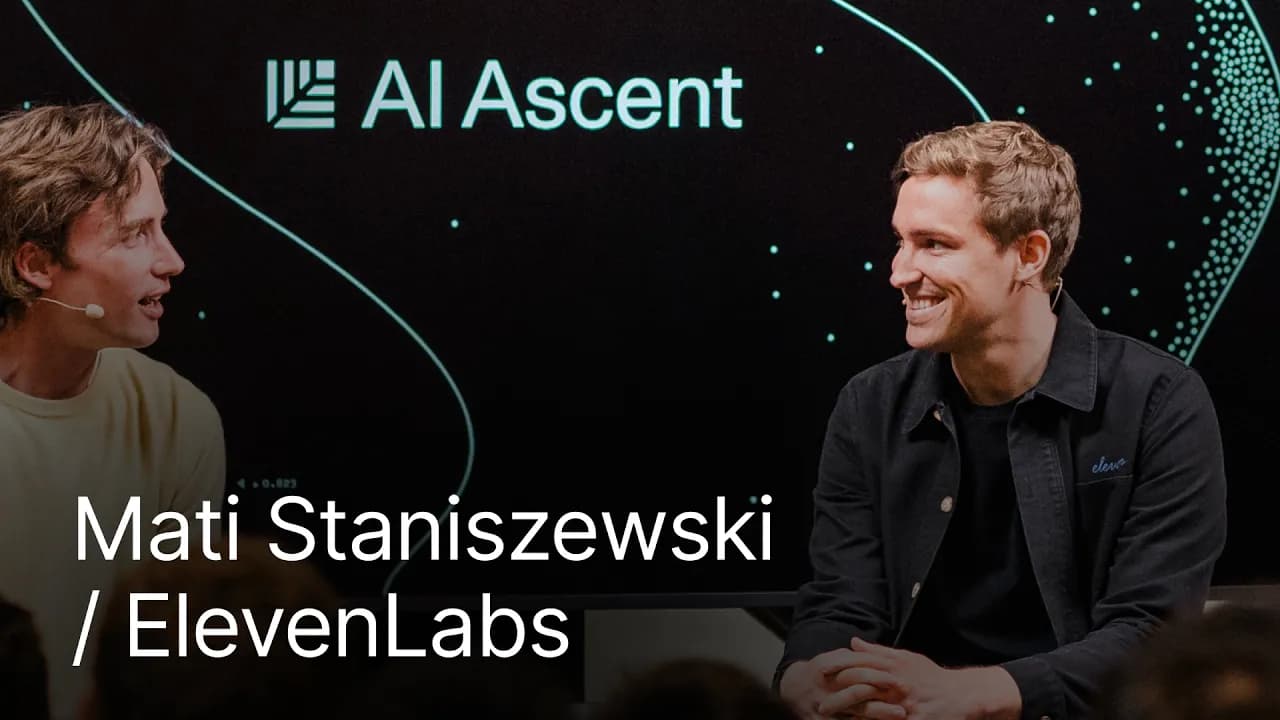
Mati Staniszewski discusses competing against Dario Amodei at Anthropic and Sam Altman at OpenAI, who have expressed interest in taking ElevenLabs' business. The company uses frontier models in its product while considering open-source alternatives.
ElevenLabs provides access to multiple models including Anthropic, OpenAI, open-source, and Google models. This model-agnostic approach allows customers to build their own harnesses, agent orchestration, and voice elements without dependency on any single model provider.
ElevenLabs maintains competitive edge in voice models through superior performance in text-to-speech, speech-to-text, turn-taking, and music generation. The research team continuously improves these capabilities through architectural innovation rather than scale alone.
The company emphasizes that architecture matters more than scale for voice models. ElevenLabs built an internal team of over 1,000 contractors to label audio assets, addressing the challenge of unlabeled data in voice training.
ElevenLabs focuses on creating industry-specific solutions for communication workflows. The product team studies how voice interactions differ across financial services, healthcare, and telecommunications, areas where frontier model companies do not invest.
The company acknowledges that some frontier model providers attempt to distill and use customer data despite claims otherwise. ElevenLabs has mechanisms to slow data leakage. The company is exploring building its own models focused on interaction capabilities rather than knowledge work or coding.
ElevenLabs ships tens of millions of dollars annually to frontier model providers. The company maintains good partnerships while focusing on demonstrating value through elevated organizational capabilities.
Staniszewski states that text-based agents have essentially passed the Turing test, feeling as intelligent as humans. The goal for 2025 is achieving the same for voice interactions where conversations feel indistinguishable from speaking with another human.
The interviewer argues that AI has passed all traditional tests created 30-40 years ago. The new test should be whether systems can be more intelligent than every person on the planet by a factor of ten. Staniszewski acknowledges achievement in certain areas.
Oracle positions itself as infrastructure for AI companies training and deploying at scale, offering access to leading models grounded in enterprise data with security features for production deployment.
ElevenLabs achieved 50% quarter-over-quarter growth sustained for seven consecutive quarters. The company became one of the fastest enterprise companies with a direct sales motion to reach $100-150 million ARR, beating Sierra by one quarter.
Legal services represent a $1 trillion annual market that remains highly fragmented. Software spend in legal technology totals approximately $40 billion, representing only 4% software versus 96% services. This ratio is expected to shift dramatically as AI compresses legal work.
Startups are already replacing traditional legal services with AI tools. One example involved a startup with $1 million in revenue, multiple funding rounds, and dozens of employees that used ChatGPT for corporate legal work, cap table management, HR, and IP assignments without a corporate lawyer.
Legal services face supply constraints where demand exceeds available lawyers. Legal service providers are using technology to serve new market segments and package new products. This shift challenges the traditional billable hour model where law firms overcharge for associates to subsidize partner time.
Kulie launched a platform allowing startup founders to log in, upload materials, and access embedded workflows for contract review. This model breaks the billable hour approach by offering fixed pricing for transactions and fundraises rather than hourly rates.
Enterprises are bringing legal work in-house using AI tools. At Lora, four acquisitions were completed in 2025 with diligence performed internally using their own tools. The fastest transaction closed in 12 days from LOI to closing, driven by aligned incentives between founders and AI systems versus traditional legal representation.
Law firms are experimenting with fixed fees for transactions and fundraises. In litigation, success-based fee structures allow firms to take a percentage of winnings. These models align incentives differently than the traditional billable hour approach.
Kirkland Ellis generates $10 billion in annual revenue with 4,000-5,000 lawyers. Partners earn between $5-10 million in annual profits. AI presents both existential threats and opportunities for such large law firms.
Legora employs "legal engineers" who function similarly to Palantir's forward deployed engineers. These forward deployed lawyers work directly with Kirkland partners to transform their business from pre-AI to post-AI operations, providing hands-on implementation support.
The shift to AI in legal work parallels the adoption of document management systems and PCs 20-30 years ago. However, AI creates more substantial productivity gains and fundamentally reshapes junior lawyer responsibilities compared to those earlier technological transitions.
The legal profession will continue requiring junior lawyers to develop into partners, similar to software engineering career progression. However, the path changes from document review in physical or virtual data rooms to orchestrating AI agents that perform document analysis and error marking.
AI enables attorneys to operate across jurisdictions more effectively. Legora aggregates case law, legislation, and regulatory updates for every jurisdiction globally. A California GC dealing with a South African customer can receive 80% accurate responses based on local legislation without needing to coordinate through multiple lawyers.
LexisNexis generates several billion dollars annually as a legacy legal research provider. Combined, Legora and Harvey are generating hundreds of millions in revenue. Legacy providers struggle to pivot to AI-native operations due to talent acquisition challenges, work culture, and organizational politics.
Legal research requires complete case coverage rather than partial data. Westlaw maintains a government monopoly on reporting American cases. Building comprehensive legal databases requires physical book scanning, page citations, and double-blind verification processes historically performed in India.
Following Opus 4.5 and 4.6 releases, AI agents can perform intelligent case strategy by combining witness statements with case law. This represents a shift from AI augmentation to AI performing end-to-end work, with lawyers transitioning to orchestration and management roles.
Legora partners with Anthropic and OpenAI, spending millions to tens of millions on tokens. Frontier models are not competing directly in Legora's product category. Claude's legal offering functions as a pipeline generator by demonstrating AI applicability before users reach limitations and seek more robust solutions.
Legora does not pursue fine-tuning or general intelligence models, viewing this as wasteful. The company develops narrow models for specific use cases that drive cost and latency improvements. An example is "tabular review" which processes 100 documents against 100 prompts, requiring 10,000 API calls where a fine-tuned extraction model provides value.
Compliance serves as Legora's competitive currency in highly regulated industries. The company hosts contracts for weapons manufacturers and government clients. Legora does not offer on-premises deployment, viewing VPC deployment as too time-consuming and roadmap-limiting.
Legora's acquisition strategy supports expansion after initial market entry. The company has completed four acquisitions in 2025, with the M&A approach designed to facilitate easier expansion within enterprise accounts once initial compliance requirements are met.
for taking some time for us. I'm going all in.
Keep All-In Podcast in your library
Save the videos and channels worth coming back to, and find them again in one place.