This Is Why Texas Will Win
In a Nutshell
Texas is building the next generation of American hardware and manufacturing through remote observatories, startup compounds like Prototown, and specialized tech ventures. The state enables ambitious projects by offering cheap land, low regulation, and a culture that values mechanical skills and hands-on work. From 550-telescope remote astronomy facilities to EV conversions, advanced prosthetics, and experimental town-building, Texas is creating the infrastructure and community that traditional tech hubs lack.
These notes were generated by AI and may contain inaccuracies.
The speaker, a self-described non-believer but not an absolute heathen, arrives in Texas and immediately seeks out Cooper's Barbecue in Llano (pronounced Yano). The barbecue experience involves selecting meat directly, with beef brisket as the primary choice, followed by sides and fixings. The meat is carried through the establishment in a tray before the meal begins.
The visit to Cooper's Barbecue is not for filming the eating experience but serves a larger purpose. The speaker expresses love for Texas towns, noting how the state feels familiar and aligns with his upbringing, characterized by a comfortable pace, friendly people, and free living.
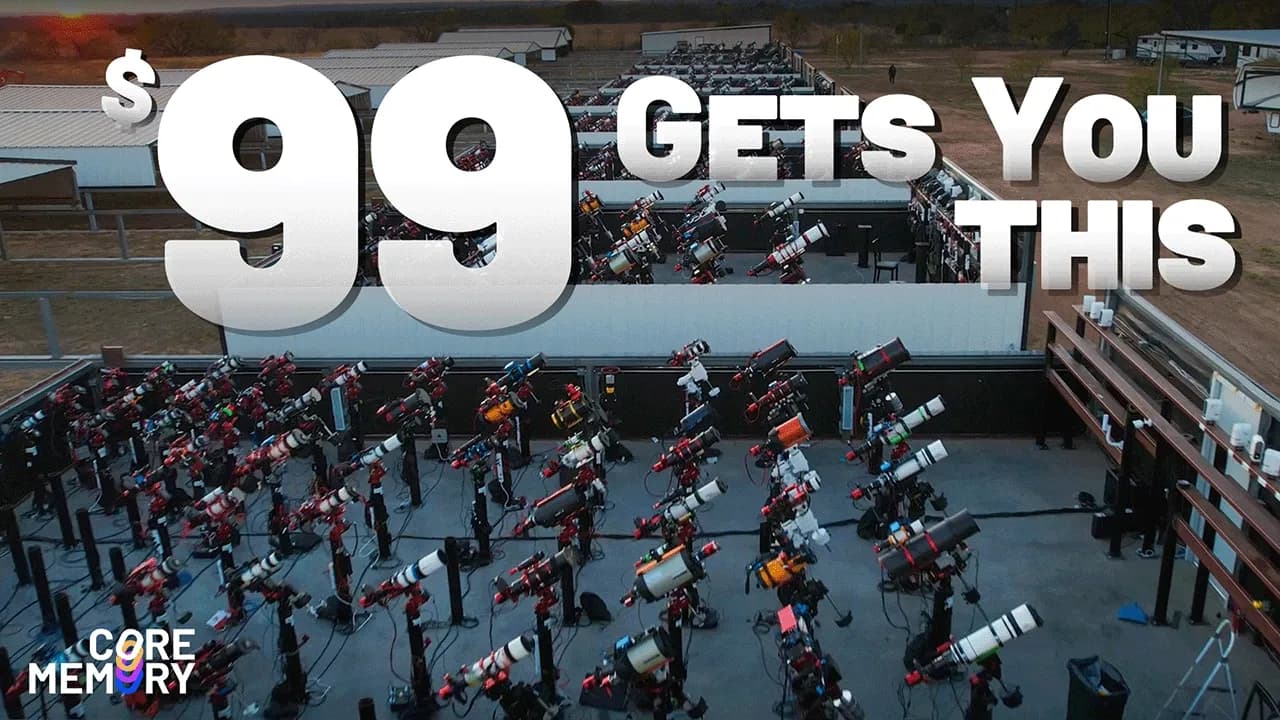
The speaker travels to the outskirts of Brady, Texas, described as the geographic center of Texas. The location hosts Starfront Observatories, a remote observatory facility founded by Bray Falls. The observatory sits in an area free from light pollution, allowing people worldwide to send telescopes for remote observations and photography. The facility houses telescopes in dedicated buildings, with all equipment mounted on equatorial mounts aligned to Polaris for tracking the Earth's rotation.
Traditional astronomy requires driving long distances to escape light pollution, dealing with weather uncertainty, and incurring costs for gas, hotels, and food. Remote observatories eliminate these logistical challenges by housing telescopes permanently and allowing remote access through computers. The mounts are secured with concrete anchors and track the sky's motion from east to west, enabling accurate long-exposure photography.
One telescope setup, featuring three f2 lenses for rapid photography, cost approximately $20,000 including filters. The owner lives on-site and uses the equipment professionally. The facility operates on a subscription model with monthly costs ranging from $99 to $400, significantly lower than other observatories charging up to $3,000 monthly. The operation spans 40 acres with plans for expansion.
Starfront Observatories broke ground in May 2024 and currently houses 550 telescopes, adding two to three daily. The facility provides remote access to dark skies for amateur and professional astronomers who might otherwise struggle with equipment utilization due to logistical barriers.
The visit coincided with observations of comet Lemon, visible for the first time on that side of the sky. The comet's ion tail changes nightly due to solar wind interaction, with visible movement detectable within 20-minute intervals. This represents the only appearance of this comet in current lifetimes.
Bray Falls discovered a nebula using equipment at the facility and retains naming rights, though no name has been assigned yet. The speaker jokingly suggests naming it the "Core Memory Nebula" in reference to the brand.
Starfront Observatories plans to raise capital for expansion, including a telescope ranch in Australia. The facility represents Texas's capacity to enable large-scale projects with minimal regulatory barriers.
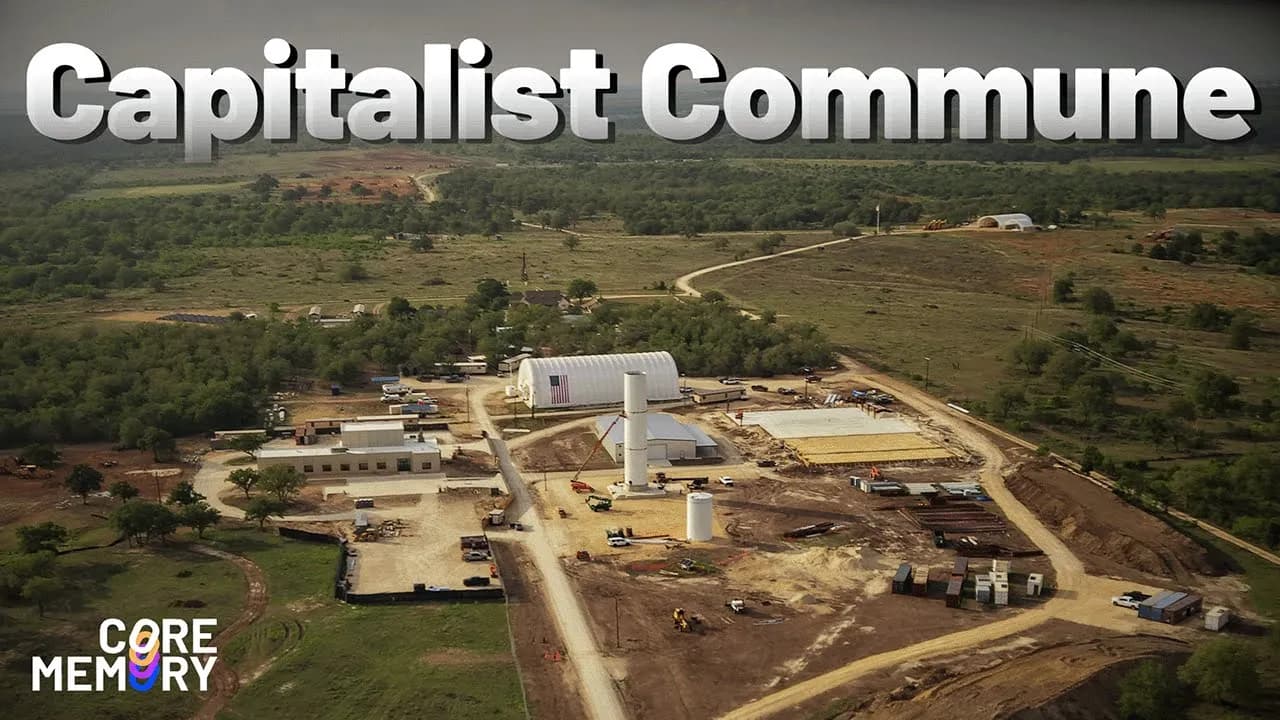
Prototown is located on ranch land approximately halfway between Austin and San Antonio. The project aims to create a hardware manufacturing hub, drawing comparisons to Detroit, Los Alamos, or Shenzhen. The initiative offers cheap land and reduced regulations to attract startups and factories.
Josh, a Duke University graduate who built hardware during college, founded Prototown after struggling to pitch the concept to investors in traditional settings. He recruited Merl, a fellow Duke alumnus and close friend, to join the project. The founders drove a converted 1950s-style bus on a 60,000-mile journey across the United States to promote their vision.
The 1,200-acre compound includes people living in ConX trailers, startups working on projects, and foundations being laid for factories. The site was originally planned for a subdivision that collapsed, allowing Prototown to acquire the land.
The founders emphasize creating a founding culture that fosters curiosity and community. Pioneers living on-site must convince their families to move to an unfamiliar ranch where hardware development is occurring. The informal selection process favors individuals with innate curiosity, creating a tight-knit community of people building hardware projects.
Josh attended Duke University where he built hardware projects, including a rocket that reached Mach 6. After college, he identified the need for a dedicated space where people could test ambitious hardware ideas without traditional barriers. The Prototown concept emerged from this recognition.
Evan works on solar-powered air conditioning using panels that absorb heat through endothermic chemical reactions, storing cooling capacity like a battery. The panels require no maintenance for 20 years and eliminate 90-95% of traditional air conditioning energy consumption. Manufacturing is planned to scale from 10 panels daily to thousands daily within six months.
Zach from Eden Technologies develops large commercial centrifuges for desalination and water purification. The technology addresses filter clogging in reverse osmosis systems by using centrifugal force to maintain clean filters and improve water recovery rates. The system applies to seawater, brackish groundwater, manufacturing waste streams, and oil and gas water treatment.
Prototown enables on-site hardware testing, including access to nearby streams for water-related projects. Residents can work and live alongside their equipment, with some sleeping near operating machinery to monitor performance.
The environment is described as a "capitalist commune" where residents form family-like relationships while working on hardware projects. Evening activities include tree climbing competitions and smoking brisket and chicken. The informal atmosphere eliminates traditional application processes, selecting for individuals aligned with the project's goals.
The site includes oak groves and a swimming hole constructed with assistance from Bedrock Robotics. The founders reference the Oppenheimer billboard as an inspiring element that helped attract early residents. The location evokes comparisons to Los Alamos as a frontier science community.
Texas's mechanical inclination and hands-on equipment culture make it suitable for hardware development. The state attracts people seeking to relocate, with a cultural emphasis on practical skills and mechanical understanding essential for hardware projects.
The founders reference Shenzhen's transformation from a fishing village to a 20-million-person manufacturing hub over 45 years as inspiration. Comparisons are also made to Mojave, California, as a location for testing ambitious aerospace projects. The vision extends beyond real estate development to creating a complete hardware ecosystem that naturally generates town-like development.
Current priorities focus on executing the prototype concept effectively while maintaining high quality for founders and companies. The name "Prototown" reflects both the prototyping activities occurring on-site and the experimental nature of the town-building concept itself.
John serves as the adult supervision for the Prototown operation. He has been a politician in Texas and became Prototown's closest neighbor. John purchased a compound and eventually bought into Josh and Merl's vision, deciding to join forces.
John discusses the broader movement of bringing manufacturing back to the United States. He believes the country lost a generation when manufacturing moved to China, resulting in the loss of craftsmen who knew how to do woodworking and welding. He believes that once people are taught or shown these skills, it inspires them to pursue those trades. John thinks people want to do manufacturing work and that Prototown demonstrates this by giving people opportunity and showing them it's possible.
The narrator requested to hang upside down in a plane to better understand Prototown, and John confirmed this was possible. During the flight, they performed a wing maneuver that the narrator described as intense.
The narrator explores whether there is something cult-like about Prototown and Texas more broadly. From 1836 to 1845, Texas was its own country, and the mythology of independence and ruggedness continues today, with Texans embracing the "cult of Texas."
The narrator references the Branch Davidians compound near Waco and the 1993 standoff with David Koresh that lasted 51 days and ended tragically. The narrator notes that people still visit the site, with one TikToker commenting that it's "still weird as fuck."
On a lighter note, the narrator visits Buc-ee's, describing it as the "Disneyland of gas stations" filled with jerky, clothes, objects, warmth, hypertension, and knickknacks. The narrator poses the question of whether a cult should choose the path of "polygamy and death or freshly sliced brisket."
John advises that everything takes longer than expected, especially hardware projects. He recommends pursuing ambitious goals like finding a room temperature superconductor, but emphasizes that it will be harder than anticipated and require more suffering. He notes that Prototown is a "long time resin project" and that while they acknowledge this, they still don't fully internalize how long things take.
The narrator reflects that their age is advantageous because they don't want to internalize the difficulty. The narrator gained new appreciation for Prototown, finding it more legitimate than expected despite its culty reputation. The narrator concludes it's "okay" and just has the right vibes with interesting people trying to make things.
In the months since the visit, Prototown has been booming. The well-funded nuclear startup Oaklo is building a research reactor on site to produce isotopes, and a semiconductor startup has also established operations there. The narrator notes they've made more progress than expected and expresses hope that the US might build something like a "Texan Shenzhen."
Mark Davis in Austin transforms classic cars with internal combustion engines into electric vehicles. He has been doing this work for almost a decade. One example is a 1972 Chevy Blazer converted using a Tesla Model S drivetrain, described as the fastest Blazer ever built.
Mark's process begins with removing the original engine, such as a modern Ford V8 from a 1968 Ford Mustang fastback replica. The team 3D scans everything to fit battery packs into spaces originally designed for engines. The battery modules used are the same as those in a Volkswagen ID series vehicle.
A typical conversion uses an 80 kWh pack, providing approximately 200 miles of range in a classic car. The vehicles can use DC fast charging. Mark notes that classic cars weren't designed with aerodynamics or weight efficiency in mind, limiting achievable range compared to modern EVs.
Mark demonstrates how electric conversion dramatically improves performance. A Lotus Eleven originally had 180 horsepower and 150 foot-pounds of torque. After conversion using a motor approximately the size of a basketball, the car gains 300 horsepower and 370 foot-pounds of torque, making it "borderline scary" in performance.
Mark works on about a dozen cars simultaneously. Easy conversions take a couple of months, while harder ones take 4 months or more. Pricing ranges from $75,000 to $175,000 for the work.
One client had a 1970 Mercedes-Benz 280 SL fully restored in Germany, but found it underpowered and noisy on the highway. After experiencing one of Mark's converted versions, the client immediately commissioned a conversion, making it the sixth Mercedes SL Mark's team has electrified.
The narrator visits Austin and notes the city's history as the state capital and former capital of the Republic of Texas. Austin is home to the University of Texas Longhorns football team.
Austin has transformed from a university town and funky haven for freethinking liberal types into a tech hub. The city is now home to Elon Musk, podcasters, and comedians. The narrator notes Austin is "still weird, just not weird like it used to be."
Mark describes being part of the tech influx in the 1990s when startups were making significant money. He acknowledges that while some lament the changes, Austin now has Michelin-starred restaurants, museums, music venues, and has become a comedy epicenter.
The early tech scene in Austin was hardware-focused with companies like Dell, AMD, and Motorola. Software companies came later in the 1990s and 2000s. Mark notes that the "keep Austin weird" generation has passed, and affordability issues are affecting the culture.
Mark had a midlife crisis that led him to pursue automotive electrification. Austin's tech-focused population appreciates the technology, and there's significant nostalgia in the city. His initial clients came from his tech industry relationships, people with considerable wealth who trusted him.
Alex Smith lost his right arm at age 11 in a boating accident on Lake Austin when a drunken boater crashed into his family's boat. He has used a standard prosthetic for most of his life.
Alex is testing technology from Phantom Neuro, which builds muscle computer interfaces. The system uses sensors that translate muscle intention into movements on a robotic hand made by Psionic. The carbon fiber hand weighs 490 grams, less than the average human hand.
Phantom Neuro founder and CEO Connor Glass explains that while brain-computer interfaces like Neuralink get attention, most people with physical disabilities don't need brain implants. Phantom's approach uses an implantable sensor system for limbs that can be installed through outpatient surgery without requiring specialized surgeons.
The system places two devices around the residual limb—one on top and one on bottom—creating a ring of sensors. These wireless electronics send signals to an edge compute module called the fusion port that computes and controls the robotic wrist and hand.
Phantom Neuro is running clinical trials for implantable devices that will be placed under the skin beginning next year. The procedure is described as similar to a cosmetic procedure requiring less than general anesthesia, taking 15 to 30 minutes total.
Alex reports that gestures worked within approximately 10 minutes of first using the system. He describes it as feeling natural and easy to use compared to other systems he's tested. Alex notes that not having to put on and take off equipment daily will be rewarding, and he doesn't want to remove the device once it's on.
The narrator experiences controlling a drone using muscle signals through the Phantom system, successfully making a drone spin in a circle and move toward the group using different finger movements.
Alex has an unusually large scotch collection. The host used the friendship as an excuse to drink some of Alex's scotch. Alex got into scotch through his dad, who is a big collector. For his 21st birthday, his dad gave him two bottles of scotch. Alex started to like it and told his dad, who suggested they try all these things and hold a whole tasting. Alex's dad has a very large collection as well. One bottle mentioned is 14 years old finished in a rum cask.
Alex prefers really heavy peaty smoky kind of scotches.
Alex and his wife started the Austin Scotch Club a number of years ago. They've had a lot of distillery reps visit. They pay attention to social media and who's out there in the community of big collectors. To their knowledge, they have very close to 800 bottles now. Nobody publishes this information, so they don't know for certain if it's the largest collection in Texas, but based on their community involvement, they believe they're very close to 800 bottles.
Brain computer interface is almost entirely starting with spinal cord injury or people with locked-in syndrome. There are north of 100,000 individuals with spinal cord injury in the US. If you're not Elon Musk and you're talking to investors, they're going to tell you that is way too small of a market. However, there's this open sky endless limit perception with brain computer interface that doesn't exist with anything else.
It's very much TBD whether brain computer interface will actually materialize into what the hype has made it out to be. In the near term, Connor is a realist when it comes to brain machine interface technology.
Phantom's implant is relatively simple in its design and is serving a very practical purpose compared to the devices from Neuralink and others.
There are interesting non-medical things being worked on that can't be discussed in detail. Humans will absolutely get additional appendages like wearable wings or multiple arms. Humans will quickly get to a point where they more or less can be what they want to be and where the body is kind of like a blank canvas of sorts.
In the defense world, there are situations where you would want to do this, such as bomb diffusion. The dream is having human arms or maybe even superhuman arms attached to a remote operated vehicle that then you can have somebody kind of transport themselves into that and be able to operate these arms from a distance with one-to-one human dexterity to diffuse a bomb or something like that. This could also apply to underwater operations, surgical robots, and space exploration.
How humans interact with machines hasn't changed since Atari, where you click something and move a little joystick around. Machines are becoming so radically more capable, and now humans are trying to interact with all these different machines at the same time. Better ways are needed for humans to be able to interface with those machines, and we're on the cusp of doing it.
Keep Core Memory in your library
Save the videos and channels worth coming back to, and find them again in one place.