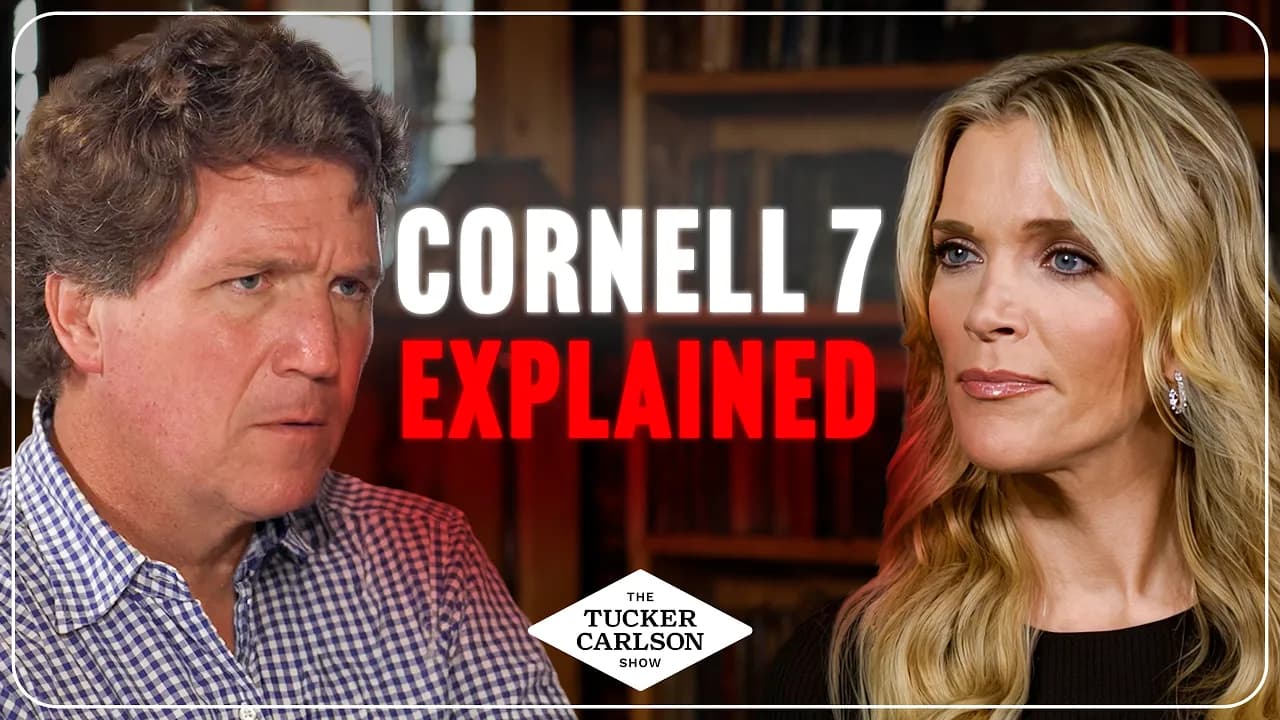
Tucker and Megyn Kelly Speak Out on Russell Brand’s Trial and Netflix’s Smear Campaign
In a Nutshell
Tucker Carlson and Megyn Kelly argue that Russell Brand was convicted based on weak, decades-old anonymous accusations that emerged only after his shift to criticizing government and pharmaceutical power, while UK authorities ignored far more serious crimes against vulnerable girls. The trial featured a single disputed anal-sex incident from 17 years prior where the accuser never used the word "rape" until after the 2023 Netflix documentary, plus three minor claims that would never have been prosecuted independently. They frame the conviction as political character assassination enabled by media-government coordination, media suppression of Brand's statements, and the unfairness of anonymous accusers destroying lives while maintaining lifetime secrecy.
These notes were generated by AI and may contain inaccuracies.
Tucker Carlson describes Russell Brand's conviction as a scandal and character assassination by political opponents who had been lying in wait for several years. Comparing sentences in rape cases, individuals who snatched women off the street, dragged them into bushes, and raped them as strangers received lesser sentences than Brand. The only rape charge resulting in conviction was the weakest charge brought against him.
The United Kingdom did not prosecute rape gangs active for years because of skin color sensitivity, as perpetrators were often Black and victims were young white girls. This mirrors the Somali fraud scheme in Minneapolis where authorities avoided prosecuting Black men to prevent upsetting people. The UK turned a blind eye while young white girls were gang-raped for years, then became suddenly interested in the "Me Too" movement once Russell Brand's name emerged and his political leanings shifted drastically over the past decade.
The complainant, known only as "the fifth complainant," remains anonymous with no real name, appearance, or voice ever revealed. She met Russell Brand at one of his shows where he made clear that going backstage would involve sexual acts. Within 10 seconds of entering backstage without introduction, she performed what was described as anal sex with her tongue on him, while her friend performed oral sex. The major dispute concerned whether her tongue was inserted or only used around his anus.
She went to Brand's house of her own volition knowing they would have sex, while cheating on her boyfriend. They engaged in vaginal sex. Brand testified they discussed and she consented to anal sex, with her only advice being "Be kind." She claims he turned her over without consent. After the act, Brand testified they watched television together. She was upset by his alleged comment to "look at the mess you made, clean it up." Over 17 years, she never used the word "rape" or accused him of rape until after the 2023 documentary.
When first speaking to her friend about the incident, the fifth complainant said she didn't know if her story had any basis and that she was young and perhaps just as responsible. The friend testified to this at trial. This testimony contributed to Brand receiving a 9-year sentence for the rape charge, plus an additional 18 months for three other women's accusations.
The three additional charges involved: a woman claiming Brand kissed her without consent in a bar and touched her breasts and buttocks over her clothes; another claiming he grabbed her breasts; and a third claiming a third party asked her to massage his shoulders at work, and when they met, he allegedly bent down to smell her private area. None of these matters would have been prosecuted standalone, and none of the witnesses went to police for nearly two decades until after the 2023 documentary.
Rose Irvine, a British journalist, showed no interest in investigating Brand in 2014 when he was the Guardian newspaper's "Hero of the Year," described by a Guardian journalist as volatile, eccentric, interesting, and controversial. This same journalist appeared in Irvine's Netflix documentary 12 years later to denounce Brand's right-wing shift and conversion to Christianity, without disclosing his previous praise. Irvine only became interested when Brand spoke out against Covid vaccines, government overreach, and pharmaceutical companies.
Out of thousands of women Brand consorted with during his period of promiscuity before settling down and becoming Christian, only six women came forward for trial. Four claims were accepted by the jury: three minor harassment cases and one anal sex incident where the complainant claimed dissatisfaction. One rape charge where the jury found Brand not guilty involved a woman who had previously accused others of rape. Another woman whose sexual assault charge was accepted also claimed oral rape, which the jury rejected.
Immediately after the documentary's release, government official Carolyn Dinnage demanded Brand be denied financial proceeds and suspended from YouTube, Rumble, and TikTok. YouTube complied immediately, while Rumble stood by him. Dinnage and her husband were involved in Covid crackdowns against alleged disinformation from figures like Brand. Police investigations followed, but none of the documentary women had their cases result in criminal charges.
Mia Lauter, identified as "Alice" in the original documentary, was 16 when she had a relationship with Brand (who was in his thirties) and is now 37. She appeared in shadows in the documentary. After Brand's imprisonment, authorities considered bringing charges in her case. When police indicated they might file charges, she gave a filmed interview revealing her identity and stated she would not participate in further charges or tell her story under oath, claiming it would be extremely disruptive to her life.
Brand stated the relationship was legal since the age of majority in the UK was 16, and described it as consensual. He expressed deep regret about the relationship with the young girl but maintained it did not break the law. Police reportedly told Lauter they couldn't use her testimony after Brand spoke publicly about her claims on shows including Tucker Carlson's and Piers Morgan's, despite any competent prosecutor being pleased to have the accused's statements for potential use against them.
The Netflix documentary features Rose Irwin and her news reporting partner discussing the same allegations against Russell Brand. The production uses actresses to portray the new victims, with testimonies that are described as much weaker than previous reviews. The actresses are directed to stop and feign tears but cannot get the words out, which is characterized as completely unfair and unethical. The actual names of the women accusing Russell remain unknown, with only first names performed by actresses being presented.
Jordan Martin appears on camera claiming she was Russell's friend who traveled with him to Hawaii to act as a buffer between him and groups of women. She alleges that following an argument, Russell sexually assaulted her with his finger after smashing her phone while she was talking to an ex-lover. However, this same woman gave a 2015 interview to the Daily Mail where she stated there had been absolutely no sexual assault. In 2014, she wrote an anonymous book under a pseudonym that recounted the alleged assault story without using her real name or Russell's actual name, though she used a similar name.
The timeline shows: the relationship occurred in 2007, the anonymous book was written in 2014, the Daily Mail interview denying assault occurred in 2015, and the Netflix appearance claiming assault occurred in 2026. The failure of journalists to disclose these inconsistencies in her statements is described as the height of journalistic professional negligence and irresponsible dishonest behavior.
The documentary is characterized as a smear campaign and yellow journalism aimed at destroying Russell Brand rather than highlighting genuine allegations, with the goal of protecting the British government from his criticism. The British government is described as the most tyrannical in the West, having kept Julian Assange in a high-security prison without charges to protect itself from criticism.
Russell Brand sent a statement from prison through his wife Laura stating he is not guilty of the crimes for which he was imprisoned. The message mentions Christ being with him, describes the staff at his facility as kind and dedicated, states he is not in a position to judge his fellow prisoners, and asks people to love, pray for, and forgive one another. He requests support for his wife and family.
The British government's extreme displeasure appears connected to Brand's promotion of Jesus and mention of Christ, which was highlighted in the Netflix documentary as one of his sins. The Prime Minister's official spokesperson stated that prisoners are strictly prohibited from making statements that cause distress to victims, and speaking to the media is only permitted in exceptional circumstances. Foreign Secretary Ed Miliband described Brand's comments as heinous, horrific, and disgusting, claiming they showed no remorse or sympathy for victims.
London Victims' Commissioner Andrea Simon stated that during the sentencing hearing, victims highlighted how Brand's denial and continued media attention over two decades had increased their pain and trauma. She noted that survivors are still having to hear Brand's comments and wants social media and media platforms to regulate message delivery. She also wants prison rules reviewed to prevent convicts from sending any messages to be broadcast, with potential penalties including restrictions on social visits, loss of gym privileges, or loss of television access.
Stop Box Pro is presented as a mechanical firearm storage solution that requires no batteries or keys, using a five-button code similar to high school lockers. It is TSA compliant for airplane travel. Listeners can receive a 10% discount using code "Tucker" at stopboxusa.com.
Following worldwide cyberattacks using AI bots that caused governments to shut down websites, the importance of keeping wealth outside the financial system is emphasized. Gold and silver are presented as consistent solutions that have retained value throughout history. Battalion Metals offers gold and silver at fair prices with transparent margins, and listeners can visit battalionmetals.com/tucker for direct shipping.
Russell Brand is an American resident living in Florida whose conviction is based on anonymous charges from 20 years ago. The lack of comment from the State Department or allied governments on this situation involving an American citizen being destroyed for political reasons is noted. The contrast with potential responses if Brand were of another religion is highlighted.
The British press universally refers to Brand as a "convicted rapist" in headlines without deeper investigation. Meta banned Brand from Instagram and Facebook following his conviction. A musician had his concerts and Royal Beatles Hall of Fame induction cancelled after posting a single message questioning the claims and stating the women had been stalking Brand.
While the women who testified at trial were known to Russell's lawyers, they remained anonymous for public purposes. This anonymity prevents journalists and the public from investigating accusers' backgrounds, as occurred in the Duke University lacrosse case where the accuser's history of false claims could be verified by those who knew her name.
The process allows anonymous accusations from decades ago to result in 10-year prison sentences without eyewitnesses or objective evidence, particularly when the accused holds undesirable political views. The ability of accusers to maintain lifetime secrecy while destroying someone's reputation and freedom is described as blatantly unfair and unjust.
The media's alignment with government against skeptics of government is compared to Soviet behavior where Pravda and Izvestia supported Khrushchev's witch hunts. The absence of journalists willing to uncover truth and stand up to entrenched power is noted.
Piers Morgan and Dan Wootton are mentioned as journalists who have addressed the other side of the story. Dan Wootton was fired from GB News and now works independently. However, many journalists are afraid to speak out themselves due to potential government campaigns against them.
Russell's former girlfriend Samantha Presti appeared on the show stating their sexual relationship was brief and romantic. When Brand attempted to go further and she refused, he accepted her decision without attempting to impose himself. She confirmed this was not an "open secret" as claimed, and noted that everyone is terrified of the British government launching campaigns against them.
Britain arrested thousands of people last year for social media posts, more than occurred in Russia. People are arrested for "wrong thinking," including standing outside abortion clinics and praying silently. Citizens fear their government and social/professional consequences for expressing different opinions.
The importance of standing up and expressing doubts about the claims is emphasized. In an increasingly authoritarian America beginning to suppress freedom of expression, it is more important than ever to exercise free speech rights. Americans fought a war to avoid answering to those across the ocean who do not want freedom of expression, and must ensure their government does not fall into the same traps.
Efforts to equate "neo-conservative" with Jews are described as language control to prevent certain discussions. Mark Thiessen, General Jack Keane, and Lindsey Graham are cited as prominent neoconservatives who are not Jewish. This language redefinition follows midterm elections where the public turned against neoconservatives.
The solution to increasing authoritarianism is to say things louder, more often, and with more people involved. Prayer for Russell and his family is suggested as potentially helpful.
The discussion addresses the timing and context of Russell Brand's current legal situation, noting that the allegations against him emerged in the midst of his growing popularity as an independent voice. The speakers observe that the pattern of these accusations appearing at this particular moment raises questions about whether they are designed to discredit him at a time when his influence is expanding.
The conversation examines Netflix's documentary about Russell Brand, characterizing it as a deliberate attempt to damage his reputation. The speakers note that such media productions often serve as tools to neutralize voices that challenge mainstream narratives. They discuss how platforms like Netflix can be weaponized to create negative portrayals that influence public perception without requiring viewers to examine the actual evidence or context of the allegations.
The speakers identify a recurring pattern where individuals who gain significant followings outside traditional media channels face coordinated attacks. They reference how alternative media personalities who attract large audiences become targets for discrediting campaigns. The discussion emphasizes that this isn't necessarily about the validity of specific allegations, but rather about the timing and methods used to silence dissenting voices.
The conversation covers how media organizations and streaming platforms employ specific tactics to shape public opinion. These include selective presentation of information, timing of releases to maximize damage, and framing narratives in ways that assume guilt before any legal proceedings. The speakers note that these methods often bypass traditional journalistic standards of verification and due process.
The speakers discuss the broader implications for public discourse when independent voices face these types of attacks. They note that such campaigns can create a chilling effect where other potential critics become hesitant to speak out. The discussion emphasizes how this dynamic affects the diversity of viewpoints available to the public and undermines genuine debate on important issues.
The segment concludes with observations about the current media landscape and the challenges facing independent commentators who challenge established narratives. The speakers emphasize the importance of examining allegations critically rather than accepting media portrayals at face value.
Keep Tucker Carlson in your library
Save the videos and channels worth coming back to, and find them again in one place.