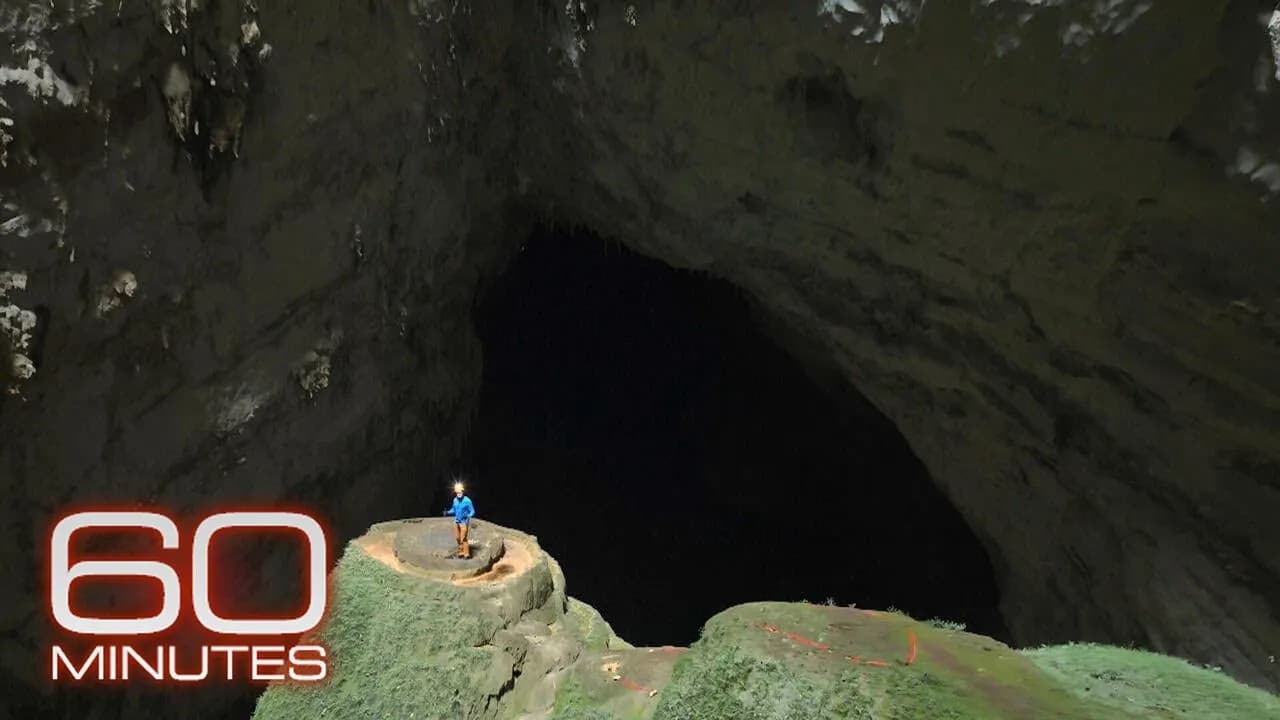
Vietnam's Son Doong cave is big enough for a skyscraper to fit inside | 60 Minutes
In a Nutshell
Son Doong Cave in Vietnam, the world's largest cave passage discovered in 2009 by British explorer Peter McNab after local villager Hokan found its entrance, spans 5.6 miles, towers 65 stories high, and could fit a 747 or the Great Pyramid inside. A grueling three-day trek through jungle, rivers, and massive chambers reveals skyscraper-scale skylights (dolines), acidic Brow Tongue River erosion over 2-12 million years, and challenges like the 300-foot "Great Wall of Vietnam." Its vast, ongoing geological evolution hints at even larger undiscovered caverns nearby.
These notes were generated by AI and may contain inaccuracies.
Imagine in the 21st century discovering a marvel on par with Mount Everest or the Grand Canyon. It happened in 2009 with the revelation of the largest cave passage in the world. It's in Vietnam and they call it Son Doong (Mountain River Cave). An intrepid British explorer, Peter McNab, led the first team through this epic underworld of caverns the height of skyscrapers. McNab is to caving what Armstrong is to the moon: the first explorer. Recently, we asked McNab to show us this wonder of the world.
Before beginning the trek, a preview: simply glorious. This was the moment Son Doong caught us in its grasp. Sunbeams cascading 120 stories from a break in the ceiling. Groundwater above slipping through the light like rain and rock reflecting what seemed like the only sound in the world. Not many have stood in this space that transcends time. It was a reward for our journey that began days before.
The only way to Son Doong is on foot: a trek of a day and a half. We had a party of 53 moving in groups, mostly porters heaving camping and TV gear, plus experts in safety and climbing. There were 20 river crossings. Water flowing through limestone: two essentials for building caves. This is the slender center of Vietnam, the Chu Son Range between Laos and the South China Sea. We were following the Vietnam War's Ho Chi Minh Trail through a jungle where tigers are not unknown and leeches are plentiful.
Leading us were explorers Howard Lambert, whose work in Vietnam over 30 years discovered 500 caves, and Peter McNab, whom Lambert sent to be the first in Son Doong.
"I find it an adventure going exploring and not quite knowing what's around the corner and just sort of finding your way through and things reveal themselves like big chambers, big passages or tight narrow bits, beautiful formations."
"And there aren't a lot of places on Earth that you can discover for the very first time."
"No, you have to look pretty hard for them."
You have to look pretty hard for the entrance to Son Doong. You'd hardly notice but for the writing on the wall proclaiming the miracle of Hokan. In 1990, Hokan, a villager, discovered this entrance after he sheltered here from a storm. He told us, "I was collecting wood. I saw a sinkhole and I felt something strange." The strange feeling was wind blowing out of the ground. Cavers know that's the breath of a tremendous cavern.
In 2000, the British cavers asked young Hokan to show them, but it took 8 years. He'd lost it in the trackless jungle. "In 2008, I finally found it," he told us. In 2009, they started exploring.
That exploration began here, just inside, looking back toward the entrance above. The first obstacle is a spectacular 30-story wall that our climbing team showed us how to descend. Darkness would be nearly total, but we lit it so you can see. Peter McNab was the first to do this. In 2009, he and four others on his team were dropping into darkness.
"There's an obvious big black hole where you're heading towards and you just sort of skirt around and look around and find this way is pretty good. This way works. Quite often you get stopped, can't get down here. You just basically feel your way through the cave by trial and error."
"You had no idea."
"None whatsoever. That was beyond the light on your helmet. Yeah. No, we didn't at all. Every corner you went round was completely new, completely exciting, and it just kept getting better and better as you went into the cave. It was absolutely spectacular."
Spectacular like the entrance we just rappelled down. Look at the two men halfway down holding lights. At the very top is the entrance and the last daylight we would see for a while. At the bottom of the climb, we met the architect of Son Doong, the Brow Tongue River. Its waters are acidic, so it's really good at dissolving limestone.
In camp, we spoke to Purdue University geologist Daryl Granger, who came here in 2010 to figure out when the river started its project.
"We found a nice package of sediment further in the cave. And that dated to about 2 to 12 million years ago."
That's when the river first found a tiny crack in the limestone ridge, the width of a hair maybe. That's all it takes to make a cave. The water started flowing through it, dissolving it bigger and bigger and bigger. We still have water going through it today. So, it's continuing to get bigger as we speak.
Our exploration of the cave took 3 days and two nights. The length is 5.6 miles. It's 65 stories tall and the width of 1.5 football fields. The Great Pyramid of Giza would fit easily. A 747 could fly through the biggest passage and not scrape a wing. Sometimes the only way forward was the width of our shoulders. But we noticed in the broadest caverns, you often lose the sense of even being underground. What reminds you is the isolation: no cell phone, no satellite. We were cut off from the world.
Roughly halfway, there was a light ahead. There are two skylights where the roof collapsed: a break from total darkness and a chance to show the scale. Geologists call these holes dolines. The word has European roots: sinkhole or depression. This doline formed because the roof over our heads, the limestone, is a little bit thinner here than in the rest of the cave. Then as the cave grew wider and wider over millions of years, it was unable to support the roof above. It all caved in right here. What's remarkable about it is that it allows light into this cave that would otherwise be utterly dark. And it allowed the jungle to come inside the cave. Like everything else about the cave, this doline is enormous: 450 feet above my head, about the height of a 45-story building.
We stopped here with Howard Lambert, who's explored Vietnam since the '90s.
When my producer, Nicole Young, suggested the story, I turned her down. "Nick, it's a hole in the ground."
"What was I missing? You're missing best adventure that happens in the world. Something no one's seen before. That's the beauty of caves. If you climb in a mountain, you can see where you're going. But in a cave, when you go in, you don't know what it's going to do."
Your father was a caver. He was a caver in Scotland. Peter McNab, the first in Son Doong, has been caving since he was a boy.
"You grew up in a cave?"
"Not quite, but within a mile of it."
McNab is a construction manager in New Zealand, big projects like hospitals. But you get the sense he does that to pay for this. In all the caving that you've done, what is the closest call you've ever had?
"I've been stuck. I've had rocks collapsed and I've been flooded in."
He was stuck a few years ago when he went headfirst into a crevice that cavers call a squeeze. McNab couldn't back out. A partner found him and used a knife to rip away his coat to give him the spare half inch he needed.
"Did he pull you out by your feet?"
"Pretty much."
"You are still exploring this region?"
"Yes. We come back every 2 years and we've barely scratched the surface of the caves in this area. There may be another biggest cave in the world. There could well be."
Truth is, McNab's first expedition in 2009 never reached the end of Son Doong. Beyond this underground lake, he discovered a 30-story wall and ran out of time before he could scale it. We climbed it on our trek and understood immediately why they call it the Great Wall of Vietnam. It's a 300-foot climb on slick rock with no foothold anywhere. It's challenging enough until you realize, of course, you're doing it in the dark and it's essentially raining. The groundwater is coming from the roof. So, with everything wet, you find yourself slipping back while climbing up. But our team got us up and over, drenched and a little exhausted.
We saved the best for last. We've made it all the way through nearly all the miles of the cave over 3 days. And now we just have a little bit further to go. In fact, I can see the exit from here. We could see it, that light up there, but we still had quite a climb to make. We learned by the end of our trek that Son Doong may be even larger than we know. Hundreds of feet below that lake behind us, the water is draining somewhere. There could be more caverns beyond. It's the work of millions of years likely to continue for millions more. Unimaginable time measured by a pendulum of light illuminating the splendor of one of the greatest marvels on or under the earth.
Keep 60 Minutes in your library
Save the videos and channels worth coming back to, and find them again in one place.