What Did Ancient Human Education Look Like?
In a Nutshell
Education began as direct, wordless demonstration—children watching and copying elders to acquire survival skills like tool-making and plant knowledge, preserved for over a million years through consistent replication of Acheulean hand axes. Storytelling around fires served as the primary curriculum in hunter-gatherer bands, while extended human childhood provided a dedicated learning window; later, agriculture and writing enabled the first formal schools like Mesopotamia's edubba around 2500 BCE, shifting education toward state bureaucracy. Ancient Greece introduced education for understanding through Plato's Academy and Aristotle's Lyceum, leading to universities and compulsory schooling, but modern systems mix these historical purposes—survival, administration, understanding, and compliance—while replacing urgent, relational learning with standardized, scheduled instruction.
These notes were generated by AI and may contain inaccuracies.
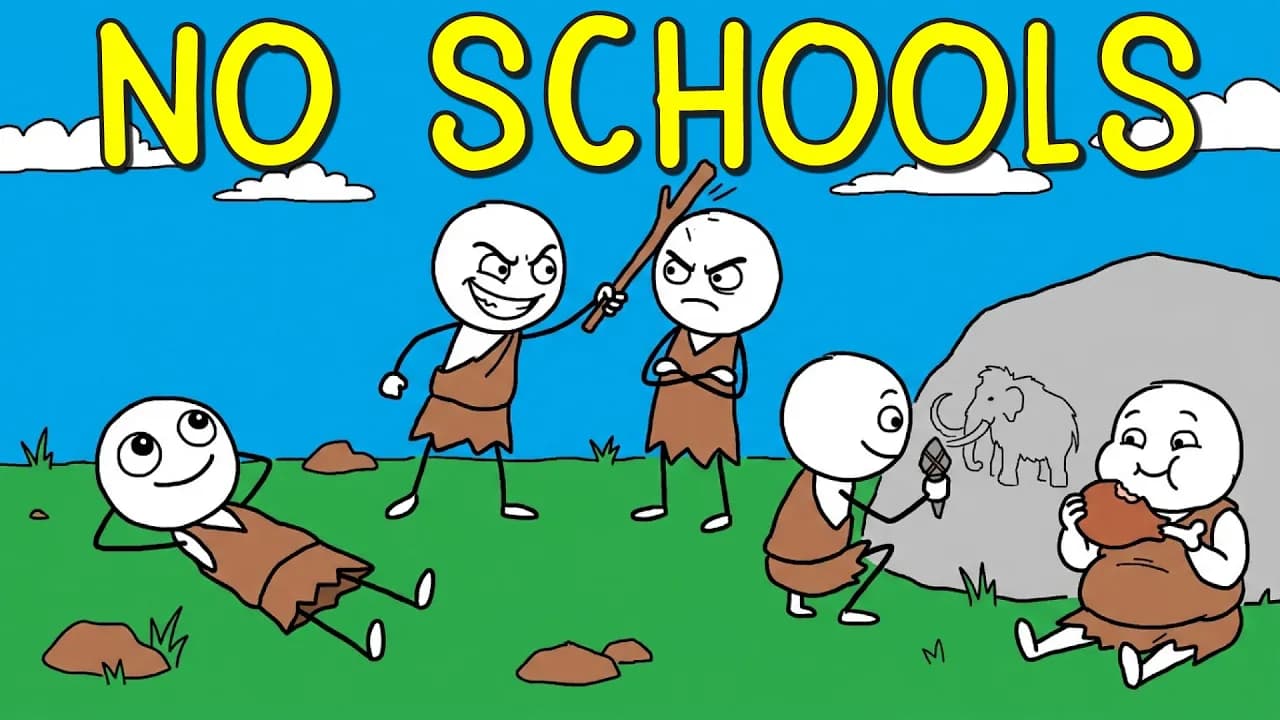
There is a child sitting in a classroom right now staring at a board waiting for a bell to ring. They have no idea that for 99% of human history that classroom didn't exist. That bell didn't exist. That teacher at the front didn't exist. And somehow every generation before us still managed to pass down everything they knew. Languages, skills, which plants would kill you, how to track an animal across miles of open land, how to stay alive. The question is not when humans built schools, but when the first human decided that what they knew was worth passing to someone else.
The earliest evidence of intentional knowledge transfer doesn't come from a building or a written record. It comes from tools. Stone tools dating back over 1.5 million years show something remarkable. Not just the tools themselves, but their refinement across generations. The Acheulean hand axe found across Africa, Europe, and Asia shows a consistency of design so precise over hundreds of thousands of years that it could only have been replicated through direct teaching. Someone watched someone make one, then made one themselves, then showed someone else. For over a million years, the same tool was made the same way because the knowledge of how to make it was deliberately passed on. This is what education looked like for most of human existence. Not a classroom, a demonstration. A child watching an adult's hands, copying, failing, trying again, being corrected not with words, but with a repositioning of fingers, a redirected strike.
Around 300,000 years ago, when Homo sapiens first appeared, groups lived in bands of 15 to 50 people. The elders were the library. If you wanted to know which plants were safe during a drought, you asked the person who had survived the last one. Knowledge was stored in people and when those people died, it died with them unless it had been passed on. It was passed on above all through story.
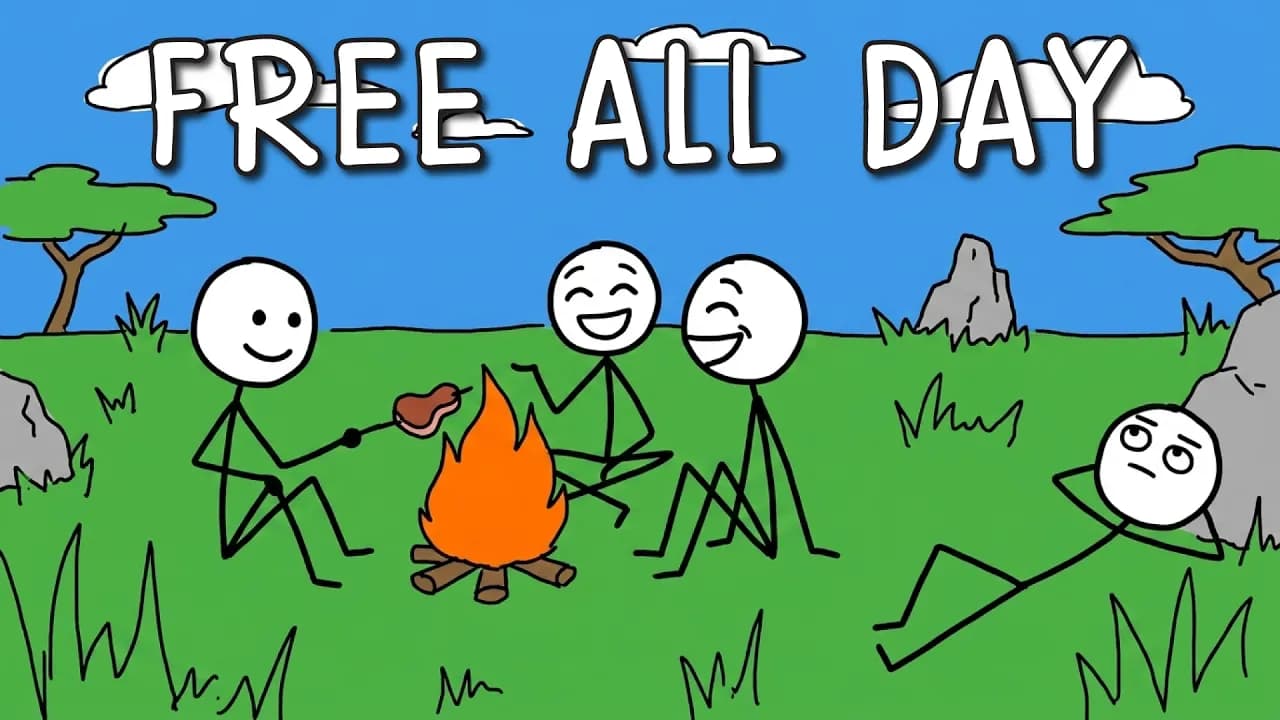
Anthropologist Polly Wiessner at the University of Utah analyzed hundreds of hours of recordings from the Ju/'hoansi people of southern Africa, one of the oldest continuous cultures on Earth. She found that 81% of nighttime conversation around the fire was storytelling. Myths, ancestor tales, moral lessons wrapped in narrative. This was the original curriculum. Not a room, a fire. Not a teacher, a voice in the dark carrying information forward through time.
Chimpanzees become nutritionally self-sufficient within a few years of weaning. Humans take 18 years. Evolutionary biologists argue this isn't a flaw. It's the design. The extended human childhood exists as a dedicated window for learning. Every other species learns to survive quickly. Humans learn to accumulate knowledge across generations and build something no other species ever built: culture that compounds.
What that education produced is visible in the archaeological record. Around 100,000 years ago at Blombos Cave in South Africa, archaeologist Christopher Henshilwood found perforated shell beads and processed ochre pigment, objects that required multiple steps to produce. The ochre had been ground, mixed, and stored in abalone shells. The shells had been carefully pierced. These weren't accidents. They were the products of a process that had to be learned, practiced, and remembered across generations. The knowledge of how to make them had to come from somewhere. Someone passed it on.
Then around 36,000 years ago at Chauvet Cave in France, someone painted horses, lions, and rhinoceroses on stone walls and did it with perspective, depth, and anatomical accuracy that took modern researchers by surprise when the cave was discovered in 1994. We can't say with certainty that a teacher guided a student's hand on that cave wall. What we can say is that whoever made those paintings had clearly spent time developing that skill. Skills that sophisticated don't appear fully formed. They accumulate through practice, through observation, through being around others who already knew how to do it. The knowledge existed in the community before it existed in the individual. That is education even without a name for it.
Then around 10,000 years ago, agriculture changed everything. Humans stopped moving and started farming. Populations grew. Complexity grew. A farmer needed to understand soil and seasons. A trader needed to count and calculate. A ruler needed to record laws and debts. When the volume of information exceeded what memory alone could carry, humans invented writing. And writing changed education permanently. For the first time, knowledge could exist outside a human being. It could be stored, copied, outlived the person who created it.
The first formal school in recorded history appeared in ancient Mesopotamia around 2,500 BCE. The Sumerians called it the edubba. House of tablets. Archaeologists excavating Nippur in the late 19th century found tens of thousands of clay tablets that were student practice exercises. The same signs copied over and over. Calculations, vocabulary lists, the homework of children who lived four and a half thousand years ago preserved in clay that hardened when the buildings around it burned. Students entered before the age of 10, and graduated roughly 12 years later, having learned cuneiform script, mathematics, agricultural science, legal principles, and astronomy. But these schools weren't built for curiosity. They were built for bureaucracy. The Sumerian Empire needed scribes, specialists who could record trade, manage temples, and run the machinery of the first cities. Education had become a tool of the state. That shift from learning what you needed to survive to learning what the system needed you to know is one we're still living inside today.
Ancient Greece changed the question entirely. In 399 BCE, Socrates was executed for asking too many uncomfortable questions. He had spent his life in the streets of Athens using systematic questioning, the Socratic method that forced people to examine what they actually knew versus what they assumed. He wrote nothing. His classroom was wherever two people were willing to argue.
His student Plato, shaken by that execution, founded the Academy in Athens in 387 BCE. A place where philosophy, mathematics, astronomy, and ethics could be studied not because they were useful to an administrator, but because they were essential to understanding reality. No admission requirements except a desire to engage with ideas. Above the entrance, according to tradition: "Let no one ignorant of geometry enter here." Aristotle arrived at 17, stayed 20 years and later founded the Lyceum where he systematized virtually every branch of knowledge that existed. Biology, physics, logic, ethics, politics, literary theory. The academic disciplines we still use carry the structure he gave them. The very word "academy" comes from Plato's school. The idea that the goal of education is to develop minds, not just produce workers. Born in a park outside Athens among a handful of people arguing in the shade.
Universities followed. The University of Bologna, founded in 1088, is the oldest continuously operating university in the world. Oxford followed around 1096, Paris around 1150. Then the printing press in 1440 made books cheap enough for people who weren't kings or monks. Ideas spread faster than any teacher could travel. Mass literacy became necessary. Prussia introduced compulsory state education in 1763. England followed in 1870. For the first time in history, education was something every child was supposed to receive.
Now step back and look at the full distance. A child in a hunter-gatherer band watching an elder skin an animal, copying every movement, learning without a single word being spoken. A student in Nippur pressing cuneiform signs into clay at sunrise because the empire needs another scribe. Aristotle walking into Plato's Academy with no idea that what he learns there will shape how humanity organizes its knowledge for 2,000 years. A child in 19th century Prussia sitting in a public school for the first time in history. Not because her family chose it, but because the state required it. Four completely different worlds. Four completely different ideas about what education is for: survival, administration, understanding, compliance. And every modern school system is a mixture of all four.
For most of human history, education was not a building you went to. It was a relationship between someone who knew something and someone who needed to know it. The child watching the elder, the apprentice watching the craftsman, the student watching Socrates in the marketplace. The institution came later. The relationship came first. We built classrooms to make education scalable, to standardize what gets passed down. And in doing that, we solved one problem and created another. We can now educate billions. But most of them spend their entire childhood sitting in rooms being told what to know, waiting for a bell to ring. For 300,000 years, children learned because they had to, because the knowledge was immediately connected to staying alive. The child who didn't learn which mushrooms were poisonous didn't get a bad grade. They got something worse. We replaced that urgency with a system. The system works. It just works differently from anything that came before it. The fire is still burning. We just moved it indoors, put it behind glass, and scheduled it for 45 minutes between 10 and 10:45 on Tuesdays.
Keep Axen in your library
Save the videos and channels worth coming back to, and find them again in one place.