What Did Ancient Human Children Actually Do All Day?
In a Nutshell
Ancient children were active, productive members of their communities from a very young age. By five or six, they foraged for half their own calories, practiced with child-sized weapons and tools, and learned critical survival skills through direct participation rather than instruction. They were included in adult activities, experienced real consequences for mistakes, and by their mid-teens were fully capable adults, unlike modern childhood which delays responsibility and contribution.
These notes were generated by AI and may contain inaccuracies.
You wake up. You're 6-years-old. No school today, no homework. You walk outside into the morning and the whole world is just there, open, waiting. Sounds like a dream. It wasn't. By the time you were six in the ancient world, you were already working. Not in the way modern children do chores for pocket money. Working in the way that if you didn't, people might go hungry. And by the time you were 12, you were doing things that most adults today would find genuinely difficult. And by your mid-teens, you were essentially an adult, fully capable of keeping yourself and others alive in one of the most dangerous environments that ever existed.
Modern childhood is a recent invention. The idea that children should be protected from responsibility, kept in classrooms, shielded from the full weight of the world until their late teens or even their 20s, that idea is a few hundred years old at most. For the overwhelming majority of human history, childhood looked nothing like that. And the archaeological evidence of what it actually looked like is one of the most surprising things researchers have ever dug up.
In 2006, researchers Kevin Sharp and Leslie Van Gelder published a study about the cave paintings at Rouffignac in southern France, one of the most famous decorated caves in the world, covered in images of mammoths, horses, and rhinoceroses. When they examined the finger marks pressed into the soft clay walls of one chamber, they measured the width of the hand impressions and found something unexpected. Many of them were tiny, narrower than any adult hand. The measurements pointed to children between two and five years old, toddlers. Somebody carried two and three-year-olds deep into a firelit cave and held them up to the wall so they could press their fingers into the clay alongside the adults.
At Gargas Cave in France, there is a handprint of a baby on the wall with an adult hand pressed beside it and a spray of color blown over both of them together. That moment, a parent and an infant making something on a cave wall 25,000 years ago, is one of the most human things preserved in the entire archaeological record.
At Pech Merle, at Chauvet, at Niaux, some of the most important prehistoric art sites in Europe, the footprints of children are pressed into the cave floors, walking through the same passages the adults walked, present in the same spaces, part of the same rituals or activities. Researchers studying these footprints concluded that at several sites children weren't just observers, they were participants. They were there making marks, leaving traces, doing whatever it was that adults considered worth doing deep underground by firelight.
This matters because it tells you something fundamental about ancient childhood that archaeology took a long time to notice. Children were not kept separate. They were not sent somewhere else while the adults did the important things. They were included from the very beginning.
By the time a child was five or six, the inclusion became practical. Anthropologist Douglas Bird at Pennsylvania State University has spent years studying modern hunter-gatherer groups as windows into ancient life, and what he found in the Hadza of Tanzania reframes everything. Hadza children as young as five can gather enough food to cover roughly half their own daily caloric needs, depending on the season. Half their own calories at five years old through their own foraging. Four-year-olds among the Maniq people of Thailand can skin and gut small animals. These aren't unusual children. This is what children do when the skills are taught early and the expectation of contribution is built in from the start.
Archaeologist Jane Eva Baxter at DePaul University has spent her career studying prehistoric childhood, and makes the point directly, for most of human history, children were productive members of their communities, not future members. The contribution happened now, not later.
The toys make this concrete. In 1960s, archaeologists excavating a coastal site in Oregon called Party found thousands of artifacts including atlatls, the handheld spear-throwing devices that were, before the invention of the bow and arrow, one of the most effective hunting weapons ever made. When researchers Robert Losey and Emily Hall at the University of Alberta looked closely at the collection, they found something that stopped them. Some of the atlatls were tiny, not worn down or broken, made small, too small for any adult hand. Scaled down versions of the real weapon, sized for a child, crafted specifically for small fingers. The largest atlatl in the collection was 166 times bigger than the smallest one, a difference that cannot be explained by variation in adult hand size. Someone made these for children. Someone decided that the right way to raise a child who would survive into adulthood was to put a working weapon in their hands as early as possible and let them practice until they were, in Losey's word, super adept.
Child-size flint points have been found in children's burials in prehistoric Sweden. Miniature versions of working tools, food processing equipment, weapons, cutting implements have been found across sites from Russia to Greenland. The pattern is consistent everywhere archaeologists look. Children had smaller versions of real tools. They were not playing pretend. They were learning for real.
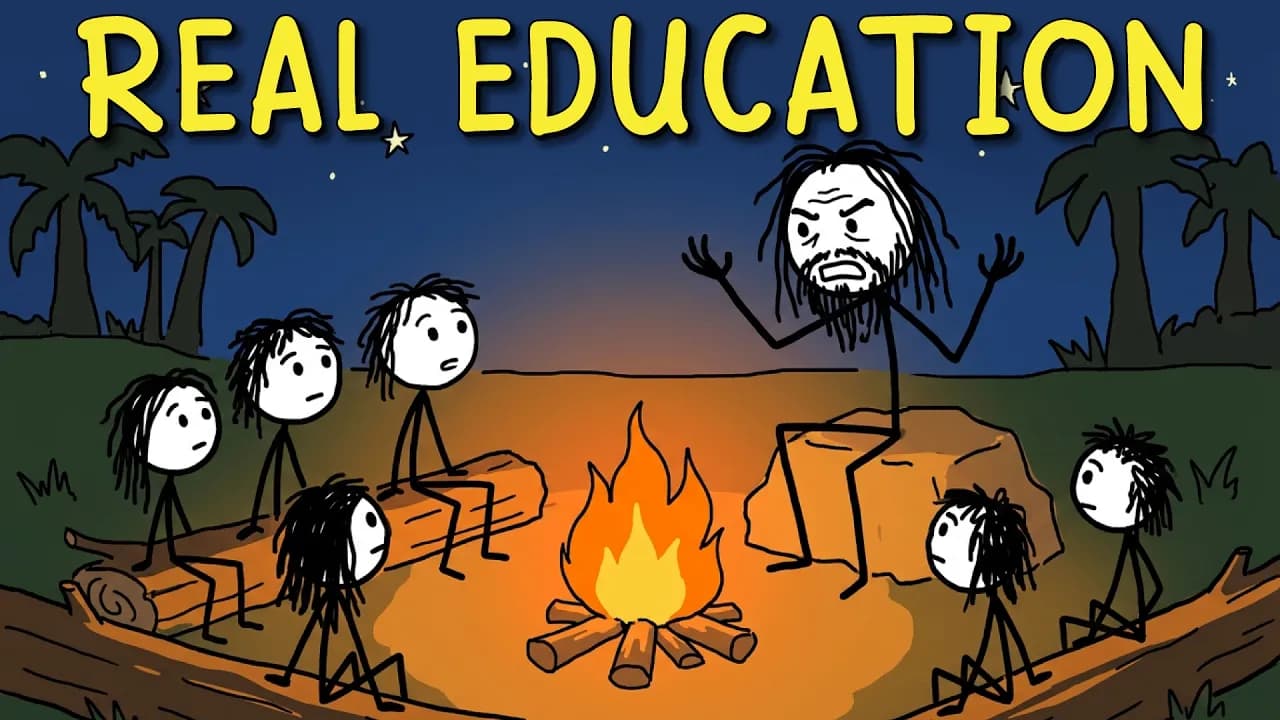
What that learning looked like day-to-day is best understood by watching what happens in communities most similar to ancient groups. Among the Baka of Central Africa and the Hadza of Tanzania, children spend their days in mixed-age groups. Older children and younger ones together. No adult supervision required. Moving through the landscape, foraging, playing, practicing skills, and teaching each other. The older child shows the younger one which berries are safe. The 8-year-old demonstrates how to track a small animal. The 12-year-old already knows the territory well enough to navigate alone. Researcher Sheena Lu Levy, who has spent years studying Hadza and Baka children, describes this as learning by doing in the most literal possible sense. Children in these communities learn because they are genuinely doing, not because they are being taught how to do.
This had a specific consequence that modern childhood specifically works to avoid. Ancient children experienced failure with real consequences. If you tracked the wrong animal, you wasted the day. If you gathered the wrong plant, you got sick. If you were careless near a water source at dusk, the consequences could be permanent. There was no safety net between a child and the actual world, and this is what made the learning stick. Every skill learned had an immediate, obvious reason. You learned to read animal tracks because if you didn't, you would be hungry. You learned which mushrooms were safe because if you didn't, you might not survive the week.
But it wasn't all survival. The archaeological record shows you that, too. At sites across prehistoric Europe, researchers have found what they interpret as children's spaces. Areas slightly separate from the main activity zones filled with small-scale marks, impressions, and evidence of activity consistent with child-sized hands and feet with no obvious practical purpose. Places where children gathered away from adults, made things, played, and did whatever children do when nobody is watching. Researcher Felix Reed at Aarhus University has described prehistoric children as Ice Age influencers, the first adopters of new techniques, the ones most willing to experiment with unfamiliar materials, the ones who picked up new technologies fastest and spread them to others. The cognitive flexibility that made children quick learners was an evolutionary advantage for the whole group, not just the individual child.
There was one more thing happening during childhood that the archaeological record makes quietly devastating. Many of them didn't make it. Child mortality in prehistoric populations was catastrophic by modern standards. Studies of ancient skeletal remains consistently find that somewhere between 30 and 50% of individuals died before reaching adulthood. The graves of ancient children are among the most carefully excavated sites in archaeology because what parents chose to bury with a child tells you what they valued and what they grieved. At sites across Europe and the Middle East going back tens of thousands of years, children's graves contain jewelry, tools, food, and objects that had no practical purpose in death. Things placed there because the people doing the burying could not accept that the relationship was simply over.
A 3-year-old child buried at Sungir in Russia 34,000 years ago was covered in thousands of hand-carved ivory beads, more beads than any adult in the site, as if the people who buried her were trying to give her everything in death that she hadn't had time to accumulate in life.
So, here is what a day actually looked like for an ancient human child. You woke up in a group, you were never alone. From the moment you could walk, you were part of a moving, working, breathing community of people who needed you and whom you needed back. By five, you were foraging. By eight, you had a small version of an adult weapon and you were practicing with it every day. By 12, you could navigate the territory around your camp, identify which plants were safe in which seasons, track animals, and contribute meaningfully to the group's survival. By your mid-teens, you were fully integrated into adult life, not as a visitor, but as a member. You had never sat in a classroom. You had never been told to wait until you were older. You had never had your curiosity managed or your risk exposure controlled. You had been handed real tools, pointed at the real world, and trusted to learn it.
Modern childhood gave children more safety, more time, more protection. What it took away was the thing ancient children had from the very beginning, the sense that they were already needed, already capable, already enough to matter to the people around them. They didn't need to grow up to be useful, they already were.
Keep Axen in your library
Save the videos and channels worth coming back to, and find them again in one place.