What Happens to Your Body Years After Gallbladder Removal
In a Nutshell
Gallbladder removal often leads to bile imbalances that impair fat digestion, nutrient absorption, and detoxification, causing constipation or diarrhea, floating stools, and deficiencies in fat-soluble vitamins. Without the gallbladder, excess bile may trigger diarrhea while insufficient bile leaves sludge in ducts, raising cholesterol and causing right-shoulder pain. Daily ox bile, TUDCA, targeted fiber, and choline-rich foods can restore balance and relieve symptoms years after surgery.
These notes were generated by AI and may contain inaccuracies.
Every single year in the United States, 700,000 people have their gallbladder removed. Most are told there's really no other option, and when you have the gallbladder out, it's not going to be a problem, so you don't have to worry about it. The lack of informed consent means patients aren't told what could potentially happen if they have their gallbladder removed.
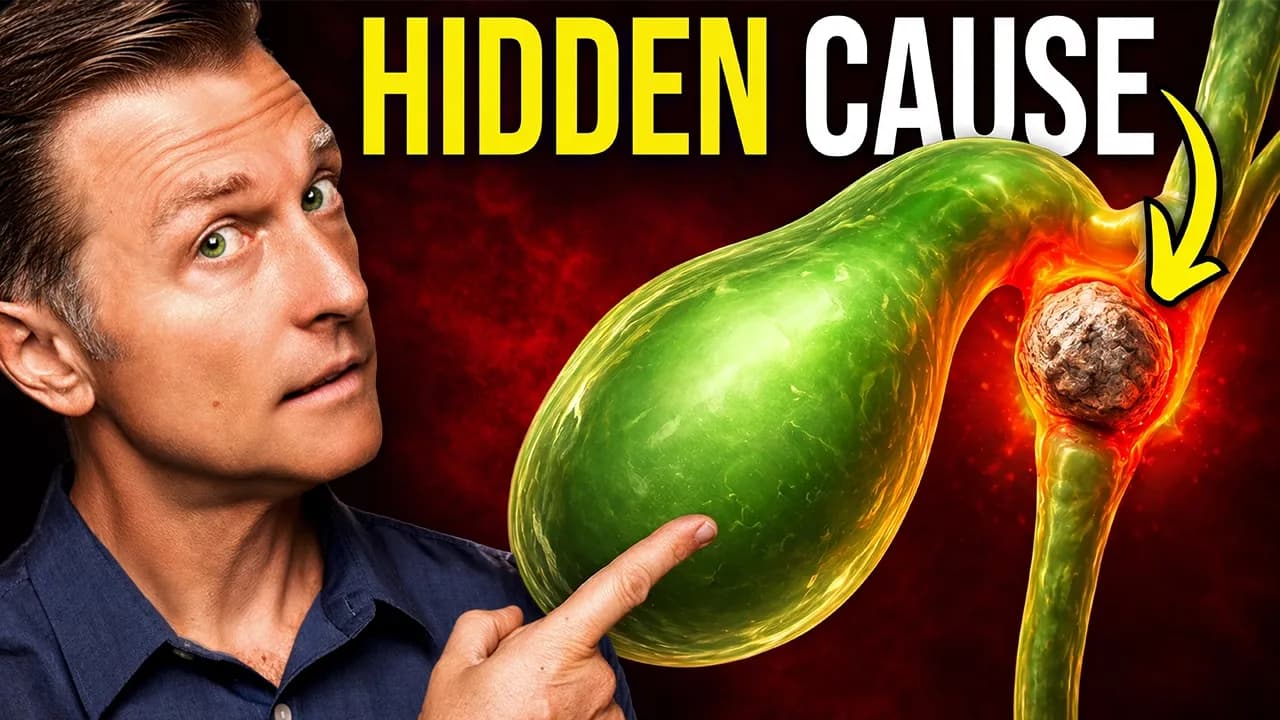
The gallbladder is a little sack that stores and concentrates bile, and then when you eat, it contracts to release the bile into your small intestine so you can actually break down fats. Bile that's stored in the gallbladder is produced in the liver. The gallbladder doesn't produce bile, it just stores it and concentrates it. The liver makes bile, and it goes down this tube, and it ends up in the gallbladder so it can be concentrated. Then it contracts when you eat, and it can help break down fat.
When the fat breaks down, it turns into fatty acids, cholesterol, fat-soluble vitamins like vitamin A, D, E, and K, omega-3 fats which have anti-inflammatory properties, and phytonutrients in vegetables like curcumin or carotenoids. A lot of the phytonutrients in vegetables are fat-soluble. Healthy bile is needed to extract a lot of good stuff from food to pull it into the body. Without this bile, the benefit of phytonutrients from vegetables cannot be obtained.
Bile helps remove toxins from the body, excess hormones like estrogen, pesticides, and all sorts of stuff. Bile is the primary route to get rid of excess cholesterol. Bile is also antimicrobial. There's a condition where there are too many microbes in the small intestine called small intestinal bacterial overgrowth. A lot of people have it without knowing, but it creates a lot of bloating, excess fermentation which is the microbes breaking down food, and gas. Bile is antimicrobial and is involved in working with the microbes to help ensure a healthy thyroid. Thyroid hormones also rely on bile as well.
Bile is involved in peristalsis, the pumping action of the digestive tract. If there isn't enough bile, people tend to be constipated. If there is too much bile, diarrhea occurs.
One of the reasons people have the gallbladder removed is they get a stone in the gallbladder. The stone is typically made out of a crystallization of too much cholesterol. When there is too much cholesterol and not enough bile salts or bile acids, thickening or sludge develops, which is the precursor to turning into a stone. The stages go from normal bile to sludge to a stone. This results from the sluggishness of the gallbladder contracting, which may not be contracting hard enough and is weak.
One of the things that triggers the contraction of the gallbladder is fat. Low-fat diets increase the risk of gallstones. Excessive estrogen can lead to a stone, which is why women that are pregnant or take birth control pills have a risk factor of developing a gallstone or a problem with the gallbladder. If bile isn't working well, estrogen cannot be gotten rid of effectively, so estrogen concentrates and makes things worse.
Another big culprit is too much insulin or insulin resistance. Consuming too much refined carbs and starches leads to gallbladder problems.
The speaker had a gallbladder problem for literally probably 15 years without knowing what it was. There was a sensation underneath the right rib cage causing discomfort not only in the right shoulder up into the neck, but also wrapping around to the right rhomboid muscle. It was thought to be a spine problem, but it was being referred from the gallbladder and other areas because there was so much pressure building up. At the time, eating all the wrong foods was raising insulin significantly.
A low thyroid situation can create a problem because with a hypothyroid condition, everything is slower.
Choline has been known to prevent a fatty liver. It keeps the cholesterol from crystallizing and turning into sludge or stone. Choline is essential to prevent gallstones and the precursor before developing a stone. Most of the population is deficient in choline. Sources of choline include egg yolks, seafood, and liver. Two eggs give maybe 60% of what is needed with choline. 50% of the population have a genetic problem with getting enough choline, on top of 90% that doesn't get it, creating a vulnerability or susceptibility.
If there is a genetic problem with choline, it doesn't mean there will definitely be a problem, but more choline than the average person will be needed to prevent problems. For endurance athletes, the requirement for choline goes up. The more stressed a person is, the more alcohol consumed, the more junk food eaten, the more choline will be needed.
When the gallbladder is removed, complications include either excess bile ending up in the small intestine or a deficiency of bile. If there is diarrhea, a medication is prescribed that binds to the bile to help limit that. Natural alternatives to that medication can be considered because the medication does have side effects. Certain fiber also binds to bile salt, such as psyllium husk which could bind cholesterol. Other fibers include pectin in green apples especially the peel, which is very effective at binding to the bile salts. Steamed okra, beets, collard greens, and steamed kale also provide great fiber to lock up some excess bile to prevent diarrhea. Taking a probiotic is also recommended.
Symptoms of not having enough bile include constipation, stool that will be light colored and will float, higher cholesterol, and right shoulder pain or a fullness or tightness underneath the right rib cage even without the gallbladder because bile ducts still exist and sludge could still be present. They just removed the sack but didn't correct anything.
Ox bile can be taken as one or two capsules after eating to provide the bile that is missing. If surgery was 5, 6, 10, or 20 years ago and there is difficulty seeing at night in the dark with dry eyes, that indicates a vitamin A deficiency, and more bile may be needed to extract more vitamin A. The same applies to vitamin D and vitamin E, all fat-soluble vitamins. Bile may need to be taken to replace what is not being produced after the meal, and the dosage adjusted based on what is needed. The average person would need between one or two capsules of ox bile after eating.
TUDCA is another type of bile salt that is protective of nerves and protects the mitochondria, and is a really good way to thin the sludge. If stool is dark, tarry, and sticky and leaves a skid mark on the toilet bowl, that indicates low lipase from the pancreas, so pancreatic enzymes should be taken when eating to help solve this problem. The gallbladder doesn't work independently but works with the pancreas and the liver as part of the digestive system. When the gallbladder is removed, sometimes it causes the pancreas to work harder, which could create a problem further down in the ducts where the pancreas crosses over and cause referred pain to the left side of the body.
Being in practice for 30 years, many people with gallbladder problems have been encountered, including the speaker's own experience. An acupressure technique was developed for gallbladder problems that is easy to do and gives a lot of relief either from the issues discussed or even if surgery occurred and there is scar tissue. This technique is demonstrated in a separate video.
Keep Dr. Eric Berg DC in your library
Save the videos and channels worth coming back to, and find them again in one place.