What you must know before AGI arrives | Carnegie Mellon University Po-Shen Loh
These notes were generated by AI and may contain inaccuracies.
For many years, humans were the top species, the most capable things on this planet. Soon, that will not be the case. The creativity in AI can probably surpass what we can do. AI is advancing so fast. Po-Shen Loh has three kids and is a math professor at Carnegie Mellon University. He's not sure what's going to happen to university. As a parent, he doesn't care much if all his children go to university because by the time they do, the world will be so different that the most important skill is the ability to synthesize your own ideas.
He interviews lots of high school students who want to work with him. He asks questions until it's clear from their body language that they have never seen the question before. The expectation is they won't solve it, so he gives hints to see how quickly they synthesize them into a solution for a novel problem. That's creativity, and we really need this skill.
Po-Shen Loh is a mathematician who likes to solve real-world problems. He's a math professor at Carnegie Mellon University and a social entrepreneur running an educational solution to make the world a more thoughtful place.
Last year, Google's AI solved four out of six International Math Olympiad problems. These problems are very original; national coaches ensure nothing too similar has appeared anywhere before. AI solved more than he can do.
The only unique thing about human intelligence is that we hopefully care that humans still exist.
In schools, students use AI to cheat on writing homework, which could harm human civilization. AI is a large language model good at patterns of words. If kids lose language ability, they'll grow up unable to think logically, just dependent on others. For adults using AI for jobs, that's fine. But in school, writing is for learning, not money.
Using AI to do your writing homework in school is like saying, "I'm not going to run a mile for exercise. I'm going to drive my car one mile for exercise." You get no exercise and won't be physically fit. Same for mental fitness.
Language skills like reading, writing, communication, logic are crucial for good thinking in the next generation.
People used to go to school to learn homework and exams. Today, everyone needs to learn how to grade homework. He teaches from International Math Olympiad team to sixth grade in schools without math teachers, learning challenges across education.
School math tests check if you listened and practiced. Many math competition problems are similar. He approaches education to help people solve questions they've never seen before.
In the 1980s, math competitions built mental flexibility through new problems. Now, there's a test prep industry cramming strange questions, requiring many hours of study so students are never surprised. This leads to school plus after-school overload, bad for students, and takes away chances to invent.
The world needs a large-scale way for everyone to learn how to grade homework and come up with their own thinking, not just do problems.
Initially focused on helping with math problems. As US Olympic math team national coach, he saw clever people depressed post-high school, thinking life is about outdoing others. Better philosophy: it's addictive to make others happy—5, then 500, then thousands. This correlates with success.
Money doesn't buy you happiness, but money is important for impact and influence. Things we build must generate money for impact.
10 years ago, idea for website collecting explanations of math and science topics for free learning (expii). Thought it'd take months, still working. No business model initially. In April 2019, started US version filming himself teaching math for paid recordings. Still pain points. Two years ago, realized people want live human expert experience that's friendly and rare.
Created ecosystem uniting learners, strong math students building EQ, and drama students needing flexible part-time jobs. 5-6 years ago, took improvisational comedy classes to communicate better about math. Drama department has people interested in paid coaching for high school students.
Win-win-win scales it. For high school students, only assign tasks explainable to parents as best use of busy time, e.g., learning from Broadway or Hollywood actors/actresses for success. Took 8 years to develop, 2 more to scale. Grows as parents discover classes like Twitch gaming streams taught by smiling math geniuses. Could reach 100,000 US high school students (1%), teaching a million middle schoolers.
Live program teaches algebra, geometry, combinatorics, number theory—curriculum for thinking via novel problems from middle school math competitions. Unlike training centers, uses them to practice thinking, not repetition. Finishing teaches generating own ideas; you'll learn anything without lifelong classes.
Key skill: wanting to create value and delight others. Humans soon not top species; must team up to survive. Be motivated by creating value to attract teams. Otherwise, no one employs you over AI.
Solve problems through empathy, visualizing through others' eyes. He works on simulating the world, using AI for it. Example: In Nashville, Tennessee, saw talented singer, asked AI about getting Broadway spots, links, background to build logic on country music performance. Uses AI to improve own understanding, not write reports. Simulating world is entrepreneurial superpower.
Focuses on autonomous human thinking and thoughtful philosophy. People less interested in thinking due to iPads; AI worsens it. Fun of life is own contributions, self-expression—lost if AI-reliant.
Losing thinking makes deception easier. Stories with true statements can evoke different feelings. Be critical; everyone has agendas (his: build thoughtful world where delighting others and thinking is fun). Without own thinking, vulnerable to harmful agendas.
Technology reveals bias impacts. As mathematician: 2+2=4 always, but life's point undefined.
Point of life is to delight as many others as you can.
Unhealthy if short menu of options with huge followers. Few AI providers (Claude, OpenAI, Gemini, DeepSeek in China) like only five viewpoints vs. 7.5-8 billion. Humanity's beauty: diverse ideas, philosophies in marketplace.
AI tools have biases. For news, checks CNN.com, Fox News, tunes X for right-leaning, Facebook left-leaning daily to see disagreements on values and reporting. With convincing AI, verify stories.
For fun, meets people of unfamiliar backgrounds. Took overnight bus to New York City to interact with real world. Cannot create value without interacting; model needs, limits, desires for effective solutions. Goes city after city after city
Gave math talks in public parks across US cities, posting a schedule on website for people to sign up. Initially uncertain if anyone would show, but 50 to 100 people attended each talk. Traveled with AV equipment, speakers, and set up stages in park shelters. This inadvertently became customer discovery, interacting with thousands of parents and students, revealing their challenges.
One to two months later, conceived the big idea: enable middle school students to learn how to think simultaneously while brilliant individuals become extremely polished for future success. Emphasizes you cannot find pain points without seeing people directly.
Goes into schools personally to work on education. Recently contacted someone involved with a large network of schools serving disadvantaged students, requesting to teach sixth grade instead of just providing money or resources. Approach: to work in a sector, step in personally and do the work to see what happens. All ideas stem from personal experiences, such as being a math person taking acting classes and learning how to think from someone knowledgeable who smiles.
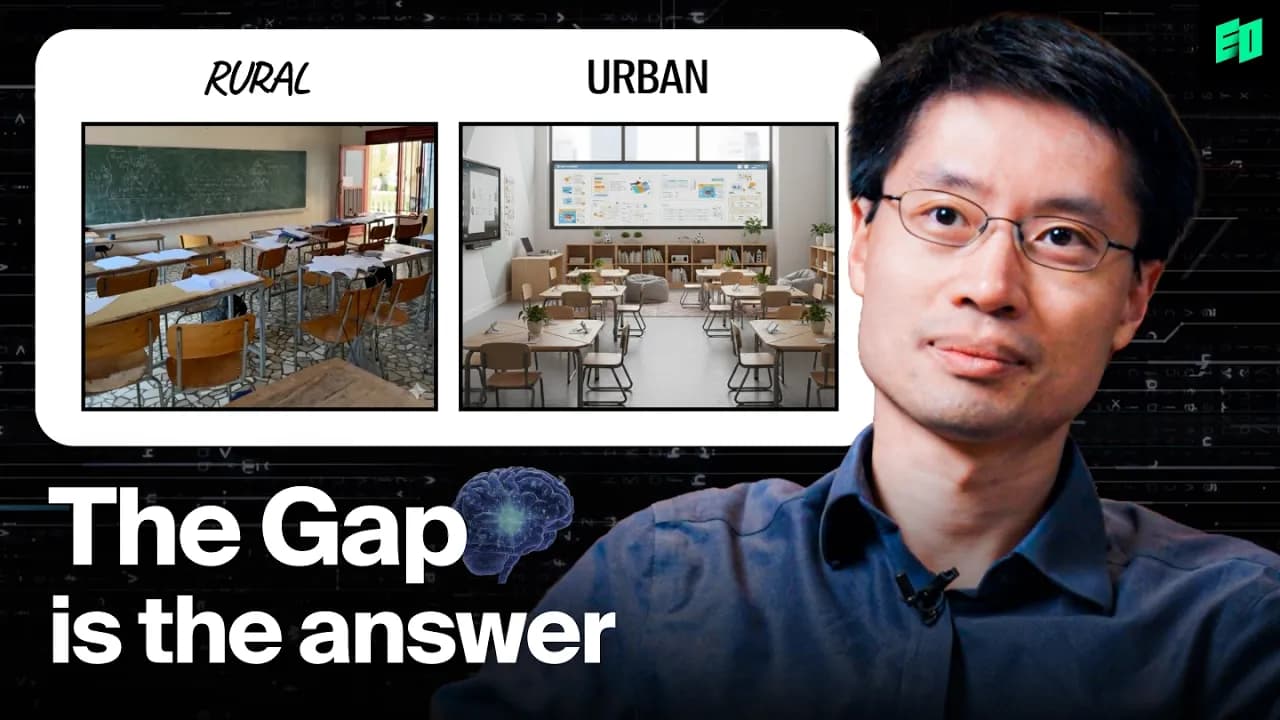
Travels worldwide, including rural areas. Walked into a fourth grade classroom in a high-poverty rural elementary school, acting as substitute teacher "Mr. Poe." Wrote on blackboard: "What is 1 + 3 + 5 + 7 + 9 =?" Kids immediately yelled "25." Classroom was exceptional: kids suggested ideas respectfully, one of the best ever taught.
Asked guide why kids were amazing; learned they lack phones and internet due to poverty. For fun, they figure out how to make their own games. Realization: huge pool of authentically interested, curious kids in rural America with wits and creativity from their way of life—very smart kids representing enormous untapped potential for unleashing science and technology across the US and world.
Keep EO in your library
Save the videos and channels worth coming back to, and find them again in one place.