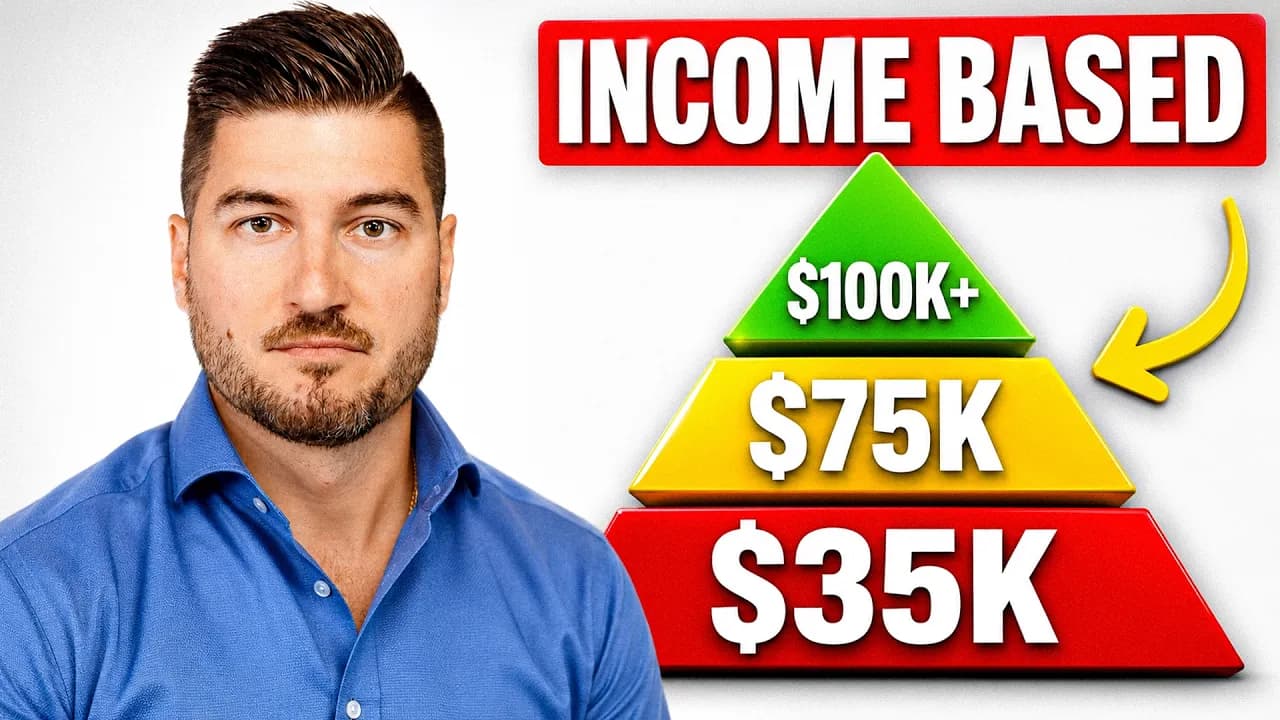
Why A $100,000 Salary Is Getting You Nowhere
These notes were generated by AI and may contain inaccuracies.
You finally got that promotion and are now officially earning six figures. You celebrated. You called your mom. You hugged your spouse. You felt like you made it. 6 months later, you're staring at your bank account at night feeling broker than you did at your previous $60,000 salary. It's not because you're bad with money. It's because the math is rigged against you.
Think back to when you were a kid or college student and somebody asked what success looked like salary-wise. For most people, it was $100,000 a year. Not $80,000, not $95,000, six figures. That specific round mythological number that parents talked about, teachers referenced, career counselors held up like a finish line. When you hit that number, you've made it. The stress goes away. Everyone's happy for you. All your friends say, "Hey, my buddy makes six figures. Let's go out."
You did the work. Went to college, probably took on debt. Grinded throughout your 20s. Stayed up late. Took unglamorous jobs building towards something. At some point, your salary crossed that threshold. Did it feel like you thought it would? For a huge number of people, the answer is no. That's not personal failure, budgeting problem, or because you're terrible with money. This $100,000 a year mark that exists in your head, that your parents talked about, doesn't exist anymore. That version of $100,000 left the building about 25 years ago and nobody sent the memo.
Start with inflation, specifically mathematically what happened to the $100,000 milestone between 1995 and 2026. In 1995, $100,000 a year was genuinely elite income: top 5% of earners, private school money, country club money, putting you in a different category than peers.
Fast forward to 2026: according to the BLS inflation calculator, $100,000 in 1995 has purchasing power of roughly $211,000 today. If you're making $100,000 right now in 2026, you're earning the inflation-adjusted equivalent of about $47,000 in 1995. Your resume says six figures. Your bank account behaves like 1995 and you make $47,000.
The label changed. The purchasing power didn't keep up. Spending habits aspire to the lifestyle that $100,000 meant in the '90s: house in suburbs, two cars, annual vacation (sometimes two), college fund, retirement savings. That lifestyle costs $211,000 now, not $100,000. There's a $111,000 gap between what we believe we should afford and what we can actually afford. Most people fill that gap with credit cards, home equity loans, car leases—financing the illusion of the life they were promised.
Say you're making $75,000 a year and get promoted to $100,000—that's a $25,000 raise ($2,083 a month). After government takes its cut (single filer; married filing jointly looks better, but logic same):
- Federal tax: New money stacked on top, immediately in 22% bracket on most—losing $5,500.
- FICA (Social Security and Medicare): 7.65%, another $1,912.
- State income tax: Nationally $1,000-$1,500.
- Student loan interest deduction: If modified adjusted gross income > $80,000 single filer, lose ability to deduct up to $2,500 interest. Raise makes student loan more expensive.
Add up: On $25,000 raise, keep around $15,800 after taxes. Still good—know what you're working with before signing lease on new car.
When income crosses six figures, something shifts psychologically: the conformity tax. Completely voluntary, but feels like keeping up.
- Can't drive beat-up Accord anymore—you're a manager with clients, reputation. Lease BMW or finance Tesla: from paid-off $12,000 used car to $700/month lease = $8,400/year after-tax.
- Can't stay in apartment—need good school district. Buy house at ceiling of bank approval, not what makes financial sense.
- Subscriptions: gym upgrade, grocery store upgrade, dining upgrade. Each defensible individually, collectively eat wealth alive.
Wife is nurse practitioner, good household income. Felt pull of house pressure, car pressure, financial adviser pressure. Consciously decided: freedom gap between earn and spend is not failure—it's the point. Nobody grades your car. Only scoreboard: net worth statement. For many six-figure earners, it's embarrassing—not from not earning enough, but paying conformity tax on every dollar.
Storyblocks: all-in-one creative toolkit with human-made stock footage, music, sound effects, templates. Professionally shot, not AI. Customizable templates for Premiere Pro/After Effects, Adobe plug-in. Royalty-free, cleared for monetized YouTube, channel whitelist. Head to storyblocks.com/marco.
Household A (or Person A): $60,000/year. Rents modest 2-bedroom $1,400/month. Drives paid-off 2017 Camry. Cooks most meals home. Saves $700/month ($8,400/year into index funds). 6 months expenses in high-yield savings. Could be fine for a year if job lost. Fixed expenses $28,000/year, savings rate 15%.
Household B (Person B): $120,000/year. Bought $575,000 house (bank approved)—mortgage/taxes/insurance $3,800/month. Two car payments $1,100/month. Child care $2,400/month. Gym, subscriptions, dining out, weekend trips: total $9,500/month expenses. After taxes, take-home $7,450/month—spend $2,000 more than make monthly. Cumulative effect: $120,000 lifestyle with zero margin. Stuck—can't take lower stress job, weather layoff, quit toxic boss.
Income is not wealth. Income is speed money moves through hands (velocity). Wealth is what stays. Running at full speed with nothing sticking = treadmill. Metric that matters: savings rate, freedom gap between in and out.
Parkinson's law of money: expenses expand to fill income available. Every raise finds new need:
- Switch to nicer gym: $40 more/month.
- Whole Foods weekends.
- Upgrade phone, internet, add streaming, delivery twice/week.
Collectively destroy retirement math. $150,000 lifestyle needs $3.75 million nest egg (25x annual expenses, 4% safe withdrawal). To accumulate $3.75M by 65 from 35 at 7% return: $3,075/month for 30 years.
$50,000/year lifestyle needs $1.25M. From 35 to 65: $1,025/month.
$200/month Whole Foods upgrade compounded 7% over 30 years: $244,000.
Margin is strategy. Team Aldi. Shop local farms, grass-fed beef, stock freezer 6 months, gym.
Mental reframe: Stop thinking salary, think like business—focus on operating margin (revenue = gross income; costs = taxes + living expenses; margin = what's left, builds wealth).
$10M revenue, $9.999M costs = breaking even. $500K revenue, $200K costs = phenomenal.
$150K/year zero margin vs. $80K 20% margin builds wealth faster. Protect margin at all costs.
Playbook:
- Automate savings before you see money: 401k pre-paycheck, max HSA (triple tax advantage), auto-transfer to brokerage/high-yield savings day after paycheck.
- Never let lifestyle inflate with income: Bank min 50% after-tax raise (e.g., extra $500/month net → $250 investments auto, $250 enjoy guilt-free).
- Run retirement math: Annual spend x25. Check trajectory to hit by 65.
People escaping HENRY cycle (high earner not rich yet, golden handcuffs) run tighter operations, treat household like profitable business. Doesn't matter velocity—only what sticks. Measure success by margin, buys freedom. Don't be rodent on hamster wheel.
Join Whiteboard Finance University: $10/month, $100/year (price raising). Live streams Thursdays, follow trades. To get $100K promotion: go to boss's office, shake hand, say you're worth it.
Keep Marko - WhiteBoard Finance in your library
Save the videos and channels worth coming back to, and find them again in one place.