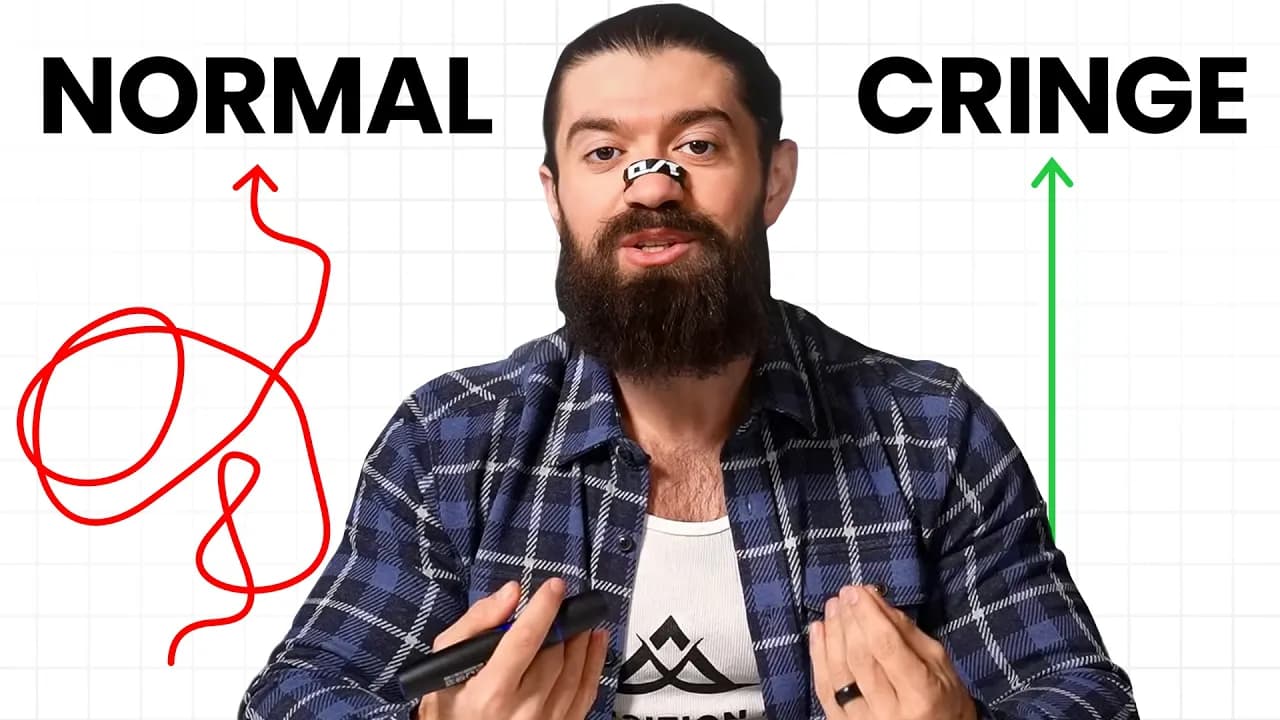
Why Almost Nobody Gets the Life They Want - Jett Franzen
In a Nutshell
Jett Franzen's core message is that most people fail to achieve what they want because they lack genuine agency—they claim to want success but aren't willing to pay the price, instead using sophisticated coping mechanisms, victim mentalities, and moral frameworks to avoid confronting their real motivations and limitations. The key insight is that self-belief comes from accumulated evidence through relentless repetition (1,620 videos before 1,000 followers), not positive thinking, and that true flow state and authenticity only emerge after developing skills through disciplined practice—while protecting your core creative process becomes increasingly difficult as success creates more distractions. Ultimately, the difference between those who succeed and those who don't is their willingness to bet on themselves despite social pressure, ignore others' opinions, and consistently execute rather than talk about executing.
These notes were generated by AI and may contain inaccuracies.
Merch goes live on Friday, July 31st at 12 midday central time or 6 p.m. UK time at mwmerch.com. First access for signups, and once sold out it will never be printed again. Six days to purchase.
A 7-day silent meditation retreat revealed that people often use releasing techniques to avoid engaging with difficult emotions rather than practicing conductivity - allowing emotions to move through you whether they cause laughter, crying, feeling great or horrible. Using release as a prophylactic can become a coping mechanism that prevents truly being with thoughts and emotions.
Jung believed the real danger for humans is not the evil they're capable of but the evil they're denying in themselves. Evil can simply mean a bad habit. Going to the gym to steer away from bad habits can become a mask, happening subconsciously and making it difficult to diagnose. The most important thing is to constantly confront yourself through a kind of psychological suicide - exposing yourself to yourself, which is potentially harder than exposing yourself to others.
After praising yourself for doing something difficult, facing the realization that it was a sophisticated coping strategy creates discomfort. The publicly acceptable "why" for working hard or building businesses often masks deeper motivations like not feeling love as a child unless performing, or fearing abandonment if not constantly working at maximum capacity.
Loneliness can drive people to seek usefulness as a proxy for being loved - people wanting you versus needing you. Extreme achievement in wealth, beauty, competence, or intellect often stems from feeling the opposite internally. The person who made themselves very beautiful feels ugly inside. The very wealthy always feel like they're not enough. The highly competent often feels powerless. Those with extensive skills and connections often feel alone.
People project the opposite of what they lack - if you lack something, you must let everyone know you have it. Some people successfully alchemize their shadow into something beautiful and receive external praise, but examining the underlying motivation feels like psychological suicide when you're already living in bliss from the achievement.
Naval Ravikant suggests living life like a lion - 110% effort when hunting, then resting and being lazy when not. Viciously ambitious entrepreneurs often lack this yin-yang balance, gripping too tightly rather than allowing flow.
Self-belief is the most important factor when pursuing goals, careers, romantic partners, or friendships. If you don't believe in yourself, no one else will. The problem is convincing yourself when you're most critical of your own flaws. Alex Hormozi's advice: self-belief doesn't spawn from nowhere - you must create evidence that convinces your brain you're the type of person capable of achieving goals.
Once you establish the identity through accumulated evidence, that becomes all the momentum needed. Starting social media meant posting 1,620 videos before reaching 1,000 followers, then gaining 100,000 followers the following month. The identity shift occurred when realizing "I'm the type of guy that could go and record a video in my parents' basement and it gets hundreds of thousands, millions of views."
Modern Wisdom took 400 episodes and three-plus years to reach 100,000 subscribers, then gained 3 million subscribers in the next 400 episodes. The opportunity shouldn't come before you're ready - you become ready far later than expected. Appearing on Rogan's show in late 2022 after 600 episodes with 1.5 million subscribers was the right timing; earlier opportunity would have meant being unprepared.
Latent leverage means accumulated skill that allows you to stay ready rather than needing to get ready. If opportunity hit after 30 videos when your quality matched someone with 31 videos, you would blow the chance because you weren't ready. The accumulated experience from thousands of repetitions creates the foundation.
Rather than fake it until you make it, the alternative is making it until you believe it - developing such a high stack of proof that self-doubt gets crushed under the weight of evidence. Both approaches work together: faking it until you make it while creating evidence that eventually transitions into genuine belief.
Accepting there's so much you don't know and will never know is part of the human condition. Trying the best you can anyway leads to wins that pile up until you're crushed by the weight of evidence. The character arc always starts with shaky confidence, developing over time.
The personality trait that matters most is agency - sovereignty over your own experience, the ability to choose. Three mentalities exist: victim mentality (life happens to me), agency mentality (I happen to life), and resonance mentality (life happens through me). Resonance involves opening yourself up to what happens and releasing, allowing flow rather than gripping too tightly.
The tool that gets you to blue or purple belt isn't the one that gets you to black belt. After accumulating experience, you need to learn to let go. Harlan demonstrates this by walking around the pitch lazy and distracted before turning it on when needed. You can't turn it on maximally if gripping too tightly.
Sometimes life feels serendipitous with no way to have made things happen through effort alone. Other times you need to swim against the grain and steel yourself. The skill lies in dancing between these states - releasing when feeling rhythm, then battening down hatches for full demon mode when required.
Alyssa Lou went viral at the Olympics for "fun maxing" - being detached from outcomes while attached to herself. After quitting figure skating and returning, she won gold within a year or two while genuinely enjoying the experience. Harlan shows similar authenticity, responding to questions about France winning with "I'm just happy to be here" rather than typical competitor statements about believing in winning.
Wanting something so badly can prevent it from happening by operating from a frequency of scarcity rather than abundance. Flow state involves being intentional without hyper-focusing on one specific outcome constantly, since finite resources of time, energy, effort, and mental capacity prevent 100% intensity at all times.
Recording 12-14 videos daily with schoolwork and gym, working until 4 a.m., created increasing pressure as growth occurred. Videos started to suffer from the added stakes. Recording eight videos outside in freezing snow at 3 a.m. with bare hands, doing one or two takes each, produced hundreds of thousands to millions of views with minimal effort.
People seeing viral success think they can skip straight to stream-of-consciousness content, but this only works after putting in the reps beforehand. You can only break the rules once you've learned them. The concept of wu wei - effortless action or trying not to try - requires prior training.
Early Confucian training requires memorizing shelves of archaic texts, learning precise bowing angles, and exact step lengths. The sitting mat must always be perfectly straight. This rigor ultimately produces cultivated but genuine spontaneity. The training process isn't complete until the individual passes beyond the need for thought or effort. The next stage of development might require more ease rather than more effort, more grace rather than more grind.
Mastery requires understanding the flow of the game rather than breaking rules to level up. The alternative is simply not playing the game at all.
Djokovic nearly quit tennis due to excessive pressure and lack of enjoyment. When asked how he regained his passion, he stated, "I like hitting the ball. I just like hitting the ball." This mindset only works when the fundamental skills have been developed first.
When people get nervous during sports, blood flow increases to the brain, creating conscious awareness of actions that should be automatic. Skills developed through training are meant to run on autopilot, which is why choking occurs. The yips represent this phenomenon where conscious interference disrupts automatic performance.
Skills must be developed to the point of becoming second nature before flow states can occur. This is a dangerous talking point when successful people like entrepreneurs or athletes claim "the game's just coming to me" without acknowledging the years of blood, sweat, and tears required to reach that point.
Agency is the key differentiator between those who succeed and those who don't. One year prior to this conversation, the speaker was sleeping on a couch in Iowa while building a streaming career through clipping and consistent content creation. Agency means being willing to pay the price required to achieve goals, not just wanting them.
95% or more of people who claim to want something are bluffing. Wanting something means being willing to pay the price it requires. The speaker demonstrated this through relentless dedication, working so intensely that parents begged for moderation, while others only see the final result without acknowledging the 1,620 videos posted before reaching 1,000 followers.
The most dangerous people are ambitious but lazy individuals who lead others to believe they'll take action but consistently fail to follow through. The speaker had a friend who would plan business ventures but always diverted conversations to unrelated topics like girls instead of executing plans.
Success requires dedicating yourself for a ridiculous amount of time. The speaker acknowledges being only a centimeter down the path of their aspirations. People like Alex Hormozi and Naval Ravikant spent years being disrespected and clowned on while relentlessly pursuing their goals behind the scenes.
Agency requires the ability to ignore others' opinions and give entrepreneurial endeavors a genuine attempt. Approximately 95% of people think they want success but don't actually want it, while only 2-5% are willing to do what's required. Before winning, everyone asks why you're working so hard. After winning, everyone tells you how lucky you are.
Talking about doing something activates the same reward centers in the brain as actually doing it. Very few people are operators who can consistently execute what's needed for success. This is why some people become serial successes while others become serial failures - the transferable skill is showing up and doing the work.
The Modern Wisdom podcast had days in 2018 with zero plays. After rupturing an Achilles tendon in late 2020, the host constructed a special recording setup to continue producing episodes with the foot elevated above heart level. This level of dedication was required to build the podcast.
A woman the host met at a breathwork class four years later asked if he was "still doing those ads," not realizing he had been recording three fresh ad reads per episode for 600 episodes at midnight instead of going out. This amounted to approximately 2,000 ad reads before dynamic insertion technology was available.
Both the host and Alex Hormozi wish they had captured more behind-the-scenes content in the first one to two years. The speaker documented the progression through YouTube videos showing someone at the bottom working their way up through daily consistency.
If you live in America, it doesn't matter how far at the bottom you start - anyone is capable of clawing their way up to at least the middle of the ladder with sufficient agency. Morgan Freeman responded to claims about oppression by pointing to his own success along with Denzel Washington and Barack Obama.
In this study, women had makeup applied to simulate facial disfigurements. They reported feeling discriminated against during interviews and could point to specific comments they believed referenced their supposed scars. Before entering the interviews, the makeup was secretly removed. This demonstrates the power of belief and how self-inflicted limitations can occur.
Media messaging that certain groups cannot succeed due to circumstances creates dangerous self-fulfilling prophecies. While acknowledging that disadvantages make success harder, the only choice is what to do about it: take action anyway and become proof that others can overcome similar circumstances, or blame and complain.
Having disadvantages makes success harder but doesn't make it impossible. The choice is between winning anyway and proving it can be done despite stacked odds, or hoping circumstances change. The cards dealt cannot be exchanged - the only option is playing the best hand possible.
"Suicidal empathy" occurs when people empathize with self-destructive habits by saying they're okay because that's the cultural narrative. Good parents give constructive criticism despite children's discomfort because they love them. The same approach applies to friends, peers, and society members.
Nietzsche's concept suggests that poor and middle-class people who haven't achieved external success often shift focus from external achievement to internal virtue, which they define subjectively. This becomes a cop-out where instead of winning in life, they claim to be "good people" according to their own definition.
People who couldn't achieve external success often cope by becoming obsessed with morality and virtue as a subconscious defense mechanism. Nietzsche recognized this pattern where individuals create moral frameworks to make themselves feel better about their lack of success. This isn't to say external success is everything in life, but there's nuance to how resentment shapes moral systems.
Many Christians engage in this coping by using biblical verses like the camel through the needle's eye to argue against wealth accumulation. However, money itself is not inherently anti-Christian since it can be used to help people and accomplish meaningful things.
Isaiah Berlin's concept of the inner citadel describes how when the path to human fulfillment is blocked, people retreat into themselves and create their own laws to avoid facing reality. Examples include:
- People claiming weight has no bearing on health because they've struggled to lose weight
- Individuals saying jobs are for suckers because they couldn't hold one down
- Those turning to polyamory or becoming incels after relationship failures
The arrival fallacy refers to the false belief that achieving goals will provide lasting satisfaction. Two patterns emerge when discussing this:
- People who try to fill internal voids with external success will not find lasting fulfillment
- Critics claim successful people are part of a conspiracy to discourage others from achieving
Successful people often report that their favorite days were during the struggle and building phase rather than after achieving their goals. This pattern appears consistently in interviews with accomplished individuals.
Lan's theory of desire states that the object of obsession must be perpetually absent to maintain desire. Once achieved, the object can no longer be wanted. This explains why relationships often change after expressing interest and why major achievements feel underwhelming.
Albert Camus's conclusion in "The Myth of Sisyphus" captures this: "The struggle towards heights is enough to fill any man's heart." The process of pushing the boulder matters more than reaching the top.
From a meditation retreat, a key insight emerged: goals function as contracts to self-criticize until success is achieved. This creates a permanent state where success becomes necessary to avoid misery. Desire itself becomes a contract to be unhappy until obtaining what is wanted.
Most of life (99.9% of time) is spent in pursuit rather than achievement. Being born is winning the cosmic lottery (one in 43 trillion odds), making it illogical to only enjoy the tiny fraction of life spent achieving goals.
After winning the Masters, golfer Scottie Scheffler gave an unexpected press conference response. He stated he wasn't out to inspire the next generation of golfers, noting that reaching number one in the world doesn't fulfill the deepest places of the heart. This represents one of the few genuine pattern breaks where someone winning acknowledges the arrival fallacy.
The Buddhist concept of dukkha translates as unsatisfactoriness rather than just suffering. Morgan Housel's story illustrates this: after planning extensively for a family holiday, he immediately found flaws in the experience and began planning the next trip while still on the current one.
The ability to "roll with the punches" and maintain lower expectations leads to being pleasantly surprised. Suffering exists in the delta between expectations of how the world should be and reality.
The hedonic treadmill explains why achievements must regress to the mean. Ancestors who killed a bear couldn't rest on their success because new predators would emerge. This biological mechanism ensures continued drive rather than satisfaction.
Even gaining thousands of followers daily feels less significant than gaining two or three when starting with under a thousand. The ruthless aspect of competence is that every new level of success becomes the minimum acceptable performance moving forward.
Jimmy Carr's observation that "trajectory is more important than position" explains why moving from 600th to 300th in rankings generates more positive response than being 3rd and trying to reach 1st. The Modern Wisdom podcast reaching 8th largest in the world on Spotify lasted about half an hour before the new baseline shifted expectations.
Gold medalist syndrome describes the psychological impact of having fallen off from previous success. Studies show bronze medalists are happier than silver medalists because nearly achieving something and missing is worse than being further away.
Arthur Schopenhauer's concept of the will describes a metaphysical force that creates desires independently of conscious choice. The will is not concerned with happiness, which is always temporary and short-lived. The will relentlessly pushes goalposts further because it seeks only to replicate itself.
Pessimism faces resistance online despite containing valid insights about human nature and the limitations of achievement-based fulfillment.
When you ask why someone pursues something repeatedly, you eventually reach an ultimate good - typically something like feeling peaceful, happy, loved, or enough. Instrumental goods are things done to achieve other things, creating an endless chain of doing the thing to get the thing. Many people live entirely instrumental lives, always doing things to get other things rather than going straight to the ultimate feeling they seek.
The radical approach is to sidestep the instrumental chain and go directly to the ultimate feeling being sought. Most pursuits are driven by feelings. Working harder to achieve goals can create a paradox where the path taken robs you of the satisfaction once the goal is reached. The fuel that gets you to the destination prevents you from feeling satisfied when you arrive.
Modern meritocracy and capitalism have created an architecture that pushes the hedonic adaptation button as much as possible. People want the next rung on the job ladder or bigger paycheck for respect, but sacrifice being home with kids, relationships, sleep, and health. The revolutionary response is accepting that you're good where you are.
The scariest place is perpetually waiting - waiting all day for 5:00 p.m., all week for Friday, all summer for winter. People say "once I graduate high school" then "once I finish college" then "once I travel" then "once I work on my career" - there's always something next, and life never gets lived.
Happiness is not wanting any moment to be anything other than what it is - not stuck in the past, not anxious about the future, fully accepting the present moment. When reality doesn't match expectations (like construction noise when you expected quiet), the gap between expectation and reality creates suffering.
How much somebody complains serves as an early indicator of their model of reality. People who complain a lot have a poor model of reality. Traffic exists because reality has traffic - your model of the world was wrong. Reality is undefeated with a million and zero knockouts.
The essay "Don't Wait" describes the belief that life's duties will one day be out of the way and then you can start living. Marie Louise von France discusses the provisional life - the strange feeling that one is not yet in real life, that the real thing will come about sometime in the future. Deferred happiness syndrome is the common feeling that your life hasn't begun, that your present reality is a mere prelude to some idyllic future.
The idyllic future is a mirage that fades as you approach, revealing that the prelude you rushed through was actually the path to your death. There's a sense of foreboding and guilt about time slipping away, doing things and working hard but not fully recalling how time was spent.
In later high school years, working graveyard shift in a Chicago factory in freezing winter conditions created resentment toward peers whose parents paid for college. The victim mindset developed - "life just sucks" at 1:00 a.m. lifting heavy boxes in 30-degree trailers without heaters.
Working with another person created a double victim mindset, but the coworker was playful about it. Resentment built toward people not working as hard, yet they got better opportunities. This pattern continued through multiple jobs during summers.
Joe Rogan advises getting away from people who constantly say "I can't catch a break." Complaining makes life worse. Reading Marcus Aurelius's Meditations provided perspective - the ancient version of "clean your room" by Jordan Peterson. It took years to shift from victim mindset, requiring hard self-examination of having no friends and nothing going on.
For millennia, people only compared themselves to their tribe. Social media hasn't allowed psychological adaptation to billions of views and opinions. Doom scrolling feeds the top 1% - most attractive, funniest, richest, most articulate people. This creates the feeling that "my life sucks" when seeing people like Andrew Tate appear to live amazing lives.
The unfairness of "degenerates" getting money and attention without earning it created resentment. Letting go of all comparison and accepting "I am who I am" allowed things to fall into place naturally. Carrying victim mindset through 20s and 30s leads to regret at 35 about not accepting yourself earlier.
As success grows, opportunities multiply - starting businesses, managing apps, taking investments, dealing with competitors, lifestyle inflation, sponsor deals, more impressive friends. The temptation is to stop doing the thing that got you there. Protect the principal output - for content creators, this means protecting reading time and new idea generation.
Growth feels like growth because objective metrics expand, but what made you differentiated was obsession with learning interesting ideas, scrutinizing them, and communicating them. The engine that created success needs protection. Building staff and managing people creates an unwieldy structure, but the main thing must be protected.
Protecting the first couple hours of the day for reading and thinking nourishes creativity and generates new ideas. One hour of focused thinking time makes everything feel fresh. The more leverage you have, the more distractions you have. The temptation of growth is to lose focus on the main thing.
The little flame, the kernel of inspiration that began the journey, is what needs protection. Protect reading time and new idea time above all else.
Last year involved 100,000 miles of travel - three times around the world. This year has already reached 70,000 miles by mid-year. This wasn't happening when starting out, requiring more aggressive protection of time when there are more compelling seductions pulling away from the main work.
The Matrix scene where Neo sees a woman in a red dress, but it's actually Agent Smith with a gun, illustrates the capacity to say no. As success increases, it's not dealing with 10 hypothetical distractions but 1,000. The capacity to say no needs to scale more quickly than the ability to be successful.
Accepting opportunities like Super Bowl invitations is fine occasionally, but doing it too much loses the thing that kept you sharp. Sports stars like Erling Haaland maintain monastic discipline during training despite having fun when allowed to be loose.
As you become more effective with more opportunities, you must learn to say no to things you would have begged for only two years ago. Momentum attracts people - "everybody wants to be your friend now." Being alone was the biggest advantage, allowing time to confront yourself and figure out what you wanted.
The realization from being unpopular and an only child is the fickleness of sociality. You're the same person as before - the difference is external trappings. Some development occurred, but much of the new attention comes because "Jet's ripping at the moment." Kanye West's observation about people loving early work but not loving it when it was new applies here.
Everybody is a narcissist on a spectrum. Society calls extreme ends narcissism when it negatively impacts others, but humans are innately selfish creatures with their own best interests at hand. Leaning into narcissism healthily propels you forward.
The mountain climbing metaphor: an empty backpack represents neutral self-sense, rocks represent self-doubt and imposter syndrome, while self-belief turns the backpack into a jetpack that propels you up the mountain.
Growing up, people always told Jett Franzen he was a narcissist, though not in the sense of negatively impacting others, but rather that he was very self-absorbed. He explains that betting on himself was the only workable solution, and that you have to lean into every aspect of yourself and build up that belief system. This is not about thinking you're more valuable than another person, but rather relentlessly trying to increase your self-belief because everything in life regresses to the mean, and the mean is your identity. Your self-belief creates that identity, so you need to figure out what healthy narcissism is and how to accomplish it.
The really humble people are often coping for the fact that they didn't go where they wanted to be. Jett comes from a humble family and acknowledges this is an unpopular opinion within his family, but you have to bet on yourself and think that you're capable of doing what you want to do. When he told his best friend he was going to do social media, he said he didn't know what it was about this particular thing, but he'd failed at all the other things he'd tried in life, yet there was something about this that he believed he could do if he didn't quit.
Once Jett started gaining two to three followers a day, he was 100% certain he was going to hit 100K because he told himself he literally would not quit until he hit that number. The interesting thing about survivorship bias is that it assumes you die before you win. If you just don't stop, eventually you've rolled the dice enough times to have something that hits.
Ego is quite antisocial while humility is quite pro-social in the way it's interpreted. Ego causes people around you to have their own shortcomings and self-criticism thrown into harsh contrast. It can also be confronting because people think "he's going to go do that thing that leaves me behind" and may try to claw him back or vent behind his back about "who does he think he is." Humility, even performative humility, is seen as having feet on the ground and not getting too big for one's boots.
This is very much a British concern that someone who thinks too highly of themselves is really not liked. The UK is a rigid class structure country that hasn't been invaded for a thousand years, which is a long time for power structures to drop in. You can tell just by hearing somebody speak what class they were from—underclass, working class, middle class, upper class—and have a good indication of what sort of school they went to because it's had time to segment out like stratified sedimentary rock.
Jett believes strongly in the idea that you need to be rootable—you want to be a person that other people want to see win. A perfect example of this over the past year or so is Timothée Chalamet, who went from someone everyone loved to someone who said on an award show after winning, "I'm really on the pursuit of greatness." Jett loved this because it's like you have a goal and clearly you're on the path to do it, and he felt like Chalamet still did it in a humble way.
You'll find a lot of insecure people or non-confident people really don't like that even if they don't want to have the nuance. People believe what they want to believe, and so if they listen to someone expressing self-belief, they'd rather believe that person is a narcissist than someone that's betting on himself and really putting himself out there and trying.
In incel communities, "ascending" typically means getting laid or getting attention from women, even as little as having the barista at Starbucks linger her eyes on you a little bit longer. Ascending is seen as persona non grata if you do that inside the incel community. If somebody that others viewed as their equal, afflicted with the same issue, is able to bring themselves out of that issue, it brings the potential for hope into reality, meaning that maybe the thing they feel afflicted with is not a life sentence but actually inside their control and they have agency over it.
Far more people fail due to a lack of support than a lack of competence. If you just had a couple more people in your life that believed in you, you'd probably be able to get 10 times further. There's a line from George Mack that says "There is a guy out there with half your talent and five times your self-belief making 10 times the money."
Jett's approach to the support side of things is that support is nice to have, but he's going to go where he wants to go regardless. All those consecutive nights where he would stay up till 4:00 a.m. just grinding, whether or not his friends or family supported him, he didn't care. His family moved out of his hometown and he hasn't been there in years and doesn't talk to those people much anymore, and he has no friends where he moved, so it's like he's just going to do this on his own.
You got dealt cards, and you're not in the optimal position now, so what are you going to do—fuss about it or just do something? People really don't want to support you if you do well, especially if they grew up near you, because you become a mirror to them. If you come from the same place as other people and more or less got the same opportunities, went to the same school, but now they go on Instagram and see that you're getting views and recognition, that's going to tell them that they're really no different than you, yet you're there and they're not, so now they get pissed about it and project.
Jett started a YouTube channel at the beginning of the year that gained traction pretty fast—he got like 200,000 subscribers in the first two and a half to three months and became very popular amongst the underground people that felt like the system was against them community, and a lot of that community is incels. He never claimed to be an incel, but in his videos he would talk about naturally having girls slide into his DMs because he has a lot of followers on Instagram. There was no good way to address it because they'd be mad if he didn't address it, but if he did address it, then he was seen as cocky.
Everyone said Jett was the biggest LARP ever because he never lied about his life. He became friends with a big influencer, very wealthy, and went to his birthday party on the east coast where there were some girls there who wanted to take a picture with him. It wasn't that deep at all, but it goes on social media, and then he posted a motivational video about working hard at a specific thing and being smart about what you work hard on, because if you work hard in corporate, maybe life isn't you're not going to be rich because you're selling your time for money. You need the potential for an increase in appreciation over time.
His entire community turned their back against him. They were throwing a fit and were mad about it, saying this Jet guy is faking it, he's LARPing, he's too good-looking to have been socially excluded growing up. They said there's not a picture of him going to any school dance or prom, and he didn't go to graduation or anything—he truly was isolated. But these people could not comprehend that now that he started to level up in life, you either die here or you live long enough to see yourself become the villain.
They came after him saying he was 6'5" even though he never even lied about his height online. When he was on a very popular looksmaxer stream and they asked him how tall he was and he said 6'5", everyone thought he was bullshitting. Then a picture came out with him working out with some fitness influencers and they were like "dude, this guy's 6'5"—there's no way that he has life hard." So you can't win with these people.
Jett was never part of the incel community—he was always part of the male loneliness epidemic, and that was more his target audience. It's the narcissism of small differences. If you go to the same school as somebody else and you have ostensibly similar skills, the difference in your outcomes is on them. Imagine a split test universe in which in one of them you end up being a real success and in another one you end up being a real failure—the guy that was the failure would feel really bad because he had all of the raw materials to become the guy that was the success. True hell is when the person that you are meets the person that you could have been.
A lot of the time people feel like "I grew up with that guy and he was no more special than I was." This is one of the things that's interesting about content creation generally and the fact that lots of people consume lots of podcasts, YouTube, Instagram. The issue is that the talent delta is not as obvious as doing something more refined like playing a musical instrument or being great at basketball. Most people—if you sat anybody down with two microphones, they have technically recorded a podcast no matter how big of a car crash that could be. If you give somebody a saxophone, they cannot reliably make a note come out of it especially if they're untrained.
Because the expertise skill delta doesn't feel as inaccessible, the small differences become even smaller. Very few people are looking at Steph Curry and going "Steph Curry, dude, the only reason that he got that is because his dad was in the NBA." No, the dude's a generational talent who literally changed the points game of basketball the way that game's played, regardless of whether his dad was great or not. No one's looking at that and saying the only reason that he's got that is because no one can do what he does. The more that people think that they can do what you do, the less respect they have for you doing it.
Jett has seen so many videos where one guy made a video that got like 300,000 views and said he was going to sexually assault him in graphic terms. That video is a statistical outlier on his channel—all of Jett's haters are going to go watch that video. Then he makes another one, another statistical outlier, and he's not really making any points, he's just like "I hate this guy." Eventually he makes a video and goes, "the real reason why I hate this Jet guy is because I make the same content as him." And Jett's like, "it's not the same—this guy is completely delusional." He's recording on an Android from like 2010, and the camera quality sucks, but he's saying Jett is just as basic as everyone else, he just has a better face.
Rakai is one of the most hated people on the internet. He participated in the highly publicized Mr. Beast $1 million streamer challenge video. His intensely competitive, aggressive play style and interaction with other creators has made him one of the most talked about and controversial figures in the event. This guy doesn't even talk good English, he doesn't do anything necessarily exceptional, but people look at that and they're like "I could do that, I could do that, but not only that, I could do it better, I'm smarter than him."
Jett has a friend who's trying to make it as a streamer, and all these underground streamers, these people that are trying to come up, it's just copy paste, copy paste, copy paste. Jett was telling him, respectfully, how in the world are you ever going to make it if you are the product and there's no product differentiation? His friend went to Streamer University—Kai Cenat does this thing once a year where he invites out all these streamers to this like school for a week or something, and it's like class. It's just an entertainment thing, nothing too serious, but people literally quit their jobs, they drive across the country to go to these auditions. But Kai Cenat only lets in already known people.
All these other people, you watch the videos and the footage and the cops had to shut it down—it's just copy paste, copy paste, copy paste. These people have the same personalities. Jett was telling his friend he's obviously going to support him and has always been like "you need to keep doing this thing," but if you're doing the same thing that everyone else is doing, how do you think at some point there's going to be a switch that's flipped? Because back in the day, you could record three viral videos and all of a sudden you're a known person on Vine. Nowadays, you record 50 and you're still and then you don't drop something for a week and you fell off.
Things have to—you just have to keep on relentlessly getting these viral clips, but what makes clips for the big people go viral is the fact that it's the big people in the clip, not that they're necessarily entertaining in and of itself. So you have to push your time in the game. People are really mad because they're like "I don't understand why I can't be where I want to be." Well, you have to find a way to product differentiate. Maybe the reason that you're not succeeding as much as me or as much as someone else is simply because you're not that person. You think you are, but you're not that person. And that's the biggest issue—everyone is just projecting "oh, I deserve to be X, Y, and Z."
When Jett was at the bottom, when he had less than 10,000 followers, he would find other creators in a somewhat similar niche as him that had around a little bit more followers than him, and he would literally look at their videos and be like "that is shit." He would be like "I am so much better—I would convince myself my videos are so much better." And slowly but surely, he started getting past them and then he's like "alright, who's the next one, who's the next one." And that goal post never ends—there's always someone else. But he would get mad at it and thought he was better, but he didn't really do nothing about it—he did something about it, and that's sort of the difference.
The difference is between simulating what somebody else does and learning inspiration that can help you improve. The best that you can hope for if you're trying to be somebody else is to be the second best in the world at being them. And you are the zeroth in the world at being yourself. Naval Ravikant said "You escape competition through authenticity."
Peter Thiel has a quote: "Competition is for losers." In other words, you're a loser if you're not being authentic. If you correlate that with what Naval Ravikant said, because you beat competition by being authentic, so you be being a loser by being authentic. Jett was like "wow, that's just it's such a basic simple thing, but people don't really internalize it, they don't understand it."
Authenticity is an interesting one because what everybody likes the idea of is seeing a person who is just being themselves—there's no filter, they're not playing a game, they're not trying to perform, they're not trying to finesse me into believing that they're something that they're not or pretend that they're not something that they are. But there's kind of a window of tolerance that people are prepared to live inside of. And as soon as you get outside of it, what you realize is that the internet is desperate for authenticity, but it's allergic to sincerity.
If you are genuinely sincere, genuinely earnest about something—like you go through a hard time and you talk about it with some beautiful montage over the top and it's sort of all fluffy and bubbly at the end—it's the wise question, right? Like how deep do you go with the why. Whereas if you see a dude do an Instagram video and he breaks down crying in it—oh no, that's too much sincerity. That's too much, I have an aversion to that. This kind of just goes to show how limited the internet's preparedness for empathy is and also how narrow most people's tolerance for an emotional window is. It's like you're allergic to somebody genuinely showing their emotions, especially when they're out of control. If it doesn't seem like they are in control of the way that they're operating anymore, that seems like a lack of congruence, a lack of competence.
Robert Greene says that authenticity is bullshit and it doesn't exist. When people say authenticity or that person is authentic, it's like let's say there's a spectrum and they're closer to their genuine self than the average person and then you're like "oh, that person's authentic." But they're not truly, if you take it in the absolute sense of the word, they're not truly authentic because I think that would probably be social suicide, right? Like if you really just say what you believe.
Jett wasn't very well-liked when he was in high school, and kind of the reason was because he was part of it was he was resentful. He started reading a lot of books and
Jett Franzen described his early mindset around honesty and how it evolved over time. He initially believed that complete honesty was always virtuous and that being completely raw and direct with people was the best approach. However, he later recognized this was not true. He referenced the Dunning-Kruger effect, noting that he thought he was smarter than everyone else when in reality he didn't know much.
Jett shared a specific example from high school that illustrated his immature approach to honesty. At a Friday night football game, a girl who appeared to be under the influence directly asked him, "Do you think I'm pretty?" His response was to say "No" in a very neutral way, which led to her asking if he thought she was ugly, to which he replied "Yes." He acknowledged this was "insanely immature" and that he wouldn't have gone out of his way to say this unprompted, but because she asked directly, he believed it was the right response at the time.
The incident resulted in significant pushback from others at the game. Jett noted that he would go home thinking he was "in the right" and justified in his honesty, but later recognized this as "psychologically infantile" behavior. He acknowledged that the negative social response was completely valid given his actions.
The conversation referenced Sam Harris's essay "Lying," which he co-wrote with his wife. The work is described as a 60-page treatise arguing against any form of lying, including white lies. Jett mentioned the philosophical position that any lie at any time is problematic, referencing the classic "hiding someone in the attic" scenario where truth-telling could have serious consequences.
The discussion explored the tension between absolute honesty and social functionality. While acknowledging the philosophical argument against any lying, the conversation noted that complete truthfulness can create unnecessary harm in social situations. The example given was responding to someone seeking validation at a party versus finding a way to be both honest and considerate.
Jett described how taking an extreme approach to always telling the complete truth can put people in difficult social situations. He used the metaphor of someone at a football game on a Friday night simply wanting to hear that they're attractive, only to receive what he called an "existential kick in the nuts" instead.
Jett was encouraged to promote his content, directing viewers to find him as "Jet Franen with JT2T" on Instagram and TikTok, and to search his name on YouTube. The host complimented his content and mentioned supporting from the sidelines while giving a shoutout to Jett's dad. The episode concluded with mutual appreciation and the standard sign-off.
Keep Chris Williamson in your library
Save the videos and channels worth coming back to, and find them again in one place.