Why Did Human Progress Explode 10,000 Years Ago After 290,000 Years?
In a Nutshell
Humans remained hunter-gatherers for 290,000 years because an unstable ice-age climate made permanent settlements impossible, despite having brains identical to ours. Around 11,700 years ago, the Younger Dryas cold snap ended, stabilizing temperatures and allowing the climate to become predictable enough for farming, which triggered the cascade of cities, writing, laws, and empires within a few thousand years. The explosion of civilization was not the result of sudden human intelligence gains but of a climate system that finally stopped punishing commitment.
These notes were generated by AI and may contain inaccuracies.
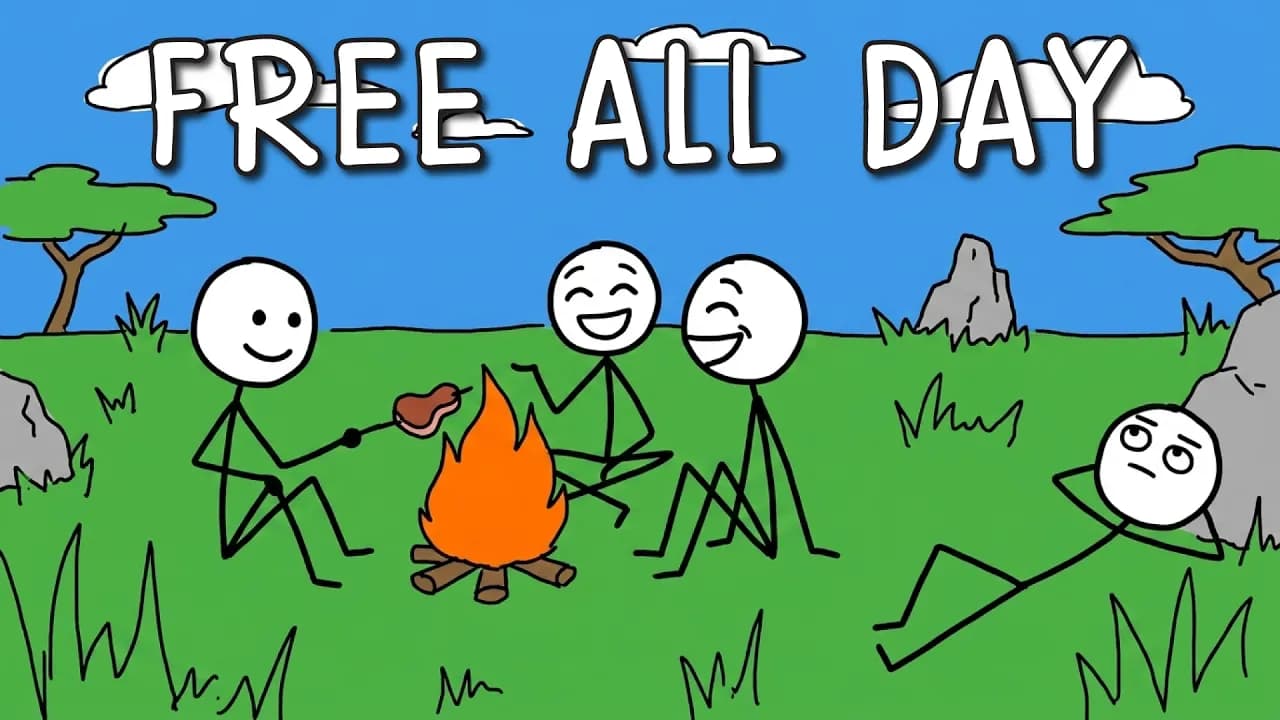
For 290,000 years, humans did almost the same thing every single day. They woke up. They found food. They kept each other safe. They went to sleep. Then they woke up and did it again. No farms, no cities, no writing, no wheels, no buildings that lasted more than a season. Just people living in small groups moving across the land surviving 290,000 years. That's roughly 14,500 generations of humans all living almost exactly the same way. And then around 10,000 years ago, something happened.
In the space of just a few thousand years, which is basically nothing in human history, everything changed. Farming appeared, then permanent villages, then cities, then writing, then metal, then laws, then empires. All of it stacked on top of each other in almost no time at all. So, what happened? Why did 290,000 years of slow, steady, almost invisible progress suddenly turn into this explosion? The answer isn't one thing. It's five things that all happened at the same time, and each one is stranger than you'd expect.
The most obvious question nobody asks is whether humans were actually stuck for those 290,000 years. The answer is no. Not even a little. For most of history, we assumed ancient humans were primitive people, slowly getting smarter, slowly making better tools, slowly figuring out how the world worked. That story isn't really true. A human who lived 100,000 years ago had the same brain as you, the same size, the same structure, the same capacity for language, planning, creativity, and abstract thought. They could have learned to code if you taught them. They could have read a book if books existed.
So why didn't they build cities? Why didn't they invent writing? Why did nothing change for so long? Because the world they lived in made those things impossible. Think about what it takes to build a city. You need food you don't have to go looking for every day. You need enough of it that some people can stop finding food entirely and just do other things. You need people to stay in one place long enough to build something that lasts. And you need a stable climate so those buildings don't get buried under a glacier or baked into dust.
For 290,000 years, almost none of those conditions existed. The last ice age was not a stable, predictable world. It was wild. Temperatures swung by 10° in a matter of decades. Whole landscapes changed within a single human lifetime. Forests turned into grassland. Rivers shifted course, coastlines moved, the animals you hunted one year might be gone the next. In a world that unpredictable, staying flexible was the only sensible strategy. You didn't build permanent settlements because you might need to move next season. You didn't plant crops because the rains might fail. You carried everything you owned because being tied to one place could get you killed. Ancient humans weren't slow. They were perfectly adapted to a world that rewarded mobility and punished commitment.
Then the world changed. Around 11,700 years ago, a period scientists call the Younger Dryas came to an end. The Younger Dryas was basically a 1,200-year cold snap that hit just as the ice age was ending. Temperatures had been slowly warming. Things were looking up. And then the climate suddenly collapsed again. Cold, dry, brutal. Many large animals went extinct. Human populations dropped. And then about 11,700 years ago, it ended. Almost overnight in climate terms. Temperatures in Greenland rose by around 10° C in under 10 years. The ice pulled back. The rains came. Plants exploded across landscapes that had been frozen or dry for centuries. For the first time in human history, the climate was stable enough that you could actually count on it year after year. And humans noticed.
Something happened right around this time that nobody expected to find. And it changed the way scientists thought about how civilization actually started. In 1994, a German archaeologist named Klaus Schmidt was surveying a hill in southeastern Turkey. He found a site that looked promising and started digging. What came out of the ground stopped him cold. Massive T-shaped stone pillars up to 6 m tall carved with detailed images of foxes, scorpions, vultures, and snakes arranged in circles built with precision and dated to around 12,000 years ago. The site is called Göbekli Tepe.
Göbekli Tepe is older than Stonehenge by 6,000 years. Older than the Egyptian pyramids by 7,500 years. It's the oldest known monumental structure on Earth. And here's the part that broke every theory scientists had about how civilization develops. The people who built it were hunter-gatherers. They had no pottery, no metal tools, no evidence of farming anywhere at the site. They were people who still moved around and found their food the way humans had done for 290,000 years.
The old story went first you get farming, then you get settled villages, then you get organized religion, then you get temples and monuments. That was the assumed order. You need all that organizational structure before anyone can coordinate the work of building something on that scale. Göbekli Tepe says the order was completely wrong. Hunter-gatherers with no farming and no permanent settlement somehow organized the effort to quarry limestone blocks weighing up to 10 tons, transport them, and build a complex that would take modern construction crews serious effort to replicate.
Some researchers now think it might have worked the other way around. That people gathered at a site like Göbekli Tepe for religious or ceremonial reasons and that feeding those large gatherings is what pushed them toward farming in the first place. The temple didn't come after civilization. The temple might have helped cause it. Archaeologist Ian Hodder said it directly. What you see at Göbekli Tepe is a very complex society with elaborate rituals and art produced by people who were not fully agricultural. The social complexity came first. The farming came after.
Now, let's talk about the farming itself. Because farming is usually presented as an obvious win for humanity, and it wasn't. Around 10,000 years ago, people in the Fertile Crescent started doing something new. They took the wild wheat and barley they had always gathered, and instead of just eating the seeds, they saved some, and they planted them, and they came back the same place the next year to harvest more.
This sounds like progress, and in some ways, it was. Farming let you produce more food from less land. It let you feed more people. It led to population growth. But here's what your history teacher probably didn't tell you. The first farmers were worse off than the hunter-gatherers who came before them. Anthropologist Mark Cohen documented this in his 1984 study, Paleopathology at the origins of agriculture. When archaeologists compare hunter-gatherer skeletons to the first farming populations, the farmers are shorter. Their bones show nutritional deficiencies. Their teeth are full of cavities from grain-heavy diets. Their spines show arthritis from repetitive labor.
Hunter-gatherers had a varied diet: meat, fish, nuts, tubers, fruit, seeds, dozens of different plants depending on the season. Farmers mostly ate wheat and barley. They got better at feeding large numbers of people and worse at actually being healthy. And once you started farming, you couldn't stop. You had more children because you had more food. Those children grew up needing more food. That meant more farming. The population grew faster than hunter-gatherer communities ever had. And that population needed feeding. And the only way to feed it was to keep farming. You were locked in.
So why did it spread everywhere? Because groups that farmed had more people and more people meant more military power. Hunter-gatherer communities that didn't adopt farming got pushed off their land by farming communities that outbred them. Not because farming was better for you as an individual, because it produced more soldiers per square mile. Once farming started, it spread not because people chose it freely, but because groups that resisted it kept losing to groups that had.
And once you have farming, you have everything else that follows. Permanent settlements appeared because you couldn't abandon your crops. Fields take months to produce results, and you have to be there to protect them, tend them, and harvest them. So, you built houses that lasted. Then, your neighbors built houses. Then, you had a village. In a village, you couldn't just walk away from a conflict the way hunter-gatherers could. If someone in your group of 25 people stole from you, you could leave and find different people. In a village of 500, you needed rules. So, rules appeared. First informal, then enforced by whoever had enough power to enforce them, then written down.
Writing showed up around 5,000 years ago in Mesopotamia in what's now southern Iraq. The first written texts aren't poems or stories or religious documents. They're records of grain storage, lists of who owes what to whom. Accounting writing appeared because farming created enough surplus that someone needed to track it and human memory wasn't reliable enough. The wheel appeared around the same time in roughly the same place. Because if you're farming enough land to feed a city, you need to move large amounts of material efficiently. Metal working came next. Better tools meant better farming. Better farming meant more surplus. More surplus meant more people who didn't have to farm. Those people became metal workers, builders, priests, soldiers, administrators.
Within a few thousand years of that climate shift at the end of the Younger Dryas, you had cities, writing, metal, laws, empires, all of it stacked on top of each other because each thing made the next thing possible. And underneath all of it was a climate that finally stopped trying to kill you every decade.
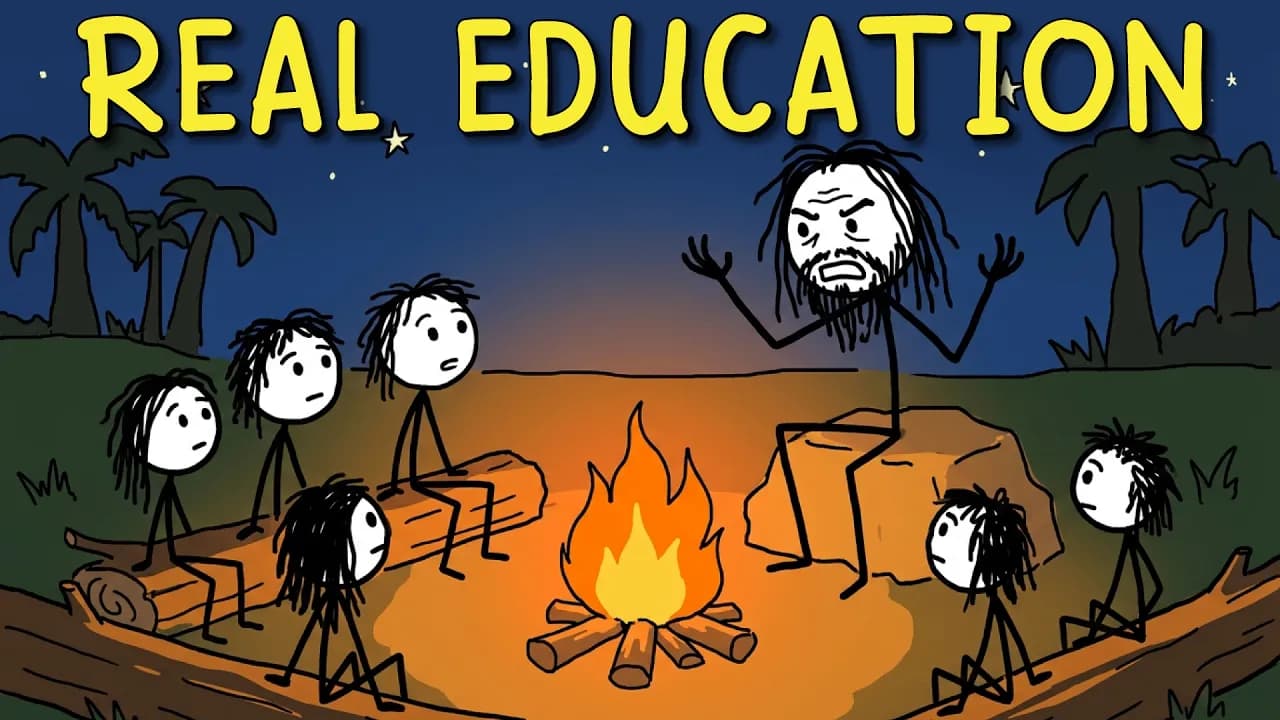
Here's what makes this genuinely strange to think about. For 290,000 years, humans were not stuck because they weren't smart enough. They were stuck because the world they lived in made building civilization impossible. The brain that eventually invented writing and mathematics and architecture and law was already there. It was sitting in the skull of a hunter-gatherer 100,000 years ago, just waiting for a world stable enough to use it. That stability finally arrived and within just a few thousand years, everything that humans had been capable of for 290,000 years came pouring out at once.
Everything you are living in right now, every building, every road, every system, every piece of technology, every law that governs what other people can do to you traces back to that moment when the ice pulled back. The rains came. And for the first time in human history, you could plant something in the ground and reasonably expect it to still be there when you came back.
One more thing worth knowing, and it's the part that most people find hardest to sit with. We tend to think of human progress as something that builds slowly and smoothly over time. One invention leads to another. Knowledge accumulates, things get better generation by generation. That's not what the record shows. The record shows 290,000 years of almost no change and then a few thousand years of everything at once. Not a smooth slope, but a flat line and then a cliff. And the cliff was caused, at least in part, by a climate system that most of us have never heard of, stabilizing at the end of an ice age which most of us never learned about in school.
The biggest civilizational explosion in human history happened not because humans got smarter or worked harder or were finally motivated enough. It happened because the sky stopped being so hostile. That's a humbling thing to think about. Every library, every hospital, every language, every law, every piece of music ever written, every scientific discovery, every building that has ever stood in any city on Earth exists because the climate settled down at the right moment. The same brain that made all of it was present for 290,000 years before it got the chance to try.
Keep Axen in your library
Save the videos and channels worth coming back to, and find them again in one place.