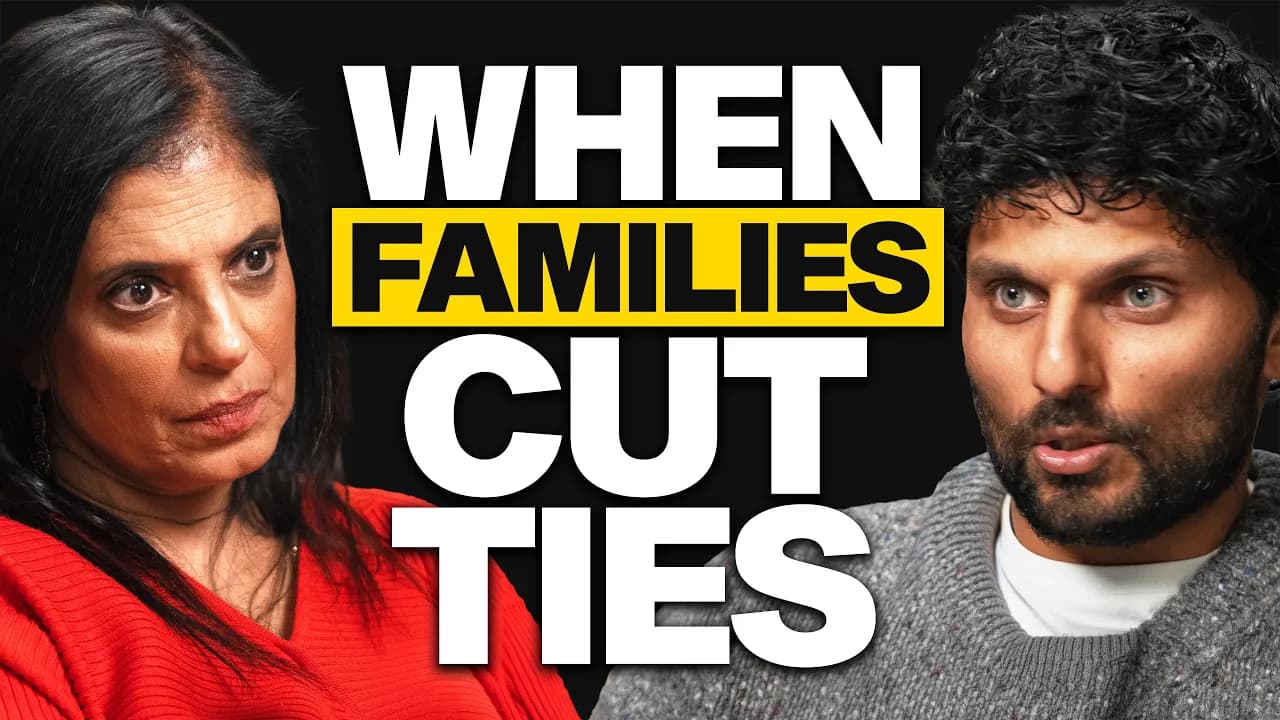
Why Forgiving Toxic Family Can Set You Back | Dr. Ramani
In a Nutshell
The decision to go no contact with toxic family members stems from accumulated harm and failed repair attempts rather than a single incident, and often produces measurable physical and mental health improvements once the chronic stress is removed. Forgiveness is frequently weaponized through cultural or spiritual pressure, and when offered repeatedly without behavioral change, it creates additional psychological damage rather than healing. The process requires accepting external judgment and smear campaigns as validation of the decision, while recognizing that maintaining distance may be temporary but should prioritize self-protection over family obligations or forced reconciliation.
These notes were generated by AI and may contain inaccuracies.
When determining whether to cut off a toxic family member, there is no single moment of clarity. The decision typically results from an accumulation of events rather than one isolated incident. A particularly egregious event may serve as the final catalyst, confirming all previous warning signs that had been rationalized away. People may also experience physical symptoms, such as feeling unwell, as an indicator that the relationship is harmful.
A natural experiment occurs when circumstances naturally reduce or eliminate contact with a toxic family member, allowing observation of how life changes without their presence. Examples include holidays where the problematic person chose not to attend, resulting in significantly more enjoyable gatherings. Family members have reported noticing the difference immediately, with statements like "This is amazing" when realizing the improvement stemmed from one person's absence.
Physical and mental improvements may become apparent during periods of reduced contact: reduced exhaustion upon waking, decreased stomach issues, fewer migraines, improved work performance, and greater mental sharpness. These physiological changes signal the reduction of chronic stress.
The decision to go no contact often follows the closet rod analogy: multiple smaller incidents accumulate like clothing on a rod until one final piece causes complete collapse. The final event is rarely the heaviest, but rather the one that exceeds the system's capacity to bear. Others may perceive the decision as resulting from a single incident, not understanding the trajectory of approximately 1,500 prior events that led to the breaking point.
No contact means complete cessation of all forms of communication: no digital contact, no in-person contact, not taking calls, and not appearing where the person will be present. It represents the death of a relationship while both parties remain living.
A national survey from Cornell University's family estrangement and reconciliation project found that 27% of US adults reported being estranged from one or more family members. While cutting off family was once considered unthinkable, increased awareness and conversations have made the topic more discussable. However, estrangement remains heavily stigmatized, with immediate assumptions that something is wrong with the person who chose distance.
No contact occurs for vastly different reasons. Some pursue it due to genuine safety concerns, including psychological harm and the need to stop abandoning themselves. A classic example involves childhood abuse where the family system minimizes or denies the experience, preventing healing. Kimberly Shannon Murphy has publicly discussed ending contact with family members whose presence continued to harm her healing process.
Others pursue no contact punitively, using it as a weapon when someone refuses to comply with demands, such as loaning money. These individuals make the decision lightly and impulsively. In contrast, those making protective decisions struggle for years with guilt, disloyalty, and self-doubt before reaching their conclusion.
The decision to go no contact typically evolves over extended periods. One example involved a 40-year process of recognizing that maintaining family relationships required canceling one's authentic self. The choice stems from harm reduction, safety, and protection rather than punishment. As a psychologist, the speaker cannot direct clients toward no contact; individuals must make this decision themselves through their own process.
A critical turning point occurs when someone becomes acutely aware that they are sacrificing massive portions of their authentic self to maintain a relationship. This awareness creates a choice between self-loathing and self-protection. There is no pain-free path, as choosing distance will generate pushback from family members and the broader community who insist "you only have one family."
No contact decisions often follow repeated failed attempts at repair. The anatomy of successful repair requires: the harmful party taking accountability, bearing witness to the other's pain, offering a genuine apology focused on the harm caused rather than personal inconvenience, and—most critically—changing their behavior. When repair succeeds, relationships often become stronger and deeper.
Failed repair attempts include anemic apologies followed by repeated harmful behavior, or denial of another person's experience. Survivors often seek simple acknowledgment that harm occurred and that protection was insufficient, rather than attempts to rewrite history.
The most frequent reasons for going no contact include:
- Denial of childhood abuse experiences, sometimes extending to concerns about exposing one's own children to unsafe individuals
- Repeated failed repair attempts where harmful behavior continues despite apologies
- Scorched earth incidents that cannot be undone, such as driving intoxicated with children or leaving them unsupervised in dangerous situations
- Lifetime patterns of criticism, devaluing, and negating comments about weight, career, or other personal attributes
- Political polarization affecting loved ones
Physical manifestations often accompany these situations: rashes, autoimmune flares, gastrointestinal issues, and headaches that occur specifically around contact with the harmful person.
Some individuals report unprecedented relief after going no contact, describing the removal of a "horrible weight" and freedom from anticipated dread. However, many experience significant guilt and shame. The decision is rarely about a single event but rather the culmination of many incidents.
Human fallibility means mistakes occur in all relationships. The indicator of change capacity lies not in the mistake itself but in the repair process: spontaneous accountability, bearing witness to harm, genuine apology, and sustained behavior change. Repeated cycles of harmful behavior followed by apologies without change indicate inability or unwillingness to modify patterns.
When considering no contact while feeling conflicted about family obligations, the critical question is identifying the "why" driving the decision. Reasons focused on punishment or making others feel bad tend to lead to greater regret. The process should be gradual rather than announced, involving successive approximations of reduced contact.
No contact may not be permanent and can serve as a healing period for developing stronger boundaries and self-awareness. The decision should be private, with no announcement to the other party. Successive approximations might include attending events but leaving early, maintaining polite but superficial conversation, or declining overnight stays.
When implementing reduced contact, the other party may accuse the individual of ghosting or avoidance. While some cases of estrangement may involve avoidance, many people choosing protective no contact have attempted uncomfortable conversations dozens of times without success. The entitled party often views reduced contact as a problem requiring explanation, though no explanation will satisfy those unwilling to examine their own behavior.
When a person goes no contact, they must prepare for the inevitable smear campaign that follows. The toxic individual will paint a terrible picture of the person who set boundaries, often accusing them of being influenced by "psycho babble" from therapy. This backlash should be viewed as confirmation that the decision to go no contact was correct, not as a reason to reconsider. These reactions represent the "crumbling bridges" that must be crossed in the process.
The path of no contact requires crossing multiple difficult thresholds including enduring smear campaigns, facing repeated accusations, and tolerating the same toxic patterns that originally prompted the decision. There is no pain-free path, and the pain experienced validates that staying in contact would have meant continuing in an unsustainable mess.
People rarely come to the no contact decision easily. The typical emotional progression involves repeated waves of grief, regret, shame, and guilt before eventually reaching peace. Even after achieving peace, individuals may still feel envy when observing other families who maintain healthy connections. Those who choose to stay in toxic relationships often do so for the societal validation of appearing to have a "normal" family, but this external approval masks the internal damage being sustained.
Staying in a toxic relationship carries internal shame that "eats you up alive," while going no contact involves external shame from societal judgment about why family relationships have ended. The internal shame of remaining in harmful dynamics is ultimately more destructive than the external shame of explaining family estrangement.
The word "forever" creates unnecessary anxiety and catastrophizing. Instead, frame no contact as "for the foreseeable future" or "for now." This linguistic shift provides relief and acknowledges that circumstances may change without committing to permanent decisions. When implementing no contact, it may be necessary to block contact across multiple channels including phones, computers, email, and physical mail, as family members may attempt to circumvent boundaries through various means.
Toxic individuals often feel entitled to explanations for the no contact decision. They may demand to understand why they cannot have access to the person who set boundaries. This entitlement reflects their inability to recognize the harm they've caused.
While some people experience grief and regret after going no contact, many report feeling relieved rather than regretful. More commonly, individuals face difficult decisions when the toxic person becomes ill or is dying, questioning whether they will regret not having a final goodbye. Some people choose to visit dying family members only to have their decision to maintain no contact confirmed when the person remains "ornery and mean" even at the end of life. Deathbed confessions and reconciliations are rare.
Forgiveness is not always healthy, particularly when repeatedly offered in situations where harmful behavior continues. Research shows that when forgiveness is given repeatedly despite ongoing harm, the forgiver experiences negative psychological consequences. Many people feel pressured to forgive through spiritual or cultural shame, being told they are "dark-hearted" for refusing to forgive. Some individuals heal brilliantly without forgiving, and forcing forgiveness can feel like another form of self-abandonment.
Trauma and abuse change a person's "emotional DNA forever," affecting how they trust the world, approach relationships, and even trust themselves. This creates a heavy burden that affects a person's entire life trajectory. Forgiving the perpetrator does not accelerate healing, and some people reach a place of healthy indifference without formal forgiveness. The resentment that remains after significant harm is not an obstacle to healing.
When forgiveness becomes the primary focus, energy gets directed toward the perpetrator rather than toward personal healing work. Healing is possible both with and without forgiveness. However, when forgiveness is performed from a place of fear or shame, or when it requires self-abandonment, it becomes counterproductive to recovery.
Going no contact with one family member often triggers pressure from siblings, aunts, grandparents, and other relatives to "fix" the relationship. The family system tends to be interconnected, making isolation of one relationship difficult. When addressing family pressure, identify if there is even one person who might understand the decision. Having one witness who validates the experience can provide significant support even when the broader family remains chaotic.
Stock responses for family pressure include acknowledging their difficulty while maintaining boundaries: "I hear you, I love you, and I understand why this is hard for you, but please also understand why this would be hard for me. I can't do this, but thank you for reaching out." Avoid turning every interaction into a battle.
When a narcissistic parent suddenly becomes loving and generous after a period of no contact, evaluate whether re-engagement feels right and safe rather than getting caught up in game-playing dynamics. No contact periods should be used for healing work so that if re-engagement occurs, the person can recognize when "nicey nice" behavior descends into manipulation. Trauma-bonded relationships can quickly return to self-abandoning patterns, making it essential to maintain realistic expectations and the ability to disengage again.
Some relationships may evolve into superficial, cordial interactions with zero expectations, functioning more like brief meet-and-greets. However, the fairy tale reconciliation is unlikely, and the original reasons for no contact remain valid.
When deciding whether to include a toxic family member in weddings, baby introductions, or other significant events, the guiding principle should be what feels safe and authentic. These decisions should prioritize preserving the meaning and safety of the occasion. When multiple stakeholders are involved, such as both partners in a wedding or both parents of a baby, the decision should be made through meaningful conversation between the key stakeholders.
Options might include allowing attendance without ceremonial roles, or complete exclusion if the person's presence would "cast too long a shadow." Professional therapeutic guidance is crucial for these decisions, as therapists have no personal stake in family system dynamics and can support the healthiest version of important life events.
Keep Jay Shetty Podcast in your library
Save the videos and channels worth coming back to, and find them again in one place.