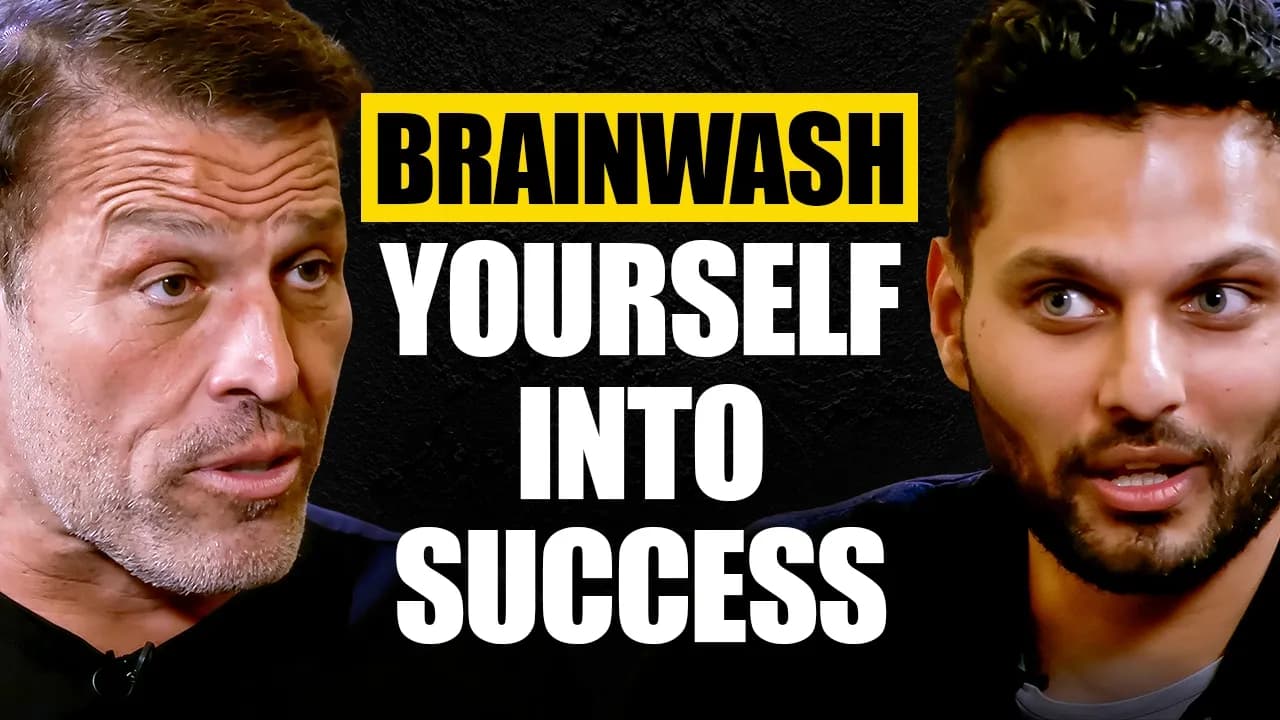
You're Only ONE Decision Away From a Different Life | Tony Robbins
In a Nutshell
Tony Robbins' core message is that decisions—not conditions—determine your life's quality, and the worst decision is making none at all. Real decisions require three steps: decide, commit, and resolve by cutting off all other possibilities. The practical framework is OC EMR (Outcome, Options, Consequences, Evaluate probability, Mitigate downsides, Resolve), paired with the truth that progress and growth create fulfillment while success without meaning leads to emptiness.
These notes were generated by AI and may contain inaccuracies.
Tony Robbins opens by addressing the most common complaint he hears: people feeling stuck in relationships, dead-end jobs, or life itself. He explains that what stops people from making decisions is fear—fear of making the wrong decision, fear of not being perfect, and fear of consequences. Robbins asserts that it's not your conditions but your decisions that determine the quality of your life. He shares his personal background of growing up with tremendous pain, angst, no finances, four different fathers, and physical and emotional abuse, yet transforming those conditions through mindset, psychology, and decisions.
Robbins explains that stress is measured by how much you feel you control events versus events controlling you. The more events control you, the more overwhelm, stress, anxiety, and fear you experience. He notes that mental health issues like depression and anxiety are at record highs not because the world is more stressful, but because of how people process the world.
Robbins identifies decision-making as the single most important tool for moving from stressed to unstressed. He credits decisions for taking him from barely surviving to serving hundreds of millions, even billions of people. He emphasizes that everyone is a creator, and if you don't like what you have, you've gotten there by the decisions that created it.
He distinguishes between type one decisions (significant, hard to change) and type two decisions (easy to change). Robbins stresses focusing on the big decisions. He shares that the smartest people are often terrible investors because they want to know everything before deciding, but by the time you have absolute certainty, the opportunity is gone.
Robbins introduces faith as the only absolute certainty in life. He uses the example of driving down streets with only a yellow line separating you from oncoming traffic at 65 miles per hour, noting that people do this daily with faith despite knowing accidents happen from drunk driving, falling asleep, or texting. He defines faith as the capacity to see beyond the present moment and have a sense of certainty.
The fastest way to change your life, Robbins says, is to start making real decisions. He notes that the more decisions you make, the stronger your decision-making muscles become. He gives the example of people who can't decide what to eat for dinner, pointing out that if they can't make small decisions, they won't be able to make life decisions.
Robbins challenges the idea that you have to make the right decision. His view is that not deciding is the worst decision. He advocates making a decision and, if wrong, finding out quicker. He shares a story about General Schwarzkopf (referred to as Schwarzgo in the transcript) who, when presented with a decision that had been debated for over 10 years with equally strong arguments on both sides, simply said "do this" because a decision needed to be made. If wrong, they would find out quicker and make a shift.
Schwarzkopf also gave two rules: Rule 13 - "When put in command, take charge," and Rule 14 - "Do what's right." Robbins emphasizes that for things to get better, you have to get better. For things to change, you have to change. It all begins with a decision.
Robbins explains that a real decision is not a one-step process but three steps: decide, commit, and resolve. He notes that people often make decisions but don't follow through because they think decision-making is complete after the initial choice. When you leave the moment of decision and get caught up in daily life, you often don't follow through.
The word "decision" comes from the Latin "incision," meaning to cut off from. When you cut off any other possibility except what you've committed to, you'll find the way. He uses the metaphor: if you want to take the island, burn your boats—when your brain has no way out, it finds a way.
Robbins distinguishes between deciding, committing, and resolving. Deciding is knowing which direction you want to go. Committing means staying in that direction for a long period of time. Resolve means promising yourself you will never give up—it's done in you, creating peace with no uncertainty, fear, or anxiety.
He uses the example of LeBron James taking the ball straight in and going over someone's head, noting that LeBron has resolved every ounce of his being that the ball is going there. This is where results come from.
Robbins addresses the issue of overthinking and how decision-making cuts through it. He shares a story about Norman Vincent Peale, who at 92 years old told him about the power of problems. Peale said the only people without problems are in cemeteries, and if you don't have any, you should pray for some because problems are a sign of life.
Peale shared an encounter with heavyweight champion Gene Tunney, who explained that muscles are built by pushing against resistance every day. Peale realized this is how we develop spiritually—pushing against problems sculpts our souls. Decision-making is how we get out of problems.
Robbins shares his six-step decision-making process called OC EMR, developed when he had only one business and faced important decisions. He now has 114 companies doing over 10 billion dollars in business, all without business background, relying on decision-making and learning skills.
O - Outcome: Start with what you want, not what you're afraid of. Write down your outcomes and put them in order of importance. Include the "why"—the emotion and reason behind each outcome. Robbins emphasizes not doing this in your head because multiple questions asked too fast create overwhelm.
C - Options: Write out all options. One option is no option. Two options is a dilemma. You need at least three choices to have a real choice.
C - Consequences: For each option, identify the upside and downside to the best of your knowledge.
E - Evaluate: Evaluate the probability of each consequence. You might stress over something with low probability or get excited about something unlikely to happen.
M - Mitigate: Look for ways to mitigate downsides by combining elements from different options. Your brain gets creative when not in fear or anxiety.
R - Resolve: The final step where you commit fully, finding peace that you'll find the way or make the way.
Robbins mentions making personally $400 million from one decision using this process, noting that the spiritual and emotional value is priceless.
Tony Robbins addresses the relationship between his process-driven, systematic approach and his deep faith and spirituality. He emphasizes that there's nothing more important than spiritual development, yet describes the balance as similar to East and West perspectives. He travels to India annually since his 20s, fascinated by cultural differences where the East focuses more on internal development.
In Varanasi, one of the world's oldest cities at 3,800 years old, fires have burned continuously for 38 years. The culture recognizes over 300 million different gods and countless paths to God, but holds one unified belief: dying in Varanasi ends reincarnation and brings Nirvana. The city fills with people dying joyously, believing the body is merely a "t-shirt" to be burned away. In contrast, Americans stress over minor issues like special sauce on burgers, while those with economic opportunity often squander it.
Robbins distinguishes between philosophy and strategy as critical life elements. Philosophy determines the quality of life and whether someone feels happy or fulfilled. Strategy determines how to execute effectively—having the right strategy can save a decade, while the wrong one can cause illness. He teaches both, believing intelligent people pursue both dimensions.
People want extraordinary quality of life, but definitions vary dramatically. Some envision it as having three beautiful children and a loving spouse, others as writing poetry or building a farm. Robbins doesn't position his life as the ideal example but demonstrates how to make personal visions real through action and enjoyment. Many achieve everything they want yet ask "is this all there is?" because they lack proper philosophy or pursued significance over love.
Two primary skills create extraordinary quality of life, defined as "life on your terms": the science of achievement and the art of fulfillment. Fulfillment lacks universal laws but contains principles, with growth being fundamental. The self-care movement emerged as an antidote to hustle and burnout culture, yet stress often stems from hustling purely for money without meaning. When work serves a higher purpose beyond money, fulfillment replaces stress.
When asked about the common key to happiness across millions of people, Robbins identifies progress as the answer. People feel happy when making progress, yet goal achievement rarely sustains satisfaction—most celebrations fade within six days to six weeks because humans are made to grow, not just achieve goals. When relationships, businesses, or personal development stagnate, they begin dying. Growth creates happiness, enabling sharing and contribution.
Robbins uses Robin Williams as a powerful example of success without fulfillment. Williams achieved everything he set out to do: starring in his own TV show that became number one in nine countries, winning an Academy Award for dramatic performance, building a loving family, and accumulating more money than he could spend. Yet he died by suicide. Williams spent his life making others happy while neglecting himself, abusing alcohol and cocaine. This illustrates that "success without fulfillment is the ultimate failure."
When actions serve something beyond oneself—children, community, country—stress diminishes. All suffering stems from excessive self-focus. While self-care is important for enabling care of others, it has become the new hustle culture when taken to extremes. True self-care directs mind, soul, and spirit toward becoming more rather than checking out.
Robbins presents alarming statistics: 61% of Gen Z has been diagnosed with anxiety disorder, 54% of Gen Z women report diagnosed mental health conditions, 34% of Gen Z currently takes prescription medication, and there's been a 129% increase in antidepressant use among teenage girls since the pandemic. The mental health crisis stems from the belief that doing less leads to happiness. A New York Times study during COVID found that teaching time management to miserable people and having them do more resulted in 20% increased life satisfaction and 18% increased productivity.
The weaker people become, the harder life becomes. Avoiding decisions increases anxiety, while making decisions builds strength and control. A few good decisions create momentum. Mastering achievement science involves studying how others succeeded, while fulfillment requires discovering what enables personal growth and contribution.
Steve Wynn, who built half of Las Vegas and is a philanthropist friend of Robbins, demonstrates how fulfillment depends on what one focuses on. Wynn spent $86.9 million on a Rothko painting—an orange square that Robbins initially mocked. Yet Wynn finds profound meaning in every brushstroke, nearly experiencing ecstasy from viewing it. Robbins notes that Wynn has given away hundreds of millions to philanthropy, emphasizing that individuals must discover their own sources of fulfillment rather than following others' judgments.
The hardest choice is regret. Not making decisions almost always leads to regret, while wrong decisions can be changed. Living on the fence creates problems because the brain struggles with uncertainty. The need for certainty is fundamental, and the fastest path to certainty is making decisions and acting on them. Many achieve much yet remain unfulfilled, while others pursue fulfillment that never lasts. Not feeling good can either destroy or drive someone forward.
Robbins challenges the pop culture concept of self-esteem, arguing it cannot be damaged by others' words or built by compliments. Self-esteem is earned through doing difficult but right things. Someone told they're worthless can respond with determination to prove otherwise, while those constantly praised may develop anxiety when discovering they're not exceptional. Parents who overpraise children without teaching them to develop skills create fragility. The way to develop self-esteem is through grit and pushing through challenges.
Comfort never creates pride or allows inspiring others. While relaxation has its place—Robbins has five children and five grandchildren and knows how to rest—life requires ongoing growth and progress to remain fulfilling. At nearly 66, Robbins maintains growth as essential to fulfillment.
Robbins measures life using zero-to-ten scales across key areas: body/energy, meaning and emotion, relationships (especially intimate ones), and work versus career versus calling/mission. The word chosen reveals the relationship—work is just work, career involves fulfillment, but mission represents purpose. When something is a mission, no amount of work wears someone down.
Robbins cautions against the pressure to find one giant lifetime purpose. Purpose statements rarely capture someone's full complexity, and purposes shift across contexts—different with a four-year-old daughter versus a 51-year-old daughter. Purpose gives life meaning, but celebrating simply being alive is itself miraculous. Celebration without contribution doesn't last, while stress comes from activity without purpose.
Robbins views life in seasons and identifies three essential skills for an uncertain future: pattern recognition to reduce fear, pattern utilization for power, and the ability to compete amid rapid change from nanotechnology, AI, and robotics. Pattern recognition reveals that current events have historical precedents, reducing anxiety about unprecedented times.
Tony Robbins shares details about his first marriage at age 24-25 to a woman 12 years his senior who had been married twice before. She moved in with him along with children from both previous marriages. Robbins adopted all the children, becoming a father figure to a 17-year-old son, an 11-year-old daughter, and a 5-year-old, while also having a biological child shortly afterward. The marriage lasted 14 years, primarily sustained by his commitment to the children. They remain good friends despite not being the right match for each other.
His second marriage to his current wife has lasted 25 years, which he describes as "the greatest gift of my life." When doctors informed his wife they couldn't have children, they used a surrogate. During COVID, when arena events were restricted from 15,000 to 100 people, Robbins pivoted to digital seminars that reached 1.3 million people over three days.
Robbins reflects on parenting in his 20s and 30s, emphasizing his desire for his children to understand they are here to contribute rather than demand from life. He takes pride that all his children have become contributors who give time, energy, money, and resources to help others. They are all good parents and "good people."
With his daughter born when he was 61, Robbins notes the different perspective that comes with later-in-life parenting: "You have so much more wisdom to share. You have more time to just experience things versus when you're running trying to make it all happen."
Robbins presents a life-stage framework based on seasonal patterns, noting that doing the right thing at the wrong time yields nothing regardless of effort. He divides life into four seasons:
Spring (0-21 years): A time of growth and receiving care, when information is absorbed. Robbins notes that even with his difficult childhood, he didn't have to fully support himself until later.
Summer (22-42 years): The testing phase where people discover their true beliefs and face reality. This is described as "the most painful stage across all studies" and "the most trying stage." People realize they're not invincible, leading many to seek wisdom about living a fulfilling life.
Fall/Autumn (43-63 years): The reward stage when accumulated skill, knowledge, and relationships pay off. This is when most people earn the most, grow the most, and become leaders. Long-term relationships (20-30 years) and industry connections become valuable assets.
Winter (64-84+ years): A stage of gradual physical decline regardless of efforts, requiring attention to mental faculties. Robbins describes this as potentially "the most fulfilling stage" according to studies, where one becomes an "elder statesman" who no longer needs to prove themselves.
Robbins emphasizes recognizing life's finite nature, noting he has friends in their 80s and contemporaries who have passed away. He shares a parable about a gambler in heaven who wins constantly at every game, eventually becoming angry because constant winning removes all value from the experience. The punchline reveals he wasn't in heaven, illustrating that unlimited success would diminish life's meaning.
"If we always got everything we wanted, if time was unlimited, would you value life as much?"
Robbins describes his relationship with God as feeling-guided rather than visual, believing he's been created for the purpose of making things better. His philosophy is encapsulated in his baseball cap message: "Be a blessing and you'll be blessed."
He shares a story about his son Josh who became very rules-driven after converting to Christianity. Robbins responded by reading the entire Bible in four to five days (18 hours daily) and asked his son whether God grows, pointing out the contrast between the Old Testament's "selfish bastard" portrayal and the New Testament's "incredibly loving and supportive" depiction.
Robbins advocates for individual spiritual relationships, stating: "If I had a choice, it should be as unique as your signature." He encourages people to read spiritual texts and "let God speak to you" rather than accepting others' interpretations.
Robbins describes how his spiritual connection manifests during his work, particularly when people stand up at events like Date with Destiny. He believes the right answers come through him by design, noting he's "never lost the suicide" in 48 years of work. He references the Netflix documentary "I'm Not Your Guru" showing a woman six years later who transformed from suicidal to becoming a psychologist rescuing other children.
He argues against nihilism, comparing the universe's complexity to claiming Webster's dictionary resulted from an explosion in a print factory. Robbins believes there's "something more than you and also something more to serve than you," which provides personal meaning.
Keep Jay Shetty Podcast in your library
Save the videos and channels worth coming back to, and find them again in one place.