48 Hours Inside the Startup Building the World’s First On-Device AGI
In a Nutshell
The startup AGI Inc is building the world's first on-device AGI agent that controls your phone and apps through voice commands, with the core vision of giving every person a personal AI "army" that equalizes productivity between regular users and billionaires. Their technical breakthrough is running fully private, on-device models that achieve #1 industry benchmarks on Android while solving the compounding error problem in multi-step tasks through advanced memory and context systems. The company operates with intense 996 culture, hires extremely selectively for culture fit, and partners with chipmakers like Qualcomm to push hardware integration including wearable pendants and smart glasses.
These notes were generated by AI and may contain inaccuracies.
Most people's experience of AI is still chatbots. The future is that you just talk to your device and it does things for you. Imagine something like Jarvis from Iron Man. Wherever you are, you have an AI that you own. It's your personal AI. And that's possible right now with things they're building. The speaker wants a Chipotle steak, brown rice, wok, sour cream, and some cheese, and food arrives. There can be an army of agents that can basically go and do everything for you. The whole humanity gets equalized on the same basis. And they want to make that happen. There will be a whole suite of new devices, like smart variables. This is going to go mega viral. They have a line of pendants that you speak into. Brew me a coffee, please. They also partner with chip companies like Qualcomm.
How do you make that demo into a real product? Make the product. Make it real and good. Everything follows from there. And that's what people are coming to them for because they're the only ones who are actually really solving that challenge. This is like a 996 type of company. The founder ends up doing 9:30 to 9:30 pretty much every day. If you love what you're doing, it doesn't matter.
The founder dropped out of Stanford PhD and turned down a billion-dollar offer from OpenAI to build AGI. They built their own on-device models that can go and take actions on your phone. So, you can control your whole phone and use any app for you. This is the most impactful thing they can do for the whole humanity right now. Signing contract. Feel the energy. It's day one at AGI.
Shariq is starting his onboarding and is super excited. Before this, he was working a lot with voice AI and voice LLMs. Their interns don't pick up coffee. They have agents that make them coffee. Open coffee link. And click brew under coffee. Is he successfully on board yet? He passed the test. Next is Num One and Div, that's a whole different test.
Div was asked about other competition that exists for AGI. All three founders were asked the exact same question and their answer was loved. They don't consider them to be competition in the sense that they are doing something to kind of push this field ahead as well. And the more competition there is, the better you're able to build. This is a very wholesome thing to have in founders' thinking about local and voice machinery moving rather than how their product itself is just moving.
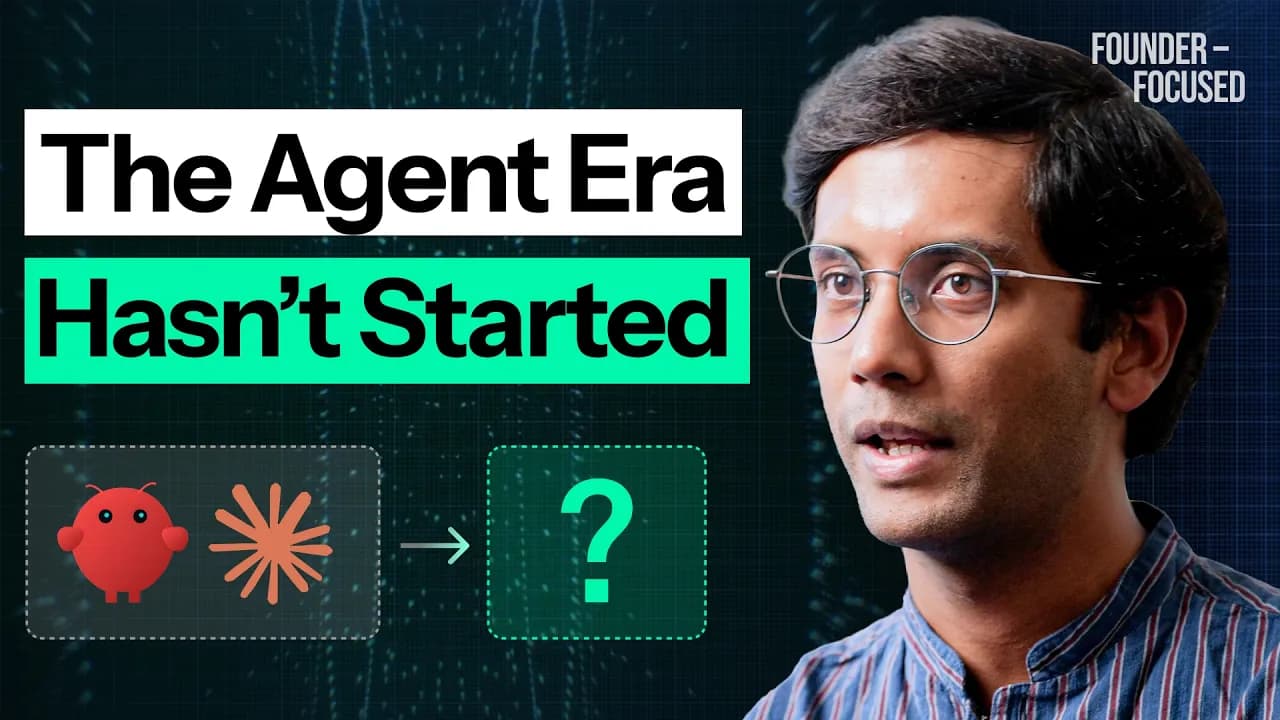
Div Garg is the founder and CEO of AGI Inc. They're building the world's truly personal AI that will be running on your phones and any other devices, including smart glasses and smart watches. They built their own on-device models that can go and take actions on your phone. So, you can control your whole phone and use any app for you. Right now, they're actually number one in the industry on benchmarks like Android world.
Welcome to the first and introductory lecture for CS 25. The founder was at Cornell for undergrad doing a double major in physics and CS. Physics has always been easy for him. He did some international physics Olympiad where he won gold medals in India. Then he joined Stanford for graduate studies. In his first year at Stanford in the graduate program, he noticed that Stanford didn't have an actual course on Transformers. It seemed like everyone in the industry cares about Transformers because that's a big thing. It's kind of weird that Stanford does not even have a course on it.
Along with two other friends, they had the idea to create this course. They wrote a three-page proposal that they want to create this course. It's not normal for Stanford to create courses. They sent it to the Stanford dean, and they were very confident and like this would be amazing. The founder decided this is such a cool concept, he should just reach out to the best person he can invite. At that time, that was Geoffrey Hinton, who was the godfather of AI and has won a Turing Award. He went to his website, and his email is public. He emailed him that he's starting this cool course series at Stanford, the first of its kind, and you want to come and give a talk. Hinton actually replied within 10 minutes, saying he's down.
They got pretty much every famous person in AI to come and give a lecture at some point. Ambi Carbaty, some of the co-founders of Anthropic, some of the research team from OpenAI. They were able to get some of the best of the best people to come to Stanford and talk to students. The founder dropped out of his Stanford PhD and then turned down a million-dollar offer from OpenAI to build AGI. Why was this problem worth putting everything on? This is the most impactful thing they can do for the whole humanity right now.
How you spend your day and how you interact with technology, that's what matters most. One way to describe this is going back to J.A.R.V.I.S. from Iron Man analogy. Imagine you had this personal AI butler that just knows everything about you. And you can ask it to do things for you. The difference between you and a billionaire is that a billionaire has an army of people who can go and do things for him. And that allows that person to be more productive. But now if we can have an army of agents that can basically go and do everything for you, that gap gets removed. So, you can imagine the whole humanity gets equalized on the same basis. And they want to make that happen.
Steve's priority is right. He's very organized on what matters, especially as the company is growing, what are the things they need to do. He's also from Stanford and very good doing some research. Steve is co-founder at AGI.
Why is this technology so hard to build? Initially the focus was more on action. If you ask it to do this, then get the agent to do that. They've done that and now more of the rate limiters are memory and context. And having the understanding of you, even if you give it something that's kind of ambiguous, to still understand and be able to do what you meant, to recognize your underlying intention. And then ultimately to proactively know that you would want that and then to do it for you.
What do you need to get there? There's a relationship between trust and capability. If you trust the AI more, if you trust the tool more, then you'll give it more context. More understanding about you. You'll allow it to have more understanding about you. And if it has that, then it can be more capable and ultimately proactive. It goes into trust.
Ultimately they're working towards running an all-on-device system. And that means that the data never leaves the device. There's no cloud to trust. That's the ultimate goal. Naman is one of the co-founders at AGI Inc. He's leading most of the engineering and research. There's his brother. He's known him since he was born.
For non-technical people, explaining how AGI technology works: Their stack is divided into three places. You have your screen and then you have multiple apps. When a user sends a task, they get a task and they also get a screenshot. Their agent is able to take a look at this screenshot and then understand within the screenshot what action needs to be performed and it does it in a loop. They have an action model that looks at the screen and predicts next action. That action is divided into click, type, scroll and this action gets transferred back to the screen to perform task. And then this keeps running in the loop until they have reached their end state. This is where their harnesses and they have their inferencing engine. Their stack is divided into application layer, the agent harness, and then the inference.
Where is the bottom neck? What is the hardest part? Getting the agent to be fully on device. This part is fully on the cloud side right now. And they are looking into making this running entirely on the device itself. So, all the inference, everything happens in the device itself. And it's challenging because as soon as you decrease the model size, the capability also decreases. And there it's their research challenge where they are looking into how do they ensure that model is still as accurate as running on bigger machines, and also it's fast enough. And this is what truly unlocks privacy and security for the users.
What if OpenAI or Anthropic someday launches their new feature they can control their phone with their voice? What happens to AGI and how's it different from that? A lot of stuff they're doing is actually will be running on the device itself. And it's also very different from their business models Frontier Labs have. A big part of their vision is you're not renting model running on someone else's cloud. So, it's like something that will be running fully on your device. So, you own the model, you own the data. And this is something that Frontier Labs don't want. For example, they can topic is not like ship your model that will run on the device. So, how will they make money in that scenario?
Their team uses WhisperFlow Note Taker when they work across time zones. Right now, two of their designers are making merch between Seoul and San Francisco. Their time barely overlaps, so they get one call and nothing can get lost. That's where Note Taker comes in. Before it starts, Note Taker already knows who's joining from the calendar invite and their own terms from the dictionary. No bot joins on Google Meet or any other platform. When the call starts, it just runs quietly in the background. When the meeting is over, it double checks its own work. The summary's done with real names, not speaker one and two. The next morning in Seoul, a teammate who wasn't on the call asks Claude what was decided and picks it up from there. And the merch made it all the way to the AGI Inc team to San Francisco. WhisperFlow note taker is free to use and you can get 1 month of Whisper Pro with unlimited meetings with the link in the description.
Will covers the scope of growth as well as the wearables and hardware departments. What can they do with AGI? Everyone's seen the traditional demos of ordering Ubers and responding to emails, but there's a lot of other things you can do. They spend a lot of focus on the consumer side as well as the accessibility side. Imagine if the grandmother could just say, Hey, can you help me order DoorDash for some fresh soondubu? Or Hey, I don't know how to use my phone. Can you pull up a FaceTime and call my grandson?
So, then can they order a lunch for them right now? Absolutely. They'll show how it works. Right here you see a bunch of presets from all the different channels, but they'll just do a custom prompt today. So, there's four of them, so do they like a custom Chipotle set? They'll let them pick the ingredients. Hey, they want a Chipotle steak, brown rice, lettuce, corn, guac, salsa, sour cream, and some cheese. And order it on DoorDash. So, it just pulled up the app hands-free. As you can see, it's hitting each individual parcel. Right now, it's clicking the steak. Got the brown rice, black beans. So, it just placed the order. It's about to place order. And then right here it says a prompt, Would you want to place this order for $91? They always have it as a guard rail. Nice. So you guys can see that where this placed. And Task complete. That's dope.
How do you make that demo into a real business? You need to find customers and you want to have people like users who love your product. It's like okay, you can build this new cool technology, but why would someone buy it? Why would someone want to use this? And what value can you create? They've been spending a lot of time understanding the friction pain points people might have in their daily lives. So that time they still had a lot of ideas where they were trying different ideas. One time even they went to the Golden Gate Park and there was this music festival going on. They went in front of the festival. They were giving away Powerade and stuff to kind of get engaged with the potential customer and then see if they get any feedback. And then they had the meeting already set up. So it's not something that they can take a month. So they had to really understand what they can deliver out of the million iteration. Finally that they were able to invent the one that works.
They were a little bit crunching 2 weeks to literally sleeping in the office 3-4 hours to really get things done. Miraculously that they were able to invent the first time ever the Android agent that no one had been ever built. They partner with big companies like Qualcomm and other big companies. So how did they get those companies? It felt very pure in a way. It was tech demos. They'd say, Wow, I've never seen a phone do that before. And that's their phone, that's their chip that's running that. Cool. What more can they do? They saw that there was a need for this by these big companies and no one was filling it and they could. It's like pick your battles. If you can automate spreadsheets, that's a great business. You will do well if you can fully automate everything people do in spreadsheets, but there's 10 other companies going after that. Large proven market. There's this more unusual path where they can build it for edge devices and there were definitely companies that wanted it, especially the ones that make the devices. No one was really going after that. They think they're still the best. Companies they work with still say they're the best in that category.
There's a big difference between building a demo prototype versus a production level technology. Because it's possible the demo only works 10% of the time, it's fine. Because you're testing out what's possible. But then if you're shipping something to a billion plus users at some point, then you just need to robustly test it. So a good analogy is self-driving cars. If you think at Waymo and Tesla, they have they actually started working on self-driving cars more than a decade ago. And it took them 10 years to go from something that was a concept to an actual thing that you can drive on the roads. Because there's so many edge cases in the real world where things can fail, something might go wrong. With the complex ones, it's 20%.
In the kitchen, they were explaining and showing something to founders. That was their baselines of their agent. So basically, they were trying to categorize how they perform across different apps. Some apps, if it was good, some apps, it's not the best because users are very unique. And what is meant by that is some people ask some really interesting things to do with an AI agent. For example, one person asked to file their taxes. So that's what is meant. There's pretty interesting use cases. A single agent can be perfect in a demo. As soon as you take it to the real world as soon as you take agent from a sandbox environment where everything is fully perfect, the real world has there's so much chaos. And for them, that's where the real challenge and real value shows is. Can the agent actually do work really well on production?
If the agent is, let's say, 96% accurate on a single turn, that is fine. But, let's say you're running across 10 or 20 different tasks, those errors actually compound. So, if an agent was 90% accurate, after 20 tasks, it actually decreases around 40% accuracy. And that's what they are trying to solve. And that's what people are coming to them for because they are the only ones who are actually really solving that challenge. With memory, you can design because it would give them more context. So, they are allowed to do a whole redesign of what is being stored. So, maybe create a plan, and if you want to experiment it, and then show them, and be like, These are the improvements. You saw this which is becoming better. They're working on making a plan. They're not editing anything in the board right now. They'll show it in 2-3 hours, and then they can invite them to the board cloud fair and workshop. So, that way they have access to once they make the changes, they can actually see in the environment key test on this code here.
They were asking about the data that is being stored on the database is not seen very quickly at companies to be working on production grade code at the very start at the very first day. When you hire a new employee, how do you decide what are they going to be in charge of? So, it does depend on the role, what's the role and in what capacity are they joining. So, typically what they do is, they actually do trials, and then do a full-time hire. So, in this case, he is on a first-week trial. So, they give him a year's of feature implementation that he want, and here are the outcomes. They are seeing how good is the person in terms of taking this ambiguous request in and actually coming up with a really good suggestion. So, what they try to do is also see how good are they at coming up with product ideas. And they want to do more brainstorming and iteration cycle. So, here's a feature you can think of or just what is seen is really useful for the user and then they want to iterate and keep refining it. They see this as a constant iteration. You just keep refining, optimizing it until it keeps attracting the users and make them actually truly sticky users. And for full-time employees, they actually like them to be independent thinkers. Typically, they want to basically be the person who's validating the ideas correct or just be the final layer of judging.
Did they finish their meeting? Do they usually have meeting at this time? Yes. So, that one started at 10:00 and that's with their remote team in India. So, it's morning for them. But, it's good because they have space. They have space in the evening. No one else will bother them. They can just focus on product. This feature is going to get a lot of what do you call it? That's a good point. They can do it. It's a good time for that. Let's talk. AJ thinks there are many people who are in their world. Where is this night culture club? They sleep pretty late sometimes 2:00 a.m.s or later. They just find it easy to focus at night because you don't have any distractions. No one is pinging you or sending an email. There's no distraction. There's nobody pinging you. It's just you and the things that you're trying to solve. And that's where they see their culture where people like to stay longer because that's where they see they want to keep contributing. They want to get it.
Is that really sustainable working 24/7? If you love what you're doing, it doesn't matter. It's like if you really are looking into building something that you truly see is a really value add, people would want to use it. It's like a meaningful sacrifice that you are going to do. They try to be very autonomous. There's a certain independence on things you're working on as long as you're performing at a certain bar. So, you are in charge of your decisions, so you make them happen. People really like it because they can unleash all their creativity and the talent. And that's very fulfilling. To see that something they've created by yourself is now getting used by millions of people over time. And that's one of the most fulfilling things that you can do in your life.
In person events are expensive. You have to pay for food, stuff, and everything. So, why does AGI keep hosting events? Events are big for them. They're building for on-device, so they need a lot of very smart researchers to join their team, and they just love bringing them together and discuss the topic. Digital becomes discounted a lot. It's like you didn't know if it's someone's agent reaching out to you, and you don't know if the information is accurate. And noticed a lot of times if people are recognizing the AS labs, you just stop reading. So, meeting someone in person is one of the best ways to actually build connection. And sometimes you don't know what's going to happen if you just have one discussion with a person. They can make an intro, they can introduce you to a client, they can refer someone to work for you. So, overall events, they just compound a lot, and they drive a lot of serendipity.
What's the favorite thing in this company? The favorite thing in this company is the trust behind the creative freedom they're given. Early on, you identify what you're good at, and then they just give you the freedom to really build out the project. For example, they'll do a company trip, and they'll go release a hundred mini phones. So, this is an example of a mini phone. A little bit chunky, a little bit like an iPod. The thought process behind this is when you see something like this, it sparks a sense of curiosity, and you ask a question like, Huh, are you texting on it? And how are you interfacing with this? It's like a modern-day pager. You speak into it, and it makes all the actions for you. So, this is just one of the many different interesting experiments they're cooking in the company.
They love AGI. This is the actual first contribution to the company. Ever since this project they've been part of the family. The biggest part. Look at this man right here. CK? This is the big brother of the company. Without CK, they really wouldn't be anywhere. CK is a big part of the team culture. Team culture? Culture is also very dynamic. A culture cannot be enforced. A culture is formed by every single person that joins the team. Most companies have this tendency of hiring fast and firing fast. They take a different route. They hire really slow, but they fire very fast because it's difficult to find culture fit in a person. Someone can be a great former. They can be the most skilled person in the industry of their job, but you don't really know the culture fit until they actually come and work with you. And so, they're very cautious about the people that they bring into this environment because every last person that joins this company adds on to the culture.
In the future, they believe there could be billions of personalized models. And every person gets their own model. That model can be just like self-learning. It's learning things about you, your preferences. It's getting better and better. And you can fully trust it because you actually have the model like it's yours. It's like how you have a car and you can modify your car and put things in and whatever. It's not like you have one generic car that serves every single person on Earth. And that's what's happening with models right now. So, they want to have this way where you can buy the model.
The vision includes the ability to purchase the model directly, customize it according to individual needs, and have it learn personal details over time. This approach leads to each person having their own highly personalized model. The choice of which AI performs this role becomes critical, as it represents a relationship potentially more influential than any human connection or at least equally influential. This relationship will continue evolving as the technology advances.
The goal centers on contributing to making the world better and seeing how far this technology can be taken. The aim is to genuinely contribute to improving everyone's lives. The approach avoids presenting AI as something given to everyday people, instead focusing on practical benefits.
One significant benefit involves looking at screens less and spending more time engaged in real life. Users can communicate with their AI through phones, watches, or other devices, allowing the AI to handle tasks in the background while the device remains in a pocket or at home.
The development extends beyond creating an agent to control apps. It encompasses an entire system designed as a new operating system for devices. This system helps users look at screens less while being more present in real life.
Small gifts were presented to the guests as tokens of appreciation, including cheese as one of the items shared during the session closing.
Keep EO in your library
Save the videos and channels worth coming back to, and find them again in one place.