5 Money Rules Nobody Taught You in School | Money & Business Expert Codie Sanchez
In a Nutshell
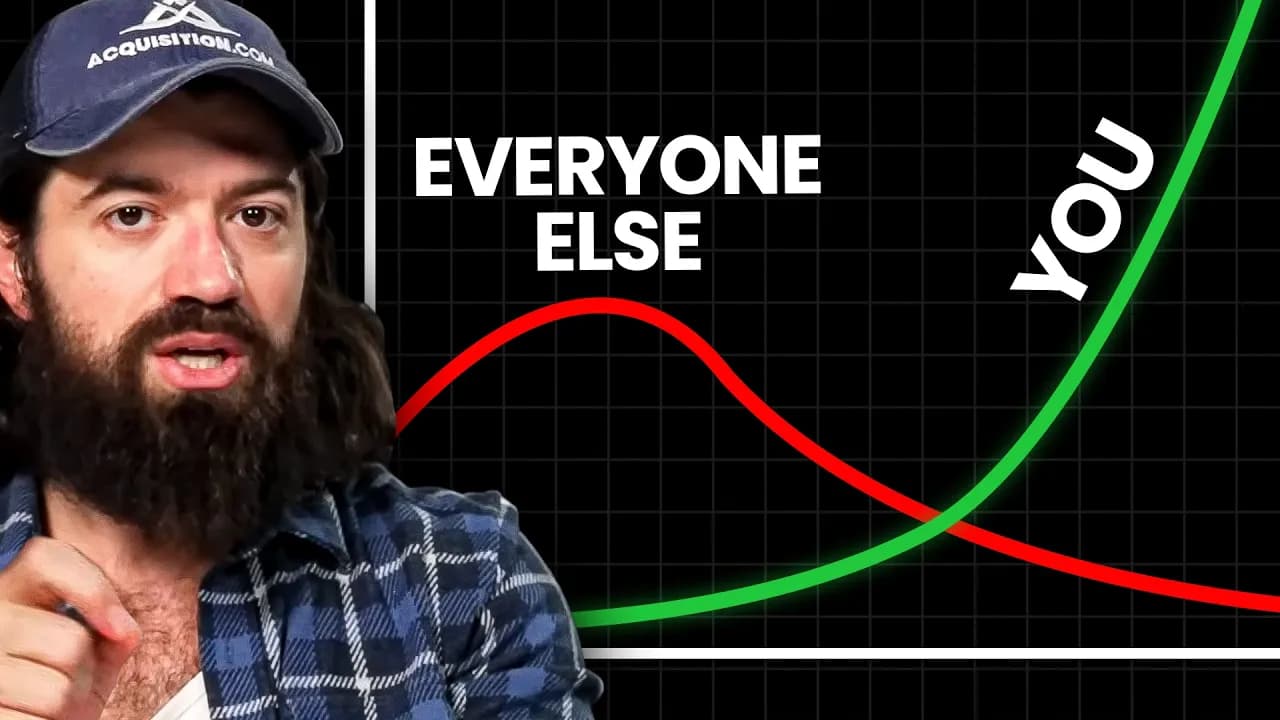
The core message is that building wealth requires rejecting conventional advice (like homeownership) and instead focusing on developing specialized knowledge, becoming a "fixer" who solves problems, and strategically using debt and networks. The most important takeaways are: invest first in yourself through learning, then in low-cost index funds (10% minimum), prioritize marriage for its 3x net worth advantage, and obsess over the "game" of business rather than following passion or trying to look rich.
These notes were generated by AI and may contain inaccuracies.
Current economic conditions make it genuinely difficult for people to build wealth. Wages have remained stagnant since the current generation was born, while housing prices have increased 9x during the same period that wages only increased 2x. The traditional advice from previous generations, such as Dave Ramsey's recommendation to buy a house as the number one financial priority, no longer works under current market conditions.
Warren Buffett's principle of being fearful when others are greedy and greedy when others are fearful applies directly to current market conditions. Housing prices in Austin are down 30% since the speaker purchased a home a year ago. Baron Rothschild's advice to buy when there's blood in the streets, even and especially when the blood is your own, reflects how real money is made when markets feel tough.
Current market conditions present opportunities because assets are underpriced compared to the height of previous market cycles. An NFT example demonstrates this shift, having sold for $60 million at peak value but now worth only $19,000.
Owning a home as an investment is mathematically not a smart decision under current conditions. With interest rates between 5-8%, a 3 million home shortage in the US, flat wages, and increased home prices, the numbers do not work. Renting and negotiating rent prices may be a more financially intelligent choice given current market excess.
The average American reads at a sixth-grade level and understands finances at approximately a high school level. Financial literacy is essential because understanding money functions like speaking a language - without it, making more money becomes impossible.
Credit cards are not inherently bad when used responsibly. They allow credit building, provide points and perks, and offer fraud protection. Debit cards do not build credit, provide no rewards, and offer less protection against fraud since the bank treats stolen debit card transactions as the account holder's money.
Credit represents the first pillar of wealth because it provides access to resources. The richest people use debt strategically on assets rather than personal guarantees. Charlie Munger's observation that men go broke through whiskey, women, and leverage, with Warren Buffett noting that leverage represents the primary risk factor.
Warren Buffett himself uses significant debt but structures it on companies and assets rather than personal guarantees like mortgaging his house. This distinction between good debt and bad debt is crucial for wealth building.
Lack of money represents a knowledge problem rather than an actual capital shortage. The richest people never use entirely their own money to buy things. Access to capital exists for those who work hard and have good ideas for deployment.
90% of startups fail over any five-year period. The recommended approach involves keeping a primary job while building a side venture, using salary to fund the business until it generates enough cash flow to match living expenses. A study of hundreds of individuals showed 33% higher likelihood of startup success when maintaining an income source during the venture phase.
Great CEOs demonstrate three core abilities: selling a compelling vision that attracts talent, making accurate diagnoses of market conditions, and executing strong decision-making based on those diagnoses. Better decisions occur when not operating in fight-or-flight mode.
Employees should understand their specific dollar value contribution to the company by asking their boss to quantify how they generate revenue. Once this value is established, employees can identify opportunities to increase company profits and negotiate for a portion of those additional earnings.
Staying at a current job often yields 25-50% salary increases compared to the historical 20-25% gains from job hopping. This approach also preserves opportunities to develop negotiation skills, up-management abilities, and new competencies.
Hard work alone does not equal wealth, as demonstrated by comparing laundromat owners to Jeff Bezos. In the age of AI, mass production capabilities mean that basic execution becomes commoditized. Success requires developing unique knowledge stacks and creative approaches in an environment of abundant content creation.
Naval Ravikant's framework of working like a lion rather than a cow emphasizes periods of sprint and rest rather than continuous grazing. With 47% increase in online creators this year, differentiation through knowledge and creativity becomes essential.
Passive income exists as a tax category distinction but does not represent truly hands-off income generation. Vending machine ownership illustrates this point - machines require ongoing maintenance, suffer from break-ins, and generate limited individual revenue despite aggregate profitability at scale.
Following passion as a path to wealth represents advice typically given by already wealthy individuals. Airbnb founders were not initially passionate about mattress-on-floor home design but learned to love the business game itself. The boring-sexy matrix demonstrates that more boring industries often generate higher income.
SAG-AFTRA union data shows 187,000 members with over 80% not qualifying for health insurance, indicating average actor income around $23,000 in Los Angeles.
When pursuing acting careers, most people make no money from it. 99% of people earn 100% of their income from their job in finance, compared to less than 20% of actors making their full income from acting. Rather than dissuading people from pursuing things they love, a more creative approach involves finding where money exists around activities you enjoy and integrating the two. This approach led to the birth of podcasts, where people who wanted to have talk shows and interview people found they could do it outside traditional studios.
There's a difference between a hobby and a skill. Soccer is a hobby - something loved for playing, talking about, and playing FIFA on PlayStation or Xbox - but not something monetized or built into an offering to the world. Passion gets confused with hobbies, leading people to try to monetize activities like painting even when they're not skilled at it.
Michael Dell stated he would care about his company after he was dead, demonstrating an obsession with the game of entrepreneurship that couldn't be pried from his cold, dead hands. Top performers are people obsessed with the game - it's not about crazy IQ or skill set, but the compounding effect of obsession. This means anyone could win against more established players if they are more obsessed with something.
To love the game, you must respect the rules. Using Monopoly as an example, you need three sets to build homes, and four homes on one street to upgrade to a hotel. People often try to change these rules, similar to how people complain about social media algorithms being unfair. The algorithm isn't fair, but it is the rule. Once you know the rules, you can play the game.
The number one rule for success today involves two types of people: fixers versus freeloaders. A fixer sees a leaky boat with holes and immediately starts fixing problems, even if they didn't create them and even if they're someone else's fault. A freeloader stands in the boat saying they don't mind the holes, it's somebody else's issue, they don't have time, or they don't know what to do. Every time a problem is found in business or life, that's where the profit and money is.
When growing a business fast, issues arise with people and operations. Taking responsibility by saying "it's my fault" is liberating because it means you can also fix it. If it's someone else's fault, there's nothing to be done about it. Being a fixer rather than a freeloader is where the money is, whether you're a team player, employee, owner, or evaluating new opportunities.
Humans are contagious - there's a correlation between having more friends who make over $100,000 and a 10% increased likelihood of making more money, plus a 2.9-5% higher likelihood of investing more. If you want to lose weight, hanging out with people who party and eat late-night food versus CrossFitters who work out daily produces different results. People who are passionate, obsessed, and moving forward make it easier for you to do the same.
When trying to save more money, entertainment spending with friends becomes an issue. Having conversations about limiting spending feels uncomfortable because people might think you're cheap or judge you. Setting expectations by saying "I'm really trying to save up to invest" and asking to pay for your portion unlocks the same permission for others who feel the same way but are afraid to say it.
The lipstick theory shows how to predict recessions through women's beauty product purchases. After the World Trade Centers came down, Estee Lauder noticed lipstick sales were up 11% and non-necessary cosmetics increased significantly. When markets crash, people pull back on big luxuries but spend more on tiny ones - choosing to look prettier rather than going on vacation. A spike in beauty products and people launching them can indicate economic conditions.
Married couples make on average more than 30% more than non-married couples, with net worth almost three times higher than singles over their entire career. This isn't to shame those who haven't found partners, but to prioritize finding one for both financial and love reasons. Marriage has gotten a bad rap, but it provides a real boon to financial health.
Successful men mentored others about how committing to one woman changed their career trajectory by freeing up time previously spent chasing, pursuing, and wooing women. Men who are married have more energy, focus, drive, and power to direct toward making money and building businesses.
64% of women will not date a man if he doesn't have the same or higher income level, though studies show this doesn't seem to be the case for men. More women are increasing their incomes and education levels than men. Couples are no happier if they have the same income level, and prioritizing income doesn't lead to increased wealth or happiness.
A personal example involves marrying a Navy SEAL where the government doesn't pay much, but he cared about service and respect rather than money. Finding somebody who plays a different game can be powerful when income levels differ.
If you want to help people full-time, you need to be able to pay yourself and pay people to help. The belief that doing good in the world requires being poor had to be rewired. Money gives access to bigger teams, opportunities, and relationships. Money is an accelerator to whatever is inside of you - bad in the hands of bad people wanting to do bad things, good in the hands of good people wanting to do good things.
The person who asks for the date should pay. Men asking women on dates should pay, while women asking men should at least offer. A high-value man wants to support and protect his woman, and a high-value woman wants to do the same for her man. When asked on a date where the other person didn't pay, it was an immediate turn-off.
Men today often feel they should only pay once there's commitment and exclusivity, preferring to split until both parties decide it's going somewhere. However, the question becomes whether you want to be right or win - being right about splitting the bill might mean talking someone back into a second date, while winning might mean picking up the bill to pursue someone you really like.
Money creates power dynamics in couples and families. Many friends have found it uncomfortable to ask their partner to sign a pre-nup before marriage, hoping that love would eliminate the need for such agreements.
Prenuptial Agreements
Codie Sanchez believes you should always sign a pre-nup before getting married. She advocates having every hard conversation upfront, including this one.
Visionary vs. Executor Partnership
Successful partnerships require both a visionary (the person with ideas and crazy ambitions) and an executor (the implementer). Having only vision without execution leads to failure and no money. Having only execution without vision means playing small games for life.
Brad Jacobs' book "How to Make a Few Billion Dollars" outlines four types of deals:
- Low-risk, low-reward: Most common deals like staying in the same job without taking risks. The problem is you won't make much money.
- High-risk, high-reward: Like investing in an El Salvadoran power plant. So likely to fail that even with super high profit, these should be avoided.
- High-reward, low-risk: The golden child or unicorn. Not many of these exist.
- The sweet spot: Big hairy problems with manageable risk that generate profit.
"Hair on a deal" refers to the level of risk that is manageable. Sanchez notes that culture has become "risk off" - people don't want the risk of asking questions or starting businesses.
SBA Data on Business Closures
The SBA has data showing more small businesses close each year than open in the US. This indicates people are taking less risk than commonly assumed, which limits wealth creation.
Stage One: Invest in Yourself
If you have only a little bit of cash, the best returning asset class is you. Put money into learning first before investing elsewhere. The highest performing asset class is yourself because you have unlimited upside that compounds over time. Bet on yourself before betting on the S&P.
Stage Two: S&P 500 Index Funds
After investing in yourself, go for low-cost, low-movement index funds. Don't try to beat the best stock pickers who obsess over this daily. Vanguard has the best cost structure. Go to vanguard.com to select a diversified portfolio based on your age and risk tolerance.
- 60/40 portfolio: 60% stocks and 40% bonds for those around middle age
- 80/20 portfolio: For younger people who should take more risk with stocks
Avoid Robinhood and individual stock picking unless doing it purely for learning and okay with losing everything.
Understanding Diversification
A diversified portfolio means never having all eggs in one basket. It includes:
- Stocks and bonds
- Emerging markets versus US markets (India, China, Russia, Brazil, US)
- The goal is averaging around 10% over time
The Impact of Inflation
Since the beginning of the Federal Reserve, a $100 bill from the 1970s is now worth about $25 due to inflation. Money under a mattress loses value every year. Stock market investing over time is what most people do to combat this.
Stocks represent the ability to have future upside of a company. You're betting the price will go up (upside return).
Bonds provide income. When you give money, you receive a promise of return over time with coupons. You don't make more if the bond price goes up or down - you just clip coupons.
The reason for both: when stock market crashes, bonds still provide income. When stock market rages, you capture upside.
For real pros wanting stage three of investing, this includes:
- Private equity: Investing in companies held by private investors that never trade on stock exchanges
- Alternative investments: Direct real estate, commodities like timber
- Equity and options: Not for beginners
Sanchez warns against day trading and options strategies promoted to average investors, comparing it to teaching brain surgery in a couple hours.
Stage four is becoming the company that others invest in. This means buying businesses outright or raising money for your own business.
Pay yourself first by treating investments like a need, not a want. Set up automatic investing so a little bit goes every time. At least 10% of income should go into investing to beat inflation. This puts you ahead of about 90% of people.
People waste money on looking rich instead of being rich. Coachella exemplifies this - 64% of average main ticket holders couldn't afford their ticket and had to use buy now, pay later options. Influencers often get paid to attend, receive free tickets, flights, and clothes, while average attendees go into credit card debt for Instagram posts.
The solution is not buying into what you see online. Sanchez respects not flashing watches, cars, or private planes because those aren't what success is - they're just accoutrements that could be fun once you're rich.
Millionaires largely don't care about money. They care about winning and learning. Real players find money uninteresting at some point. The goal should be loving the game and respecting the rules, with material things as byproducts rather than destinations.
Keep Jay Shetty Podcast in your library
Save the videos and channels worth coming back to, and find them again in one place.