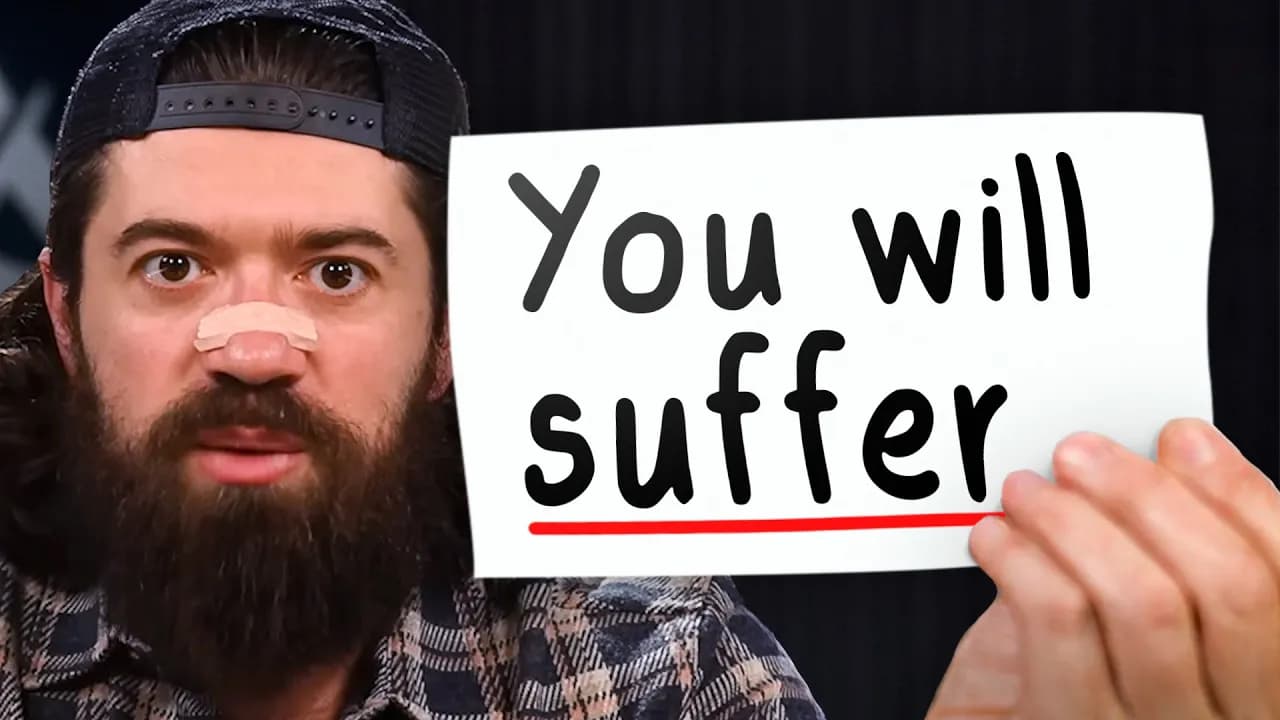
Alex Hormozi: If I Started Today, This Is What I Would Do
In a Nutshell
Start by selling a service you can deliver today—use testimonials, not money, to land your first ten customers, then raise price 20 % every five clients until the market tells you to stop. Focus all energy on the single offer, ignore “follow your passion,” and treat fear as a concrete list of worst-case outcomes you can survive. Only once active income reliably exceeds lifestyle costs should you invest; investing is the last step, not the first.
These notes were generated by AI and may contain inaccuracies.
The goal is to provide clarity on the specific actions required to build a business and generate income. An objectivist approach focuses on observable elements rather than manifestation or energy concepts. The fundamental requirements are: letting people know about what is being offered, having something to sell, and ensuring the price charged exceeds the cost to deliver. These three elements form the basis for creating sustainable income.
The primary misconception is conflating sequence—believing that making money comes from investing when investing should actually be the last step, not the first. People observe wealthy individuals making investment bets and assume they can replicate success by taking similar risks without first building active income. The reality is that high-net-worth individuals typically have high active incomes that generate excess cash flow, which then allows them to make larger, riskier investment swings. Active income is scalable, contrary to the belief that working for income is not.
The "get rich quick" mentality leads people to view speculative investments as the path to wealth. When someone does not understand the variables affecting an outcome, they are essentially gambling. Speculative investments often follow the greater fool theory—selling to increasingly uninformed buyers until the market collapses. The recommended reframing is to think in terms of money per unit of time rather than active versus passive income. This creates an actionable decision framework: if someone offered a billion dollars for one hour of work, that would be worth selling time.
Most entrepreneurs progress through five stages:
- Uninformed optimism: Hearing about someone else's success and becoming excited without understanding the process
- Informed pessimism: Experiencing initial setbacks and realizing the reality is harder than expected
- Valley of despair: Losing significant resources and feeling completely lost
- Informed optimism: Understanding the rules, variables, and realistic expectations
- Achievement: Reaching competence and success
The critical mistake is jumping back to uninformed optimism when hitting the valley of despair, rather than pushing through the painful learning phase. Staying in the pain creates the catalyst to develop necessary skills.
Rather than putting money into speculative investments, focus on developing skills that generate income. The three basic elements of any business are:
- Promotion: Letting people know about offerings
- Conversion: Creating exchange mechanisms to sell
- Delivery: Fulfilling the promised value
Business ideas emerge from three sources:
- Passion: Topics of inherent interest
- Profession: Current job skills and experience
- Pain: Problems personally solved, often deep personal challenges
Service-based businesses represent 78% of all businesses in the United States because they are the easiest to start—trading time for money directly.
This advice is problematic for three reasons. First, passions change over time—what interested someone ten years ago likely differs from current interests. Second, some passions have no market value, making income generation difficult. Third, it creates emotional decision-making where people quit when business becomes difficult, believing they should only pursue what feels good. The reality is that business involves both liked and disliked elements, and the disliked elements are the price required to become the desired person.
Entrepreneurship serves as a path for personal development because the market provides brutally honest feedback. The goal should be becoming useful to others, which requires developing skills to serve someone else. Traits like patience, endurance, and wisdom require specific experiences—patience requires not getting things quickly, endurance requires tolerating suffering, and wisdom requires learning from mistakes and potential betrayals.
The misconception that successful businesses require revolutionary ideas prevents action. Most successful entrepreneurs have multiple failed businesses before achieving success. The four concrete steps to start a business are:
- Form an LLC
- Open a bank account with the LLC
- Connect the bank account to a payment processor
- Ask a stranger to exchange money for services
These steps can be completed in one day. The barrier to starting is lower than ever due to internet connectivity, while the barrier to distraction is simultaneously lower.
The approach involves doing work in exchange for testimonials and feedback rather than payment. Business owners are willing to pay for testimonials, making this arrangement valuable. Terms can include requirements for feedback throughout the process and reviews in multiple formats. The first 5-10 reviews generate more long-term value than initial payment would provide. After building confidence through free work, prices can be increased by 20% every five customers until the market indicates the maximum viable price.
If someone has had their same day over and over again, then they're not learning. If your day looks the same every single day, you have learned nothing. If you listen to this podcast and then nothing changes about your behavior as a result, this was just entertainment, not education.
Fear is the number one emotion that people don't know how to control that leads to failure. A powerful question to ask is: "What would you do if you weren't afraid?" Fear is the thing that gives you the hundred reasons not to act.
Brains are exceptionally good at finding problems, which is why inverted thinking is valuable. The approach is to think about all the ways to kill your business and then do the opposite. The brain is much better at spotting problems than spotting opportunities, so use the problem-finding tendency and then flip it. This approach comes from Charlie Munger.
Fear typically only lives in the vague, not in the specific. People tend to catastrophize, where making one post leads to imagining being shunned and dying alone. Playing it out into the specific means recognizing that some people will like a post, some won't, negative comments might increase reach, and life continues normally afterward with dinner and sleep.
A significant downside from an opportunity and moneymaking perspective is that humans underestimate the upside and overestimate the downside. This tendency has been valuable for staying alive but not valuable for making money. In the developed world, the absolute worst case scenario is that you still have shelter, food, air, and water because these things are available to anyone.
The worst case scenario is living completely free with no one bothering you. Playing fear all the way out makes it concrete - for example, asking a friend named Sarah how long she would let you sleep on her couch if you failed, and getting a specific answer like six months. This concreteness evaporates fear rather than the vague feeling that you will die.
The best advice ever heard or received: "Do so much work it would be unreasonable for you not to be successful."
The worst advice ever heard or received: "Follow your passion."
A piece of advice wished received sooner: "Find people better than you and do whatever you can to get them to help you, including helping them first without expectation."
A lesson that took far too many times to learn: "Focus. One thing all in."
If creating one law that everyone had to follow, it would be that everyone has to give all their wealth away at the end of their life, not to their kids. The reasoning is that if you have a good son, there's no need to accumulate wealth, and if you have a bad son, there's no point to accumulate wealth. This creates a Sanskrit principle that forces the best allocators of capital to also become the best at allocating it.
If everyone has to give wealth away, then near the later part of life, people would stop trying to amass and start focusing on giving. Most people who give get addicted to giving because it fills a hole that wealth never did. From a societal perspective, if the best allocators of capital tried to solve all the world's problems, many fewer problems would exist. This would also eliminate cronyism and nepotism from multi-generational wealth trusts.
The philosophy supports equal opportunity, not equal outcomes. If everyone's slate was clean each day because no one received inheritance, everyone would start at zero. Genetics can still play a factor, but this represents the most equal start possible. The ones who super win would then turn into supergivers.
Keep Jay Shetty Podcast in your library
Save the videos and channels worth coming back to, and find them again in one place.