9 Reasons Your PSA Is High (Only 1 Is Actually Cancer)
In a Nutshell
Prostate cancer is rarely fatal—most men have it by age 80 but die of other causes—yet PSA screening leads to massive overdiagnosis and unnecessary procedures. PSA rises for nine non-cancer reasons, including enlarged prostate, inflammation, recent ejaculation, exercise, digital exams, biopsies, infections, and medications. The real risks come from insulin, low vitamin D, zinc deficiency, and environmental estrogens; addressing those through fasting, vitamin D optimization (50-70 ng/mL), and avoiding plastics is far more important than the PSA number itself.
These notes were generated by AI and may contain inaccuracies.
Prostate cancer is the number one new cancer diagnosis in America right now. Over 300,000 new cases in this year alone. By age 80, up to 60% of men have prostate cancer and never know it. Men in their 40s, up to 35% of them have cancer. When they hit 50, up to 40% of them have cancer. 60s, it's over 55% of them have cancer. In their 70s, it drops down to 50, but in their 80s, it goes up to 60%. It sounds like a crisis or even an epidemic, but here's what you need to know. Almost none of the men that were diagnosed or have cancer will die because of it. Other things will kill them, but not the prostate cancer. They might die with prostate cancer, but not because of it. If prostate cancer was as dangerous as the diagnosis rate suggests, most men over 60 would already have been dead by now, but they're not.
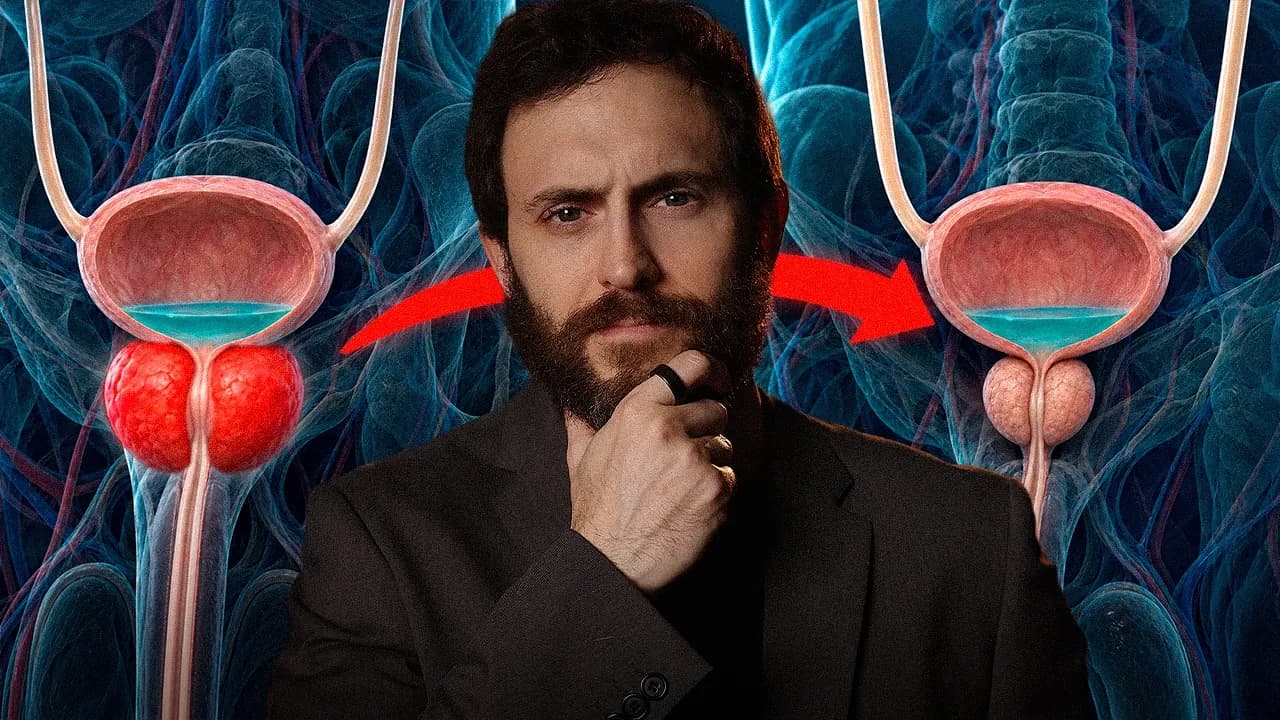
The prostate actually wraps around this little tube that's connected to your bladder called the urethra. So, it's right below the bladder, and normally it should be the size of a walnut, but it can get bigger. There's a condition that's very common that's called benign prostatic hyperplasia, okay? Where basically it's benign, it's not going to be a problem, it just gets bigger over time. So, it can get the size of a ping pong ball, and it can even get bigger. I mean, it can become the size of a lemon. And sometimes it affects the urination, sometimes it doesn't, even if it's enlarged, okay? But that's where it is, and the question is what does it actually do? It produces part of your semen. This is a fluid that helps transport sperm into the female's body. Now, the problem is the sperm that is supposed to fertilize the egg that is in this gel. So, there has to be some way of liquefying the gel because these sperm have little tails and these sperm are super fast. They can literally travel, if we compare it to a human, 213 miles an hour. But, to do that, that gel needs to turn into a liquid. So, the enzyme responsible for changing into a liquid is called prostate-specific antigen. Wait a second. It's a blood test, so how are they going to find that? For various reasons, a certain percentage of it gets transported in the blood and we've kind of created different values. Typically, it should be under four, but there's some debate on if that's really the number or it should be a little bit higher.
PSA is not a cancer marker. Now, it can be associated with cancer, but there's many other reasons why the PSA is high. But, I also need to mention this powerful form of testosterone called DHT. Because if there's too much DHT, it can actually cause growth of the prostate. In fact, testosterone turns into DHT with a certain enzyme and there's certain medications and also natural things to inhibit that enzyme, so a person would not get as much DHT and that's supposed to actually help reduce the prostate size. But, one thing you need to know is there's some interesting data about vitamin D. There are vitamin D receptors in the prostate. But, what's unique about the prostate and vitamin D is that the prostate, it doesn't have to go through all these different organs like the liver and the kidney to activate vitamin D. It can do all of those steps within the prostate cells, so it's not dependent on these other organs because vitamin D is intimately involved in helping regulate the size of the prostate, believe it or not. In one study, they showed sufficient vitamin D was able to slow the growth of the prostate by 40% despite what's going on with DHT. And then, of course, we have the insulin factor, right? Insulin is a growth hormone. It will definitely make the prostate be enlarged. If you just take a look at women with polyendocrine metabolic ovarian syndrome, they have a lot of androgens or male hormones. Where is it coming from? Insulin. So, insulin makes the androgen receptors more sensitive. And also, insulin increases something else that will make things grow called insulin-like growth factor. Estrogen mimickers in the environment, they're called xenoestrogens. There's so many chemicals in the environment, and apparently the industrial chemicals that are made on a wide-scale basis are very similar to estrogen. So, when we're exposed to these chemicals or plastics or whatever, it can actually act like estrogen, and that can make the prostate grow.
The prostate really needs enough zinc to make sure this conversion from testosterone and DHT is smooth and optimized. And here's a typical scenario, right? You get to a certain age, they do a blood test, do a screening. The doctor says, "Oh, your PSA is too high." Okay? And then you're thinking, "Oh my gosh, do I have cancer?" Well, I'm going to go through the nine reasons why that could be high, but one of the problems with this PSA test is the person who even discovered it wrote a book about it. This scientist said PSA was never a cancer marker at all. And he was very much opposed to these screenings because it turned into a business, and a lot of men are being over-diagnosed, and there's been a lot of complications with biopsy and removal of the prostate. It's just been a nightmare for men, all revolving around this darn PSA test.
Number 1: Enlarged Prostate
It's almost normal for a man when they get older to have an enlarged prostate. It doesn't do anything, it just gets bigger. It does create some problems, but it's benign most of the time.
Number 2: Inflammation
Inflammation in the prostate can elevate PSA.
Number 3: Recent Ejaculation
Ejaculation within 24 hours and then you get the test, that could show a high PSA.
Number 4: Vigorous Exercise
Vigorous exercise, let's say you're doing your bike really hardcore or you're doing deadlifts or really intense exercise and then within the next day or the next couple days you will get the test. Because think about what's happening, you're creating a lot of pressure down into the pelvic cavity and that can easily press certain fluids out into the bloodstream.
Number 5: Digital Rectal Exam
A digital rectal exam can elevate PSA.
Number 6: Biopsy
A biopsy even like days or even a week before because they're creating injury to the prostate.
Number 7: Urinary Tract Infection
Urinary tract infection can be a cause.
Number 8: Certain Medications
Certain medications can cause high PSA.
Number 9: Cancer
Cancer could potentially be associated with higher PSA, but you should also know that you could also have cancer with normal PSAs.
Even the diagnosis of cancer can increase the rate of getting a heart attack and that's relevant because when someone is diagnosed with prostate cancer, there are three completely different things we call prostate cancer and they don't actually have a lot in common, okay? Number one is called the turtle. It's a cancer that will never turn into a malignancy, it will never be a problem. Now, of course, I shouldn't say never, but the great majority of the time it doesn't do anything. 40 to 50% of prostate cancers are turtles. You don't have to sweat, you don't have to worry about these guys because they're not going to do anything. And then we get the slow bird, which that's 30 to 40% of the time and those are slow and they're not as dangerous and they can be treated effectively without a lot of complications. And then number three, we get the rabbit, which is like 10 to 20%. This is the one that's probably already spreading. It's aggressive and it needs to be treated. But the point is you can't differentiate these three by PSA.
The question is what should a confident doctor that knows about the prostate really do to determine which of these three. Number one, they would want to monitor the velocity or the change of what happens to the PSA number, okay? So over a course of a year, if it goes from two to seven, that's a little bit of a red flag. The velocity of greater than 0.75 ng/mL per year would be kind of a red flag. There's another thing called a PHI, prostate health index test. So these three can be done before a biopsy. Because if you have a turtle, why would you want to do a biopsy or remove the prostate? I mean, here's another way to look at PSA. The estimated life gained from doing a PSA screening is only 37 days, a little over a month with all the other fears and complications and procedures that end up occurring because of that. Now again, I'm not telling you not to do it. I'm just giving you the data so you can do your own research.
Number one, get your vitamin D tested to make sure it's at least maybe even between 50 and 70. There is some data that shows that if someone does have prostate cancer to bring it up to 90 or maybe a little bit higher, but you'd have to check with your doctor with that. Insulin is another big factor. I highly recommend you go get a blood test, fasting insulin test. You want that under five. Not just to help keep your prostate in check, but just to keep your whole body healthy. Also, you want to actively and aggressively avoid estrogen chemicals in the environment, plastics, pesticides, insecticides, herbicides, chemicals. Make sure you have sufficient zinc. The prostate needs zinc. And one of the best ways to lower insulin is to do intermittent fasting and prolonged fasting because prolonged fasting can really decrease the inflammation in the body. And also, if someone does have cancer, even the rabbit, there's a gentleman that I interviewed that had prostate cancer that metastasized. He had the rabbit. It spread through his whole body. I interviewed him, and he should have been dead 7 years ago. What he did, aggressive fasting.
Keep Dr. Eric Berg DC in your library
Save the videos and channels worth coming back to, and find them again in one place.