Amtrak in 1973 and other stories about trains | 60 Minutes Full Episodes
In a Nutshell
Amtrak's 1973 struggles—chronic delays, poor tracks, financial losses, and railroad resistance—highlighted failing U.S. passenger rail, echoed in modern woes like California's ballooning $126B high-speed rail project's delays and funding shortfalls, Brightline's private Vegas-LA push, and NYC subway's $40B overhaul needs. Broader infrastructure decay includes 70,000 deficient bridges, crumbling roads, congested air/sea/rail hubs like the 104-year-old Portal Bridge, and political gridlock stalling fixes despite bipartisan calls for gas tax hikes and spending. Without national will, U.S. lags global leaders in high-speed rail and maintenance, risking economic and safety crises.
These notes were generated by AI and may contain inaccuracies.
Amtrak is a semi-public corporation set up by Congress a couple of years ago to save long-distance passenger trains from death. Railroads still operate the trains despite wanting out of passenger business. Amtrak funnels money to 13 railroads in its system. Congress gave Amtrak over $200 million since operation; Amtrak lost it all.
Conservationists argue trains pollute less than automobiles. Energy experts say trains carry most people for least fuel. Nostalgia buffs see trains as symbol of America's glory days. In 1930s, train travel was elegant adventure, most comfortable for long distances.
Passenger trains declined in 40 years: 20,000 trains a day to less than 250. By end of 1970s, intercity passenger trains may disappear except perhaps Metroliner New York to Washington, like steamboat and stagecoach.
Crew boarded James Whitcomb Riley train in Indianapolis for Chicago. Union Station Indianapolis once finest in nation, 200 trains a day, vital link east-west, called Railroad City. Now 6 passenger trains a day at Romanesque revival station, bleak with Amtrak banner.
Train 20 minutes late, often over hour late. James Whitcomb Riley, named after Hoosier poet, running 30 years. Trip once 3 hours 50 minutes; now 5 hours 30 minutes, 4 cars, miserable roadbed, already 35 minutes late.
Amtrak passenger traffic up 10% last year, but Riley sparse: capacity 130, only 35 from Indianapolis. Why take 5.5 hours vs. half time by car or 1 hour plane?
We're an old railroad family and we want the children to have contact with the railroad, which we're afraid in the near future they won't have.
This is the most convenient and cheapest method of transportation for the children and I when going to see my parents.
Our children didn't want us to drive. We're getting older and they worry about us and wanted us to fly or train. He doesn't like to fly, but I do. So we go by train.
Riley costs $5 per mile to Chicago (200 miles). Bus costs less than $1 per mile. Staff: conductor, trainman, baggage handler, Pullman porter, dining car chef, assistant chef, two waiters, engineer, fireman (relieved 60 miles outside Chicago). Coach fare $8.25. Full capacity profit ~$100; 35 passengers this day.
Amtrak bought 1,300 old cars from railroads, newest 20 years old, legacy of neglect. Overhauling fleet: $31,000 per car, slow; by end 1972, only 600 cars cosmetically upgraded. Still broken equipment in service, but cars cleaner, comfortable, white tablecloth dining back.
Riley moving snail's pace due to track conditions: engineering said not safe over 10 mph.
Sometimes they get pretty discouraged. Looks that way somebody's trying to discourage passengers.
Penn Central runs train; Amtrak pays bills. Railroads bill Amtrak costs plus 5% extra; no contract muscle for efficient service. Riley arrived Chicago Union Station 1.5 hours late, 5.5 hours for <200 miles.
Senator Vance Hartke heads subcommittee overseeing Amtrak. Riley 1.5 hours late. Tracks: pull spikes out of ties, rails jump.
That's certainly no way to run a railroad. I am absolutely disgusted. Indianapolis to Chicago ought to be 1.5 hours easy, but can't on 10 mph track.
Amtrak is a sincere effort to preserve railroad passenger service. Railroad management wants rid of it; more profit from freight.
Louis Menk, Burlington Northern chairman (profits from freight), on Amtrak board by buying stock as business expense loss. Paid $33 million, now books at $1, thinks worthless now and future.
Passenger trains except highly populated corridors should die honorable death.
Mr. Quinn (Milwaukee Road), Mr. Moore (Penn Central) agree. All on Amtrak board committed to speedy efficient service; no conflict of interest.
Roger Lewis, former aerospace executive, Amtrak head since April 1971.
Railroad men on board speaking as citizens or presidents of their railroads, not board members.
Consumer/passenger rep slot vacant.
Leadership in Amtrak not good. Roger Lewis not capable. Lacks imagination, dedication to continue operation. Not sure he wants continuity of passenger service. Maybe in liquidation business.
Amtrak told Penn Central to speed Riley 1-1.5 years; still 10 mph spots, powerless despite paying bills. No enforcing provision or penalties; service as good as when Amtrak took over. On-time: some trains <50%, Metroliner late 25%. Very dissatisfied.
Tracks belong to bankrupt Penn Central trustees, no money to fix. Taxpayers must renovate to compete with air/auto. Airlines: runways, towers federally funded; highways tax-built for buses.
Senator proposed federal government buy right-of-way, renovate, lease to railroads.
Nobody in administration feels passenger railroads important; low priority.
Amtrak to surface debate on rail role vs. air/highway/bus/car. Small % of transport spending yields significant results.
European/Japanese trains cleaner, faster, comfortable because governments committed. American taxpayer must demand or James Whitcomb Riley joins stagecoach in memorabilia.
Trains central to American story, iron horses on steel tracks. US high-speed rail absent despite common elsewhere. California state-run LA-San Francisco project: billions, may never happen. Private company betting on success, had bumps. High-speed rail stand-in for if America can build big things.
Morocco's high-speed rail: 200 mph, revolutionized travel, national pride.
2008: voters approved LA-San Francisco <3 hours, $33 billion, complete 2020. Cut pollution, revitalize economies, clear gridlock.
Now: first tracks Bakersfield-Merced (1/3 distance, pop. 96,000), open 2033 maybe. Cost same.
California high-speed rail nightmare quintessential government waste/mismanagement. Needs to stop.
Congressman Vince Fong (R-Bakersfield, House Transportation): 2008 bait-and-switch, no trains/track laid.
Business plan theoretical, no specifics.
Mistakes made; criticism fair. Voters/public didn't understand needs, political buy-in. Inland Central Valley route: 3,000 parcels negotiated. One farmer delays. Environmental regs triggered reviews/lawsuits/delays. High US labor/construction costs. Federal modest; state burden. No financing to complete at start.
By 2019: costs ballooned, timeline off; Gov. Newsom: no path Sacramento-San Diego, let alone SF-LA. Focused Central Valley segment few want/ride; ultimate goal full connect.
Cutting off arms/legs when budget insufficient.
Lou Thompson (Amtrak founder 1970s, CA HSR peer review to 2024): failure option, but will cut back, do best with money.
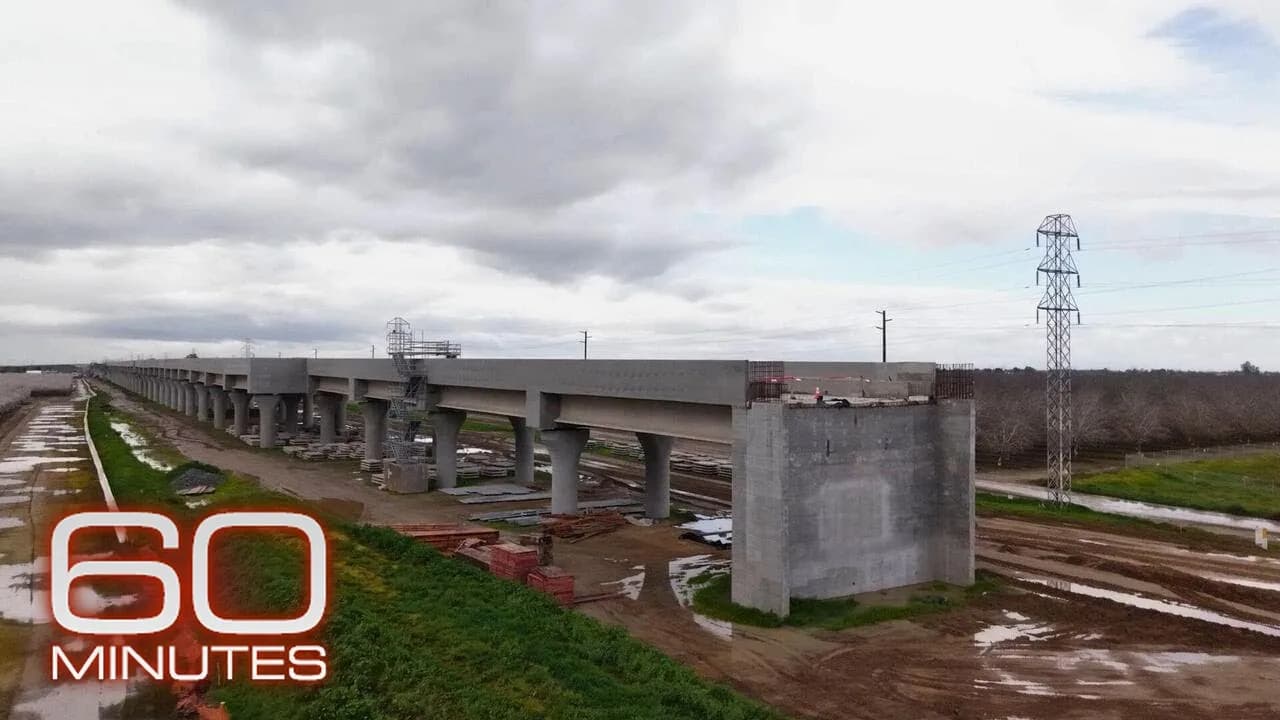
Near Fresno: bridges/viaducts like Stonehenge, for future HSR, now curiosities.
US once envy: 1800s transcontinental railroad. 1950s Eisenhower interstate highways funded car culture. Japan bullet train 1964; 20+ countries HSR (150+ mph): Germany, France, China, Turkey, Indonesia, Egypt.
We know we can do this. Economic engine.
Mike Reininger, Brightline West MD: LA-Las Vegas >2 hours vs. 5 car, 200 mph max, first true US HSR, service 2029. Uses I-15 median.
Florida Brightline (Miami-Orlando 2018, 125 mph): beta test. More enjoyable, safer, reliable to change behavior. Car culture crackable.
Florida: 200+ killed by trains at street level (Miami Herald/public radio). West desert safer, no street crossings.
Finances: costs outstrip revenues; debt junk status.
Business built slower, fewer passengers than expected, but growing month/year, solidifies viability.
Federal funding received; hopes $6B Trump loan.
Infrastructure systems publicly funded worldwide. Welcome government role.
Absolutely. We welcome it.
Rail authority insists state funds cover Central Valley leg. Funds to complete LA to San Francisco not all there today, but they believe they can get them. Estimated cost with optimization: just over $125 billion, current estimate $126 billion. More funding than Amtrak has received in its history, shortfall of roughly $90 billion.
That's a big gap to fill. It is a big gap to fill. But again, we have an understanding of how to get there and to fill that gap.
Plan to cut costs, lure private investment, connect to bigger cities sooner. Political challenges: one party pushes, other pulls back. Gavin Newsom now champions project after earlier pessimism.
This is not just a transportation project. This is about reimagining the future of this region.
In 2025, President Trump cancelled $4 billion in federal grants.
Did you ever hear of Gavin Nuskum? He has got that train is the worst cost overrun I've ever seen.
Secretary of Transportation Sean Duffy statement: administration favors high-speed rail, but this project has wasted billions in taxpayer dollars yet delivered nothing. Initial segment possible without federal help; full 494 miles challenging without it.
Is this a non-starter to build a project like this without federal funding? Well, not only can't it be done, it shouldn't be done because a lot of the benefits of the project, the reason why you build the project is public. Pollution reduction, congestion reduction, improve safety, comfort, reliability, all of those things are public benefits.
Other US high-speed rail ideas like Dallas to Houston, but nothing else building. Why no US high-speed rail like Morocco, Serbia, China, Japan, Western Europe?
Well, the simple answer is they've decided they want to do it and pay for it and we haven't.
You think we will in our lifetimes? I don't know. I'm dubious. I'm dubious. Absent a national political will to work with the states to create some of these systems. I think it's going to be in of course my lifetime almost certainly not, but maybe yours. I don't know.
New York City subway: packed trains, routine breakdowns, delays. After derailment injuring over 40 people, governor declared state of emergency. Once a feat of American engineering over a century ago, now example of ailing infrastructure.
Andy Byford, Englishman, new president of transit for MTA (state agency running trains), proposes largest infrastructure expenditure since 1950s.
Subway: 400-ton trains, 600 miles of track, 24/7 operation, nearly 6 million daily riders. Fare: $2.75. Near 70-year ridership peak, but years of neglect, deferred maintenance, financial mismanagement strain system.
Incidents: passengers trapped almost 1 hour in heat; ceiling collapse in Brooklyn (one concussion); September rains flooded Manhattan station. Heat, rats, delays.
This has to be the mother of all transit challenges. It is. And the way I look at it, Bill, is someone has to take this on. If every transit professional said, "Oh, it's too tough. I'm not going to risk my career in going there. Nothing would happen. I'm prepared to give it a go."
Byford background: train enthusiast from Plymouth, Britain; worked London Tube, mass transit in Sydney, turnaround in Toronto. Hired January to stop hemorrhaging.
I pitch myself sometimes cuz that how did this spotty kid from Plymouth suddenly end up running New York City Transit? But it's a dream. Some people would call that a nightmare. People when I left Toronto, there was a mix of people saying congratulations or are you crazy? But I like a challenge. If we can turn this around, then it'll be the most satisfying period of my career. I mean, it'll be the pinnacle.
Byford wears name tag, does own market research, motivates workers, picks up trash.
How do you find the service? This is what I like to see. Aim high. I will. Thank you. Thanks for what you do. You know, we got to up our game and get better at the basics. Number one. Excuse me. You really do. Just pick up the trash. Absolutely. I'm not going to walk by that. Things like that. He's fastidious down to the last crumb. Trash. Yeah. Get rid of it. I don't want to see unclean stations or messy stations.
Modernization plan: hundreds of station renovations, thousands of new subway cars, state-of-the-art computer signal controls for faster, more frequent trains. Cost: $40 billion.
Sounds like you're going for broke. I've said in the past that's what we have to do, not to tweak this system. That it needs way more than that. It needs to be a comprehensive top-to-bottom modernization of every aspect of our operations. Why shouldn't we be on a par with London, with Hong Kong, with Shanghai, with Singapore? This is New York for goodness sake.
MTA track record poor: computerizing one line took decade. Byford plans to upgrade nearly entire system in that time. Funding challenge to politicians. Mayor Bill de Blasio wants millionaire tax; Governor Andrew Cuomo wants congestion charge for Midtown Manhattan vehicles. Needs New Yorker patience during shutdowns.
How are you going to come up with that kind of money? Well, I mean, I leave that to smarter people than me. I leave that to the politicians. Any one of those things would be next to impossible to achieve. How are you going to achieve all three? By British charm, I'm um it will not be quick, it will not be cheap, and it certainly won't be easy. So my message to New Yorkers is there's no gain without a bit of pain. This will be worth it.
L train ( Brooklyn-Manhattan, 400,000 daily riders) faces 15-month shutdown.
Antiquated signaling from Great Depression, over 100 years old. Operator Rakia Spady uses levers. Low-tech map with dots for train locations, not precise.
This is 2018 and this thing was built before we were born. Long before. But it I mean I call it old trusty. It's moving a train. So you see how that green dot is up there behind the blue dot? It's still in transit. So it's moving into the station. And now he stopped. But you don't know exactly where on the track that train is. Yeah. No, this is New York City. They don't know exactly where the trains are at any given time in the subway system.
Modern signaling for precise train locations, closer trains, more frequency.
That's what we need to transform and it's about accelerating towards a modern signaling system that would give us precise absolute identification of where trains are and it would enable you to move trains up safely closer together. Go more trains.
Repair shop manufactures replacement parts since original companies gone.
I have 50,000 employees working with me as a big team. We've got old processes, old systems that we use and yet my miracle workers keep that going every day.
Frontline workers face aggravated public. Melvin Wright (third-generation operator); Cheryl Nicholson (conductor 29 years).
Pulling into a station, people tapping their watch at me, you know, like reminding me we're late. That's real life stuff. That's what. I used to cry. I used to cry because of what people would say. People were so mean. And they say it's gotten worse.
August: passengers pummeled conductor in Brooklyn after skipped stops.
They're frustrated. And I get it. They have reason to be frustrated. They do have a reason. If your job depends on you to be there and your boss said, you know, this is the third time, Mr. Whitaker, what are you thinking? Oh, that conductor's going to get it. It was the MTA. Yeah. We get it.
On-time performance up slightly. Using $800 million state emergency funds for maintenance overdrive. Upgrading Spady's equipment.
MTA rail control center: Haley Dragu in Twitter division ( 2,000 tweets/day from irate passengers).
What's the purpose of having a schedule if you never abide by it. We just kind of try and put ourselves in these people's shoes and try and answer them as best we can and as accurately as we can. And then we hope that that made their day a little better or at least more clear. The subway riding public is kind of fed up right now and I get that. So our job is crystal clear. We need to turn this around for New Yorkers and I absolutely want New Yorkers to start feeling by the end of this year it's definitely getting better. By the end of this year.
You've got a lot on your to-do list. One or two things. That's what I love. It keeps me busy. And the upside is also I get to live in New York. What's not to like?
US roads, bridges crumbling; airports out of date; seaports becoming obsolete from decades of neglect. No consensus on funding despite complaints from business, labor, governors, mayors, congressmen, presidents. Political paralysis in Washington.
Nearly 70,000 bridges (1 in 9) structurally deficient.
Ray LaHood, former Obama Transportation Secretary, 7-term Republican congressman from Illinois, co-chair Building America's Future (bipartisan coalition pushing infrastructure spending).
Our infrastructure is on life support right now. That's what we're on. According to the government, there's 70,000 bridges that have been deemed structurally deficient. What does that mean? It means that they're bridges that need to be really either replaced or repaired in a very dramatic way. They're dangerous. I don't want to say they're unsafe, but they're dangerous. I would agree with that.
Pittsburgh: City of bridges, over 4,000 in metro area, 20% structurally deficient. Liberty Bridge (1928, designed for 50 years, now 86 years old), carries daily traffic. 5 million people/day cross needing bridges. One arch bridge has structure to catch falling concrete.
Andy Herman, past president American Society of Civil Engineers.
From up here, you can see why they call it the city of bridges. Yeah. Between the highway and the railroad bridges, there's a many of them. And most of them old. Most of them old. You're nearing the end of their useful lives. Yeah. This is the Liberty Bridge ahead. Yes. An important bridge for Pittsburgh. A very important bridge for Pittsburgh. A connection from the south to the city itself and then to the north. One of these arch bridges actually has a structure built under it to catch falling deck. See that structure underneath it? They actually built that to catch any of the falling concrete so it wouldn't hit traffic underneath it.
Pennsylvania: 300 bridges become deficient yearly (1% added to 23%). Philadelphia: 9 million/day over 900 deficient bridges, 15 on 22-mile I-95 stretch (nation's #1 highway), fix cost $7 billion. Ed Rendell, former Democratic governor.
How critical is the stretch of I95 to the country? It's the nation's number one highway. 22 miles of it goes through the city of Philadelphia. There are 15 structurally deficient bridges in that 22 mile stretch. And to fix them would cost $7 billion to fix all of the roads and the structurally deficient bridges in that 22m stretch.
2008: PennDOT contractors saw 8ft gash in pier under I-95 bridge after sausage sandwich stop; closed 3 days, buttressed with steel.
And fortunately, they wanted that sausage sandwich because they saw one of these piers with an 8ft gash in it about 5 in wide. and all they knew automatically that this bridge was in deep trouble. I mean it was unbelievable. It's so fortuitous. And if they hadn't wanted a sausage sandwich, there's a strong likelihood that bridge would have collapsed. These all are tragedies waiting to happen.
I-95 bridges early 1960s. Like I-35 Minnesota collapse (2007, 13 dead, 145 injured); Skagit River Bridge (Washington, collapsed last May after truck hit truss).
ASCE: 32% major roads in poor condition. Federal Highway Trust Fund (18 cents/gallon gas tax) almost insolvent by next spring.
That was the pot of money that over 50 years helped us create the best interstate system in the world, which is now falling apart. Why? How did it get this way? It's falling apart because we haven't made the investments. We haven't got the money. The last time we raised the gas tax, which is how we built the interstate system, was 1993. What has the resistance been? Politicians in Washington don't have the political courage to say this is what we have to do. That's what it takes. They don't want to spend the money. They don't want to raise the taxes. That's right. They don't want to spend the money. They don't want to raise the taxes. They they don't really have a vision of America the way that other congresses have had a vision of America.
Public spending lowest since 1947. US ranked 16th globally (World Economic Forum), behind Iceland, Spain, Portugal, UAE.
Business support: Caterpillar, GE; US Chamber of Commerce president Tom Donohue for gas tax raise.
First, let's start by having some courage and showing some leadership. For once, let's do what's right, not what's politically expedient. Second, let's educate the public and your fellow lawmakers.
AFL-CIO president Richard Trumka: every $1 billion on transportation creates 35,000 jobs.
If business and labor can come before you, united on this issue, and we are united on this issue, despite our sharp disagreements on a variety of other matters. I think that should tell everybody something and tell them very loudly.
No debate in midterms. Rep. Bill Shuster (House Transportation Committee chair), Rep. Dave Camp (House Ways and Means chair) declined interviews. Rep. Earl Blumenauer (Oregon Democrat, 9 terms): last major 6-year bill 1997, then 21 short-term extensions; no hearing on highway trust fund in 44 months despite bipartisan failures.
I've actually been trying now for 44 months to at least get a hearing on transportation finance on the highway trust fund that is slowly going bankrupt and we've not had a single one. Why can't you get a hearing? It has to this point not raised to the level of priority for the Republican leadership. Although in fairness when the Democrats were in charge we had a few hearings but not much action. So you see this as a bipartisan failure? Absolutely. The Bush administration they had two blue ribbon commissions about infrastructure finance that recommended a lot more money and additionally the gas tax being increased. we couldn't get them to accept being able to move forward. Since President Obama's been in office, there has been to be charitable a lack of enthusiasm for raising the gas tax.
Problems beyond roads/bridges/gas tax: aviation, shortage of airport runways and gates along with outmoded air traffic control systems
US air travel is the most congested in the world. When a new generation of big cargo ships begins going through an expanded Panama Canal in another year or so, only two of the 14 major ports on the east coast will be dredged deep enough to accommodate them. There are more than 14,000 miles of high-speed rail operating around the world, but none in the United States. In Chicago, it can take a freight train nearly as long to go across the city as it would for the same train to go from Chicago to Los Angeles.
The most glaring example of neglect and inaction is the Portal Bridge over the Hackensack River in New Jersey. Built 104 years ago, it is critical to the US economy according to Amtrak President and CEO Joe Boardman.
This is the Achilles heel that we have on the Northeast Corridor.
It's almost 500 trains a day. It's the busiest bridge in the Western Hemisphere for train traffic, period.
It's safe, Steve, but it's not reliable and it's getting less reliable. It's old. Its systems are breaking down. There's an inability to make it work on a regular reliable basis.
Boardman says the Portal Bridge is based on a design from the 1840s and was already obsolete shortly after it was completed in 1910. It's a swing bridge that needs to be opened several times a week so barges can pass up and down the river. It takes about a half an hour. The problem is it fails to lock back into place on a regular basis.
It causes trains to stack up on both sides. And actually, when a train stacks up here, it can stack up all the way down to Washington and all the way back up to Boston. This is a single point of failure. That's one of the biggest worries we have on this corridor is these single points of failure.
Amtrak's president says the bridge has to be replaced. The design work has already been completed and the project, which would cost just under a billion dollars, is shovel ready.
If Congress wants to do something now, build this bridge. It's ready to be done. It's been ready for two years. Build it. It's tangible evidence that they can really get something done.
It's less a case of wanting to get something done than coming up with the hundreds of billions of dollars needed to do it. There's no shortage of ideas from Democrats or Republicans who suggested everything from raising the gas tax to funding infrastructure through corporate tax reform. But there is no consensus and not much political support for any of the alternatives. As Andy Herman told us last summer when we were flying over Pittsburgh:
You're sitting there at these committee meetings. They seem to agree with you. Yes, we have to make investments in infrastructure. Yes, we have to do the things. But then they come around and say, "Well, where are we going to get the money?" And you sort of sit to yourself and say to yourself, "Well, we elected you to figure that out."
Keep 60 Minutes in your library
Save the videos and channels worth coming back to, and find them again in one place.