Apple Health BETA: BIG Improvements!
In a Nutshell
Apple's new Health app beta introduces a Longevity tab with a "healthy age" metric that shows users up to 10 years younger based on factors like VO2 max, resting heart rate, HRV, sleep, and activity. The app consolidates health insights with a wheel-style dashboard covering cardiovascular fitness, sleep, activity, and metabolic health, while adding a camera-based VO2 max test. The update brings Apple Health closer to competitors like Whoop by providing more actionable data interpretation, though the ±10 year cap limits motivation for further improvement.
These notes were generated by AI and may contain inaccuracies.
Some of the biggest improvements Apple has made this year are not in the hardware, but in the firmware and applications, specifically in the Apple Health app. This looks much better and addresses many complaints from reviewers. In the past, the Apple Health app was somewhat limited in its interpretation of data, and this has improved significantly. The current version is still in beta, so things could change, perhaps drastically.
The review covers a first look at the beta version of the new Apple Health app, what the new Longevity tab offers, and how the healthy age is calculated. A new VO2 max test will be performed using the camera to see if it is close to the normal VO2 max level. The last real VO2 max test was conducted a year ago, with usual values between 54 and 60. Based on overall feeling of fitness, the expectation is that the value should be in the 53 to 60 range.
VO2 max is defined differently across activities. The last test showed a VO2 max cycling rate of 58, while the running rate was 54, showing a significant difference between the two activities.
The new app experience is significantly better than the old Apple Health app. The old version is shown in dark mode for comparison. The new app displays sleep scores and vital signs in a completely different arrangement.
The Overview tab shows the Insights section. The Nomi section is waiting for sufficient data to be available to obtain the HRV hospitalization rate and other metrics. There is a nice overview of sleep data. The readiness tab also requires more data, despite data from other wearable devices being synced with Apple Health. The indicator remains blank because only two nights of sleep data were recorded with the Apple Watch.
The fitness tab shows no exercise has been done yet, as it is still early in the morning. The resting heart rate is usually relatively low. Apple currently shows cardio fitness at 51 on the VO2 max scale. Over the past five weeks, the resting heart rate has been trending downwards. Apple used to refer to 58, and now it's down to 45.
Resting heart rate is defined differently by manufacturers. Some take the lowest heart rate at night, which is not the true resting heart rate while awake, which is usually higher. The heart rate drops to about 35 beats per minute at night, but during the day it can reach 45. Apple defines it as when awake but inactive.
The Vitals app also lacks sufficient data because an Apple Watch Series 12 is being used on this app, and an Apple Watch Ultra 4 on the new experimental app. The Vitals app will examine resting heart rate, respiratory rate, wrist temperature, blood oxygen, and recovery HRV rate. With the new Apple Watches, Recovery HRV has been added alongside regular HRV. Recovery HRV looks at long-term trends, while Recovery is a shorter trend.
The longevity tab shows a wheel display indicating hearing is excellent. Sleep was good, but not a long amount of sleep was obtained, making it not ideal. Heart health is good, though high blood pressure is typical, with old measurements from August. Physical activity shows minimal activity today, but significant movement over time. Overall, the data looks very good.
The flower- or wheel-like display shows areas to focus on, including mental health, nutrition, and metabolic health. Metabolic health includes body composition and laboratory values, requiring laboratory assessment from a doctor or Apple collaborator.
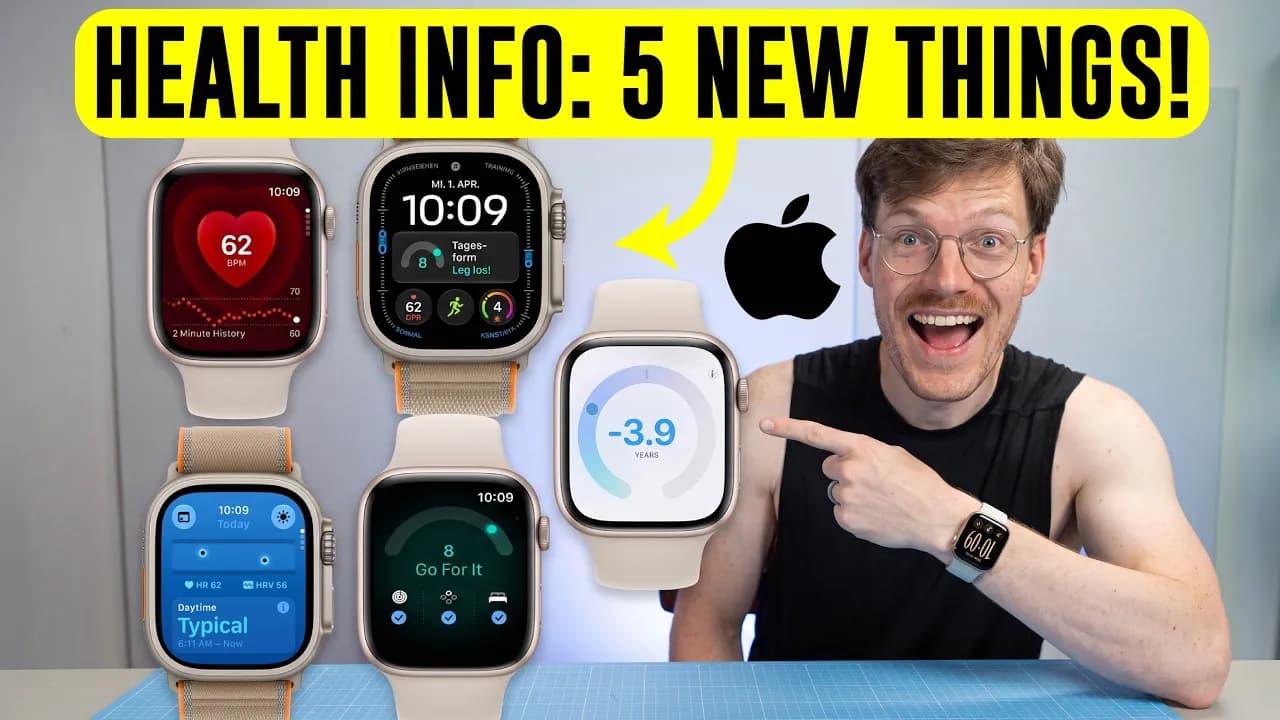
The healthy age shows a correct age of minus 10, with a limit currently between minus 10 and plus 10 years. The real age is 38.1 years, showing as 28.1 years. The record shows being a little older according to Apple, which has decreased over time, and has been at minus 10 since July.
Contributors to the healthy age include heart rate VO2 max at 51.0, workout minutes giving minus two, steps giving minus 1.2, heart rate variability giving minus one, resting heart rate giving minus one, and sleep score at minus 0.9. When combined, these contributors result in a slightly shorter healthy lifespan of 28.0 instead of 28.1.
There is a limit in place, which makes sense because there must be a limit to how young someone can be and how long they can live. Apple is not claiming this extends life by that amount, and a drastic reduction in healthy lifespan is not considered a realistic option. There will always be a limiting factor in the body that prevents increasing age or health span beyond certain limits.
Additional data can be added, such as glucose and LDL cholesterol levels, which may increase or decrease the healthy lifespan. This is very similar to how the Whoop device works, suggesting possible inspiration from that system.
The cardiovascular fitness level shows 51.0, with healthy habits offered to help improve. The evaluation will be conducted. The age improvement approach has been used to improve long-term health, and the same will be attempted with the Apple Watch to see if performance is similar and what Apple's special features are.
The minus 10 limit makes sense but is not the most motivating, as there is no desire to lower it further at this time. From a motivational standpoint, it would be preferable if the number could continue decreasing. The effect may gradually diminish, with the greatest improvement at the beginning, followed by smaller increases as further improvement occurs. This would eliminate the strict dividing line.
The VO2 Max assessment begins after having one more cup of coffee. The test requires going up and down with the rhythm in round one. There was a problem with reading heart rate, with the message to make sure the heart rate monitor is secure and in contact with the skin. The test did not work out completely, but this is expected since it is a beta version, specifically a developer version, making it very preliminary.
The test was unable to read heart rate consistently and accurately, but it gave an impression of how it works. The approach is logical considering how many people will try this. It is closer to a submax test, not reaching maximum effort, but reading heart rate as workout intensity increases and during recovery. Based on that, it provides an estimate of VO2 max level, which can work very well with training and artificial intelligence, since these subtests are sometimes accurate.
Once fully activated, the device estimate of VO2 max will be examined, and a lab test with a friend or home testing using a VO2 analyzer may be conducted to verify accuracy of Apple's estimate.
The new health app represents a huge step forward and is what has been expected from Apple for many years. It is unclear why it took so long, as competitors have been doing this for a long time, but it is good that it is here now. This will help a lot of people.
The only caution is not becoming obsessed with health age or biological age. Use it as a tool to improve health, but be realistic and understand that this is not a scientific gold standard. Apple has devised a way to make this work for many people, but it is not an absolute truth. There is no factual basis for this age. Lowering it, even to some degree, will help improve health, which will ultimately help prolong healthy life or lifespan.
Although many things may happen in life, the goal is to motivate living in a healthier way, which will also help feel more energetic in the present moment. The ability to go down for more than 10 years would be preferable, even if progress slows and improvement becomes more difficult. This would only be useful for comparison with the Whoop device.
The Whoop device shows an age of 13.1 years younger compared to Apple's 10 or 10.1 years, though the range is very close. The aging pace provided by Whoop focuses more on short-term behavior rather than long-term behavior. Both systems work in a very similar way. For many people, this will make obtaining some kind of biological age much more accessible.
Kudos are given to Apple for this development. This represents a very quick first look at the new beta version of the Health and Healthy Age app.
Keep The Quantified Scientist in your library
Save the videos and channels worth coming back to, and find them again in one place.