Apple Homeview Impressions: Not Convinced!
In a Nutshell
Apple's new Home View display costs $300 but offers no native apps, App Store, or compelling differentiation from cheaper competitors like the $179 Echo Hub. The device supports only CarPlay streaming from iPhone, has limited facial recognition without infrared sensing, and requires expensive wall-mount accessories that can cost up to $130 extra. With thick bezels, weak speakers, and an unclear target audience, the product fails to justify its premium price point in an already crowded smart display market.
These notes were generated by AI and may contain inaccuracies.
Apple held a mini home event introducing three new products: the HomePod Mini 2, a new Apple TV 4K, and the Home View display. The HomePod Mini 2 features new colors and a glowing display at the top that matches album art. The Apple TV 4K includes farfield mics and a remote with built-in speakers for locating it via Siri.
The Home View serves as a smart home dashboard equivalent to the Google Nest Hub Max ($229) and Amazon Echo Hub ($179). Apple's Home View is priced at $300. The device features a 7-inch square touchscreen in a color-matching metal base with speakers, a camera at the top, and an articulating display arm.
Two versions exist at the same $300 price point: a stand version with a metal base containing a woofer for fuller sound, and a wall-mounted version lacking the woofer. The wall-mounted version requires separate purchase of wall adapters: $60 USB-C, $80 AC, or $130 Power over Ethernet. Only silver or gray colors are available for the wall-mounted version, while the stand version offers additional colors.
The device contains an A18 chip and runs Home View OS, a new operating system distinct from iOS or iPadOS. The software incorporates familiar Apple elements including Apple Watch-style clock face customization with complications and modular faces. Swiping up from the bottom reveals a customizable app drawer with widgets.
No App Store is available and third-party apps cannot run natively. However, CarPlay standard is supported, allowing content to be beamed from iPhone to the display. Tapping an iPhone to the device beams content including Apple Music, Safari links, and FaceTime calls.
The single 12-megapixel center stage camera enables facial recognition for fast account switching. When recognized users approach, the device switches between personal contexts including messages and calendar information for up to six people. Without recognized users present, only general functions like timers, weather, music, and Siri remain available.
The facial recognition system lacks full Face ID capabilities with no infrared or depth sensing. Security is supplemented by checking nearby unlocked iPhones or Watches. No voice recognition is implemented, requiring users to be in the camera's vicinity rather than around corners for personal context switching.
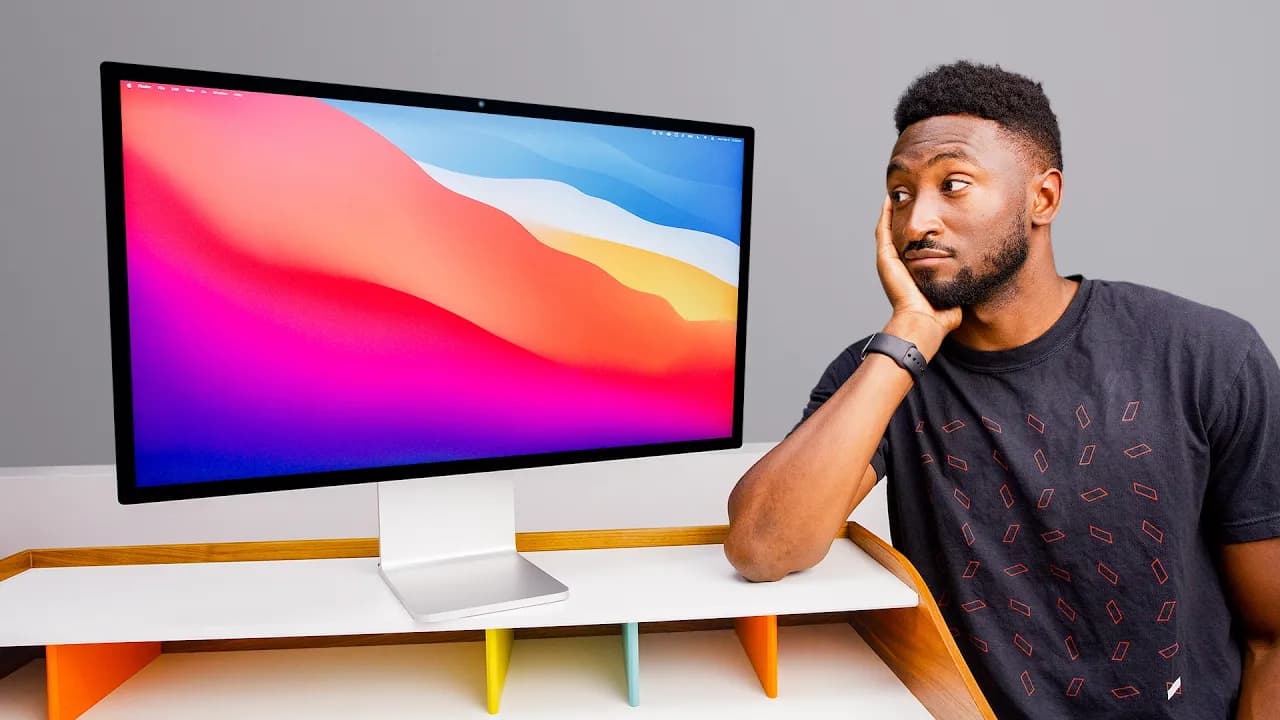
No battery is included, though USB-C connectivity provides some portability. The device features thick black bezels, contrasting with recent iMac designs that adopted white bezels for home placement.
The LCD display reaches 500 nits maximum brightness and 0.3 nits minimum, with True Tone support for reduced eye strain in dark environments. The refresh rate appears to be 60Hz based on initial interaction.
The device relies on the new Siri AI with improved capabilities but noted slowness. First-party app responses include Apple Music for music requests and Apple Calendar for scheduling. Sound quality includes the subwoofer for bass response, though maximum volume is relatively low without distortion.
Third-party services like Spotify require AirPlay streaming from iPhone. Apps supporting CarPlay standard can display content from iPhone without native execution on the Home View.
The product aims to fill an ecosystem gap for users transitioning from Amazon and Google smart home systems. Apple partnered with LG to create compatible smart home devices including doorbells, thermostats, and security cameras meeting Apple standards.
The target demographic remains unclear after extended use. Casual users may appreciate ecosystem integration and iPhone connectivity features, while smart home enthusiasts find the ecosystem smaller than Amazon's and Google's offerings. The display's value proposition appears similar to competitors without compelling differentiation beyond the price premium.
Keep Marques Brownlee in your library
Save the videos and channels worth coming back to, and find them again in one place.