Are We Actually Witnessing the End of Heart Attacks?
In a Nutshell
LDL reduction alone won't end heart attacks—30+ years of statins haven't decreased cardiovascular disease, and trials show only modest event reductions despite cutting LDL in half. The real driver is undiagnosed metabolic disease (prediabetes/diabetes) affecting 90% of people, which creates residual risk independent of LDL through inflammation, high insulin, and poor glucose control. The protocol prioritizes comprehensive testing to catch metabolic disease, lifestyle intervention (eliminating glycemic carbs, exercise), and treating inflammation rather than chasing LDL targets.
These notes were generated by AI and may contain inaccuracies.
At age 64, many people have never smoked and maintain LDL around 70 with statin therapy. Dr. Brad Stanfield's video titled "Are We Actually Witnessing the End of Heart Attacks?" has gained over half a million views, arguing that medicine has systematically eliminated heart disease causes, with cholesterol as the final target.
Medicine effectively reduced LDL levels 30 years ago when statins became widely used. The newest trial cited by Dr. Stanfield drove LDL down to 45 using a new drug. Over four and a half years, 8 out of 100 people on placebo experienced major cardiac events (MACE), compared to 6 out of 100 on the drug. Despite cutting LDL by more than half, three out of four events still occurred.
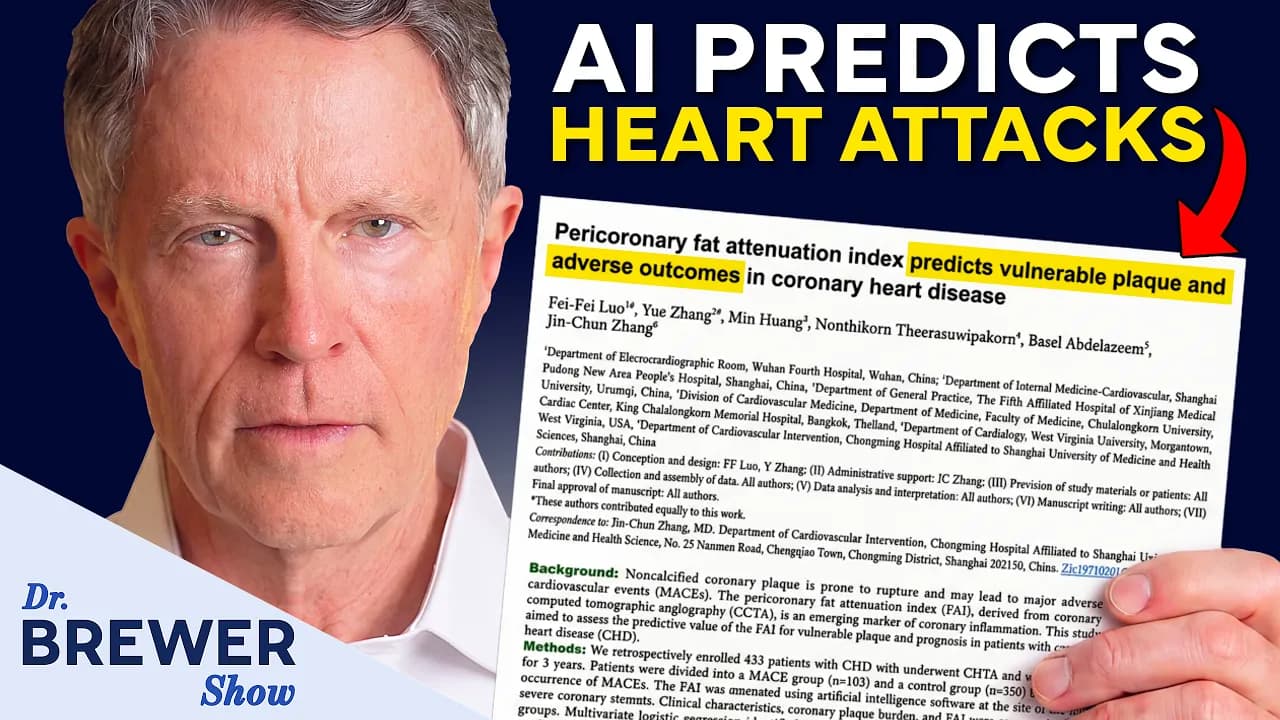
Dr. Brewer ran the preventive medicine program at Johns Hopkins and now focuses on helping people avoid heart attacks, strokes, and early death. The show's philosophy emphasizes that plaque is the enemy, testing beats guessing, and healthy arteries are the goal. The approach prioritizes teaching people how to think about preventive medicine over providing prescriptions.
Dr. Jesus Vega has started his own medical program called Heart Attack Strokes and runs a Spanish-language channel. The discussion focuses on analyzing Dr. Stanfield's video and addressing viewer questions through live calls.
Dr. Stanfield's video compiles multiple studies with an optimistic conclusion that lowering LDL will reduce heart attacks. Heart attacks showed a downward trend from the mid-1950s (around President Eisenhower's era) until 2019, then increased. The title "witnessing the end of heart attacks" may contain clickbait elements, though Dr. Stanfield appears to genuinely believe modern healthcare will solve the problem.
Smoking reduction achieved a 72% decrease in U.S. cigarette consumption by 2011 following the 1964 Surgeon General's Report, though rates are rising again in younger generations. Blood pressure treatment represents medicine's major contribution, with historical examples like President Roosevelt's blood pressure of 300 over 190. The Framingham study showed 2.6 times coronary risk increase with hypertension. The 1967 VA trial stopped early with 27 severe events on placebo versus 2 on treatment. The SPRINT trial with over 9,000 people demonstrated over 25% event reduction by targeting systolic blood pressure of 120 versus 140.
ER technology improvements have increased survival rates for acute heart attacks compared to 1955, yet heart attacks remain the number one cause of death globally. Only Japan has cancer as the leading cause of death, with heart disease ranking second.
The DASH diet achieved over 5 points decrease in blood pressure through salt restriction. The Mediterranean diet receives criticism, while low-carb approaches show more practical impact on people's lives.
Residual risk refers to the remaining cardiovascular risk after LDL reduction and blood pressure improvements. This residual risk primarily stems from 90% of people with prediabetes and diabetes who remain undiagnosed because their doctors don't recognize it. Research from Singh and Associates at Johns Hopkins demonstrates that only 5% of patients with metabolic disease, prediabetes, or diabetes receive proper diagnosis, treatment, and documentation in their medical charts.
LDL testing is simple and leads to statin prescriptions when elevated. LDL often serves as a biomarker for underlying metabolic disease, creating confusion about whether LDL itself or undiagnosed metabolic disease drives cardiovascular risk. High insulin, high glucose, and diagnosed diabetes impact heart disease and stroke risk independently of LDL and ApoB levels.
The protocol involves six or seven steps, with the first six remaining consistent regardless of debate over the seventh step. The foundational step is "test, don't guess," requiring tests that can identify undiagnosed prediabetes, diabetes, and metabolic disease rather than relying on standard internet recommendations focusing only on LDL and plumbing issues.
The Satch-Diva trial from 2009 in the American Heart Journal reported mean triglycerides of 161 and mean HDL less than 40, alongside LDL reduction. The HDL under 40 and triglyceride-to-HDL ratio of 4 represent major red flags that receive no attention when focus remains exclusively on LDL. A triglyceride over HDL ratio above 2 indicates cardiovascular risk, and values showing triglycerides over 100 with HDL under 40 require intervention.
Almost everyone has some degree of metabolic disease until proven otherwise through proper testing. The condition worsens with age, as evidenced by the fact that heart attacks rarely occur in 18-year-olds. The NHANES (National Health and Nutrition Examination Survey) data shows that over half of 18-year-olds in the United States already have A1C levels indicating prediabetes, with ADA numbers suggesting A1C may miss up to 70% of cases due to factors like anemia and inability to detect glucose area under the curve.
The complete approach addresses eating patterns, exercise routines, removal of contributing factors including sleep apnea, thyroid issues, toxins, and stress, plus targeted supplements and medications when appropriate. The Dr. Brewer Protocol to Prevent Heart Attacks is available through the video description link.
The PESA study tracked plaque development linearly with hemoglobin A1C, HOMA-IR, and other metabolic indicators, even when LDL was not predictive. The SELECT study found that two-thirds (66.4%) of the non-diabetic population had prediabetes at baseline by A1C measurement. Benefits occurred independent of baseline weight, with early weight loss not predicting later cardiovascular benefit. Waist circumference changes explained only about one-third of the effect. The drug that lowered insulin demand and cooled inflammation reduced heart attacks in a metabolic disease population.
Statins were introduced in 1987, with widespread use beginning in the 1980s and accelerating in the 1990s. Despite decades of statin therapy, cardiovascular disease incidence and prevalence have actually increased worldwide, contradicting claims that LDL reduction alone will eliminate heart disease.
Statin use has been widespread since the early 90s, allowing LDL to be lowered for 30 years. However, the expected continued decrease in cardiovascular disease since statin inception has not materialized. Cardiovascular disease has not really decreased since the inception of statins. The human body generally is able to regulate the amount of cholesterol it needs. Statins damage CoQ10, which is another consideration in the statin conversation. Calling statin use "therapy" implies something that is good for you, which is problematic. The over-focus on one factor is problematic because cardiovascular disease is now known to be complex with many factors involved, and you cannot rely on one factor thinking 90 percent of the problem has been figured out.
Earl is almost 76 years old. He has resisted hypertension for years and has been taking two valsartan tablets, 160 milligrams in the morning and 160 at night. He recently switched to Telmisartan, which has a longer half-life for better consistent control. Earl has Parkinson's disease. Since 2022, he lost his daughter to fentanyl poisoning and lost his wife two years later to renal cell carcinoma. He had a calcium test a couple of years ago with a score of 516. His labs from July showed LDL at 119. He takes 4,400 mcg of K2 in a combo pill with 4,400 mcg of vitamin D and K2 MK7, plus baby aspirin every day, plus CoQ10. He also takes Carbidopa Levodopa four times a day for Parkinson's. Earl lives alone in the country next to Pleasancy, Tennessee, with his coon dog.
Earl had a stent placed on November 2nd, 2023. He had no chest pain but felt something was off. Blood tests showed something abnormal, and he was taken to Centennial in Nashville where Dr. Hoar placed a stent in his heart. Doctors wanted him to take a statin afterward, specifically 80 milligrams of atorvastatin, but he experienced the worst stomach ache known to man and cannot tolerate statins. They dismissed him from the practice when he said he couldn't take statins. Earl's father died of cardiac arrest on the golf course after drinking scotch for 50 years. Both of Earl's brothers have Parkinson's, which runs in his family.
Statins are not the only medication doctors can use to get LDL down. There are three other drug classes: bempedoic acid, ezetimibe, and PCSK9 inhibitors. These are all different drug classes that will get LDL down. Most doctors are trying to get LDL down because they've seen some correlation and think if they drop it, that will solve the problem. Many statin problems are what is called a nocebo, but that does not give doctors license to ignore statin symptoms because they happen.
Roger is on a ketogenic diet and his LDL has skyrocketed. His LDLP is 2937, small LDL particles are 1860, size is 20.4, and his LDL number is around 144. His ApoB is at 155. Roger had a heart attack. He is taking Repatha to bring LDL down while on the ketogenic diet. He started his keto diet back in 2023 for weight loss. Roger has been using Dr. Brewer AI for at least a month and has gotten substantial information from it. The AI has told him about tests his doctor doesn't even know about, including uric acid, CRP HS, glucose fasting, insulin, homocysteine, ferritin, the albumin creatine ratio, C-peptide, and the L-carotene panel. Roger ordered an OGTT with insulin response with six specimens, specifying the second draw at 30 minutes instead of one hour. He is getting a CIMT done in November.
Engaged healthcare is much better than being very dependent upon doctors to tell patients whatever they want to tell them. When patients are engaged in their health, they get better outcomes than just being dependent upon some expert or doctor to give information. Patients who use the AI become the smartest patient in the waiting room, and quite often when they get back in the exam room with the doctor, they are still the smartest person in the room. This is not about revolution or overthrowing doctors, but about health. It has been shown for decades that if you are engaged in your health, you are going to be much better off.
Lifestyle is key. As long as you fix your lifestyle, you may be able to use some supplements, but all of that is going to be way more important than any medication. No medication is going to fix this. You cannot out-prescribe a diet. You cannot out-medicate. You cannot outrun a bad diet. There are specific strategies you can do with your lifestyle that will help you get further than any pill would ever do. At some point, for some people, some medications will make sense.
Statins are used, but not to lower LDL. Statins are used if there is plaque, and used for inflammation. When statins are used, it is to decrease inflammation, not high doses or even mid-level doses. Patients typically come in on 40 milligrams of atorvastatin, and doses are usually reduced to 5 milligrams of rosuvastatin two or three times a week as soon as possible.
There are multiple factors involved in cardiovascular disease. The over-focus on LDL is too much. LDL has a role, and statins have a role, but neither is what most people hear from mainstream medicine.
Victor is 48 years old. His HDL is at 41 and his LDL is at 153. He has been wearing an arm monitor to watch his glucose with an average of 41. Victor is trying to figure out a healthy way to get his cholesterol down.
An HDL of 40 is a flashing red sign that HDL is too low. This is a very strong indicator of pre-diabetes or metabolic disease. What is usually going on is that HDL particles, the Apo A1 protein, are being used up to go over and cover for all of the triglyceride or lipid laden particles, the remnant particles, which are high because the body is not able to burn them.
Triglyceride over HDL ratio exceeding four indicates metabolic disease. This ratio serves as a strong warning sign that was completely ignored in the study group, as well as by Brad Stanfield and others when examining vascular risk.
The live format creates connectivity issues including dropped connections and poor reception. Viewers are encouraged to consider the super AI option for quick answers to questions rather than waiting for live interaction.
The live format provides unique access to Dr. Brewer that cannot be found elsewhere on YouTube. Viewers can directly engage with Dr. Brewer and explore topics in depth, though this requires managing the technological challenges of live streaming.
Michael Preggler follows a meat-based diet avoiding simple sugars, seed oils, and grains. Dr. Brewer describes his own diet as not strictly carnivore but focused on avoiding glycemic carbs. He consumes grain products only occasionally, perhaps a spoonful or two once a week or twice monthly.
The Mediterranean diet requires careful attention to carbohydrate sources. Grape juice, grapes, and grains represent major carb sources in typical diets. The standard American diet (SAD) is acknowledged as harmful to health.
Dr. Brewer's current breakfast consists of eggs, ham, bacon, cheese, and butter. This represents a diet he would have considered dangerous 30-40 years ago due to high fat content and lack of whole grains. The impact of grains on blood sugar has changed his perspective on grain consumption.
Dr. Brewer previously consumed substantial bread, oatmeal, and grits as part of a low-fat, high-carb diet. This dietary pattern has been completely reversed based on blood sugar impact observations.
Dr. Gil Carvalho's recent YouTube video discusses CIMT and ankle-brachial index as useful tools for detecting cardiovascular risk. This represents a two-year lag behind Dr. Brewer's recommendations. Dr. Carvalho is respected despite disagreements on certain topics.
Multiple YouTube creators including Gail, Brad, and Physionic (Nick Verhoeven) are working to share expertise and gain views. Their openness to agreeing on certain areas while disagreeing on LDL/ApoB concepts is noted positively.
Heather from Louisiana called regarding atrial fibrillation testing recommendations. The call experienced technical difficulties with audio delays and reception issues common to live broadcasts.
The ZEUS trial demonstrated that ziltivekimab suppressed IL-6 and hsCRP as intended but produced no MACE benefit with a hazard ratio of 0.99. This suggests that lowering circulating inflammatory markers alone does not reduce cardiovascular events. hsCRP is tracked clinically while IL-6 is not routinely monitored.
Reducing inflammation markers does not equate to complete inflammation suppression. Colchicine demonstrates effectiveness through mechanisms beyond simple marker reduction. Multiple factors contribute to heart disease beyond inflammation markers alone.
Heather experienced cardiac arrest and subsequently discovered Dr. Brewer's content through independent research. She has implemented recommended testing for atrial fibrillation and is attempting to become a patient. Previous testing includes CIMT, Sangrid deals, diabetic eye exam, and sleep study.
Heather requested recommendations for additional testing including inflammation markers, liver function, kidney function, urine analysis, TSH, and possible Doppler ultrasound for leg veins. She mentioned previous blood work showed both thick and thin blood inconsistencies.
Heather deliberately limited water intake before blood work to avoid frequent bathroom visits, resulting in falsely elevated blood viscosity readings. Proper hydration before testing is essential for accurate results.
Atrial fibrillation represents the most common cardiac dysrhythmia. The condition feels like heart palpitations or fluttering. Diabetes and prediabetes contribute through inflammatory processes that affect atrial cells, making them more electrically active and creating chaotic atrial rhythms.
Step 1: Test don't guess Step 2: Eliminate glycemic carbs Step 3: Exercise with intensity even during episodes
Lifestyle modifications including weight loss and exercise remain crucial regardless of atrial fibrillation status. Dr. Brewer experienced atrial fibrillation over 20% of the time and resolved most episodes through seven pounds of weight loss, reducing frequency to 3-4 times annually without requiring ablation.
Dr. Brewer self-diagnosed using an iCardia device from Amazon with thumb electrodes that provided rhythm printouts. A 3 AM episode revealed chaotic heartbeat between 150-200 beats per minute with irregular irregularity pattern.
Atrial fibrillation episodes associate strongly with sleep apnea, breathing difficulties at night, and high blood pressure. All these factors connect to excess weight. Lifestyle intervention proved more effective than ablation in Dr. Brewer's case.
Heather received a complimentary Heart Reveal live lab panel valued at $500, including specific tests for metabolic disease and inflammation assessment plus result review appointment.
The Heart Reveal panel provides comprehensive testing for metabolic disease and inflammation markers along with professional result interpretation. Dr. Brewer AI offers additional analysis capability with a 14-day free trial period.
Growing old is not for sissies, but it's a lot better with healthy arteries.
Keep Dr. Ford Brewer MD MPH in your library
Save the videos and channels worth coming back to, and find them again in one place.