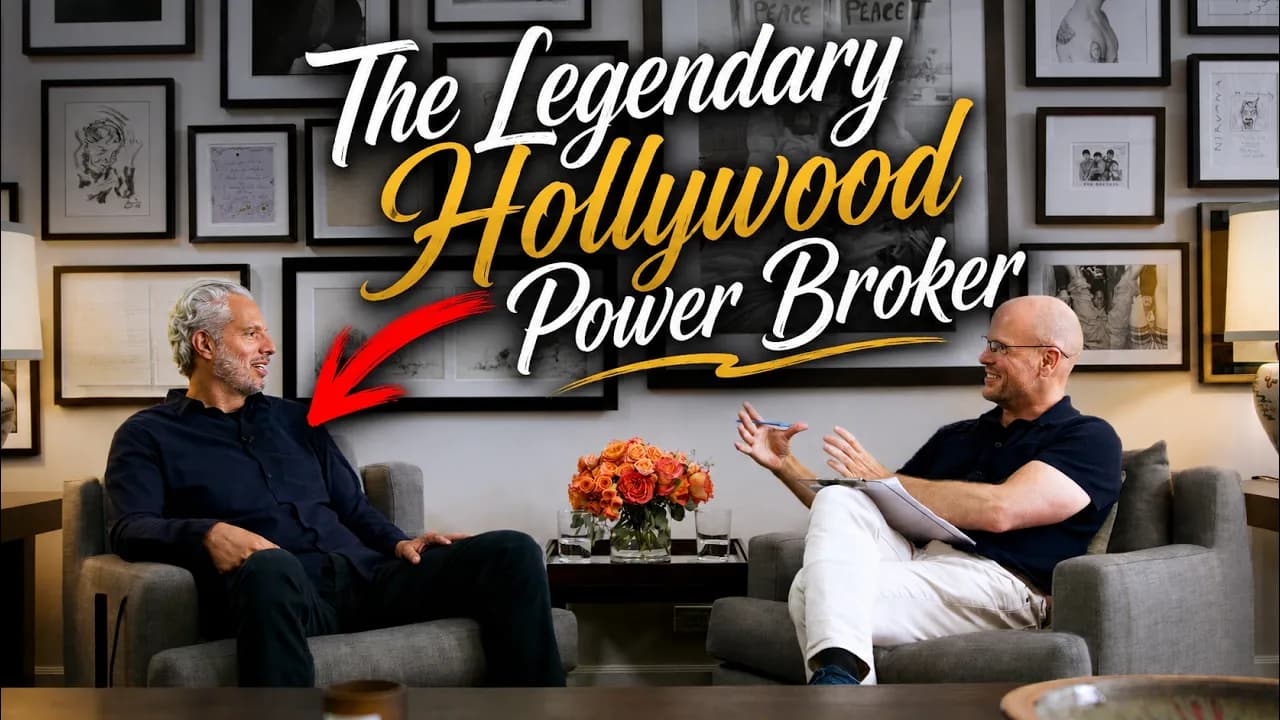
Building an Empire with Risk, Rage & 200 Phone Calls A Day | Ari Emanuel, WME & TKO
In a Nutshell
Ari Emanuel built a sports and entertainment empire through relentless deal-making and strategic acquisitions, most notably buying UFC for $4.2B and securing a $4B ESPN deal that validated direct-to-consumer sports media. His success stems from "rolling calls" relentlessly, creating serendipity by reaching out to powerful people, and applying lessons from mentors like Egon Durban—particularly the principle that being slightly aggressive and missing a deal is forgotten, but losing one you should have won is remembered. Personal transformation through therapy, meditation, and psychedelics helped him manage rage and insecurity, enabling him to build TKO Group Holdings while maintaining the same intense work ethic that made him successful.
These notes were generated by AI and may contain inaccuracies.
The UFC had taken off on Spike TV with the reality show and fight notes. The term was up and a meeting was called with Dana White, Lorenzo Fertitta, Frank Fertitta, Ari Emanuel, the head of Spike at the time, Phil, and one other co-CEO. The team pitched that UFC should be considered a sport rather than a reality show. Phil responded that Spike had made UFC and if they left, Spike would get somebody else and replace them. Dana and Lorenzo were ready to explode from the insult, as they had put their heart and soul into the company and Phil's comment implied anyone could recreate Dana White.
The meeting ended and Ari called Phil asking what he was doing, noting it was an easy ask to double the money since UFC was their highest rated property. Ari had previously represented WWE and moved it back to USA, which led to a lawsuit with Barry Diller. Dana was boiling at the offensive notion that somebody could replace him. Phil ultimately destroyed the company by letting go of everything of value and buying bad stock, though he made money buying it back from $80 down.
UFC moved to Fox in an incredible deal at the time. After the Fox deal was made, the world blew up. The team thought Fox would have to make the deal because they owned RSNs and local station groups, and UFC had significant play on the network. Rupert sold the business to Disney, eliminating the economic need. President Trump slowed down the AT&T deal. Comcast didn't want it because they already had the sports they wanted.
Ari signed Dana but later with Egon Durban bought UFC for $4.2 billion. Everybody was calling them idiots for overpaying. Ari had been involved with the company for 20 years and knew the network business and how much Fox needed UFC. The biggest competitor was the Chinese. Ari thought it would be Warner Brothers and Jeff Bewkes, and TNT wanted it, but Egon said it would be Fox because it was already on Fox and an easy transaction. Jeff Bewkes was downsizing to sell the business and didn't want to do the deal. They got it for a little cheaper than the Chinese bid at $4.2 billion.
The hardest thing was Brexit happening and the banking system falling apart. Egon stayed steady because he believed in distribution and the value of sports. They pieced it together with Michael Dell doing the preferred. Henry Kravis and George Roberts from KKR backed Egon and Ari. People were saying it was the most expensive deal in sports history and they were crazy. Ari became physically sick from the stress, having put clients into it and all chips on the table.
After the deal closed, there was nowhere to sell the television rights. Netflix wasn't in sports. They almost had a deal with Jeff Bezos for $260 million that was negotiated for 4 months, but it went to a committee and came back at $140 million. Ari went crazy and confronted Jeff at a party, but Jeff wasn't going to override his team. They pitched ESPN with Kevin Mayer and John Skipper. Mark Shapiro told Ari he was lying to himself and not listening - they had passed. They pitched Disney, but John Skipper was shining them on because he didn't like UFC, calling it human cockfighting. Skipper got in trouble and Kevin Mayer took over, wanting to go direct to consumer.
Kevin Mayer called with the price they wanted. Ari slid the phone over to Mark Shapiro during a pitch to Bob Bakish at Viacom, where they were pitching to reinvent Spike as a sports channel. The deal was $300 million. They negotiated over WhatsApp while on a plane with Bob Iger and Kevin Mayer. It was eight episodes on ESPN and the rest behind the paywall on ESPN Plus. Dana refused to do eight episodes and demanded ten, saying he wanted stars on ESPN so people would understand the sport and buy the paywall. Ari went crazy on Kevin, who turned white. Bob Iger told Jimmy Pitaro to give them the ten episodes. Dana was happy.
At the celebration, Ari confronted them about making him and Mark pitch pay-per-views when some were going behind the paywall. Bob Iger asked if they could buy the pay-per-views too. Monday they bought the pay-per-views. It was a 7-year deal worth almost $4 billion, nearly the purchase price of UFC. The deal validated that direct-to-consumer was the direction the world was going. From the first approach to Disney/ESPN to closing was three and a half months.
Writer deals in television that Ari started with took 3 weeks during upfronts. The UFC deal and IMG deal each took 6 months to a year. The merger took 4 years.
In 2003, they went to a Harvard professor who laughed and said there was no such thing as a merger - there's an alpha and beta, conqueror and conquered. Patrick and Ari spent 4 years stealing clients and agents from William Morris, weakening them. There was dissension on the street. Ari screwed up the first meeting badly by going crazy, which pushed the merger out 4 years. Patrick was perfect in that meeting.
After meeting with a senior agent at a Jewish holiday event to break the fast, Ari Emanuel reconnected with Jennifer Walsh, who ran their book division. The renewed discussions moved quickly over approximately six months, as the agency was experiencing significant internal disruption and dissent. This internal conflict allowed Ari and Patrick to position themselves as conquerors in the situation. Egon's involvement in their company enabled Ari and Patrick to economically incentivize staff and take control.
The deal between William Morris and Endeavor was approved by both sides' votes, but before closing, they realized they couldn't proceed with the current leadership structure on the William Morris side. Peter Light in their music department and Mark Gitkin in non-scripted business were identified as critical to retain. Ari held separate meetings with both executives, bringing them to their side of the fence because they were unhappy with existing leadership.
Patrick was instrumental in maintaining momentum when Ari developed cold feet. Four years after the failed 2003 meeting, Patrick sent a memo requiring Ari to be on all head of studio calls. When Ari became nervous about the merger, Patrick confronted him in the third-floor conference room, challenging him with "What? You don't think you can take this guy out?" This confrontation provided the emotional wake-up call needed.
During negotiations, they established clear terms regarding majorities and supermajorities for board decisions. William Morris had five votes while Ari and Patrick had four and a quarter votes. Jennifer Walsh and Patrick approached Jim Wyatt's counsel to inform them the deal wouldn't work. The 2008-2009 financial crisis provided additional leverage, as the world economy was collapsing.
Jim Wyatt received a $24 million buyout, which he accepted. Irv Win believed he would get Wyatt's position once he departed, but Ari and Patrick called to inform him he lacked the required two-thirds board votes. After negotiations, Win received a $20 million buyout. The total buyout costs reached $44 million during 2009, plus they lost a lawsuit regarding the shared garage with their competitor.
The buyouts, lawsuit losses, and bonus payouts of $20-40 million created significant financial pressure. Russell Goldman at City National Bank provided crucial support, having previously backed them with a million-dollar loan without collateral when they started Endeavor. When they needed funding for the merger, Goldman provided the necessary capital.
Fifteen to nineteen years later, when the bank was being sold to a Canadian company, Goldman requested some of their bonds. Ari needed $300 million worth of bonds to help Goldman complete his deal, and Goldman arranged this. They repaid him through these bonds as part of his transaction.
During the IMG deal negotiations, Ari learned that Peter Turner was bidding $1.9 billion while they were offering $2.3-2.4 billion. Egon Durban advised that the additional $400 million wouldn't be remembered and recommended making an offer that couldn't be outbid. This strategy proved successful, though they had concerns about retaining college business executives George Pine and others, which later proved unnecessary as the college business was worth little.
When raising funds for their events business called Moran, Ari's CFO became anxious about meeting fundraising targets. Ari advised focusing only on making calls, emphasizing they had a good product, story, and company with favorable market conditions. He encouraged continuing to tell their story, as it was improving daily.
Ari emphasizes not listening to the negative internal voice that creates guilt about family time, questions decisions, or undermines confidence. This voice tends to generate negative narratives that aren't based in reality. He references Brené Brown's work on how people tell themselves stories they then believe, though these aren't actual reality.
Egon's philosophy that "you're not going to remember the $400 million" proved transformative. Ari applied this lesson during another deal when an internal team member suggested lowering an offer, and Ari refused, quoting Egon's approach. The principle is that missing a deal by being slightly aggressive isn't remembered, but losing a deal you should have won is.
Ari notes that business projections are often wrong, sometimes in negative ways and sometimes in positive ways that exceed expectations. During the Disney-Cap Cities deal, ESPN was valued at zero but became the most valuable asset. In the Red Sox cable deal, the cable portion valued at $75 million proved most important. The key is maintaining flexibility and working through challenges rather than trying to predict every outcome perfectly.
David Geffen advised Ari during the William Morris merger negotiations when Ari was terrified: "Just merge with William Morris, get in traffic and get hit." This meant believing in yourself and partners, working harder than anyone, and surviving the challenges. Geffen's approach involves cutting through complications to identify the single most important action rather than overcomplicating situations.
Ari describes his approach to business development as "creating serendipity" by reading about people and reaching out. He called Michael Rapino after reading about him in the Wall Street Journal 25 years ago, leading to a lasting friendship and board position. This same approach led to his relationship with Mark Andreessen and subsequently Egon Durban.
"Roll the calls" refers to Ari's practice of having his assistant start dialing people who have called him, or calling his office from his car to begin making calls. This approach has been central to his career, as phone conversations lead to meetings that create opportunities. He views business as puzzle-solving, similar to assembling talent for films or TV shows, and applies agent skills to broader business strategy.
Ari acknowledges his dyslexia created fear about his capabilities, but working with partners and observing masters like Egon Durban and Michael Dell helped overcome this. He now sees running and building companies as an art form, comparable to how great artists create in entertainment.
People in their 60s like certain entrepreneurs are still active and engaged. These individuals have a very friendly interface despite their intensity. They spend hours teaching without obligation. They are remarkable human beings who operate as artists in their field.
Ari Emanuel loves capitalism and finds it incredible that certain parts of the population view great businessmen negatively. He rejects the notion that creating great wealth for people and the country is somehow wrong.
Emanuel shares that he is the son of a Cuban immigrant. Growing up in South Florida at age 9, he met people who came over on rafts. He describes the instinctual understanding that four children on a raft represents a one-way trip, and this experience revealed to him how special America is as a destination.
Emanuel wants to learn from these individuals. He discusses the concept of the "Ari Emanuel Rolling School of Entrepreneurship" and when he got the idea.
One of the first ideas came from his boss at InterTalent, Bill Block, who read the 1992 book Life After Television by George Gilder. Emanuel called George Gilder after reading the book. He notes his habit of calling people repeatedly until they respond, sometimes perceived as stalking, but using levity and humor prevents negative consequences.
Gilder discussed the business, leading Emanuel to realize when starting the company in 1995 that there would be more television and distribution would change. The same amount of people would make content, with new forms emerging like podcasts, social media, and micro dramas. Content creators would become more valuable. This premise was all he and his three partners needed to start the company.
Emanuel discusses his relationship with Michael Rapino, who grew a $200 million company to $40-50 billion. He describes how he lives his life by tapping into great minds like Rapino, Mark Andreessen, and Elon Musk. He called Musk after reading about him starting a car company and developed an incredible relationship.
Musk was talking about AI in 2007 and what it would become. He also discussed that live sports would be important. The only thing that cannot be disintermediated by AI is live entertainment, which gave Emanuel the idea behind Moran.
Moran is a separate company from TKO, doing similar things but in live events from art to car auctions to holiday events to tennis events. TKO is purely sports-focused, while Moran is an events business with some sports assets including the Miami Open, Madrid Open, Escape from Alcatraz, and collectible businesses like Freeze, Barrett Jackson, and Collectcon in the Pokemon space.
Emanuel spends significant time on both TKO and Moran. He continues doing client work because it's important for TKO. He has been doing all the work around Moran.
At age 24, Emanuel saw a job listing for assistant to a talent agent. He didn't know what a talent agent was initially. A friend of a friend explained what William Morris was. He landed in New York and realized it seemed like something he would be good at.
Three key takeaways from the book section include: Robbie had a similar school of entrepreneurship through dictation and writing letters to great minds. Someone older and successful told a young Emanuel that he had insane talent and drive, advising him to move west and build his own empire. The third element was getting to listen in on calls.
Mike Ovitz is on Mount Rushmore of agents. He created the packaging business in the movie industry along with Ron Meyer and Bill Haber. They had a vision for what the movie and TV business could be. There's a parallel to Emanuel's UFC experience where people initially viewed it as dirty or low class, similar to how the CAA was called "the TV guys" as a pejorative.
Emanuel reflects on why Ovitz didn't buy an advertising agency like Gray when he took over the Coke advertising business. He wonders if this would have added a new leg to the stool and changed the business. Emanuel and his partners realized they wanted to own an asset, possibly learning from what Ovitz didn't do.
Emanuel discusses listening to Ovitz's phone calls and the difference between Robbie and Ovitz. Ovitz, Ron Meyer, and Bill Haber's salesmanship was far superior. Ovitz had the ability to package movies and television in an unprecedented way, which was his genius.
When Emanuel asked Mark Andreessen what Ovitz's superpower was, Andreessen said he was the world's greatest agent, meaning the world's greatest salesman. Emanuel worked directly for Bill Haber, with Ovitz there, and notes that Ron Meyer was incredible as well.
When asked what he was doing at the same age, Emanuel's advice is: "Don't have the guilt that I had about not seeing your kids." He mentions being a more relaxed version than expected from the book, which describes him as a bundle of anxiety, fear, and not feeling safe.
Being hit by a car and almost dying led Emanuel to realize life isn't a dress rehearsal. At age 32, with his career going great and being physically fit, he realized it could end instantly. This started a chain of reactions about not being invincible.
Emanuel kept working on managing his rage and anger, realizing he wasn't enjoying it. He got tired of the rage and recognized that rage and anger would prevent reaching really big heights. He wasn't happy with how he was living his life.
The rage took a toll on his marriage. He scored a touchdown with four incredible kids, but didn't think he could progress as he wanted or build the company as envisioned in his previous state. He went on a path of meeting people who would help him become a better person.
Jeff Bezos told Emanuel that when you're on the field, be on the field, but when you're off the field, get off the field. Don't play the chess match or be scared of getting off the field. It makes you more potent when you're on the field.
Emanuel did a 5-day meditation retreat in India. The leader said: "You can't live in a world of war and anger and also in a world of beauty. You must choose. Do you want to live in a beautiful state?" The final advice was: "Do whatever you do for the joy, the artistry, or else don't do it. Then in serenity, move on."
Emanuel's dyslexia and identity issues from childhood were addressed during the retreat. Dr. K said he was really successful and should stop worrying about being found out or thinking he was stupid. In the 1950s, really successful people were considered great businessmen, not just people who could read.
Emanuel's father was an immigrant, and his mother was first generation. Education was everything in the family, but he wasn't great at it because he couldn't read. He held onto this insecurity for decades, which is common among top entrepreneurs.
As the middle child with an older brother Zeke and younger sister, Emanuel discusses birth order psychology. He was considered "the other one" compared to his smart brother and artistic brother Rahm.
Emanuel tried 5-MeO (toad/Bufo) psychedelic in New Mexico with his then-girlfriend, now wife. He asked his brother Zeke if it could kill him before trying it. The experience involves smoking it, reading a poem, going offline for 10 minutes, then tripping for about 30 minutes.
The experience helped Emanuel realize how small humans are in the world and how meaningless things can be in a non-negative way. It reinforced that legacy is meaningless and helped with the ego project more than Dr. K. It led to wanting a meaningful life, being happy, doing the best you can, enjoying life while working hard, and having purpose.
Emanuel disagrees with Mark Andreessen's view that psychedelics make founders work less hard, calling it complete nonsense.
Ari Emanuel reflects on how his perspective has shifted over time. He no longer worries excessively about legacy, recognizing that it will contain both good and bad elements regardless. When discussing the most important businessman of 1953, he correctly identified Alfred Sloan of General Motors, noting that few people remember even prominent historical figures like Sloan, and that legacy concerns are ultimately secondary to the work itself.
Nine months to a year prior, Emanuel co-created TKO Group Holdings with Mark Shapiro and other partners. The company operates with a clear vision and full commitment rather than half-measures. His daily routine remains intense, including 5:00 AM calls, workouts, office work, and additional podcast appearances. He describes his work ethic as undiminished despite any personal changes.
Emanuel emphasizes that he does not focus on accumulating wealth or comparing his financial position to others. He works hard because the work itself provides meaning and enjoyment. He describes being unable to simply sit on the beach, stating he would be miserable without active engagement in business activities.
Emanuel shares his favorite Ben Franklin quote, paraphrased as emphasizing that life consists of how time is spent rather than money accumulated. This perspective emerged after decades of therapy and following a DMT experience that changed his internal state. He references the Bezos concept of being on the field while learning how to get off it, noting that his work ethic persists even during vacation periods.
Emanuel discusses a podcast appearance with Cara Swisher, who experienced a stroke while flying in coach for a conference in China or Hong Kong. The incident occurred without warning at age 50. This event, combined with therapy and the DMT experience, contributed to a realization about prioritizing time usage over legacy concerns or wealth accumulation.
Emanuel describes his two-hour morning routine as essential preparation that includes 40 minutes of stretching, dynamic warm-ups, sauna, and red light therapy, followed by one cup of coffee. He characterizes this routine as his primary non-substance source of feeling good and performing at his best, contrasting it with others who might use different methods.
Mark Wahlberg approached Emanuel with the concept for Entourage, developed with his longtime manager Steve Levinson. The show was named by either Wahlberg or Levinson. Emanuel initially feared the series would damage his career and personal life, and his wife also disliked it. He avoided watching it initially but has since viewed the first two seasons.
Following the show's success, people began approaching Emanuel with lines from the series, including "Hug it out, bitch." The cultural impact extended to his brother, who was serving as a congressman and later worked in the White House. While initially viewing the show negatively, Emanuel acknowledges it opened doors professionally by making him recognizable and accessible to anyone he needed to contact.
The show's success eliminated cold meetings in Emanuel's business dealings. People now recognize him and take his calls, making it easier to present ideas and connect with others. He notes this created a generally positive impression that facilitated business development.
Emanuel draws parallels between his own experience with Entourage and the podcast's influence on entrepreneurship. Guests have reported that podcast appearances eliminate cold meetings for them as well. He cites investor Brad Jacobs, who raised $750 million from two listeners after his book appearance, demonstrating how podcast exposure can directly facilitate business connections.
When discussing his book with J.R., Emanuel chose to reveal personal details rather than present a sanitized version. He acknowledges that people may think they know him from his public persona, but he accepts this as the cost of authenticity. The book and Entourage together provide readers with an unfiltered view of his approach to business and life.
Emanuel states he never had a plan B, viewing his career as agency or nothing. He encourages others to adopt the same commitment, noting that building businesses involves significant challenges. He references Jeff Bezos's line that plan B should focus on making plan A work, aligning with his own philosophy of full commitment to chosen paths.
Keep David Senra in your library
Save the videos and channels worth coming back to, and find them again in one place.