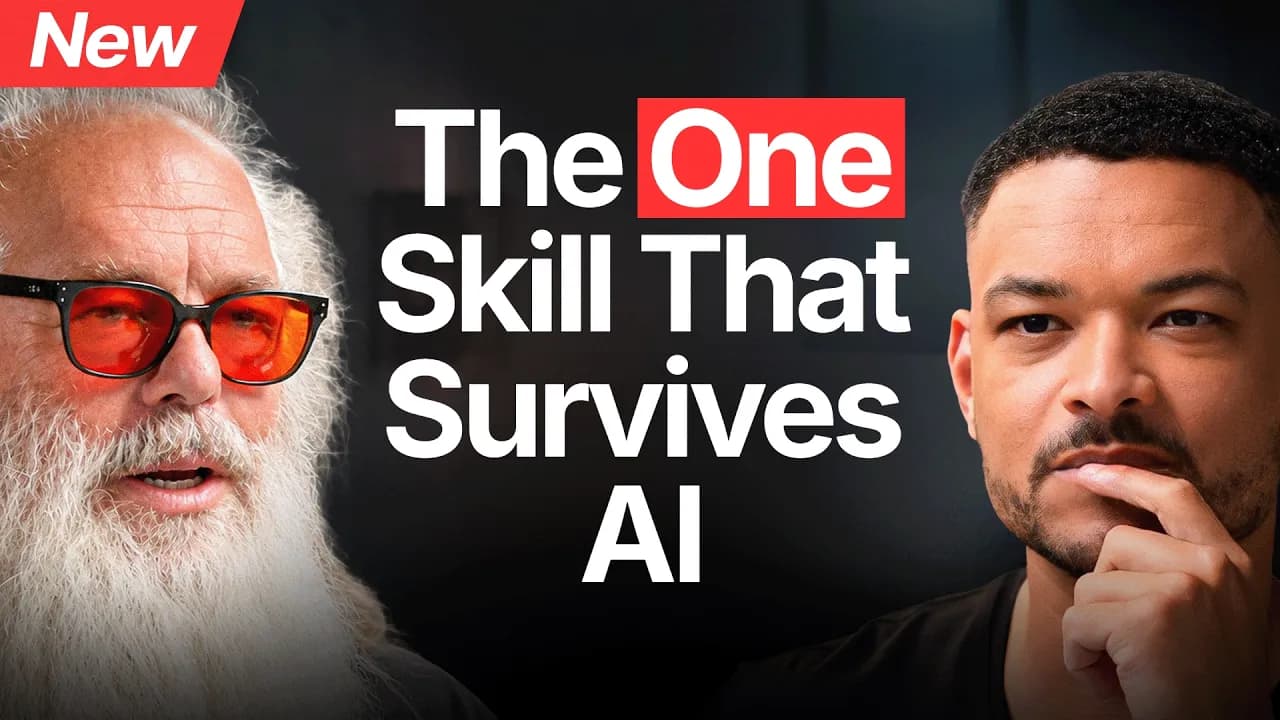
The Art of Unstoppable Self-Belief - Joe Santagato
In a Nutshell
Joe Santagato's core message is that self-belief isn't loud confidence or certainty—it's the refusal to let fear or external expectations override what feels right internally, even when the path is undefined. He dropped out of college without a backup plan, built a sold-out touring business with a six-person team, and consistently turned down misaligned opportunities because the internal voice demanding authenticity was louder than the fear of missing out. The key practice is starting imperfectly, treating every outcome as information, maintaining high standards without ego, and separating your identity from the work so you can keep growing without becoming trapped by success or comfort.
These notes were generated by AI and may contain inaccuracies.
Joe Santagato discusses his commonly mispronounced name, with people frequently saying "Santiago" instead. He mentions that if there is a famous Joe Santiago, this person might be losing credibility to him. Santagato describes himself as plain, white, Italian-Irish.
Santagato has one of the biggest podcasts in the world and recently sold out Madison Square Garden. He discusses potential audience crossover with the host, suggesting minimal overlap. He acknowledges having a recognizable face from being on the internet for so long, though people may not know what he actually does.
Santagato describes performing at MSG as surreal. He attended a Noah Khan concert there beforehand and couldn't imagine himself on that stage. He mentions the mental preparation required, including seeing a vinyl poster announcing the sold-out Basement Yard show, which made the reality hit. Walking through hallways with photos of famous moments added to the surreal feeling. His mother's reaction of "What are we doing?" helps keep perspective.
Santagato describes his audience support as borderline religious, noting the Patreon is top five in the world despite viewership not matching that metric. Every show has sold out except occasional casino shows. Merchandise sales are strong. Comments at big shows like Radio City and MSG feel like friends expressing pride rather than fanaticism, creating a parasocial relationship that feels genuine.
A report from Babland, a sex toy boutique, ranked Wyoming women as most sexually satisfied in America, followed by New Hampshire, Maine, Oregon, and Texas. The study examined weekly sex frequency, sexual experience ratings, number of sex shops per state, and adult boutique reviews. Santagato speculates boredom in rural areas leads to higher sexual activity.
Santagato discusses how states like New Hampshire, Vermont, and Maine have limited activity compared to urban hubs. He mentions visiting Portland, Maine and seeing a life-sized stuffed moose at the airport arrivals. He prefers taxidermy at full size rather than replicas, calling smaller versions cowardly.
During a camping trip in Bozeman, Montana, Santagato's group received bear warnings. They saw a baby bear upon arrival, which made one friend want to leave immediately. The group was advised that mother bears are more dangerous than adult males.
Santagato did a van trip in Washington where they slept in a van for a week, taking only two showers. They hiked at 3:30 AM with headlamps. The group discussed needing bear spray, which Santagato found concerning as city dwellers unprepared for wilderness situations.
Santagato fears being surprised by animals and prefers being prepared. He discusses squirrels' speed, noting that if they were larger, humans would be defenseless. He hates bugs, especially cockroaches, and finds tarantulas disturbing due to their multiple eyes, mouths, teeth, and hairiness.
Santagato's guiding principle: "Be realistic about where you stand, but not where you can go." He believes being honest about current position is crucial, preventing conflation of manifesting with actual capability. This humility helps withstand criticism. However, he remains extremely unrealistic about future potential, believing he can accomplish anything with enough work.
Santagato watched Ben Affleck and Matt Damon winning the Academy Award for Best Screenplay approximately 20 times. He believes he could achieve similar success if he applied himself fully, though he acknowledges it would require significant work. He uses this belief as motivation.
Santagato becomes intensely obsessed with goals. For Radio City, he knew the entrance song (Baba O'Reilly/Teenage Wasteland) a year before booking. He would cry listening to it during runs while visualizing the performance. He watches inspiring content repeatedly to understand why it resonates, treating energy as real and actionable.
Santagato has always felt he would be fine, even when not financially secure. His primary goal was entertainment work on his own terms, maintaining authenticity. He loves constructive criticism and views it as progress. When writing a script, he received eight pages of feedback from a collaborator explaining why it failed, which he found valuable for improvement.
Santagato's approach to ambitious projects involves dotting every i and crossing every t, aiming for the greatest possible outcome rather than just getting projects greenlit. He believes strongly in his collaborators and values their contributions toward extraordinary achievements.
The team remained intentionally small even during major expansions like touring, with only six people total and four making key decisions. Rather than accepting help from an outside company, the decision was made to handle everything internally to understand the full scope of work and avoid unnecessary costs. This approach proved successful over two years of touring.
Venues frequently expressed surprise at the minimal crew size, with comments like "it's just you guys" and noting that the group arrived at Madison Square Garden with only five people. While some venues provided experienced stage managers, others had limited technical support.
At a venue in Tampa, the on-site computer for uploading show assets was outdated and non-functional. The venue staff attempted to use a 1995 MacBook that also failed to power on. The team's photographer had to retrieve his laptop from the hotel to set up and run the entire show, demonstrating the challenges of operating without a full technical crew.
The podcast audience is approximately 70-30 female to male. Live shows skew even more heavily female, estimated at around 85%.
The first live show took place in New Jersey with 1,700 attendees. The overwhelming volume of audience noise was the dominant impression upon walking on stage. The sound level at Madison Square Garden was measured at 130 decibels.
Imposter syndrome is frequently cited by women as a primary area for personal growth and is the most common topic raised during Q&A sessions. Joe experiences a form of imposter syndrome, particularly questioning why large crowds attend his shows and feeling surprised by rapid success. However, this self-doubt does not create a ceiling on future ambitions.
With employees who have families, mortgages, and financial obligations, the stakes have increased. Despite moments of disbelief while standing on stage at sold-out venues like Madison Square Garden and Radio City Music Hall, the sense of responsibility to the team and audience prevents stopping or pulling back.
Fear is present constantly, though it diminishes with repeated exposure. The fear of not discovering full potential is stronger than the fear of failure. Opportunities have been declined due to fear, and the goal is to understand personal capabilities without self-imposed limits.
Initial nervousness about live performances stemmed from the contrast with editable online content. The concern centered on whether a two-hour unscripted performance could be delivered effectively. The decision to tour was delayed until there was a strong concept that would justify the ticket price and deliver genuine value rather than a minimal-effort show.
Money is not the primary motivation. The priority is ensuring the audience receives a high-quality experience rather than a phoned-in performance. Mailing it in would feel manipulative, especially if the audience still enjoyed it.
A memorable line states: "Control freak is a word that people with low standards use to describe people with high standards." This reflects the obsessive attention to detail in show elements such as emotional impact, energy, and music selection, even for shows not yet booked.
Obsession is distinguished from motivation and discipline. Motivation is relatively effortless drive, while discipline requires forcing action through willpower. Obsession means being unable to stop pursuing the activity. This feeling was strong enough to lead to dropping out of college.
Despite being a strong student at a Catholic high school with near-90 averages, no college applications were submitted. A semester at Queensboro Community College was attempted but abandoned due to an overwhelming internal resistance. There was no concrete plan or alternative career path at the time, as this occurred in 2011 before the influencer economy existed.
The internal conflict manifested physically, including sitting in a car outside the college unable to enter. A fabricated Barbara Walters interview scenario was imagined as a form of escapism, revealing intense desire for an undefined future without knowing its form.
The experience demonstrated having significant passion and ambition without a specific target. Many people in similar situations choose safe, conventional paths out of fear of having drive without clear direction. This can lead to "sliding versus deciding," where individuals drift into unfulfilling but secure situations while their passion remains unused and eventually diminishes.
Some individuals are genuinely fulfilled by traditional paths of college and stable employment. Those with persistent internal drive often must contort themselves to find outlets for their energy.
The drive produced a physical reaction against continuing college. Dropping out represented the first major instance of following an undefined excitement despite high expectations from family and community. This period involved multiple perceived failures in quick succession.
There was a period of intense self-questioning, wondering if the passion was meaningless and whether the individual was "full of shit." Sitting at home with parents while imagining future success felt delusional.
No five-year plan exists. Decisions are guided by the appearance of genuine excitement rather than obligation or predetermined goals. This approach feels more feasible after establishing some success and having the option to rest on previous accomplishments.
Life decisions have deliberately avoided paths taken purely out of obligation to others' expectations. There is a strong desire to earn achievements through visible effort so that observers recognize the work involved.
Current cultural trends favor nonchalance and ironic detachment, particularly online. Enthusiasm and visible effort are often viewed as lame or "too keen." This behavior frequently stems from insecurity. Willingness to try hard, fail publicly, and continue provides a competitive advantage because it allows learning from clear outcomes rather than maintaining appearances.
The sensation of putting full effort into something that began as an idea, was spoken aloud, and then materialized through dedicated work creates an unmatched feeling of accomplishment. Mark Manson's quote captures this: "Do hard shit not because it's fun, but because the win actually means something. You bled for it. You broke for it. You earned it. Easy wins are forgettable. Hard ones change you."
Reliance on AI for jobs, writing, and creative work robs individuals of the core experience they sought: the feeling of working hard and achieving results through effort. The process of improvement happens one repetition at a time, and watching older work reveals genuine progress that cannot be replicated through assistance.
Early episodes from 2018 recorded in an office in Newcastle, UK, demonstrate how far someone can progress over 1,100 episodes. A video analyzing these early episodes noted that the host didn't appear destined for podcasting success, yet this assessment proved incorrect through consistent effort.
A fan sent a screenshot of an early episode titled "Who the fuck is this guy" where the host discussed personal beliefs and podcast direction. The message praised that the host's voice remained consistent despite success and recognition. This authenticity was intentional from the start, chosen as the competitive advantage when few people were creating similar content.
When many creators were producing similar YouTube content, choosing an authentic personal approach felt like the only way to differentiate. Copying others felt lazy, leading to experimental work done in a personal voice. The principle holds that no one can outperform someone at being themselves, though many attempt to emulate others instead.
Attempting to replicate Mr. Beast's specific formula and style will ultimately fail because that particular approach already exists and belongs to him. Even if someone like Mr. Beast were performing rather than being authentic, copying them would still be inauthentic to the imitator. Inspiration can be taken and internalized, but direct imitation cannot succeed.
Growth requires the willingness to admit being wrong and change viewpoints after conversations. Everyone has something to offer, even through advice that gets rejected. Learning shouldn't be limited to heroes or successful figures; family members and people outside one's field can provide valuable insights about life and personality.
Attempting to control everything that happens proves impossible, but taking responsibility for personal involvement in situations remains within control. When something negative occurs, the choice exists between building walls and blaming others or extracting lessons from the experience. An example involves relationship betrayal, where examining one's own role in partner selection and relationship dynamics provides growth opportunities without absolving the other person's actions.
People often become defensive because acknowledging personal mistakes through reflection feels threatening. Blaming others creates distance from responsibility. Many situations involve self-betrayal through ignored red flags, dismissed advice, or insufficient attention. This doesn't indicate being a bad person, but it does mean lessons exist to be learned.
Converting negative situations into valuable learning represents a form of alchemy. Walking away from any experience with something useful that aids future situations makes the difficulty worthwhile. Even realizations about personal limitations or patterns constitute valid takeaways from self-assessment.
Creative projects often encounter rejection, which narrows future options and increases chances of eventual success by eliminating unworkable paths. Receiving specific feedback about why something failed allows improvement, provided the creator genuinely cares about the work. Defending failed ideas prevents learning and leads to repeated mistakes.
Close family relationships involve direct communication without behind-the-back grievances. Issues get addressed immediately rather than festering as grudges. A mother who transitioned from making decisions for her child to allowing mistakes while maintaining supportive presence created space for authentic development. The relationship evolved to feel more friendly while she maintained that parent and child cannot be friends.
Parents face the difficult decision of allowing children to experience consequences rather than constantly intervening. The impulse to protect persists, but recognizing when someone can handle difficulties becomes necessary. This applies whether the parent believes the child needs the lesson or has developed sufficient capability. The transition from being the coping mechanism to stepping back requires acknowledging that constant fixing can become enabling.
Moving into halls of residence or college provides built-in guardrails and support systems compared to moving directly in with friends. Students can approach a hall manager to request a different flat if needed. This represents another umbilical separation between parents and children, this time geographically, which can be significant for personal development.
For an only child from an insular, introverted family, this transition tripled socialization skills and understanding of the world between ages 18 and 21. The experience mirrors putting young children in pre-K for socialization, but at a higher level of independence.
Working from home can make people "weird" in ways similar to being an only child. Moving into a first real apartment can feel disorienting. One person bought weights and a bench but quickly got a gym membership half an hour away specifically to force leaving the apartment and avoid becoming isolated.
A single friend living alone sends random headstand pictures at 8:30 PM. When his fiancée leaves, one speaker finds himself walking around, cleaning, and struggling to know what to do with unstructured time.
Living alone leads to developing unusual hobbies. One person wrote extensively on post-it notes and performed headstands when left alone for the evening. Another person sneezed 15 times in a row after returning from dinner, which was described as both annoying and potentially dangerous.
Some people suppress sneezes internally, which can be concerning for neck health and eye pressure. One speaker's father would clean his ears with car keys before driving, was possibly deaf from the habit, and would sneeze 10 times while driving on the highway at 60-70 mph.
The father also drove a work van with no seats in the back, where the speaker and brother sat among tools, 2x4s, wood, a washing machine, and a miter saw. The father is believed to be allergic to the sun.
The father's entire tooth came out while sleeping. He put it in his sock drawer and went back to sleep rather than seeking dental care. The tooth was a back molar, not a front tooth. The family kept the tooth. American parents keeping children's teeth was discussed as potentially a British custom.
Nationalized healthcare in the UK provides free dental care, yet UK teeth stereotypes persist. American medical bills are cited as the number one reason for bankruptcy. One speaker joked about not paying medical bills, leading to discussion about potential consequences like property seizure.
Athletic Brewing Co. produces non-alcoholic beer. A full variety pack can be shipped directly with 15% off first orders using code "modernwisdom" at athleticbrewing.com/modernwisdom.
The creative side of the brain doesn't require separation from the business side when creativity directly supports business outcomes. Multitasking is difficult, particularly with background noise like TV and phone videos playing simultaneously, or air conditioning during movies.
Creative ideas arrive with such intensity that work must stop immediately to document them. One app idea was typed out in a car, causing the person to abandon a gym visit to go home and complete it. Greg received the idea and called it "the dumbest thing I've ever seen."
Most of the MSG comedy set was written immediately upon waking. The brain wave state just before sleep is one step away from flow state. Historical engineers and Nobel Prize winners used a technique of holding metal ball bearings over a plate while relaxing with eyes closed. As they drifted toward sleep, the bearings would drop and clang, waking them to work on problems.
The Flow Research Collective identifies beginning work within 30 seconds of waking as the easiest hack for entering flow states. This aligns with the advice to "sleep on it" for perspective after memory consolidation.
You can't white knuckle creativity.
Forcing creativity rarely works. The harder one tries, the more it recedes. Riffing is significantly easier than generating ideas from zero. Greg provides prompts and seeds of ideas that unlock creativity. The speaker cannot start creative conversations independently but can generate four ideas once prompted.
Writer's rooms work by having multiple people bounce ideas, with one diligent person providing structure. The creative person needs initial push points. Pressure helps performance, and the speaker prefers decisions resting on their shoulders. Most creative decisions throughout life have come spontaneously rather than through deliberate scheduling.
Joe emphasizes the importance of staying humble and not taking yourself too seriously while still taking the work seriously. He describes his job as a podcast host where he tries to be funny and entertaining, working with a longtime friend. While he takes the work very seriously because fans derive significant value from it and use it as an escape, he doesn't see himself as changing lives or the world. He wants to earn respect from others in the space and be good at what he does, but he avoids arrogance about his decisions. Even when achieving long-sought goals, he doesn't feel the need to say "I told you so" because his motivation isn't spite or insecurity—it's genuinely enjoying his life and helping as many people as he can.
Joe stresses that being content with this simple motivation is important to him. He wants to find new ways to help people while ensuring everyone involved remains happy. He believes that to entertain others effectively, the team needs to be happy. He runs his company with flexibility, ensuring people don't miss important life events like birthdays or weddings due to work demands. No one is late to obligations out of disrespect, and he maintains a loose work schedule with balance between work and personal life.
Joe views his job as an extension of himself but maintains it as a completely separate part of his life. His personal life, social life, and friends are very important to him. He rarely discusses podcasting or work when hanging out with people outside of work contexts. He doesn't watch many podcasts or YouTube creators because it's simply not what he's into—he maintains what feels like a normal life with this work existing alongside it.
He compares this to MMA fighters like Dustin Poirier and Michael Chandler—normal people who happen to have one extreme area of their lives where they become the most abnormal person on the planet in specific situations. He sees this separation as important and wants the people he works with to have flexible schedules so they can be creative, see their families, and have freedom.
Joe fully supports employees pursuing their own creative projects and believes his job becomes easier when everyone is happy. When touring, he books nice Airbnbs with pools and good views rather than cheap hotels because he wants people to look back on the experience fondly. He wants team members to have memories attached to these abnormal experiences, not just the work itself. He acknowledges this is a luxury since he doesn't have shareholders pressuring him about numbers—he can prioritize everyone's happiness and creativity.
When asked how to engineer fun without work becoming stern and overly focused on outcomes at the expense of the process, Joe explains that manufactured fun doesn't work. Trying to force enjoyment by saying "we're going to have fun" isn't genuine. Instead, he advocates following excitement and doing things that genuinely resonate. If something doesn't feel aligned, even if it pays well, he will decline it.
Joe shares multiple examples of turning down opportunities that didn't align with his values. He initially declined touring for years because he felt simply going on stage to talk with his friend for money wasn't authentic. During his YouTube career, he turned down a $75,000 brand deal for a zombie phone game because the brand wanted the ad placed in the first 30 seconds to a minute of the video, which violated his principle of placing advertisements only at the end.
He has declined six-figure deals when brands weren't aligned or when requests made him uncomfortable. He was once offended when people tried to incentivize him with money after he already said no, feeling they were trying to "buy" him into something he didn't want to do.
Joe recounts being contacted by The Rock's team to host a YouTube series called "Rock the Promo" involving wrestlers and promos. The opportunity involved traveling to LA for two weeks, which he initially declined because he didn't want to disrupt his established schedule and life in New York. Despite the opportunity to work with The Rock, he prioritized his routine. The Rock's team ultimately moved the recording to New York to accommodate him.
Joe notes that at the time, name-dropping in meetings bothered him significantly—he preferred focusing on whether the work itself would be good and mutually beneficial rather than hearing about past clients. On set, a PA mentioned his agent had warned the team not to name-drop around him, which made him reflect on the reputation he'd developed.
Despite initial reservations, Joe describes The Rock as genuinely nice. They joked around between takes to the point where the lighting technician asked how long they'd known each other. At the end of the shoot, The Rock referenced a script Joe had sent his producer (which Joe had forgotten about) and suggested they improvise a scene instead. Joe proposed a bit where he wasn't The Rock's first or second choice as host, gets offended, and ultimately receives a Rock Bottom. They filmed it in one take, and the video exists on Joe's YouTube channel.
Joe mentions he also received a Diamond Cutter from Diamond Dallas Page during his time at Elite Daily, where the wrestler came to shoot content and performed the move on everyone in the office.
Joe acknowledges some regret about initially refusing to go to LA, recognizing that at the time he was protecting his authenticity and doing what felt right in the moment. He gives himself grace, noting that even current decisions might look different in hindsight, but beating yourself up about past choices isn't productive.
When asked how to distinguish between authenticity and impulsiveness, Joe admits he doesn't think he always knew the difference. He makes an effort not to make emotional decisions—when angry and wanting to say no, he walks away to decide from a clearer headspace. He tries not to make decisions in spite of something or to prove someone wrong, viewing that as an insecurity issue. He considers himself a secure person when it comes to creative decisions and gives himself credit for following his gut and intuition successfully thus far.
He explains that if someone else—an agent or outside party—makes a decision for him that fails, he would be furious because it would feel like he let go of control. He prefers owning his failures because they result from his own choices. He values high conviction decision-making, noting it's better to fail with high conviction than low conviction because high-conviction failures provide learning and the ability to update approaches. Low-conviction failures leave you stagnant without developing decision-making skills.
Joe clarifies he doesn't believe he's always right—he believes everyone should trust their own intuition. If someone can genuinely sit
If you can really sit with yourself and you know yourself, you're right. Just believe that you're right and keep following that. Allow yourself to make mistakes, allow yourself to believe in yourself, and allow the belief to dictate your behavior. You'll be surprised where that can bring you. It drags you along when you can really say this is what feels like the right decision in this moment. This applies not only professionally but personally as well.
If you are sitting somewhere and you know you do not want to make an emotional decision and you have that awareness and you need to do what is best for you, what you truly believe in your heart, you are right. You have to be right because it is you. It is your life. You are in charge of everything. Everything is your fault. Everything that goes wrong is your fault. But what that means is that everything you get out of life is because of you too.
You should be happy for the good things in your life. That can get hard because when things start going bad, you feel like you are messing everything up right now. But it makes the wins that much sweeter. When people reach the point where they feel deeply about something one time and it ends up being right and they get the validation that it is correct, they realize they can do that. That is a huge moment. Feeling something so deeply, making a decision that way, and then it being the right path is powerful.
Instead of overthinking, stopping yourself, and saying no because of this, this, and this, just ask what is the thing you feel. Make it simpler. Authenticity is important because it reveals what is driving you. It seems almost selfish, but it is further back than that. It is not a self-serving thing. It is just something you believe and you need to see play out, not in a negative way like needing to get your way.
There is a belief that you are right and you can be wrong, but it does not change the fact that you believed. You get to a point where you are okay with being wrong because that is fine. The only thing you need is to believe something. That is how you feel about all decisions and every single opinion. If you have spent time with it and you have an opinion, you believe in it and will fight for it. But if something completely destroys it, there is no ego. You can get rid of it and keep the new one. You are willing to learn and grow. You want to be wrong because that is where the growth comes.
A lot of people want to live in a comfort zone that validates them completely all the time. Having comfort every single day of your life will not result in a net positive. It is only a matter of time before you get restless and create a problem because you do not have any problems. Humans are not designed that way. You need purpose and part of purpose is challenge. If your actions are just putting you back in your comfort zone, you are not growing. The innate human need for challenges and purpose will deteriorate your mental health if absent.
There are people on Wall Street making $80 million a year who still work 80 hours a week with $250 million in the bank. Part of it is understood because it is not necessarily about the money anymore, but work-life balance is very important. The goal is not to work super hard to have $250 million and then enjoy life later. You can enjoy your life now, hang out with friends, see family, and spend time. Sacrificing your entire life for the end goal of relaxing later means missing the point.
The parable of the Mexican fisherman illustrates this. An American investment banker at a small coastal village sees a fisherman with large yellowfin tuna. The banker asks how long it took to catch them. The fisherman says only a little while. The banker asks why he did not stay out longer. The fisherman says he had enough to support his family's immediate needs. When asked what he does with the rest of his time, the fisherman says he sleeps late, fishes a little, plays with his children, takes siestas with his wife Maria, and strolls into the village every evening to sip wine and play guitar with his friends. He has a full and busy life.
The banker, with an MBA from Harvard, says the fisherman should spend more time fishing, buy a bigger boat with the proceeds, buy several boats, open a cannery, control product processing and distribution, move to Mexico City then Los Angeles then New York City, run an expanding enterprise, do an IPO, sell stock to the public, make millions, and then retire to a small coastal fishing village to sleep late, fish a little, play with his kids, take siestas with his wife, and stroll to the village in the evenings to sip wine and play guitar with his friends.
The point is that life is often simpler than we make it.
A lot of people have their identity become their job. Self-awareness is important to avoid that. Separating the job, followers, and live shows from personal identity prevents becoming unlikable. The goal is to enjoy life. Passions and accomplishments exist, but the things that actually matter will never be sacrificed, such as missing a birthday.
What matters is making sure you are being a good person. When you pass away, you want people to say that was a good dude. You want to be as helpful as you can and make an impact, but the core desire is to be a good person and earn things because it feels good to put in work and get things back. That feels like a cool exchange.
There is a notion online that if you are 20 years old and not drop shipping, into crypto, and wearing blue tinted glasses, you are a loser. Life is not the Lambo. Everyone says they will get money then buy a Lambo, but you do not need to do that. Money will make you happy because financial security is a massive weight off your shoulders, but you cannot buy your way to happiness. Having a plane and cars does not fix being emotionally messed up from not spending time with family or working for a higher number in a bank account.
Being social, making new friends, learning new things, traveling, and putting yourself in uncomfortable situations is the only way to feel like you are growing. Growth and learning what the world has to offer is an obsession. Everyone has something to offer. The desire is to meet everybody and have a conversation with them. Deep conversations happen with strangers because that is enjoyable. One dream job would be to be a bartender in a slow pub to get to know regulars. That sense of community is valued.
A video on TikTok showed an old woman talking about pubs as the greatest thing because you go to your local pub, talk to people about problems at your job or relationship, talk to the bartender who gives advice that may be bad or good, and feel that sense of community. Different versions of that exist. You can never know everything. Everything changes. Everyone is different and everyone's right. If they believe they are right then they are. You are right for you but not for others.
The desire is to get out there, experience everything, feel uncomfortable because it is rewarding. Growing up in Astoria, Queens, where everything wanted was there and there were lots of friends in the neighborhood, meant rarely going into Manhattan. Something shifted toward wanting to see more things. Traveling began, including a flight from Paris to Mykonos where looking out the window revealed the world is massive. Pictures will not do it justice. The world is cool and there are cool people. The fantasy of going to a random small town in Ireland, walking into a pub, and making a friend is the greatest thing. You are lucky to live in a time where you can keep in touch with that person and now have a friend in Ireland.
That is the point. The job exists so that can be done. Being fortunate enough to do things like that now means being good. The personal need to create and make an impact must be fulfilled. If given the privilege of being more successful, more will be given back through donations to charities. There is no need for all the money. Joy comes from helping people and other people being happy. Being in a group where everyone is super happy is loved.
The mistake was once made of thinking everyone should want the same things, like being entrepreneurial and chasing passion. Not everyone is wired that way, which is the beauty of it. You cannot force that on people. The simplified version is to make yourself happy. Do not do it in spite of anything. You do not need everyone to do the thing you are doing. Run your game. Run your race and everyone else is running their race. Make sure everyone around you is happy. If you are content with one fish a day, nothing can be said against it. If not content with one fish a day, more fishing is needed. Just because you have not wanted it does not mean anything.
At a certain point, if what is wanted out of life is to travel, see people, learn things, talk to people, and have conversations, and it is being done, there is nothing to be upset about. Getting on a plane to have a conversation means doing the thing wanted for so long. Playing with house money applies. Do not get on the hamster wheel for the sake of getting on it where nothing is ever good enough. Free yourself up. If you are looser, things are easier to get done. Being strictly focused on needing to be creative right now to make more money misses the point. Find what you are doing and try.
The way of talking about self-belief can sound like being a freight train that has to do things one way and everyone get out of the way. It is not like that. There is more softness than that. Mostly there is fear and second guessing, but one foot is put in front of the other because there is a voice in the head that is so intense and loud saying do not be a coward, do it. That voice cannot be ignored, but it only exists internally. It is not a freight train externally, such as on set or when talking about ideas.
A conversation with David Deida, who wrote The Way of the Superior Man, revealed his eclectic career including quantum mechanics, pure mathematics, AI in the 80s, running a yoga ashram, coaching, family, authoring, and more AI work. When asked how to thread his path in a straight line, he said being out of alignment with that voice is so painful, physically painful, like someone's wrenching his insides. He has no choice. What looks like self-belief and bravery from the outside is actually fear of pain from the inside. The pain is being out of alignment.
The voice in the head is so loud that the thing cannot not be done because it says do not be a coward, go chase your dreams. If there is potential seen in yourself, discouragement never happens because the voice says just keep going, you cannot stop, you believe it. If you believe it, you have to keep going and see it through.
There was a point of being very experimental, trying different things creatively. There is merit in realizing along the journey where your strengths are. It is okay to pivot and do things that now make more sense and resonate harder because there is no way you have it figured out on day one. No matter what, planning will not make things go the way you think.
Creatively, people get into a rut feeling they have to keep planning to perfect something, but that is not helpful. You can only learn by doing, by trial by fire. Put yourself out there. You can plan a little bit. For example, if starting a podcast with a loose idea, start. Spending three months on strategy and dialing it in means you think you will not pivot, but you have not even started. You do not have it right. You need to start now because you will only learn those things by doing.
Joe explains that moments like walking out to a song feel like scoring a movie of his life. After the first show, he immediately told his agent he wanted Radio City Music Hall. When on a high after performing, he was ready to book Yankee Stadium without hesitation. The approach is to book the venue even when not ready, then work toward it rather than stalling the process to perfect something that cannot be perfected.
He describes how the decision to go on tour leads to immediate action the next day, such as talking to the agent about the process. While there is planning involved in what the show will be, the key distinction is not waiting to book until the show is fully written.
Joe emphasizes that shows change constantly, with 40% of content altered between performances. The only way to learn is by jumping in rather than over-planning. He compares this to getting a tattoo: the permanent nature creates doubt, but the decision comes down to saying "fuck it" and proceeding anyway.
He states that you are never going to be super ready or have everything fully dialed in. The approach needed is to do it and accept that it will suck initially. If you are lucky, it will suck, because looking back on early work and recognizing it as flawed indicates growth. No one gets it right on the first try.
Joe stresses that you cannot plan your way out of not sucking. You will look back embarrassed at times, and things will change anyway, requiring adaptation. The directive is simple: just start. If you want to be a rapper, be a rapper by making it your identity. People will associate your name with that pursuit. Being successful at it is a separate challenge that comes later.
The worry that stalls people is concern about what others will think or whether it will look cringey. The goal is to reach a point where you are okay with that possibility and believe in who you are regardless.
Joe acknowledges there must be a balance because unchecked belief can become problematic. The approach works without making someone difficult to be around when there are checks and balances, willingness to take criticism, and openness to listening. Everyone can teach something, so shutting up and listening is necessary at times.
If you can master believing in yourself while remaining willing to be wrong, it becomes empowering. Joe states he is okay with potentially reaching a dead end because he is already grateful for what he has and had nothing to lose from the beginning.
Joe recounts a meeting after being signed to William Morris where he told agents there was a chance he would say no to a thousand things they presented. He wanted them to know he was not intimidated and would continue doing what felt right, even while accepting help and guidance that resonated with his core approach.
He has missed out on opportunities by saying no to things that did not align, but he is willing to lose and learn from mistakes. Making mistakes is evidence of taking risks. Without risks or mistakes, there is no growth or excitement in the process.
When asked about struggling with self-belief and hearing gut instinct, Joe responds that it is normal to try, fail, and become scared because of past outcomes. The solution is to keep listening and keep doing what interests you. He still gets things wrong regularly and does not claim current statements are perfectly coherent.
He encourages laying everything out, being vulnerable, and accepting cringe moments because that leads somewhere real. He could say things people want to hear on podcasts, but that would not be authentic or valuable.
Joe describes how he was invited to a Spotify panel in LA and saw the host was participating. His brother had recently shared a link to one of the host's interviews, making the connection feel meaningful. He decided to pursue being on the show after meeting and feeling immediate rapport.
He views luck not as a magical force but as opportunity that was taken advantage of. Being on the panel was not guaranteed, but intentional action to connect created the possibility. If he had gotten in his own way by assuming the host would not want to interview him, the opportunity would have been lost.
Joe states that getting out of your own way results in opportunities appearing in surprising ways. Saying yes consistently eventually leads to connections and progress, even if nothing happens for years initially. Being a good person matters because people want to root for those they like and respect.
He refuses to surround himself with negative people or those who hurt others. Simplifying the approach means getting out of your own way, being confident and assertive while remaining humble and likable.
When fear arises, Joe suggests asking what the actual reason is and what you are afraid of. If something does not work out, you remain in the same position as before. Opening a door either reveals an opportunity or leads to nothing, which is neutral. The fear itself creates disadvantage by closing off needed opportunities and help from others.
Being assertive sometimes requires putting a foot in the door rather than letting it close. Knowing who you are, believing in yourself, and remaining humble are essential. Success can make someone less relatable, while failure provides stories and material.
Joe expresses appreciation for the conversation, noting he does not often discuss these topics on camera. The host describes the interaction as gravitational and electric, and values becoming friends with someone whose work he admires. Joe shares that he rambles about these ideas with friends regularly, and the conversation went in a productive direction.
Go on, press it.
Keep Chris Williamson in your library
Save the videos and channels worth coming back to, and find them again in one place.