Daredevil Michelle Khare — How to Become a YouTube Superstar
In a Nutshell
Michelle Khare built her Emmy-nominated YouTube series *Challenge Accepted*—featuring extreme stunts like recreating Tom Cruise's *Mission Impossible* plane hang and Houdini's water torture cell—through fear setting from Tim Ferriss's *4-Hour Workweek*, quitting BuzzFeed after preparation, and focusing on quality over quantity with a "category of one" blue ocean strategy that prioritizes defensible, high-production challenges no one copies. Key takeaways: mitigate risks via fear setting (define/repair worst-case scenarios), assemble a Formula 1 team of coach/mentor/cheerleader, master cold emailing for collaborations (credibility upfront, clear 3-part structure, phone CTA), learn all roles first (e.g., BuzzFeed), say no to scope creep for longevity, and thrive on "hard choices, easy life" like Jerzy Gregorek's mantra. Her path proves slow, steady growth with systems over willpower yields billion-view impact and creator sustainability.
These notes were generated by AI and may contain inaccuracies.
What are you putting off out of fear? Putting off quitting my job. Putting off reaching out to all the people needed to make this dream a reality because it means saying it out loud. Waiting for a false sense of security to inspire taking a leap. Actually being challenged to create own security. Never designed own rubric of success because don't trust self to define success. Scared to assume that responsibility. That's fear setting, a very personal process.
Michelle, at long last, here we are. So nice to meet you in person. This is exciting and surreal. Thank you for letting me infiltrate your podcast studio. About three years ago first put you and your channel in newsletter, Five Bullet Friday. Mutual friend Adam Grant repeatedly said have Michelle on the show. Excited to put in newsletter: "I'm so happy that someone finally cracked sort of this premise and did it right."
Challenge Accepted is a show where I attempt the world's toughest stunts and professions. Ranges from learning Harry Houdini's deadliest trick, the water torture cell, to training with the Secret Service for a week, to recreating Tom Cruise's stunt from Mission Impossible hanging off the side of a military aircraft as it takes off. More than 6 million followers, more than a billion views. Michelle hopes to prove that with enough dedication and failure, anything is possible. Characteristics appreciated: breakdowns, stumbles, falls are included—feature not a bug. Not just highlights, also lowlights.
Michelle's work earned multiple streaming awards including show of the year, featured in New York Times, Forbes, Vogue India, and more. In 2025, Challenge Accepted made history, successfully petitioning to join the prime time Emmy ballot. Named a Time 100 honoree for impact as creator and storyteller.
Rewind to Shreveport, Louisiana. Shout out Shreveport. Not much there. Intrigued because compelling tax incentives for filming. First exposure to the business: dad is big movie and television lover, learned English after immigrating from India by watching films, even on plane from India to America. Growing up in Shreveport, every Friday night at movies—blockbusters or low-rated Rotten Tomatoes B-side movies, kids movies, PG-13, saw it all. Then to pizza shop to talk about the movie. Homegrown film school: printed AFI top 100 movies, checked them off as watched with dad.
Tax incentives brought films to New Orleans and Shreveport—Twilight knockoff movies, one Scary Movie shot there. Town had economic art renaissance. Friends and family became extras. First job: internship on movie Snitch starring The Rock, out in 2013. Lowest on call sheet after PAs—PA intern, getting coffee, learning. Incredible experience, window into traditional Hollywood storytelling.
Hope to bring to Challenge Accepted: midpoint of digital freedom, ownership, but structure, understanding, respect of visual storytelling history.
Two reasons for this podcast relate to ownership. First: 4-Hour Chef, suicide mission deadline—book that should take three years done in one year, ran self into ground self-testing techniques, learning photography for hundreds of photos. Distribution hamstrung: largest title by then-nascent Amazon Publishing scared big publishers, boycotted by Barnes & Noble, all big box retailers. Did as well as could but limited.
At same time, debuted Tim Ferriss Experiment in 2013 through Upwave startup in Turner Broadcasting—weekly experiments. Internal problems, regime change, episodes locked up. Took 2-3 years to get rights back, self-published on Apple, did well.
Traditional outlets want to compress production schedule: takes 6 months or year, they want week. Have largely complete editorial control, choose positive constraints. Tim Ferriss Experiment: week per episode, led to injuries, compression pants, DMSO, impossible physically.
Two issues: production control and distribution control. Used podcasts to launch 4-Hour Chef—RSS feeds allow doing whatever, being self. That's how ended up here.
Human guinea pigging 4-Hour Chef while shooting Tim Ferriss Experiment, back-to-back with overlap. Pre-production while finishing 4-Hour Chef. First four-color book, 600-700 pages cut from 1000. Difference from 4-Hour Workweek and 4-Hour Body: did experiments while writing earlier sections, risky. Expected kneecapping on distribution, got TV deal before release using prior success leverage.
Few can empathize: Morgan Spurlock ( Supersize Me pioneer, rest in peace), David Blaine. Content not filmed in vacuum—life happens, jet lag, emails about next episode. Level of professional athlete unappreciated.
Building on experiential journalism models like AJ Jacobs ( Year of Living Biblically—suggested he redo as YouTube video), Morgan Spurlock.
Dizziness of freedom, paradox of choice: lack of constraints as bad as too many without framework. Working on 2-3 challenges concurrently: post-production one, planning another, middle of third. Editorial calendar for Challenge Accepted: 12-15 months from idea to upload.
Example: one day astronaut training for NASA episode—started with fighter jet in middle of nowhere California, threw up while closed, exited plane, drove 3 hours back to LA for ballet lesson. Training for multiple things at once.
Gift of choice: maximize milestone memories per year—makes life feel longer, better episodes, more revenue, opportunities. Athlete who thrives with coach and training plan, but business owner is both coach and athlete. Put Formula 1 team around self—like Max Verstappen needs mechanics and engineers. Assemble best people to challenge in business, relationships, content, story—decide how to spend each minute.
Exemplify focus on quality over quantity—borrowing best storytelling techniques and production quality from traditional, applied to digital native environment. Publishing fewer videos fights algorithm drive for frequency, economic incentives.
Keep lights on: AdSense, ad revenue; brand partners (editorial calendar helps forward-looking thematic deals); app among other things. Breaking mold like traditional TV on internet requires new financing approach.
Episodes take day to year to set up—how create Gantt chart? Production superpower. Antithetical to most creators: started uploading multiple long-form videos a week pre-TikTok, then short form. Tried growing for stability after leaving job—videos on anything thought would perform, with own lens.
Strategy: three videos a month for "studio," one passion project—like traditional TV where director does blockbuster then passion project. DM'd stunt performers like Tom Holland's stunt double for week training. Targeted undervalued communities—stunt performers often can't share work. Gave them highlight opportunity. BTS from Marvel movies manicured and short—wanted space for experimental process.
Passion projects outperformed expected videos. Limited resources, decided to focus only on Challenge Accepted. Inflection point. Season one retroactively named. Stripped everything else.
Key decisions when back against wall: had to decide or everything breaks. Risky to go all-in on show committing physically for months. Now release 8-10 episodes per year. Every opportunity big bet.
Created something unique—defining unique more valuable than consistency or mass viewership. Challenge Accepted gets lots of views. Scarcity mindset for advertisers: 10 episodes, limited inventory, sell at premium. Thesis: whatever we do has to be one of one. Importance of owning or creating
Category of one idea, blue ocean strategy—good exploration 10 years ago. Hard to start now what was done in 2014: broad exploration deconstructing world-class performers in interview format (now 600 episodes). For sustainability and premium from partnership/CPM perspective, model shows like Michelle's. If 20 now, would want Michelle's job. Other examples: Acquired, Founders (David Senra)—highly focused, long form, hard to replicate due to massive work. Same with Michelle's: spending six months on a video is complex, easier to publish frequently without long lead times.
Challenge Accepted strategy: do something so crazy no one would copy—run seven marathons on seven continents in one week and make a documentary; call FAA 300 times for permission to hang off military plane recreating Mission Impossible stunt. Untouchable things become opportunities for great stories of overcoming. Second mover takes long to catch up, becomes "like Challenge Accepted but..."—hard to overcome.
Hard thing is easier long term: solve hard problem upfront makes life easier. Applies everywhere.
Jerzy Gregorek and wife Anella Gregorek, Polish immigrants/political refugees to US with $10-100 in California. Both mid-60s, multiple world records in Olympic weightlifting. Jerzy: Indo board with fully loaded barbell, perfect Olympic snatch (heels together), drop and repeat—at least 65 now. Anella: daughter's ball in tree, ran up tree, got it, came down. No prescription meds.
"Hard choices, easy life; easy choices, hard life."
Applies to physical training/health, creation (defensible moat like Michelle's), startups.
Vibe code app in 20 minutes—experiment, barrier to entry lowered dramatically. But barrier to attention higher than ever. Hard startup (solving hard problem, good team, hardware) easier: most won't attempt, margin of safety if execute. Spend time on hard thing upfront buys safety.
Before YouTube, grew up in Shreveport, first taste of film industry. College at Dartmouth, internships in industry and Google (saw behind scenes of platform).
Google internship end: called everyone if get job. Group text: everyone got it except Michelle. Pivotal: life as athlete (follow coach), school (SAT books, 5am summer study)—immigrant mentality holy trinity doctor/lawyer/engineer for safety/instability. Led to BuzzFeed, first creative risk—fastest growing YouTube channel then.
BuzzFeed Role
Started intern, became producer: ideation, filming, editing, uploading. Learned all skills (home film school in Shreveport from dad Vet K not enough). Unlike traditional film sets (specialized, unions, yelled at for touching other dept equipment), learned everything—ingest footage or delete all. Helps as leader: empathize with depts (sound frequencies, boom pole setup).
Without BuzzFeed, straight from Google rejection to YouTube—exponentially different, wouldn't succeed. Advice: don't start company right after school. Get MBA/master's or job doing every role on someone else's dime—learn breadth in mature company (10-30 employees), make dumb mistakes first, increase odds.
Applies to YouTube/Visual Storytelling
Work at startup first, then own. For visual storytelling, get job at BuzzFeed-like place before YouTube leap—educational, define what enjoy/don't (list for company culture, avoid X/Y/Z). Challenge Accepted sets: digital mind (shoot for performance/retention) + storytelling (Hollywood lunch breaks every 6hrs, pre-production). Pain points fixed: voices heard, retention high, artistic expression/experiment/learn.
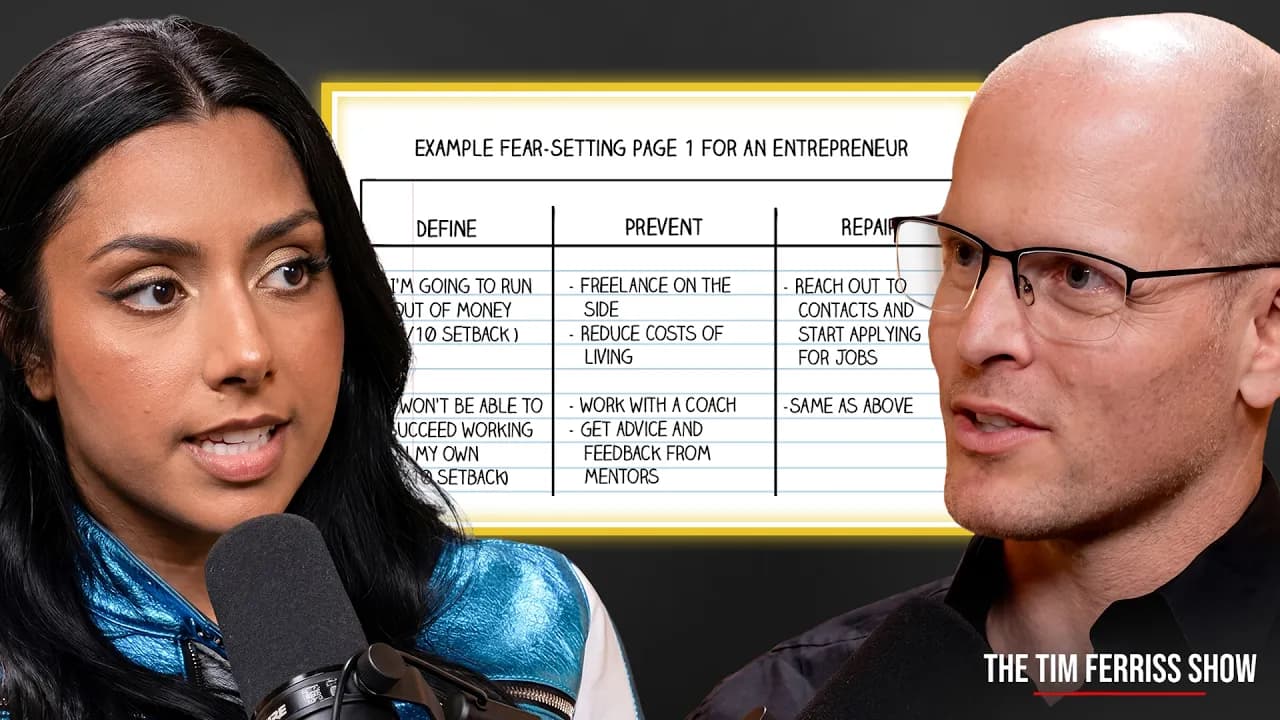
Fear setting fits: Challenge Accepted began with whiteboard of fears connected to circumstances addressing them—not just self-help (anxious person), but better story (Snyder's beats: vulnerability, all-is-lost moment). Thesis e.g., "want to be firefighter but not brave enough"—emotional core (burning building climax). Mission Impossible: brave enough to strap to plane like Tom Cruise?
Brought 4-Hour Workweek (2016 copy, borrowed/stolen from coworker—pristine, no annotations). Email to therapist Jodie (recommended book), March 18, 2016 (10 years ago, exactly March 31, 2026? Wait, prior to 2017 define/prevent/repair chart).
Dream: leave job, start YouTube channel, succeed, own ideas, start company grow as storyteller/help others without traditional barriers.
- Define nightmare: going broke, never figure best at (joy in trying everything vs specialize), people not think funny, not being funny.
- Repair damage: use Google internship savings, resume/LinkedIn ready.
- Fired today, financial control: savings, aggressively apply jobs (listed companies).
- Putting off out of fear: quitting job, reaching out to people (say dream out loud).
- Cost of postpone: emotional high stress, want resonant stories/creative joy/quality values, unhappy opposite environment.
- Waiting for: false security (brand collab, financial stability)—challenged to create own. Success in others' rubric, never happiness/own rubric—scared to define/trust self.
Fear setting (Stoics, systematized): identify fears concretely, prevent/repair to demystify nebulous anxiety, test under microscope.
"Guys, it works. It actually works."
Action immediate, quit job 1 year later. Train for worst: moved studio apartment roommate, stripped finances (cancel memberships, stay healthy solo), commit post-work/weekends stories—prove care. Built savings, mental/physical stamina, LinkedIn/resume ready, defined/prevented/repair planned. Quit exactly 1 year later: 2 months videos backlogged (own machine), first project training stunt doubles, shoot date, 3 months savings (dream project vs daily expenses)—back against wall.
Hypervigilance focus on safety/security—not big risk taker, risk mitigate, accumulated injuries that
Broadly speaking, always mitigate risk, which underscores the entire fear setting exercise. It's about convincing yourself while preparing and training yourself and your circumstances. When starting the first company, did it during lunch hours, evenings, and weekends while doing the other job well. Wanted a head start so not beginning from scratch after quitting. Simultaneously developing skills and proving no need for the crutch or training wheels of the company.
Moonlighting conflicts with how some might think, but difference between putting your back against the wall and burning all the ships and bridges. A year to the day, quit job in LA with groundwork set up, some videos ready, probably COBRA for residual health care, handful of months without paying for own healthcare. In fear setting, options if it fails: LinkedIn and resume ready, temp waitering job, bartend, sell furniture, sell used car and take public transport, sleep on air mattress in friend's room. Proven permanent irreversible risk is low while propelling toward defining decision of taking the leap.
Emotional stability important: brainstorm worst case from place of safety at job, be creative about solutions without panic.
It's a recipe, replicable, different for every person, but a formula that works.
At BuzzFeed, learned all different jobs. Benefit beyond expertise of spot-checking team: team respects you more because you've done the thing you're asking them to do.
In 4-Hour Chef (book about accelerated learning), profiled chef Grant Achatz (chef wunderkind genius) and Nick Kokonas (former genius options trader in Chicago, magical at cold emailing). Grant can work every station in the restaurant better than everybody else, improve systems, teach, coach, give feedback people take seriously because he's done it. Huge advantage, makes mistakes less expensive, allows hiring more effectively (contractor or full-time).
Channel like self-authored path. Damian Walters: former elite British gymnast turned stunt work, insane yearly highlight videos. Suggest connecting, though may have graduated from stunt work. Love for stunt community where channel started. Stunt coordinator today: Steve Brown.
In 2016, few months after cold email, at kebab shop in LA, sat at counter eating dinner alone, critically thinking about going off on own. Guy sits next, nice conversation, go separate ways. He goes on to choreograph stunts for Logan, Marvel projects, all Avatar films—and does stunt coordination on channel. Special to connect with passionate people before their peak and rise together. Between Avatar movies, straps to side of plane or throws in Houdini tank due to kebab friendship.
Speaks to putting yourself where action is. Bill Gurley (famous investor) talks about this: less likely in small town in Montana than LA. IRL matters: for tech talent, be in San Francisco. Virtual guy spent 17 years in Bay Area for tech and angel investing—success would have 0% likelihood otherwise. Best relationships started with chance encounters at barbecue or kebab shop equivalent (e.g., bump into someone, spill drink, conversation leads to 30% of net worth). Provide surface area for luck.
Barbecue, kebab, spilling drinks, key to success, 30% of Tim's chapter one. Chapter one, bump into people.
Practiced poverty: moved into shared studio apartment, got rid of memberships, proved can survive, not that bad. Reminds of Stoics like Seneca the Younger. Kevin Kelly (founding editor Wired, studied Amish, big Amish beard) used to camp in living room in sleeping bag with instant coffee and oatmeal for a week yearly: "Oh yeah, great. I don't really need that much." Gives courage, practiced skill. Subconscious must believe you can do it—can't just read books for confidence.
Formula 1 expensive ($250 million cars with everything). After quitting with 3 months runway, capital constrained first 3-6 months. Strategy for every challenge: Formula 1 team of three people—coach, mentor, cheerleader.
- Coach: Most important, find before pursuing (e.g., for black belt in taekwondo in 90 days, controversial in martial arts—find respected master. Spend all time with, learn from.
- Mentor: Recently done the thing (e.g., other students in black belt class who've broken brick with hands). Different skill from coaching; coach decades removed, hard to put in your shoes. Mentor led to finish line, knows being in arena.
- Cheerleader: Detached from outcome (e.g., best friend Olivia, sibling, family—roots for you no matter success or fail.
For channel start: mentors = other recent channel starters (50k-100k subs, met at YouTube Space meetups, peer groups). Reach out today for thumbnail/titles feedback—people couple steps ahead or similar helpful. Cheerleader: sister Maline, one who believed when quitting job. Coach: cold emailing respected people ahead (teaching/advising in small doses).
Love great emails; well-written email opens any door (assuming seen). Different from Instagram DM. Used cold emails to collaborate with FBI, Secret Service—first YouTube channels to do so.
For FBI video: went to FBI.gov, called 1-800 number (crime tips, didn't realize). Pitched: "Hi, my name is Michelle K. Trying to contact someone who works with film and television. Content creator, several hundred thousand subscribers, hoping to talk collaboration."
Connected through routes to Hollywood guy at FBI (handles film/TV to ensure seal accurate, not misrepresented). Did McMillions (HBO docuseries on McDonald's Monopoly fraud in '90s/2000s—peel stickers for prizes, all winners related/friends who gamed system; FBI uncovered). Retiring soon, said let's try it.
Surface area for luck: pinballs in pinball machine.
Subject line shows value (e.g., "Collaboration with Michelle Khare [X followers]", views, collaborated with institutions).
Body: three blocks of two sentences each.
- First: Who you are + legitimacy ("Hi, Michelle K., content creator [followers], done X,Y,Z."). What asking/offering ("Inquire to film collaboration"—offers audience access, marketing/recruiting).
- Second: What want to do (details: shoot few days academy, embed activities per protocol). Show homework (watched online: academy activities best for camera)—flatters, same language.
- Third: Call to action ("Hop on phone? Good time? Phone number, text anytime."—removes barrier, shows availability/trust, no formal email needed).
Nice email signature: sans serif font, little color (no Comic Sans, no Times New Roman).
Owe career to cold emails; translatable to in-person. Including cell phone: shocked how many interesting emails surfaced by team lack phone— no time for back-and-forth without offered time.
Include cell phone in the final sentence of the email, not tucked under your name, to truly invite them. Make it explicit.
Draw parallels to the email formula. Number one: credibility up front. For someone above your pay grade, use subject line tips. For example, reaching MrBeast or Tom Cruise—route through someone else. Use credibility indicator in subject line or mutual connection.
Example subject: "for Tom Cruise via Tim Ferriss"—mention mutual connection first because subject lines truncate on mobile. "Via" is good as it doesn't require vetting the referrer immediately.
If mentioning mutual connections, assume the recipient will text them to verify. They often do. If the connection says they don't know you or only met once, you're disqualified for misrepresentation.
Subject line: keep short, include via if applicable. First line: default to Mr./Mrs./Ms., something appreciative. Be polite—"yes sir" is safe. Avoid casual openers like "Hey Tim," "Yo bro," "Yo Ferriss"—risky, shows lack of awareness, reputational risk. Busy people have more opportunities than they can handle; don't disqualify yourself.
Casual familiarity feels like a stranger hugging you at the airport. Pro tip: don't hug strangers even if they offer a hand—assume maximum distance, like in Japan.
Subject line credibility, e.g., "for interview (1 billion+ downloads)" for podcast. If no big numbers, use examples of work showing homework done, e.g., "No one's watched this, but beautifully edited."
Early days: volunteer for organizations with name cache like TiE (The Indus Entrepreneurs) in Silicon Valley to use in subject: "for so-and-so via TiE." Invite them to speak for free. Highest paying jobs early on pay no money but in dividends.
Example: Volunteered for Silicon Valley Association of Startup Entrepreneurs, emailed Jack Canfield (co-creator Chicken Soup for the Soul, sold hundreds of millions copies as franchise). Met him, still friends 25 years later; he introduced agent who sold 4-Hour Workweek after 26 rejections. Long-term greedy, not short-term.
Include text establishing who you are—don't make them scavenger hunt via links or attachments. Hyperlink achievements: "and I've done this thing" with link.
Reasons: Recipients get 1000 emails/day, no time; phishing risks—avoid making them click suspicious links. Example scam: fake "Tim Ferriss podcast invite," leads to Zoom for screen access to hijack Facebook for crypto scam ransom. Include text.
Be clear about the ask. Vague "let's hop on phone next Tuesday 2pm" shows no value for time, skepticism about follow-through.
Close: Make cell phone explicit, not in signature. Use burner or Google Voice. "Feel free to text anytime... promise not more than 10 minutes"—don't exceed. "If you've read this far, I appreciate it. If too busy, totally understand." Display zero entitlement—email is audition.
Follow-up: Once only, after at least a week. No repeated bumping. If no response, common denominator is your email; move on.
Cold email to Hank Green (sunshine, joy, human encyclopedia; groundbreaking in YouTube; spoke at Buzzfeed). Subject: "hello from Michelle Khare Buzzfeed."
Body: "I'm learning as I consider pursuing my own creative endeavor. Curious, what was the most formative pinpoint for you as a child to pursue this profession?"
He replied multi-page; ended "Thanks for the thoughtful question. No one's asked me before." Learned from his story; now peers. Even no reply practices communication, makes great story.
Tim: First 5-10 cold emails just to improve. Asked better-known folks to critique emails at events: "Would you critique this? Sent to a couple, low response. How to change?" Concrete, not setup for real ask.
Avoid clickbait setups like "loved your sweater" then pivot to pitch.
Hank Green: Reach out to those who already mentor. If response, be patient—treat like dating in 1800s Downtown Abbey, not sex party. Don't reply instantly with 10 questions. Life is long; develop genuine relationships with a few people, not 100.
For narrative arcs in YouTube/long-form: Study Survivor—reality docuseries, best ever, Jeff Probst GOAT. Lessons: Curate hundreds of hours footage into story beats (kill your darlings); hosting; act breaks; why certain storylines chosen.
Probst: Fan/researcher of contestants; at Tribal Council recounts decades-old details to open them up. Masterful interviewing.
Michelle's HBO Karma (kids survival show, produced by JD Roth): Hosts research binders (headshots, family); notes in MCR trailer with live feeds.
Syllabus: Watch Survivor weekly, discuss.
Study Snyder's Beats and Save the Cat—understand story bones (hills/valleys, all is lost). Applies to all storytelling: books, 5-second Vine, cat video—premise, upend, resolution, character changed.
Even a video of a cat leaping off something and doing something crazy has a beginning, middle, and end where the cat is different at the beginning and the end of that America's Funniest Home video clip. And that's why we like it.
Third part of the syllabus: everyone brings a piece of work released online within the last week that impacted them. Assess and dissect: Why did this YouTube video speak to you? Example: "I wanted to learn about how the coronavirus spread originally and saw this video on Kurzgesagt." Break it down: title, thumbnail, why it stood out. Bring things that performed well or didn't to understand resonance. Attention is a valuable, finite, rare resource. Include discussion on relevant impact in recent media.
If project assignments, the most formative writing class had once-weekly lectures (2-3 hours) focused on structure, plus reviews of submitted work. Weekly writing assignments (3-5 pages) submitted at lecture start, followed by one-on-one with professor John McPhee. John McPhee: read Levels of the Game (about a tennis match involving Arthur Ashe); wrote books on oranges, handcarved wooden canoes, geology and nature of Alaska. Won one or two Pulitzer Prizes.
Assignments: e.g., find a sculpture on campus and write 3-5 pages. No further direction, forcing different approaches (history, subjective experience) while applying structure lessons. At lecture end, read uncorrected work aloud for peer review and professor comments.
Assignments: make content. Students create account on a platform. Define type of content: why uniquely yours, how different from others, data-backed by what others have done. Produce and post videos weekly (if class is to become a YouTuber). Peer review, see real-world performance, data analysis, educated guesses on performance, critique on work itself (e.g., why introduction worked, technique improvements).
Idea: small class, show short weekly videos, make predictions/hypotheses (invest in videos), modify based on feedback to refine thinking.
Radical Candor by Kim Scott; The Six Thinking Hats by Edward de Bono.
Six Thinking Hats: learned from Jodie (therapist). Filter thinking by type: yellow hat (things that could go well); black hat (things that could go wrong). Six techniques to assess ideas/solve problems. Helpful for default black-hat thinker (mentality: everything will go wrong, no creativity/entrepreneurship). Gives fair shot to ideas.
From design thinking class at Dartmouth: weekly wacky assignments, e.g., turn poster board into a chair supporting body weight (no glue, scissors, other components; cuts/shapes only). Professor Roby forced critical thinking on possibilities.
Both speakers found it helpful: used as virtual board of directors with different perspectives. Black hat has place, but structured time for each hat. De Bono also wrote Lateral Thinking.
Kim Scott in Mount Rushmore with Tim, Adam Grant. Quad chart for feedback. Quit job at 23, no manager training. Identifies with ruinous empathy: too nice, sandwiching/downplaying critique. Radical candor: direct feedback.
Workshopped critical feedback with Kim (e.g., "cut off that sentence, that's fluff").
Example: collaborator great at execution but doesn't compliment/uplift others (prickly, not vocalizing positives), creating unsure environment. Feedback: "You're doing great at communicating tactically, but missing emotional side that's important." Provides why (value), not just task.
Inspired by 4-Hour Workweek virtual assistant chapter. Full-time: 7 (Michelle, Garrett - chief creative officer, Nick - head of production, 3 editors, 1 assistant). Slinky operation: tight core, balloons for big projects (e.g., Mission Impossible stunt: camera team of 7, stunt team of 6, total 50), then shrinks. Internal team are department heads who staff up.
Nick (head of production): from Broadway Video under Lorne Michaels (Taco Bell Super Bowl commercials), understands feature film/high-budget commercials. Others like Michelle, editor Ryan Gonzalez from digital-first content studio (fast output, do everything). Bridge between traditional entertainment and digital worlds.
Giant spreadsheet from The Great CEO Within. Outlines every action (e.g., decide brand deal worth, take out trash) - hundreds of responsibilities, who does what.
Garrett (chief creative officer): defines creative tone/thesis; oversees episode story, directs episodes/post; updates brand book, marketing materials (e.g., Emmys for your consideration event) for cohesive Challenge Accepted story/quality.
Nick: when greenlighting episode, assembles crew, insurance, permissions, logistics (e.g., seven marathons on seven continents in one week: local crews). Handles cash flow, branded partners. Touches many things, like head of ops.
Privileged to be happy now, loves industry evolution, content creator profession, convergence of traditional/digital. Wants longevity like Tom Cruise, David Blaine, Jeff Probst, Richard Branson (50s-60s, keep going). Help lengthen list of women with such careers.
External to channel: bridge supporting legacy studios/companies understanding creator world; mentor burgeoning creators (share wins, learnings, spreadsheets, skip mistakes). Lead by example.
Excited for next 3-5 years, arrow headed there.
Decisions on episodes pursued, overlap. Host example: realized could easily scale podcast episodes (4/month easy, up to 6-8 for revenue growth, high margins). Did so, funded science/foundation, offsites. But subtle energetic change: dragging feet, becoming job (unpleasant sense), even if batching works. Easy in small operations not dependent on venture financing.
Tim Ferriss noticed a subtle energetic change while producing his podcast: he wasn't exhausted but started dragging his feet, and it became a job in the unpleasant sense. This is common in small operations not dependent on venture financing. He could make more episodes work by batching, but batching prevented retaining, studying, using, and applying learnings from conversations. Batching led to fatiguing days or weeks. He stepped back to four or five episodes a month, enabled by his financial position. This was crucial for the podcast's longevity (now 11 or 12 years) and his enjoyment.
Tim asked how Michelle thinks about what drives the show's work product, as priorities change (e.g., family, professional motivations, team advancement). Pitfalls are gradual: scope creep from adding features, obligations, or splintering focus removes time and energy for other goals. Michelle agreed.
Tim empathized, sharing he flew 73 times last year (a record for him), with no real vacations. His wife Kim Scott advised: when sent abroad, take at least 6 hours a day for yourself (not requiring an extra day). He did this last week in Italy for a speaking engagement with friend Olivia, seeing the whole city.
Avoiding scope creep requires precision amid shiny objects like collabs, merch lines, or brand deals (big checks for products not fully endorsed). Being brutal: if unprotected, everything falls apart—not from fragility, but fractured trustworthiness, which cannot be bought back. Examples of pitches: licensing Challenge Accepted brand for a kids channel (sounds great on paper, but requires getting in the weeds, feedback, no time). Must stay focused on tip of the spear: making Challenge Accepted the best show—emotionally, financially, socially important. Had to say no a lot.
Saying no is still a learning process. Michelle has never experienced creator burnout like colleagues who hit the wall and take months off (knocking on wood). Channel growth has been slow and steady, not overnight TikTok blow-up, allowing adjustments to scope creep.
Tim is confident Michelle will figure it out due to:
- Inbuilt novelty in show format: every episode changes her life (e.g., now training for Taekwondo Nationals, flying back to LA for 3-hour training tonight). Avoids fatigue of narrow lanes, pretending to be someone else, or audience capture.
- Willpower and discipline are overhyped; systems beat dreams and goals. Her format has inherent cycling and rejuvenation.
Tim's guest lectures at Princeton High-Tech Entrepreneurship (basis for 4-Hour Workweek) started as "Drug Dealing for Fun and Profit" from his bootstrapped sports nutrition company. Professor Ed Zschau (had him on podcast) invited him as the bootstrapping example among venture-backed peers. Tim felt unqualified but was valued for proximity to students.
Throughline: owning everything you do. Tim is constitutionally allergic to debt/venture, avoided credit cards post-college initially (thought no debt = good credit). Never carried a balance except briefly.
Class opener: "How many want to be a salesperson?" (Princeton EE/operations/finance class, no hands). "How many want to be good at negotiating/deal-making?" (all hands). They're the same: everyone must be salespeople (selling positions, yourself romantically, persuading).
Michelle has honed sales/communication via cold emails. Has Kim Scott for honesty over people-pleasing (ruinous empathy). Tim leans that way too. Don't learn to steer when ship heads to burnout iceberg.
Kim's book (upcoming): saying yes to everything breeds resentment toward others (self-created). Tim's 850-page notebook (to be hacked down, tactical templates) has test readers still using it months/year later.
Saying no is a practice like working out: fall off wagon, focus on getting back on. Book on no: case studies/toolkits for renegotiating/canceling (harder than initial no, long-term vs. short-term pain).
AJ Jacobs' Esquire piece "I Think You're Fat" (30 days radical honesty experiment): told wife he stopped listening 5 minutes ago. Wife saint for enduring experiments; excess becomes opposite.
Michelle's first Twitter handle: Mindy Kaling fan (now changed). Paths parallel: same college, Indian women in entertainment. From Shreveport, Louisiana, didn't see herself on Disney Channel; The Office shifted view (Bollywood thriving, but U.S. example key). Mindy spun The Office into production company uplifting female stories. Michelle started at media company, now independent, shifting culture for Indian women/content creators. Loves upending expectations (YouTuber surprising viewers).
Compares to Shonda Rhimes. BJ Novak (on podcast) knows Mindy; obsessed with both. The Office like PayPal Mafia density of talent.
Tom Cruise's Deadliest Stunt: Strapped to C-130 side, first to recreate Mission Impossible stunt (previously only Tom Cruise/Paramount). Hollywood episode: crazy cold emails, 3AM calls to foreign militaries for plane. Creative training: wind tunnels, custom scleral contact lenses (no goggles, multi-hundred mph winds; lens technician on set). Underdog story.
Tim: Study peregrine falcons (eyes/nostrils evolved; aircraft designed from them). He did falconry New Year's Day (hawks for beginners, stubborn birds build skills; like training non-intrinsically motivated dogs vs. Belgian Malinois).
Excited for traditional media to join forces with creators. Specific: Norland College (Royal Nanny School, England)—biggest fans, want to collaborate. Train nannies for billionaires/royals: Mary Poppins silhouette based on them. Wear outfit/hat, push pram while wielding gun, defensive driving (Secret Service meets Butler Academy).
If picking 2-3 to pay for again:
- Black Belt Challenge: 90 days to black belt in Taekwondo. From stunts with martial artists, realized gap in her skills/fortitude. Devoted life to it; transformative (body and person changed). Studied with Grandmaster Simon Rhee (believed/pushed her). Taught politeness: bow to mat, yes sir/ma'am—becomes practice.
It might sound gimmicky to someone on the outside but it does become a practice and an automation and a way of life and that's something I'm really proud of as a now black belt and grateful for it. I would pay to do that again and in fact I am because we're doing a sequel so I am paying to do it again and I'm trying to qualify for nationals this year with Mastery.
The other one I would pay to do again for the experience I had ultimately, not when I was going through it, is the Houdini challenge. For that I had six weeks to learn how to hold my breath and pick locks to attempt Houdini's water torture cell which famously is hanging upside down in a glass box filled to the brim with water escaping a series of lockpicks with one breath of air. That I would say is probably among the most physically challenging challenges I've done. Free diving, breath holding is a level of athleticism that is so bizarre to me because when you're in a workout class and it gets hard, they say, "Keep breathing. This is the one time you can't do that."
Ultimately, I got to 3:30 and most Navy Seals is like 2-3 minutes is pretty good. Houdini's best time was also 3:30. But on the production side, it was a really fascinating challenge because it was the first time we creatively designed our own obstacle and solution. In the beginning, we spent months trying to connect with other magicians on earth who own a water torture cell. There are not many. Ultimately we came to the conclusion of designing our own which was really incredible and creatively challenging. How do you create a glass box that can be filled with so many gallons of water and maintain the structural integrity when there's a person inside and function with all the locks and the hinges with water as an involved substance. It was a huge engineering challenge for our team and I'm really proud of the final result because both of those things are things I would have never guessed that 2016 me would have been able to do. First of all, holding my breath that long. Second of all, taking the creative liberty to design something that was inspired by a work of history but also our own.
Which one would you pay not to do again? The one I would say for me is episode one of the Tim Ferriss experiment in terms of filming. We had 11 or 13 episodes that we filmed in that number of weeks. Every week we were filming. It was 13 consecutive weeks. The first one was parkour. There were a couple of inherent problems with that. Number one, even if you tried to prepare your body for it, the impact of falling onto hard surfaces is very hard to train your body for even over the course of say a year with proper technique because of the connective tissue adaptations and sort of ligament and tendon adaptations that need to take place which require quite a bit of time. Secondly, the promise of the show was I haven't cheated, right? So, it's like I can't pre-prepare for it if I'm showing what it's like to start from zero. And I am still contending with injuries from that week to this day. 12-13 years.
I tore multiple heads of the quadricep in both legs and then continued filming for 12 more weeks. That included the Yabusami episode. The Yabusami episode was actually from a totally different TV show, a pilot filmed right after the first book came out with a production company in Singapore. It was kind of wonky. All of my experience transparently of the show has been in like online rips cuz much of this material is no longer available. All of the Tim Ferriss Experiment stuff. I got the rights back for a launch on iTunes as it was called back then and it was the number one non-fiction show when it launched for a while. Negotiating with a big behemoth where you just don't really have any leverage whatsoever. Ultimately getting the rights back completely so I could just release it for free on YouTube.
What would I pay not to do? First one is chess. I recognize the people who have sadness here. 99.9% of people in the Tim Ferriss sphere play chess. Everybody is on chess.com. When you go to these entrepreneur events, there's always a chess board. Everyone loves chess. Chess was very challenging for me. Originally I had one month to prepare for a competition and I did the month of training. I got to the competition. I didn't do as well as I had wanted. And something about the episode just felt empty. When you haven't gone the distance with something, you haven't given it your all. I continued training for nine more months, 10 months in total, to achieve this goal of my ELO rating and finally did it. I was studying so hard on the London system. I'm good to be a casual chess player.
The other one I don't think I'll do again is one that hasn't come out yet. The most challenging physical thing I've ever done is the seven marathons on seven continents in one week, which is going to be coming out this April as a three-part series on the channel. Specifically within that, the Antarctica marathon is something I probably won't do again. People got frostbite when we were out there. The sneaky sleeper marathon is most people think Antarctica is the worst when they hear about this challenge. But the sneaky one is marathon number six in Colombia. Historically people have gone to the hospital from heat exposure. It's marathon number six. So, you have five other marathons in your body that you have done in the five previous days before. They actually scheduled this marathon to happen overnight to try and avoid the sun. But because our flight was slightly delayed, we started around 3:00 a.m. And that meant we were literally racing against the sunrise. And the slower you go, the more heat exposure you have. 100% humidity. Psychologically, you feel like you're at the finish line cuz tomorrow's the finale. Tomorrow's Miami. Tomorrow's race number seven. But really, number six is the unexpected one.
There are the most unexpected people who do this marathon. There was a guy named Adrian for whom his first marathon he ever ran was marathon one of that week. He knew some of the race organizers and just decided to come along. Originally, he was going to run half marathons and just decided, I'm going to go for the fulls.
There are mutants for each of these disciplines. Professional high jumpers and I'm just looking at them and I'm like we are not the same species. Your attachment points and where your Achilles is. Everything is different and that's true for every discipline including chess. There's an 83-year-old man named Dan Little who does this event. It was his fourth time doing seven marathons on seven continents in one week. He's from Oklahoma and just the most incredible person you'll ever meet. So joyful and excited and he's the last person on course every day. He takes seven or eight hours to do the full marathon and he is smiling the whole time. The coolest things about our jobs is perspective. The people you meet, it really redials your compass.
If you're the average of the people you spend the most time with, it's like, choose those people really carefully. The older I get, the more I enjoy spending time with people who are doing things like that. Arthur Brooks, Adam Grant. They take fantastic care of themselves. With each passing year, the entropy that leads people to gather and just complain about their new aches and pains or how little time they have or how busy they are with the kids increases. I have a lot of friends who are counter examples. If there's only one counter example in the world, maybe it's just inevitable. But I've gathered five to 10 close friends who are all counter examples. From a personality perspective, from a life perspective, from a financial perspective, very different, which means if you want it badly enough, you can be the counter example.
Favorite documentaries? My favorite one is Free Solo. Alex Honnold, what you doing? Talking about counter examples here. I am just endlessly inspired by him as a person and I think Jimmy Chin's work directing filming it's just outstanding given the care and the sensitivity of the subject nature and how he executed it. For people who maybe watched the recent live Netflix climbing of Taipei 101, go watch Free Solo if you haven't seen it. Fun fact, I actually interviewed Alex about 6 months before he did his free solo ascent of El Cap. He was in that white van that is in the movie and freaked me out cuz he parked outside of my house. It's also before he got media training. Freestyle is an amazing movie to Chai Vasarhelyi. Chai is married to Jimmy Chin. She is in a lot of ways the filmmaker and Jimmy obviously without his expertise and these crazy complicated rigs and the ability to climb and actually be suspended around Alex. There are a lot of adjustments that need to be made with that. The Dive. They've also had some follow-up films that are just incredible.
I remember seeing a tweet when Alex did the Taipei climb that was like, "Everyone's freaking out about this. What if I told you this is actually not the craziest thing he's ever done?" Referring to Free Solo. Watch the El Cap climb. It is infinitely hard to any really seasoned climber. Taipei 101 is risky to climb with no ropes. The tower is dangerous if you make a mistake. From a technical perspective, it's actually not that difficult. Doing what he did on El Cap, it is very much in the death-defying category.
People ask, "What's something you wouldn't do?" I'm like, "I'm going to let Alex Honnold own the category of whatever it is he's doing." That category is well covered. The category of things I wouldn't do is pretty broad and it gets broader every day. After a few very scary avalanche experiences with backcountry skiing and heli skiing where people have gotten really injured and could have been buried, I'm done. Any real avalanche risk, I'm out. I'm out from Everest. There are many reasons I'm out from Everest, not the least of which is plenty of people have already done it. Why would I risk my life for something that's not even going to be a notable footnote for anything or anyone?
Book or books you've given most as a gift or recommended a lot? I have recommended Radical Candor to pretty much everybody I know who's a content creator trying to figure out their business. The other one is The Great CEO Within, which is a really fast and easy read. For anyone who didn't start in Silicon Valley or a startup culture or a startup of any kind was really helpful to me to just understand here's what a company is and how it works. And then I've given Adam Grant's Originals to a few people, too.
If you could have one giant billboard anywhere with anything on it. Could be a quote, nothing commercial. Everything you want is on the other side of fear. Very simple. It's what I return to when things are hard in any aspect of life and especially when I'm doing a challenge. It's a way for me to remind myself this is the struggle I asked for to make myself better at the thing I want to be better at. And it's also a reminder to move forward through it and not shy away from it. Challenge Accepted was born out of writing my fears on a whiteboard. I have a very intimate connection with that sentiment. I think about it even in an exterior capacity. When I get nervous about something, personal life, business, whatever, exterior to the challenge itself, I return to that often.
Where can people find you? You can follow me at Michelle Khare on everything. The three-part series of my experience attempting seven marathons on all seven continents in one single week will be coming out on my YouTube channel in three consecutive weeks throughout April and May. We're going for a prime time Emmy this year. We're on the ballot for outstanding hosted non-fiction series or special. I want to be a part of a future where it's not unheard of that a YouTube channel is going for something like this.
Michelle Khare is M-I-C-H-E-L-L-E K-H-A-R-E.
Anything else you'd like to say? I want to say thank you, Tim. It was really special to go back through the archives and realize that your impact in my life started 10 years ago and to almost to the date be meeting you 10 years later is really full circle and affirming for me. I hope that anyone listening can hear the very grassroots fear setting chart that I had for myself in the beginning. It's a special moment for me to reflect on the length of time it takes to do something special and how that commitment can lead you somewhere unexpected.
It makes me so deeply happy. I get so much joy out of the fact that you exist and you're doing what you're doing because it tests a lot of assumptions about a direction that I would view as pretty dystopian about online content creation. You're putting out long form positive life affirming non-fiction where you show that failure is not a terminal sentence. It's just feedback along the path. I'm such a fan of your work, such a fan of Challenge Accepted. I hope you keep doing it for a super long time.
Show notes, including some template emails for people in the show notes at tim.blog/podcast. If you search Khare, there will be only one response. Until next time, be just a bit kinder than is necessary to others, but also to yourself.
Keep Tim Ferriss in your library
Save the videos and channels worth coming back to, and find them again in one place.