Could This Be Bigger Than Botox?
In a Nutshell
Acorn BioLabs extracts 50 hair follicles from patients, freezes the stem cells at -190°C, and currently sells their secretions as $4,000 topical cosmetic treatments while storing the cells for future reprogramming into other tissue types. The company’s goal is to create a “biohealth insurance policy” of personalized stem cells that could later treat serious conditions such as diabetes, cartilage damage, or cancer. Storage costs about $190 per year, and all advanced therapies remain pre-clinical.
These notes were generated by AI and may contain inaccuracies.
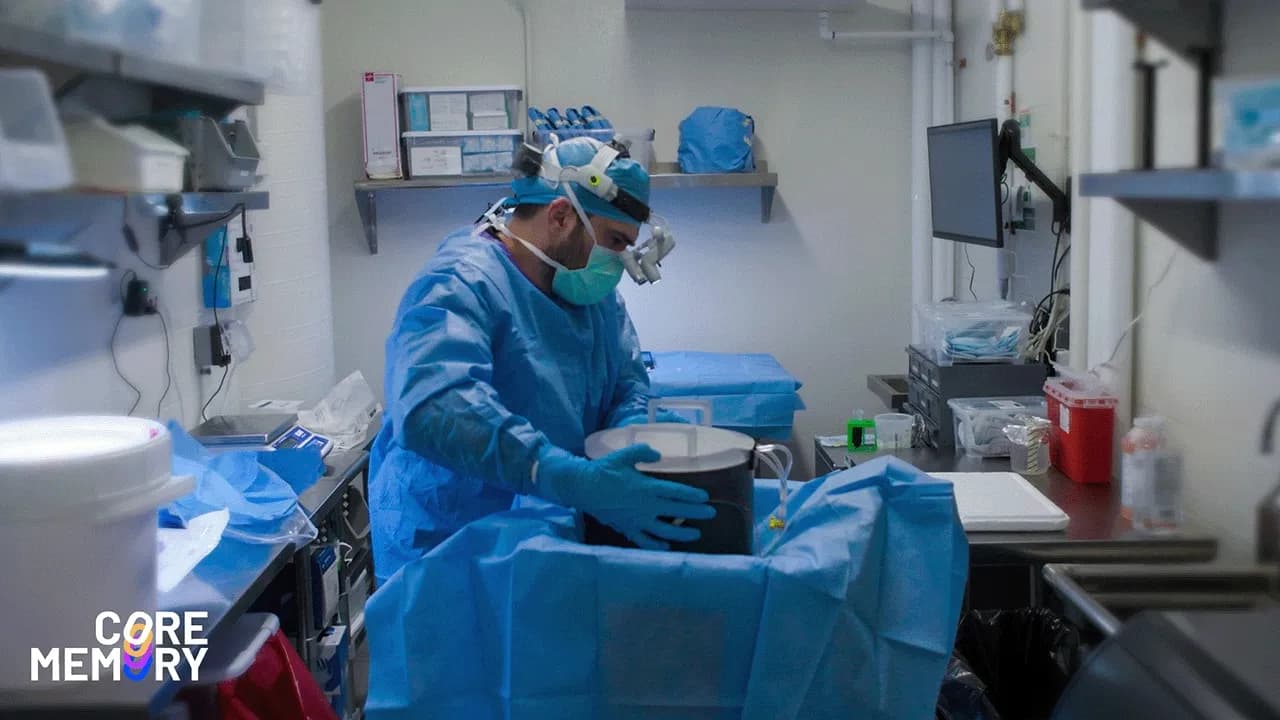
The video begins with a patient undergoing hair follicle extraction at Acorn BioLabs, located in the basement of Toronto General Hospital. The patient, who has previously had tattoos and Botox injections, describes the hair plucking process as "extremely annoying" on an annoyance scale of 20 out of 20, noting they feel fine but are hungry after waking up early and consuming mezcal the previous night.
Drew Taylor runs Acorn BioLabs, a regenerative medicine startup that uses a patient's own stem cells for experimental treatments. The company performs ultra-high-temperature cooling by taking a small sample of cells and freezing them to create a "frozen mold" of the individual. This differs from whole-body cryopreservation concepts like freezing Walt Disney's head.
The process involves plucking approximately 50 hairs from the back and sides of the head. Each hair contains a small root of living tissue including skin cells, connective tissue cells, and adult stem cells. These are mesenchymal stem cells, the same type found in bone marrow and fat tissue.
The extracted cells are cooled to -190 degrees Celsius (approximately -310 degrees Fahrenheit), which is only 10 degrees warmer than Pluto's surface. At this temperature, there is no metabolism, and the cells are "literally frozen in time." Acorn's facility houses thousands of cells in super-cooled tanks, stored in separate reservoirs for redundancy in case of catastrophic events.
Currently, only what the cells produce ("cellular secretions") is returned to patients as topical products for skin, hair, and scars. The cells themselves remain frozen for potential future applications.
In 2007, Japanese scientist Shinya Yamanaka discovered that treating adult cells with four specific proteins reverts them to an embryonic cell-like state called induced pluripotent stem cells (iPSCs). This breakthrough earned him the Nobel Prize. Acorn uses this technology with cells from extracted hair follicles, with the goal of reprogramming them into specialized cell types including cartilage, pancreatic cells, and immune cells that fight cancer. All applications remain in pre-clinical stages.
Drew Taylor's path to regenerative medicine was unconventional. He received an offer to play baseball at the University of Michigan for the Wolverines while planning to enroll in medical school. He later received an offer from the Toronto Blue Jays and briefly played for the Philadelphia Phillies before an arm injury (torn labrum and supraspinatus muscle) ended his baseball career. He then enrolled in a PhD program in regenerative medicine.
The cells are stored with extreme precautions due to their potential life-saving applications. While current uses focus on cosmetic purposes and wound healing, future applications could include treating serious medical conditions. The storage cost is approximately $190 per year, described as cheaper than Netflix subscription fees.
Some beauty clinics offer microneedling or hair follicle regeneration using Acorn stem cells as part of $4,000 packages. The cells are shipped in temperature-controlled luxury boxes. While no patient has yet used their cells for advanced applications like 3D-printed kidneys, the company envisions this as a "biohealth insurance policy" that insurance companies might eventually cover.
Dave Elliott demonstrates the collection process using patented vials containing sugars, salts, minerals, and antioxidants to nourish hair follicles during transport. The solution is compared to "first class with full meal service." The collection uses completely new sterile tools for each patient, which patients can keep afterward.
The proper technique involves using fingers to disconnect the hair line, pulling down following the curve of the skull in the direction of hair growth to obtain the bulb at the base (described as "like a small onion"). Beard hair collection is also possible. The process is described as requiring practice to perform correctly.
Each hair bulb is individually analyzed for condition before being sorted into different bottles for freezing. The cells are treated like "small factories" that produce compounds similar to expensive skincare products available at retailers like Ulta and Sephora.
Team member motivations include family connections to stem cell research. One team member's mother was a stem cell researcher, and another has a brother with childhood diabetes, leading to programs converting hair follicle cells into pancreatic cells. A team member undergoing breast cancer treatment sees potential for converting stem cells into immune cells to fight cancer.
Dr. Jim Miller, his wife, and son Tripp represent the personal motivation behind Acorn's work. Tripp's cells were collected and transformed in the laboratory into other cell types including cartilage and bone, demonstrating the technology's potential for family members.
The company operates within Canada's context of strong university funding for innovative technologies but faces challenges in reaching profitability and expansion stages. Historical examples mentioned include stem cells and insulin discoveries in Toronto being commercialized by American pharmaceutical companies rather than Canadian firms.
The narrator expresses respect for the natural order of aging and death while acknowledging the value of modern medical interventions like vaccinations, sunscreen, and Botox. The approach is distinguished from "vampire" longevity research associated with Silicon Valley, positioning it as treating afflictions of living beings rather than attempting to reverse aging itself.
Keep Core Memory in your library
Save the videos and channels worth coming back to, and find them again in one place.