DEBATE: Why Do Gen Z Women Hate Men So Much?
In a Nutshell
Gen Z women harbor more negative views of men than vice versa, rooted in evolutionary factors like historical vulnerability, reduced benefits of modern mating (self-sufficiency lowers male provisioning value), ingroup loyalty ("girl's girls" hate men to signal allegiance), political mismatches, and online social contagion amplifying empathy-driven distress over practical solutions. Women prioritize self-actualization, career, and high standards amid deceptive fuckboys and risk aversion, leading to singledom; men over-optimize looksmaxing/fitness for wrong audiences, misread female preferences (favoring protectors over extremes), and undervalue cross-sex friendships as relationship pathways. Feminism pathologizes female-typical behaviors and male formidability, fostering pessimism among privileged women despite their privileges, while scales like benevolent sexism mismeasure evolved realities.
These notes were generated by AI and may contain inaccuracies.
New Statesman article discusses women having a bleak outlook on life, spending a lot of time online which worsens it, and disliking men more strongly than men dislike women.
Women's bleak outlook predicted by evolutionary framework. Throughout history, women vulnerable as targets of sexual abuse due to reproductive value, smaller size on average, needed assistance for calories for themselves and children. Data shows women's foraging insufficient to sustain even themselves. Women signaling vulnerability through pitiable appearance favored, along with communicating sadness and need. Women globally perceive themselves as less happy and less healthy than men, both mentally and physically. Social contagion effect: women's sadness spreads to partners and networks, unlike men's depression.
Women signal loyalty to each other in patrilocal environments away from kin by being good friends and girl's girls. Hating men signals being a girl's girl. Hannah Bradshaw's research: women who are guys' girls not trusted by other women, seen as more provocative.
Data shows women bias toward concern for women stronger than men's bias toward men. Women advocate for women to signal "I'm on your team."
Error management perspective: evolution involves trade-offs. Ancestrally, women selected men for provisioning and protection. Modern women earn own money, achieve status, live safely, so these benefits less salient. Costs of bad mate same as ancestrally, but benefits reduced—juice not worth squeeze. Modern women happier single than risk costly mate.
Women provide more value: men value physical attractiveness highly; modern women look better, contribute resources and status. Men get more from women, women get less. Women seek shared political ideals, emotional intelligence, humor. Modern men lost on providing new value.
Pathway to long-term relationship involves uncertainty, dealing with fuckboys, dates, spurns. Modern market enables deceptive short-term strategies due to anonymity, access to millions, no kin/friend revenge. Many men pursue this; women avoid pathway lacking benefits.
Long-term male partner hinders woman's career; he dislikes her around rivals, wants her home as caregiver. Girl boss culture clashes with relationships. Women can have it all but not at same time.
1 in 4 young women say partner differing politically is red flag. 6 in 10 find it difficult to date someone disagreeing on Palestine-Israel or Donald Trump. 74% difficult with differing social justice views. Young women more likely than men to avoid relationships over immigration disagreement.
Gen Z views morality through distant conflicts like Middle East. Men's views treated as subjective; judge via Palestine posts, immigration stance. Less religious, so use easy signifiers. Virtue signaling via social media.
Women frustrated by men woke fishing—status-seeking in activism via speeches, leadership. Same male frustrations persist.
Women evolved to evoke care, signal vulnerability; design world aiding vulnerable. Signals kindness; other women dislike unkind/cruel women. Competition to display pro-social kindness to women. Romantic partner reflects this; forgoing partner honest signal of high standards.
Women prefer partner kind to them over others, unless high status. Political kindness signaling high status, encourages domestication.
Male emotions (frustration, anger, rage, aggression) antisocial. Anecdote: Joe Hudson's daughter cried to get hug from sister, as anger makes her run away. Women in activism wanted emotional outpouring over men's logistical solutions (e.g., protests). "Sit in the emotion." "Get on with the crying."
Progressive politics spread via online rumination. Anger/practical solutions don't spread like collective empathy and one-upping emotional distress.
Conspiracy groups race to most insane theory (e.g., ice wall Antarctica to woolly mammoths). Activism: entropy toward empathy, extreme distress ("couldn't leave house"), intersectionality one-upping (black vs. black lesbian vs. considering trans).
As gender equality increases, sexes diverge: men taller, risk-taking; women more anxious/depressed. Proxy for social competitiveness activating sex-specific adaptations.
Men drive for muscularity aids competition. Short-term mating orientation emphasizes physical attractiveness, overindexed in online dating/media. Both sexes prioritize it more.
Inability to add value elsewhere; visual online dating requires threshold. Men extreme in status/sex pursuits: overdo muscularity. Men overestimate women's muscularity preferences, but error management favors more over less.
Mark Manson's Models (2014): fitted t-shirt in grays/navies/blacks, jeans not hanging off, nice belt. Good haircut, shape, fitted clothes, stubble massive improvement.
Smart cover cools/heats bed up to 20°, temperature duvet/pillowcase, sensors track heartbeats/breathing/HRV, white noise, autopilot, snoring detection lifts head. Adds up to 1 hour quality sleep. 30-day trial, ships internationally. $350 off at eightsleep.com/modernwisdom code modernwisdom.
Poll: Clavicular (high-profile looksmaxer, handsome) vs. popular K-pop heartthrob. Men preferred Clavicular, women K-pop star—mismatch in cross-sex attractiveness reading.
"Gigachad face vs. soy" is cope. Women don't lie; basement dwellers claim this without real-world test. K-pop star does well with women. Men overdo looksmaxing, signaling active mating market, self-obsession, unwillingness for casual couple activities. Prefer dad of four still in shape. It's a bit sus
Sudden fitness improvements in men signal potential infidelity, as it predicts re-entry into the mating market. Men's self-improvement is feminine-coded, mirroring women's social media addiction like editing photos, cosmetic surgery, obsessing over aging, sheet masks, red light therapy, and elaborate routines such as a 100-step beauty regime involving magnesium spray and lamps meant to keep bird eggs alive or like food warmers.
Men's 10-step routines stand out because the baseline expectation for men is lower, making it appear neurotic. This resembles teenage girls on Instagram, driven by dating app incentives where profiles advertise like products. After matching, people check Instagram for evidence of being a good person: holidays, social proof.
At dinner with Signal from X trends, discussion on looksmaxing: men fail at cross-sex mind reading, optimizing for other men's formidability and respect rather than female attractiveness. Evidence shows women prefer slightly feminized faces with masculinized bodies. Jaw surgery overshoots into comical androgyny with intense cheekbones and huge jaws.
Examples: Clvicular having jaw surgery; overdose could be built into recovery. Suggestion for poll: run Clvicular's face through AI (e.g., Cove, Midjourney) to feminize/masculinize variations blindly to test preferences.
Men, lacking experience with women, optimize for what they find attractive or respectable. Ultimate male reward is short-term mating success; they hate being "the guy I'd marry but not for a one-night stand." Evidence: women prefer masculinized faces for short-term mating, so men pursue that optimization.
Signal's point: women scrutinize men in group chats and Instagram; men optimize looks to future-proof against this. Similar to Tea app where men are rated/reviewed on pictures as green/red flags. Men market memories (e.g., holidays) for future partners scrolling profiles.
Nikki Glaser on Call Her Daddy revealed enjoying seeing her male partner with other women (monopoly, not cuck fetish). Evidence of stronger mate copying in women: social proof/pre-selection more important. Women's mate value observable; men's less so, relying on indirect cues like surrounded by women in clubs or beautiful partner.
Anecdote: Coleman Hughes dating fiance; fans approaching in steakhouse act as wingmen, signaling status.
LMS (Looks, Money, Status): Looks set minimum threshold, but status wipes away deficits. Physical attractiveness can be off-putting: too much mate guarding needed, too many options, infidelity risk tied to extraversion.
Men prefer less extroverted women due to paternity certainty/cuckoldry concerns, selecting for slight insecurity/humility. Modern young women: insecure/anxious about looks but portray empowerment, strength, independence, denying jealousy/insecurity.
Studies: agentic/assertive women face backlash when negotiating for self, not others. Women agentic as advocates for moral causes/vulnerable, where hostility is allowed.
Ad: Whoop - Tracks 2,000 days: sleep, workouts, recovery, breathing, heart rate, steps. Whoop 5.0: 7% smaller, 2+ weeks battery, health span, hormonal insights. Free join, first month free, 30-day guarantee: join.woop.com/modernwisdom.
Women acclimatized well to modern career/capitalist society, outperforming expectations given predispositions. Modern world conducive to women's traits: no aggression allowed, rewards subtle aggression (women's expertise), egalitarian bosses, prestige over dominance.
Agentic women disliked by female colleagues; use egalitarian strategies to compete/assert while appearing kind. Workplace neuters men's aggression (no fights), rewards gossip.
Bless his heart study: women phrasing negative gossip with concern (e.g., "bless his heart") not seen as gossip; believed as good person. Men's complaining/venting about friends less effective; lacks sympathy.
Substack Men Are Good (Tom Golden): men told to open up emotionally, but incentives oppose it—other men see it as ick, unreliable ally. Paradox: push men's mental health, but mock crying men (soy boy, man up). 95% male suicides sought help first. Men don't check in on struggling bros.
Men's ancestral coalitional value: vulnerability liability to self/allies. Better: "We need you, you're valuable/useful, get stronger—we've been there."
Anecdote: James Sexton (NY divorce lawyer)—women's feedback on stubble: complaint ends relationship; praise ("so sexy") succeeds. Men respond to encouragement. Gym: men give form feedback; women chit-chat.
Male podcasts: maximize productivity; female: "you're a queen, leave if not recognized." Men: looksmaxing/financemaxing; women: wallowing, no call-outs. Women co-ruminate/support neurotic assumptions.
Trend: retweet masculinity as tonic masculinity. Morbidly obese man saved by friend texting daily "you fat pig"—worked as caring push to improve.
Original Disney Mulan: smaller/weaker, uses guile/agility/speed, works hard to heroism—self-empowerment.
Live-action Mulan: immediately better than men, Mary Sue (perfect character), restriction only world's disbelief. Magical estrogen chi makes her superior.
Captain Marvel: most powerful, off saving elsewhere while Thanos kills 50%. Question for daughter: what role model?
Do I want her to believe the worldview that the only time you encounter obstacles is because of something systemic that's out of your control because the world doesn't believe in you? Or do I want her to believe that you can overcome stuff just the same way that the men can? And that if you do encounter obstacles, that's part of the course. There's no entitlement. This isn't something that's wrong. The world is filled with problems. You just need to work out a way to solve them. And you can. Not that they're a bug, but they're a feature.
It's also quite sexist because they lionize the male default. So if a woman shows male-typical behaviors, that's how she shows she's kick-ass. If she shows feminine guile, that's not the same. They don't want to promote those gender-typical behaviors.
The soft bigotry of male expectations. Remember the hunter-gatherer paper that came out, example of it. They tried to present data to show that the man the hunter is basically a myth and that loads of cultures have women as the hunters in the society. But they were coding their data where any society that a woman did any hunting at all—a rabbit, one rabbit killed—is coded as woman was hunting as well, even if men were by and large responsible for 364 days of the year.
Women contributed as many if not more calories to the society through their gathering. And that's cool, but it's sex-specific, but it's just as good. You don't have to be just the same as the men to be as good or good in a different way. It's actually really sexist because it devalues whatever female-coded behavior.
Line from Andrew Schulz where his wife who used to work at Google had their first kid and would be walking around the supermarket near where her ex-employees and colleagues would walk around. They said, "What are you doing now?" And she'd say, "I'm just a mom." And he said it was the 'just' that killed him. There's something about doing something that was inherently female-coded that was seen as less valuable. How is this not sexist to say the thing that came to you naturally, the gathering as opposed to the hunting? Women can do it just as much as men and maybe sometimes even better. But that implicitly devalues the thing that they were doing more of.
Feminine guile is meant to be kept mysterious and you don't want it said out loud the way you do things. Women are not a monolith; women have competing interests. Feminism isn't operating on behalf of all women. It's really good for hyperagentic women. It might be penalizing the women who are more female-typical, who are more nurturing, who want these things. Tragic that as a result of championing these women, we have to denigrate these women. If you really wanted to be pro-women, support them in whichever direction they take.
For a community that's trying to be very inclusive, it's highly exclusionary. To critique some women for wanting love and babies—that's beautiful. Support all types.
We have a somewhat therapeutic culture now where the ultimate goal for women is self-actualization, becoming their authentic selves. That's why you see these story lines in movies where the woman is trying to find her authentic self and everyone else is a distraction and an obstacle. The men then become obstacles. This goes back to the beginning of the conversation with marriage and women having a negative view of men and the risk aversion because they will be an obstacle to their self-actualization.
Moment in the second Doctor Strange Marvel movie where a zombie version of Benedict Cumberbatch goes back in time to tell the female protagonist (America Chavez, Latina daughter of a lesbian couple) that she just needs to believe in herself—that's where she's the most powerful; she was born as the most powerful person in the world but she just didn't believe in herself enough.
Patronizing to tell women you're perfect as you are. You are immutable and the world is mutable. You don't need to change yourself. The world should bend around you. Whereas male podcasts say the world doesn't give a single fuck about you. You need to do everything you can to try and counteract this entropy locally.
Simplified nutrition to one scoop a day of AG1, which includes 75 vitamins, minerals, probiotics, and whole food ingredients. Drinking it every morning for over 5 years. AG1 NextGen, backed by four clinical trials: fills common nutrient gaps, boosts healthy gut bacteria by 10 times, improves key nutrient levels in 3 months. Refined since 2010, 52 iterations. More bioavailable with clinical validation. 90-day money-back guarantee in the US. Free AG1 welcome kit (bottle of D3 K2, AG1 flavor sampler) at drinkag1.com/modernwisdom.
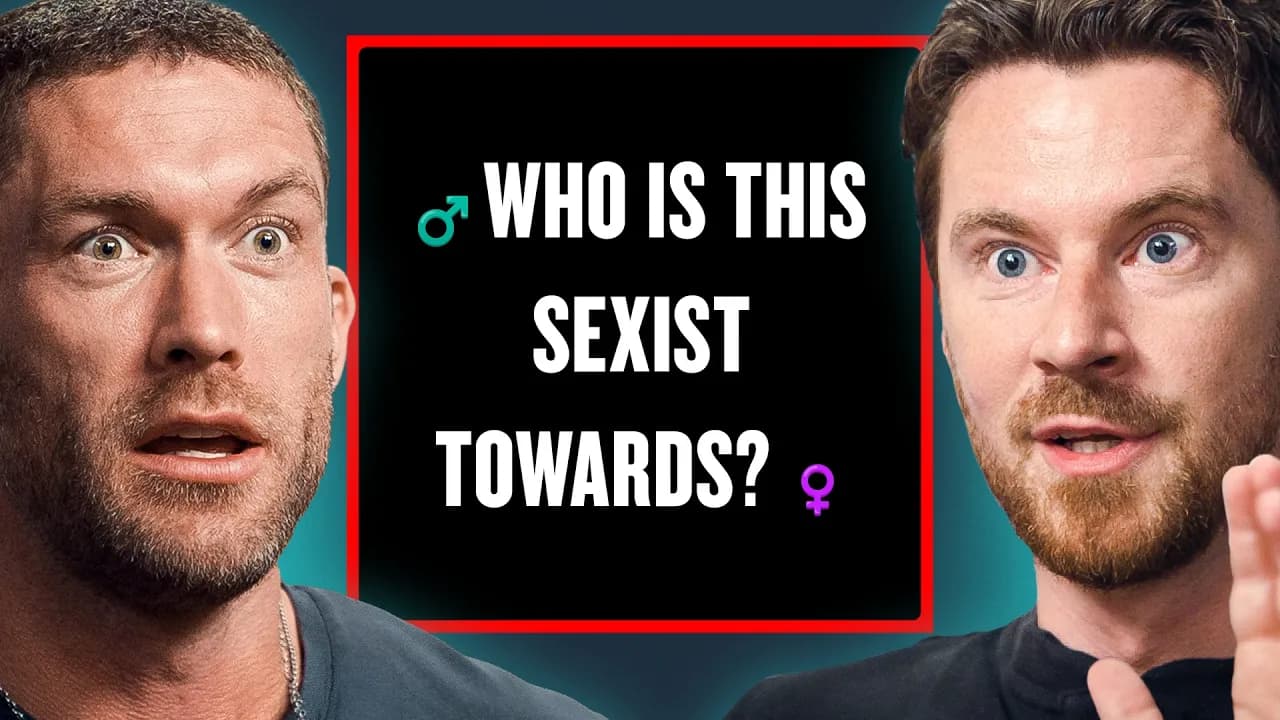
Questions on whether it's closer to sexist towards men or women:
- Women have a superior moral sensibility. >> Sexist toward men.
- Women have a quality of purity few men possess. >> Sexist toward men.
- Women have a more refined sense of culture and taste. >> Sexist toward men.
Full house: sexist towards men.
Next: Good or bad if men mostly agreed with:
- A good woman should be set on a pedestal. >> Good.
- Women should be cherished and protected by men. >> Good.
- Men should sacrifice to provide for women. >> Good.
- In a disaster, women need to be rescued first. >> Good.
- Every man ought to have a woman he adores. >> Good.
- Men are incomplete without women. >> Good.
- Despite accomplishment, men are incomplete without women. >> Good.
- People are often happy without romance. >> Bad.
You are a massive benevolent sexist. Those are the items on the benevolent sexism scale. Freya's followers believed the statements were either sexist to men or a good thing.
Idea called the mismeasurement of men (strategic title referencing Stephen Jay Gould's The Mismeasure of Man, critical of evolutionary psychology). Now, lack of insight into evolutionary psychology creates problematic scales: toxic masculinity, benevolent sexism, male sexual entitlement. They're measuring awareness of facts about the world. Example: "Women are often attracted to muscularity and dominance" taken as evidence of toxic masculinity, with no attitude added.
These scales are the Kathy Newman of scales—require extra inference about the implication. "You believe that women deserve to be protected. Oh, so what you're really saying is they should have their autonomy limited to keep them safe for their own good." That's not measured. Total mismeasurement of men. Pathologizes women's own preferences. Women have strong preferences for protection and provisioning; men care about being seen as attractive to women, prioritize that over being seen as sexist.
Benevolent sexism is one end of ambivalent sexism scale: hostile sexism (direct antipathy towards women, e.g., "women are trash") vs. benevolent (subtle infantilizing of women). Could be a real concept, but items used to measure it are absurd.
New Statesman piece concluded liberal women are unhappy. Some say this is new, first to have the balls to say it. Speaker says the same but attributes to unmet needs: women want to belong, feel protected, safe, stable (compassionate worldview). Gets viewed as sexist. New Statesman presents it differently, not as sexist—female privilege revoked because speaker is white/right-of-center, treated as honorary man.
Women are attracted to men who believe women should be protected, but not to the extra inference that women need rights limited for their own good. Properly designed scale would show no problematic attraction.
Video of two travelers in Thailand, guy pulls out a knife to steal woman's bag. She fights him off; guy hides behind a pillar. Replies/quote tweets: "Girl, he's trash." Another dude (maybe with the attacker) comes; benevolently sexist man intervenes with helmet to the head.
Universal reaction: guy hiding behind pillar—what are you doing, dude? Knife is scary, but do something.
Women's preference for protection is seriously strong. Poll: stronger effect on women's attractiveness if man unwilling to protect them than if he cheated on her in a one-night stand.
Women not interested in men nowadays because men don't get to display abilities. No war, no hunting—don't see value of male formidability. Women may not realize how much stronger men are (students surprised by sex difference in upper body strength). TikTok trend: couples challenge guy to handcuff her in 30 seconds—greatest foreplay ever, women turned on by strength difference.
Andrew Thomas (does krav maga/martial arts): ability to turn on and turn off aggression is rare. Aggression bleeds out. Women love man aggressive but never to them.
MMA fighters have awful domestic abuse situations—selected for guy who stands up, but hard to turn aggression off. Trade-off: predictable in dangerous ecologies; smaller women prefer strong/aggressive mates.
Study primed women: friend Sarah's boyfriend either punches wall (aggressor) or defends her from robber (protector). Expected aversion to formidable men in aggressor condition, but same preferences. Protector prime made them like all men more. Women may not be aware of tradeoffs; formidable protector likely same as wall-puncher. Didn't register formidability as predictor of violence.
Gen Z/Alpha girls prefer phronology signaling anime-level cuteness: tousled hair, thin body (soft boy aesthetic)—less threatening post-MeToo. "He couldn't even force himself on me if he wanted—like a cuddly teddy bear best friend."
Pushes toward divergence later. Jordan Peterson: don't want to dominate partner; not good long-term to have non-threatening partner you can control—see them as child eventually.
Katherine Salmon research on come-on face. After Fifty Shades of Grey, dark romance genre boomed (dominant, assertive, tall, strong, masculine billionaire CEOs). Tried golden retriever husbands or cinnamon roll husbands (soft, pliable)—didn't sell well. Short-term mating/fantasy like porn.
Shift from incel to sex doll researcher. Analyzed public dataset of sex doll body specifications. Dolls reveal classically predicted male mate preferences in supernormal stimuli way. Artificial depictions undiluted window into preferences—can be any form, co-evolution of market/consumer. No market for obese sex dolls (niche exists).
Dolls typify preferences extremely: e.g., beetles mating with beer bottles (supernormal stimuli like porn).
Romantasy is for women what porn is for men. Examples: Disney princesses vs. real life; Court of Thorns and Roses fantasies vs. reality ("wait until the death of a thousand sons just to touch your cheek" vs. "trash is smelling again").
Supernormal stimuli everywhere, even in romantasy. White pill: still low status for guy to be a sex doll
Having a collection of sex dolls lowers status. One speaker's collection is just Deborah. Currently low status to have sex dolls, but that may change. No selection makes it like subscribing to OnlyFans—something everyone can get is not high value, seen as desperate. If you can see someone naked for the price of a cheeseburger per month, it's not high value. A subset of men may retreat into AI-integrated sex dolls and video games for satisfaction and status, leading to male sedation.
Women have smaller feet than men due to sexual selection. Adult human women are the only mammal carrying pregnancy on two feet, where falls are dangerous and could terminate pregnancy. Biomechanically, expect big feet for stability, but they have small feet. Men prefer small feet as a sign of femininity. Women's feet get bigger with age and pregnancy. Older women with many kids have bigger feet.
Attractive female faces show neotony (child-like features). These features make people want to care for babies, help women more, and find them attractive. Women selected to be neotenous.
From New Statesman article: Women feel more negatively towards young men than vice versa. 50% of women have neutral or negative view of men; 72% of men have positive view of women. Three times more women (21%) hold actively negative view of men than men of women (7%). Despite manosphere misogyny talk, young women more negative toward men. Men more optimistic about women.
Women fulfill their part (beauty, finances), but hold negative views seeing only risks. Not just about relationships—actively negative view of men as bad in themselves. Possible causes: porn (hyper-masculine, rough porn stars lead to preference for non-threatening anime men and generalize brutality to all men); signal to other women "team women."
Student Michaela designing scale of opposite-sex hatred. No existing scale measures sexism in both sexes, so can't compare. Women hate men more than men hate women, aligns with error management perspective.
Young women deterred from committing early due to self-actualization goals. Other women fear they'll give up potential. Women had more to be liberated from, so closing options seen as suspect. If eligible man taken (Danny Silkawski-pilled), off market, contrasts others' situations. Having a boyfriend now cringe—girls avoid posting relationships online to not make single friends feel bad, leading to pushback.
Dating tough for young people, especially girls: uncertainty, fear, social anxiety, worries about losing freedom/independence.
Groups of women do deep dives on potential mates (e.g., years-old tweets). Everyone cringe in some way—must accept boyfriend is a little cringe. Embrace the cringe.
Anecdotally, women get the ick (sudden disgust), men do not. Possibly absence of sufficient masculinity threshold or violation of it. Cultural: messages to young women to be on guard (feminist: independent, don't let man block goals; therapeutic: watch for red flags). Social media encourages taking ick seriously as incompatibility. Signals allegiance to sisterhood, elevates own mate value (high standards, scarcity of guys, refined palate).
Men saying they have types is posturing (narrow parameters signal many options). On Love Island, first press question: "What's your type?" (physical only, e.g., ginger girls with specific blue eyes). Never emotional or interest-based.
New Statesman: Privileged women most pessimistic. Middle-class professional women less likely to feel valued by society or believe hard work leads to success vs. working-class women. Young men more likely unemployed than young women, yet young women 21 points less likely to believe they'll out-earn parents. White women more likely to feel country racist than non-white women.
Women agentic only on behalf of others; successful women must be deeply caring/martyr to avoid envy (ethnographies: adolescent girls popular only if super nice, over-deliver kindness). Joyce Benison paper on leveling: women more likely say "we should all be equal" when someone surpasses. Middle-class no threats → threat system bored, reacts to trivial (like hay fever when no parasites).
More time to introspect: scrutinize partners/selves, pathologize, overanalyze traits. Funnel neuroticism productively (e.g., child-rearing) vs. inward/against partner. In higher ed (women dominating), status for such views—shows fealty to ideology.
Studies: Cognitive heuristic sees women as victims, men as perpetrators in harm instances. More likely blame men, sympathize with women. Harder to see men as victims, easier for women. Sucks for both: men disadvantaged in harm (no sympathy), women in agency domains (not seen as capable for CEO/president).
Agency-warmth continuum: Women expected warm, assertive → bitchy/diva/low warmth. Men expected agentic, warmth (crying) → incompetent. Both stay in lanes. Warmth negatively associated with competence; brusque seen higher competence. Protectiveness of women repackaged as oppression.
Women are wonderful effect: Prefer women over men in many ways. Job hiring discrimination against women down, but overestimated as still present. Sensitized to detect it. Discrepancies against women cause outrage, against men no big deal.
Attractiveness under-acknowledged privilege. Pretty privilege benefits (enormous across board, male/female); costs (other women see pretty as promiscuous). Unattractive has enormous costs. Reluctant to acknowledge it exists. Data (including unpublished lab): women far more attractive than men. Beauty is status for women—defer to beautiful women like men to formidable men.
Motherhood horror stories: massive beauty hit (less than ever, but still). Impacts mate value. New data: relationships/parenthood similar happiness to non-parents, greater meaning (esp. women), lower relationship satisfaction. Women reluctant to sacrifice beauty/status benefits.
Social media: women as products (marketing/optimizing selves). Child disrupts perfect pristine product. Instagram dopamine/status > reproduction.
Misconception: fitness-optimizing mechanisms. Actually adaptation executors. Desire high mate value/sex (over time led to reproduction), not explicit offspring desire. Reliable contraception evolutionary novel, disrupts.
Joyce Benison cross-cultural study: young people primary goal romantic partner, lowest having kids. Evolved mate attraction desire, not kids (sex led to kids pre-contraception).
Relationships brand partnerships to display online. Selection criteria changed: how other women react (soft launch). 60% romantic relationships begin as friendships. Fewer cross-sex friendships now. New paper: courtship in cross-sex friendship—men provision financially to friends interested in mating. 50% have romantic interest in cross-sex friend; same number had sex with
The same number of young people have had sex with at least one opposite-sex friend. Cross-sex friendships provide a direct route to relationships because attraction grows over time through proximity, which breeds intimacy. They allow displaying qualities that make for a good mate, such as protection, physical attractiveness, and resources—traits people select in both friends and mates. These friendships also broaden networks and improve cross-sex mindreading, disproving red pill and black pill beliefs through real-life interactions with opposite-sex friends.
William Costello's survey of 527 heterosexual and bisexual people asked if opposite-sex friendships are ever truly platonic: 81% of women said yes, only 58% of men said yes. Women were three times more likely than men to say their friendship was purely platonic. Women may get upset learning nearly half of their male friends would sleep with them, but it's not that they only want sex—it's that they probably would. Test it next time out for drinks. A study in The Economist of Americans found men in platonic couples far more likely than women to find their friends sexy and to think she finds them attractive. A man's assessment matches how much he fancies her, unrelated to her actual feelings—men are prone to wishful thinking. Men need courage to ask out; everyone wants to be approached more. Women keep some opposite-sex friends as backup mates. Celebrate and cultivate more opposite-sex friendships as a pathway to proper relationships.
Social media disincentivizes opposite-sex friendships by creating separate worlds. Men and women grow up with different influences: women with Zoella, Facetune (app downloaded hundreds of millions of times; 70-80% of young women won't post on Instagram without it); men with Runescape. Algorithms suggest content reinforcing differences, reducing common ground.
Question: Is there a sex difference in opposite-sex friends matching mate preferences? Data shows people select opposite-sex friends based on the same traits as partners. If both sexes do this equally, women claiming no attraction to male friends shouldn't be shocking—what are the odds the tall handsome guy matching her boyfriend type isn't attractive? From a jealousy perspective, men pump the brakes on women's careers and opposite-sex friendships or work colleagues (e.g., "work husband" is a disaster) for mate-guarding.
On looksmaxxing: Australian interviewer mogged Clvicular (looksmaxxer) by being more effortlessly good-looking—men need to appear as if they didn't try. The interviewer pulls off effortlessness despite trying (deep dive into his Instagram). Commentary proves Clvicular's philosophy: reactions lionize looks, confirming it's all about looks. Clvicular stages walkouts for attention; his tense, neurotic demeanor (almost autistic) contrasts with the interviewer's playful smirking, which is more attractive to women. Effortlessness attracts women; same for men.
Sydney Sweeney appeals to straight men (big breasts); Sabrina Carpenter to women and gay men (neotenous: small body, big head, big eyes, dull). Research shows women hate women with big breasts. Women's fashion signals: baggy, slouchy, cozy (e.g., Alex Cooper on Call Her Daddy in big hoodies)—not revealing bodies, which men hate. Pick me insult drills into Gen Z women: anything masculine-coded (e.g., preferring masculine podcasts) gets labeled pick me, shaping presentation, mannerisms, temperament toward female expectations to avoid it. Clever intra-sexual competition: don't appear to appeal directly to men (like men avoid simp shaming or cuck labels).
Slut shaming is a price enforcement mechanism to keep sex price from dropping below what most women want (Mate by Jeffrey and Tucker). If one woman gives sex on second date but another waits until fifth, slut shaming raises the price so she doesn't undercut. Equivalent for men: giving resources without sex (e.g., men hate OnlyFans women extracting resources without dating, reducing shots for average men). Women giving sex without commitment get castigated; men giving resources without sex get castigated.
Frey India: Cool Girls book, substack freyindia.co.uk. Tanya: New paper "Greater Female Vulnerability Hypothesis" (forthcoming). William: Follow on X for fire poles and exciting stuff; Google Scholar for academics. Evolutionary psychology roundtable in new studio.
Keep Chris Williamson in your library
Save the videos and channels worth coming back to, and find them again in one place.