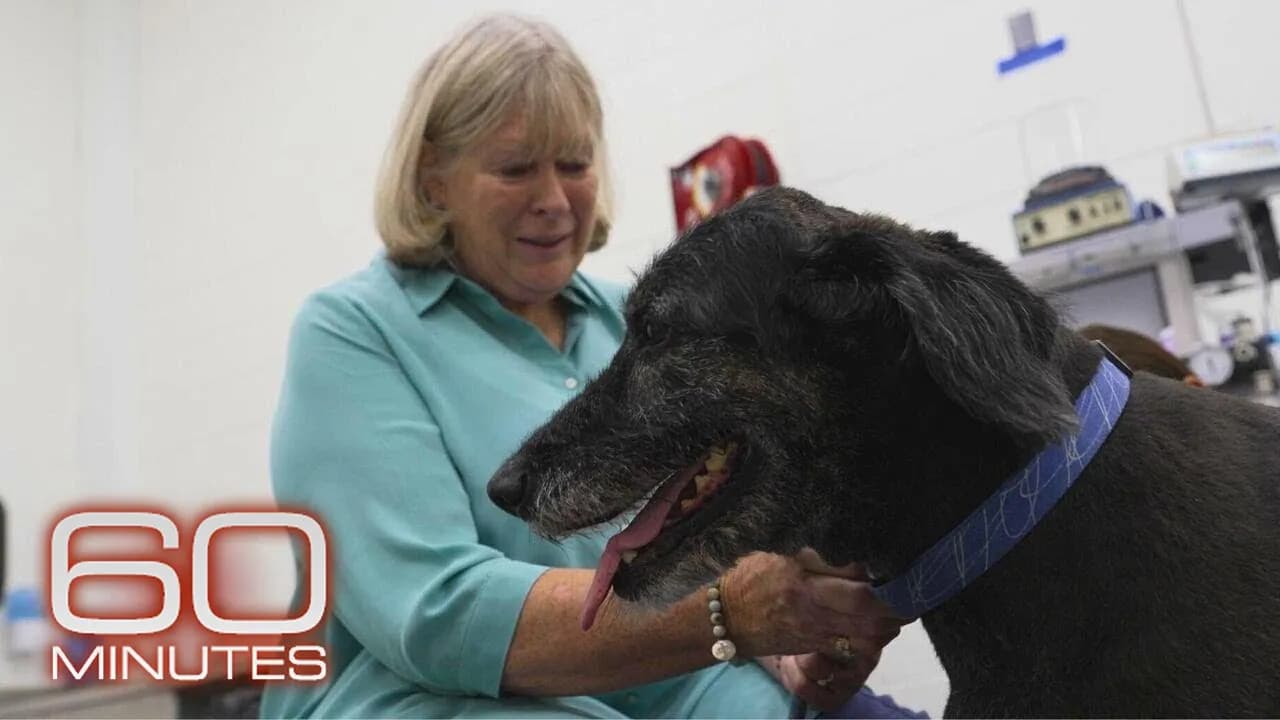
Elemental Crisis; Turning the Ship Around; The Dog Aging Project | 60 Minutes Full Episodes
In a Nutshell
**US faces critical vulnerabilities in rare earth elements and shipbuilding due to China's monopolies—MP Materials revived the sole US rare earth mine at Mountain Pass with Pentagon backing to produce magnets for defense and tech, while foreign investment modernizes struggling yards like Philadelphia to counter China's 1,000 annual cargo ships vs. America's 3.** **The Dog Aging Project studies 50,000+ dogs' aging via MRIs, blood tests, and lifestyle data, revealing parallels to human dementia and cancer; trials of rapamycin reduced brain inflammation in dogs, promising longevity drugs like Loyal's for healthier years.** **Government interventions, including equity deals, price floors, and a White House shipbuilding office, address these crises pragmatically amid trade wars and national security risks.**
These notes were generated by AI and may contain inaccuracies.
An hour southwest of Las Vegas in the Mojave sits the only active rare earth mine in the US at Mountain Pass, California. This is a battlefield in the trade war with China, which has a near monopoly over these strategic metals. When Beijing choked off supplies last year, James Latinsky and his company MP Materials got the call from the Pentagon with a directive from the president to solve this problem quickly.
American shipbuilding is in shambles, a money loser falling decades behind rivals. China makes roughly 1,000 cargo ships a year; the US makes maybe 3. > "At the end of the day, ship building is a national security necessity. The US needs to be able to secure our own commerce. We need to be able to export our own energy. We are in a ship building crisis in the United States and every American should be aware of that."
Dogs live alongside humans, exposed to the same environments, exercise, food, and water. Researchers believe dogs may help treat age-related illnesses like cancer and dementia, which occur in dogs as in humans. > "And you believe looking at dogs can help us not only help dogs but humans as well." "Yes, of course. Absolutely."
China holds a near monopoly on rare earth elements, key for smartphones, robotics, EVs, fighter jets, drones, and radar. China controls materials essential to US ability to wage war. MP Materials mines rare earths, processes them, and makes superpowered magnets. It's part-owned by US taxpayers via a federal government deal.
Mountain Pass is the ultimate front in the trade war with China, the only active US rare earth mine. > "Are we stepping on rare earths as we speak?" "Yes. Everywhere you look is rare earths."
Michael Rosenthal and James Latinsky, two Floridians and finance types with no geology background, run it. > "This is just such an important site and the idea that this entire supply chain was on the other side of the world in China. It just occurred to us that someone had to help fix this problem."
Doug Burgum, Secretary of the Interior: > "If you have a cell phone, have a laptop, if you drive a car, then you're touching rare earth minerals and rare earth magnets. It's essential to everyday life, but it's also essential to aerospace, telecom, defense systems."
One F-35 fighter jet contains about 100 pounds of rare earths. US defense is subject to China's whims. President Trump created the National Energy Dominance Council for secure supply chains of critical minerals.
China corners the market and weaponizes it by dumping supply to crash prices if others try mining or refining. Rare earths aren't rare; rare are high-concentration, accessible sites. They are elemental metals, periodic table numbers 57-71 plus two others: lanthanum, cerium, praseodymium, neodymium, samarium.
Julie Klinger, professor at University of Wisconsin-Madison and rare earth expert: Rare earths have fantastic magnetic, conductive, optical properties, used like spices in small amounts to make magnets small and powerful.
Geologists found rare earths at Mountain Pass in 1949. By the 1960s, mining separated them, e.g., europium for red color in early TVs. In 1982, neodymium was found to strengthen magnets, used in cell phones, drones, smart bombs, high-speed rail, EVs.
Mountain Pass was the world's rare earth mine for decades, but mining and magnet making moved to China, which did it cheaper. > "The US disinvested in rare earths." "Absolutely." "It's a dirty business. It's a risky business. It's a difficult business to really break even."
In the 1990s, Mountain Pass faced economics and environmental issues after radioactive water leaked. It languished until Molycorp tried reviving it unsuccessfully. James Latinsky, running a Chicago hedge fund, saw opportunity when Molycorp filed bankruptcy in 2015.
"When you're running a hedge fund, there's not much tangible to it. You're moving numbers on a screen. And then I made the mistake of going out and looking at the site, actually seeing what your investment looked like. Yes. And I was just blown away by the scale of the assets."
The mine is 3,000 ft across, 600 ft deep with one of the world's richest deposits. Latinsky partnered with friend Michael Rosenthal. > "You appreciate the absurdity of the story for sure. Two hedge fund guys buy a mine. What could go wrong?"
They bought it in 2017 as MP Materials; it was financially underwater with 30 million gallons of water at the bottom and only 8 employees. Process: blasting earth, crushing to gravel, milling to powder. Latinsky CEO; Rosenthal on-site expert. > "I get dirty and Jim explains what we're doing."
Today, Mountain Pass employs over 700. Mining is easiest; hard part is separating rare earths from rock and each other. Two years ago, after hundreds of millions invested, MP refined neodymium and praseodymium to 99.9% purity. > "This is the refined product. This is the money room. This is it." Each bag worth $120,000; 300 bags, $36 million inventory.
"So, this fine powder will end up could end up in your pocket. Could end up in my iPhone."
In Fort Worth, Texas, MP built a facility turning powder into magnets for GM cars and Apple products starting next year, fulfilling mind-to-magnets plan.
Last spring, after Trump unveiled global tariffs (Liberation Day), China retaliated by choking rare earths. Ford stopped making Explorer SUVs. After truces, supply resumed. Latinsky: Major manufacturers unaware of supply chain exposure; economy on verge of shutdown.
Trump officials summoned them to Washington. > "We got called into the Pentagon and it was clear that there was a directive from the president to solve this problem as quickly as possible." Pentagon wanted Manhattan Project-style acceleration of rare earth supply chain.
Pentagon injected $400 million into MP, took 15% ownership. Americans own part of rare earth business. Deal includes 10-year price floor so China can't crash prices. > "Has there ever been anything like this?" "Well, exactly like this, maybe not. But if you look back, whether it was the railroads or aluminum for aviation prior to World War II or the semiconductor industry, there's actually a long tradition of really critical industries where our country needs to bring online infrastructure."
Government stipulated 10-fold ramp-up in magnet production. MP building bigger factory in Texas to meet US needs by 2028. Still, >90% of world rare earth magnets made in China, which can hold world hostage.
Secretary Burgum supports stockpiling, defends deal: > "You're talking about equity positions in private companies and price floors and in this case a demand that production increases 10-fold. That has the whiff of socialism." "I wouldn't call it socialism. I'd call it pragmatism because free markets work but they don't work if you have an adversary that controls a monopoly that controls the price. There's no market setting the price. It's China setting the price."
"This kind of industrial policy you're talking about, does this happen but for China's retaliation to last April?" "I think it was a catalyst. Frankly, we probably needed a crisis to wake up."
If China invades Taiwan and shuts off magnets, US needs Chinese permission to make military things, unacceptable. Current US-China trade truce expires in 8 months; supply vulnerable short-term.
War in Iran highlights ships' importance, including cargo vessels. US shipbuilding in shambles from short-sighted policies. Submarine program sluggish; commercial nearly extinct. China: 1,000 cargo ships/year; US: 3.
Philadelphia Shipyard, one of two US yards building large commercial cargo ships, symbol of decline, money loser. Uses 1942 crane. > "Now, talk about a metaphor of how far behind we are. A lot of times people call it a dinosaur." "What else is a dinosaur? Almost everything that you've seen out there."
David Kim, head of Philly yard, works for Hana (South Korean ship maker, #2 after China). Hana bought yard in 2024 for $100 million, invested another $100 million. Kim, Korean-American from Texas, modernizing it. Delivers 1-1.5 ships/year vs. 1/week in Korea.
Not building ships is national security threat; China could weaponize merchant fleet. Hana plans $5 billion investment, sent 50 trainers from Korea. Aspires to 20 ships/year, add 7,000-10,000 workers, robots, automation.
US shortage of skilled labor: welders, pipe fitters. Work grueling, dangerous. Training: 20 at a time, takes 3 years. Apprentices Justin, Jeff, Meg: > "I worked at Amazon as a grocery picker." "Before this job, I was a cake decorator at a bakery and a nanny." "If you were to pitch this job..." "Instead of paying out of pocket to go to trade school, you're getting paid while you learn here the entire time... and healthcare."
"Not the easiest work. Like I go home, granted I'm more tired, but it's more fulfilling to me. Makes you feel like you're part of something bigger."
Yard imports propellers, engines; ships take twice as long, 5x cost as in Korea/China.
Michael Coulter, Hana US exec: Scale up to lower costs. > "So you're saying if we build more ships then the cost per ship will come down significantly."
At Hana Korea yard: 9 ships at once, robots, 26,000+ workers, trains 400 at once with VR. Builds military vessels, submarines. > "From a Hanwha perspective, we build great submarines here in Korea. We have told the US government that if they so wish, we will build submarines for them in the United States and in Philadelphia just like we do in Korea."
"Is the ultimate goal for your company to build nuclear submarines for the US Navy?" "US submarine program is heading in the wrong direction and we think we can help."
Hana wants to build LNG tankers in Philly. US largest natural gas producer but builds no LNG ships. Jones Act (century-old) requires US-made ships for cargo between US ports, e.g., Baltimore to Boston.
Colin Grabow, Cato Institute: LNG ship costs $260 million in Asia, $1 billion in US. New England imports pricier gas abroad despite nearby extraction; Puerto Rico imported Russian gas same month Russia invaded Ukraine.
President Trump signed executive order for multi-agency action plan, White House Office of Shipbuilding. > "We're way, way, way behind. We used to build a ship a day and now we don't do a ship a year practically."
Paradox: 50% tariffs on steel raise ship costs. US steel now 2x China's price. > "What you're saying is when the price of steel goes up because of tariffs, then the American steel manufacturer hikes the price of steel. These are profit-oriented enterprises."
Grabow: Buy ships from ally South Korea. Administration hostile to skilled immigrant visas; immigrants traditionally do this work. ICE raided Korean battery plant in Georgia, detained 300 Korean trainers despite training Americans.
Korea offered $150 billion to revive US shipbuilding after Trump tariff threat; Philly is start. > "There's a recognition that the United States has a problem that Korea may be uniquely positioned to help."
"Wouldn't it be more profitable and wiser if the United States just bought the ships from Korea? That doesn't solve the problem. At the end of the day, ship building is a national security necessity."
"The idea that we now rely on Korean expertise to help us build an industry that we need for national security reasons. Should we be ashamed of ourselves? Should we feel weak?" "I don't think we should be fearful or feel weak. We are in a ship building crisis... but that doesn't mean that it's not solvable."
White House suspended Jones Act for 60 days to ease oil/gas transport amid soaring gas prices.
Dogs might treat age-related illnesses as they develop same diseases like dementia; dogs' brains like humans'. Dog Aging Project studies natural progression to unlock longer, healthier life for humans and dogs.
At hundreds of vet clinics/hospitals, including **Colorado State University College of
Veterinary Medicine and Biomedical Sciences, people are bringing in their dogs. >> Does he ever seem more irritable? Yes, we know >> the Dog Aging Project is a collaboration of dog owners, scientists, and veterinarians studying dogs. More than 50,000 of them so far by collecting data on their diets and exercise, analyzing blood samples, and doing MRIs of dogs' brains.
Did you always want to be a doctor? >> Matt Creelman (corrected from Cabberline), a biologist who spent decades trying to understand and reverse the causes of aging, co-founded the project in 2014. Where did the idea of the Dog Aging Project come from? >> I had this light bulb moment which I still remember vividly. I realized, oh my god, we know about three or four or five ways to slow aging in laboratory animals. Some of those are going to work in dogs. >> You think that's possible? >> Absolutely. I have no doubt that's possible. The biology of aging is so conserved or shared across the animal kingdom. Much of this works the same way in dogs. Much of it works the same way in people.
You're okay. To help study how the brain ages, Creelman recruited Stephanie McGrath, a veterinary neurologist from Colorado State University. I think a lot of people would be surprised to know that there are neurologists for animals. >> Yes, a lot of people are surprised. >> And you believe looking at dogs and looking at dogs brains can help us not only help dogs but humans as well. >> Yes, of course. Absolutely. >> There's no doubt. >> Why? Because right now we are using mice and we are putting them through treatment trials and then we go directly to human trials. >> I've read that as many as 90% of the things that work in mice do not end up working in humans. Right? >> So to have something in between would be hugely beneficial, right? And not just another species but a species that very closely mimic naturally occurring diseases of aging in humans. cancer, dementia, all these diseases that we see as humans age occur in dogs.
One reason, they live alongside us and are exposed to the same environments. They exercise with us, eat our food, drink the same water. Also key, McGrath says, is the fact that dogs have shorter lives because they age faster than humans. >> We can get a ton of information that would take decades to do in humans. In a human being, if you wanted to do a lifelong study, you obviously you would have to do it from the age of 1 to 60, 70, 80. >> Exactly. So many decades versus 5-10 years. So we just check to make sure his sensor is good.
And >> McGrath has been tracking hundreds of dogs to see how their cognitive ability changes as they age, including 12-year-old Murphy, a German Shepherd poodle mix. >> He gets his puppy zoomies about once a week now versus once a day. >> Okay. All right. They're still in there, though. >> They're still there.
For Pat Schultz, like many of the dog owners we met, enrolling Murphy in the Dog Aging Project was personal. Her husband, Bill, suffered from Alzheimer's disease, progressing to the point he stopped recognizing Pat as his wife. >> What do you do in a situation like that? >> Just go along with it. He asked me out on a date. >> Really? >> Yeah. Can we go on a date? Sure. Let's go have dinner. You know, >> throughout his decline, Murphy was Bill's constant companion. >> Murphy was a caregiver in some >> Murphy was like his nanny dog. >> Bill would forget his phone. I have a tracking collar on Murphy. So, as long as Murphy had that tracking collar on, I knew where Bill was. >> So, while Bill is dealing with Alzheimer's, you hear about the Dog Aging Project. And >> I think I was looking at clinical studies and I found something about dog studies. I thought, well, dog studies, I had never heard those. You know, Murphy was getting older and knowing that he's a big dog, they don't have as long a lifespan usually. >> Go ahead, puppy.
For the past 3 years, Murphy has undergone testing to assess his physical and mental fitness. >> Come on. >> In games like these, dogs are shown where a treat is hidden and seconds later allowed to go and get it. >> Okay. >> If they can remember where it is. >> There it is. When it was Murphy's turn, he struggled, wanting to stay with Pat, too anxious to do the test. >> Puppy, look. Okay. >> On the second try, he got a little turned around, but eventually found the treat. >> There you go. That a boy. Good job. >> The anxiety that Murphy showed, is that a potential sign of dementia? >> Yes, is the short answer. In the last few visits at CSU, he's really progressed um in terms of his challenges with his tasks um both here and at home.
Another dog, Ralph, was also tested. At 14, he's already shown signs of advanced dementia. >> Puppy, look. >> Ralph quickly forgot about the treat, wandered off, and picked up a piece of lint off the floor. >> Okay. All the information collected in the Dog Aging Project, including from these tests, goes into a public database accessible to researchers around the world. It's been used in more than 50 scientific studies so far, many of which found correlations between lifestyle, environment, and disease risk. One finding, dogs that live with other dogs appear to suffer from fewer diseases. And when it comes to cognitive decline, dogs that don't exercise are found to have a six times greater chance of developing dementia.
When some of the dogs in the aging project die, their brains are donated and examined. Dr. Dirk Keene (corrected from Keane) is a neuropathologist from the University of Washington. For the past 20 years, he studied thousands of human brains looking for causes of Alzheimer's. His motivation for participating in the Dog Aging Project was watching his mother suffer from Alzheimer's and also seeing his dog Spring decline from what looked like to him the same disease, what some call doggy dementia.
So that Spring when she was a healthy, happy dog, >> tongue out, tail wagging. >> She was a happy dog. Yeah. And this is Spring near the end of her life. She would get confused and sort of lost. She would stare at walls. She would just stop and stare into space. She would lean against things. This happens to people. It's not just memory. When we start to have dementia, dementia is a very complex thing that includes confusion. It includes loss of the ability to remember sort of spatial references. Very similar to what we're seeing in dogs happens in people.
This is half of a human brain. >> This is half a human brain. >> That's a dog brain. >> That's the dog brain. >> Half a brain. Wow. >> Dr. Keene showed us how similar dogs brains are to humans. You can see the dog brain has the same frontal lobe, temporal lobe, occipital lobe, >> the same basic shape as the human brain. >> Very very similar. >> And it turns out dementia changes brain size and structure in very similar ways in both species. >> This is a person in their 80s who was not demented. This is a person who was in their 70s who was demented. And so the most important sort of thing to notice is how much different in size they are. I'm going to let you hold this if that's okay. So just grab on there. >> Yep. You can sort of feel how much different >> the weight difference between a healthy brain and an atrophied brain is stunning. >> As disease kills off neurons, the brain shrinks and the space in the middle cavity enlarges. >> I mean, it looks like something has completely fallen out here. >> Yeah, it's remarkable. >> It's so depressing. >> Dementia in dogs also results in enlarged spaces and brain shrinkage.
This is Spring's brain. Under a microscope, Spring's brain, one of the first to be donated to the Dog Aging Project, shows beta-amyloid plaques, a hallmark of Alzheimer's. >> And this is a human brain. This is >> and it looks strikingly similar to the plaques in a human brain as well. Progress in preventing Alzheimer's and other forms of dementia, which will affect an estimated 40% of Americans over 55, has been slow.
The Dog Aging Project hopes to change that by testing the drug rapamycin in dogs. It's been shown to slow cognitive decline and increase life expectancy by a remarkable 60% in mice. That's led some longevity researchers and influencers to suggest rapamycin for human use. So basically >> to understand whether it might work in dogs, Julie Moreno, a molecular biologist from Colorado State University, helped conduct a pilot study of 12 dogs, all with signs of dementia. 10-year-old Cubert was among those given a placebo. 13-year-old Monkey received rapamycin. After the dogs died, Moreno examined their brains and found that Monkey's brain showed fewer microglial cells which produce inflammation commonly associated with dementia. >> So if you just kind of focus in on this side, you see quite a bit of those teal colored microglial cells. And then if you look over here, you just see less, right? Like there's just less number of them. >> Two other dogs receiving rapamycin, including Ralph, have since died. Their brains also showed fewer cells associated with inflammation. >> So, Rapamycin, at least in this study, worked on dogs. >> Yeah. >> What do you think when you first saw this? >> I was super excited. >> You were? What's your hope in doing this study? >> If it works in a dog and it's safe and it's helping their cognition, then maybe it would help humans.
The Dog Aging Project is now conducting a larger clinical trial funded in part by the National Institutes of Health, giving hundreds of dogs, including Murphy, either a placebo or rapamycin to see if the drug can extend life. >> The first ever longevity drug on the market to give >>
There are three other drugs being developed by the for-profit company Loyal, a biotech startup founded in 2019 by 31-year-old Selene Hollywood. >> Does she like how it tastes? My vision is that this is, you know, it's a daily beef flavored pill that are given preventatively to keep them healthier longer, similar to a statin for older Americans. >> And you think you will actually help extend a dog's life? >> Yeah. >> How long? >> Approximately one healthier year of life. Maybe it'll be more, maybe it'll be less. >> One of their drugs in a clinical trial is being given to dogs over the age of 10 who are monitored for signs of aging. The FDA has signed off on the drug safety data and says it has a reasonable expectation of effectiveness, but final results from the trial won't be known for several years. >> That extra year would be a healthier year than otherwise. >> An aging drug is about delaying and slowing the rate of decline that a dog or a human has over time to give them more healthier years. It's not something that you would give to a dog or a human on their deathbed to give them another year. It doesn't work like that.
Silicon Valley is betting big on longevity. Loyal's company has raised more than $250 million to bring its drugs to market. >> If we can achieve this, this is a massive multi-billion dollar company. If we only do that, we're all happy. But oh by the way, this also unlocks the possibility of us working on human longevity one day. I think going dogs first is the fastest way to work on and understand the biology of human aging.
After a long struggle, Pat Schultz's husband, Bill, died two years ago due to complications from Alzheimer's. As part of the Dog Aging Project, she won't know for another few years whether Murphy got the rapamycin or not. But for now, she told us she's simply focused on making sure they both age as best they can. >> You've cared for a human with Alzheimer's. You're caring for a dog in this study who, you know, is aging. What have you noticed in terms of similarities? >> The thing I noticed is that they both need to be loved and cared for. Just holding Bill's hand and patting his hand was enough just to decrease that anxiety, decrease that fear that, you know, was there. >> And that works with Murphy, too. >> And that works with Murphy, too. Yep. >> Good boy, Ralph. What Ralph's life meant for science and his family. >> I mean, your pets are family, too, right? >> At 60 Minutes overtime.com.
The last minute of 60 Minutes is sponsored by United Healthcare. Coverage you can count on for your whole life ahead. No American woman has won more Olympic medals than swimmer Katie Ledecky, 14 total, including nine gold. Now she's training for the 2028 summer games in Los Angeles. We asked Ledecky as an Olympian, what has she learned about America? What I have learned over time as a member of Team USA is that we are a nation of strivers that embraces competition of all sorts. We are a very prideful nation in how we compete where that striving and competitive spirit when harnessed correctly brings out the best in us and shows us the best of the human spirit. I've learned that sports test our determination, our resilience, and our discipline. Sports teach us every day that anything is possible, that when we try and when we give our best effort that we can overcome obstacles. I grew up swimming in summer community pools in my home county. I have trained and swam throughout the country in numerous places. And what I have seen in so many different communities is that sport in America is at its best when it's joy and fun and yes, its challenges bring us together. I'm Leslie Stahl. We'll be back next week with another edition of 60 Minutes.
Keep 60 Minutes in your library
Save the videos and channels worth coming back to, and find them again in one place.