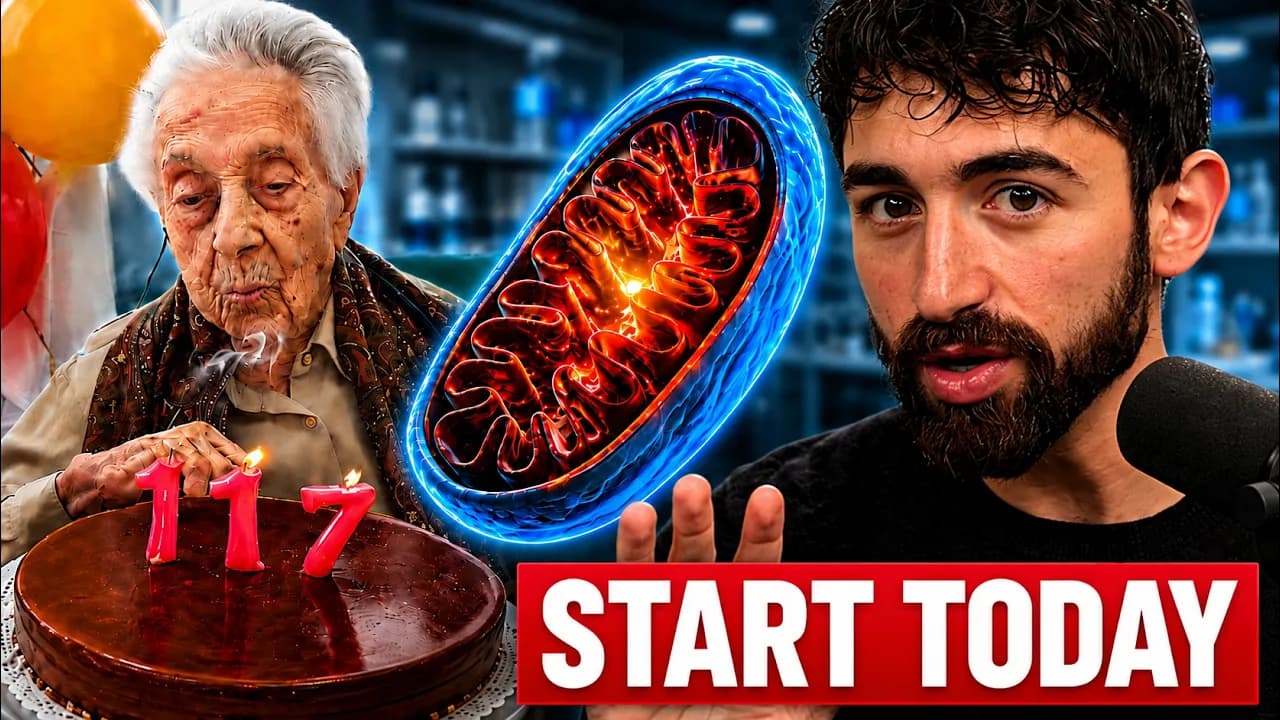
Mitochondrial Transplants Heal Cells | Tom Benson Ep 234
In a Nutshell
Mitochondrial dysfunction drives aging and many chronic diseases by depleting cellular energy production 50-60% by age 90, as mitochondria are damaged by stress, toxins, and time. Mitochondrial transplantation—injecting fresh, healthy mitochondria from donors or bioreactors—can restore energy, regenerate tissue, and treat conditions like heart damage, stroke, Alzheimer's, and Parkinson's by delivering far higher doses than stem cells. The approach is moving into early human safety trials and clinics, with potential for emergency use, personal mitochondrial banking, and large-scale hospital deployment within years.
These notes were generated by AI and may contain inaccuracies.
Stress burns mitochondria out rapidly. High stress jobs take years off your life. We already know these things. It's just now we know why.
We live to be 90 because our body is constantly supplementing the mitochondria through the bloodstream. Without that, we'd only live 20-25 years.
Mitochondria as a part of the healthcare system is just non-existent. It is believed to be a coming revolution in medicine. There are no doctors anywhere who know about this. Doctors say they had no idea. This is not in the textbooks. This is really that new.
Tom Benson is CEO and co-founder of Mitrix. He has been starting tech companies for a long time. He used to have software companies and then went back into physics. He worked at Stanford Linear Accelerator studying mitochondria and other molecular components and biologics.
About six or seven years ago, he came across the concept of mitochondrial transplantation while reading. It sounded crazy at first. He realized it was real breakthrough research and decided to start Mitrix to commercialize and develop it.
There is some research that magnetic and radio waves do have an impact on metabolism and on the body, but it is not fully known. Mitochondria are extremely delicate.
Mitochondria are tiny organelles that float around inside cells. They are where all the energy is generated in the cell. A mitochondria is about the size of a bacteria. A typical cell has a couple hundred of them. They have little molecular spinning turbines that generate energy by burning glucose and oxygen or fat and oxygen.
Mitochondria are the last mile of the digestive system. Nutrients broken down in the digestive system cannot be used by cells unless combusted into usable energy. 95% of the energy in cells comes from mitochondria.
Mitochondria have been in cells for a billion and a half years. They were the key thing that allowed cells to develop into larger organisms. Humans are about 10% by weight mitochondria.
Mitochondrial dysfunction occurs eventually to everyone as they age. We are born with a set of mitochondria. The egg cell when first fertilized has between 300,000 and 500,000 mitochondria. Each mitochondria has three, four, or five copies of a tiny ring of DNA that controls the engine.
At birth, mitochondria are 100% perfectly functioning. They decline slowly at first. Around age 55-60, the decline speeds up significantly. The DNA in mitochondria becomes damaged from stress and usage and eventually stops working properly.
By age 90, mitochondrial decline becomes a cliff. This is one of the two main reasons people get old. Energy production declines 50-60% by age 90. This causes weakness, loss of muscle, and lower energy levels.
Mitochondria are very delicate and easy to kill. Most poisons kill mitochondria first. Radiation kills mitochondria. Smoke kills mitochondria by the billions. Chemotherapy destroys mitochondria by design.
If mitochondria are killed off earlier, lifespan shortens to around 75 instead of 95. High stress burns mitochondria out rapidly. Certain medications can impact lifespan because they affect the finite amount of mitochondria.
All information presented is based on research and working hypothesis. Other people may disagree.
A recent study published in March out of Guanghu, China showed mitochondrial injections into the brain of mice with Parkinson's reversed the condition. Mitrix has done injections showing brain tissue regenerating in areas associated with Alzheimer's.
It used to be thought that mitochondria just sit in cells. The only way to help them was to provide proper nutrition, which is not difficult with a normal diet and reasonable vitamins.
About 10 years ago, researchers discovered mitochondria can be taken out of cells, isolated in a tiny bit of fluid in a test tube, and reinjected into the body through the bloodstream, directly into muscle, or other methods.
Mitochondria are extremely mobile within the body. They move around constantly. Cells trade them like baseball cards. They are delivered through the bloodstream at all times. Billions of mitochondria are transferred from bone marrow to the rest of the body.
Mitochondria are supplemented through the bloodstream as a continuous flow to keep tissues full with fresh mitochondria. This is called the mitochondrial cycle of the body. There is a very well-designed distribution system for rationing young healthy mitochondria to the brain, heart, and muscles.
Without this system, humans would only live 20-25 years. The body constantly supplements mitochondria through the bloodstream, allowing people to live to 90.
Cells create mitochondria but stem cells specifically preserve the heritage of the best mitochondria. Muscle cells, skeletal muscle, and heart create or refurbish mitochondria every three months. Mitochondria wear out really fast.
Under stress, cells replicate much more quickly and do a sloppy job creating mitochondria, leading to damage. The bone marrow acts as the factory creating fresh younger mitochondria and sending them out to replace burned out ones.
Stem cells in bone marrow create platelets. Each platelet has between five and 10 mitochondria. The body creates 100 billion platelets per day. At the end of their 10-day lifespan, platelets squirt out their mitochondria in extracellular vesicles before being recycled. Nearby cells absorb them within five minutes.
Mitochondria are like money. They are very hard to make and really important, so cells grab them quickly. This is an evolutionarily conserved process from a billion years ago.
In the brain, mitochondria are manufactured in star cells and other types of cells. They are put into vesicles and float to neurons. Neurons grab them, use them, and when burned out, put them into other vesicles to be rebuilt.
Mitochondrial dysfunction is always in the background and a contributing factor for many conditions even if not the main cause. When energy levels go down around ages 55-60, people start getting Alzheimer's, Parkinson's, ALS, arthritis, and cancer rates increase.
Cancer odds at age 60 are about 10 times higher than at age 30 because mitochondria have weakened and cannot power the immune system to keep cancer under control.
CO destroys mitochondria on a massive basis. Long COVID and other conditions may result when mitochondria are hit harder. Mitochondrial dysfunction contributes to multi-system failure, chronic fatigue, pain, and many untreatable disorders.
Mitochondria may not be the main reason for diseases but are always a contributing factor.
Mitochondrial transplantation was discovered about 10 years ago. It was originally used for heart surgery on babies to restore damaged heart tissue.
Northwell Health, the biggest hospital chain in New York State with 23 hospitals, has projects using this in emergency rooms for heart attack patients. Fresh mitochondria can bring back damaged heart tissue.
Studies have been done on stroke victims with very successful results. It has been used for ischemic wound healing, burns, and chronic diabetes wounds. Mitochondria in gel applied to wounds get into the tissue and promote healing.
When the body gets an infection or cancer, the number of mitochondria loaded into each platelet doubles. The body responds by sending more mitochondria when needed.
The body rations mitochondria because it has a limited quantity and constantly adjusts to avoid using them up too fast while keeping the person alive.
Mitochondria can be taken from the outside world, from donors or
Mitochondria can be taken from donors or grown in a bioreactor, which is the primary focus. A bioreactor can grow a new supply for an individual, and if they get sick, they could receive a large quantity to strengthen their immune system until the illness resolves. Hospitals could maintain bags of transplantable mitochondria to help injured individuals such as soldiers or firefighters heal faster.
An original source of mitochondria is required to begin bioreactor growth. Current work uses blood as the source rather than bone marrow transplants or muscle tissue. Stem cells can be obtained from blood, though this remains an active area of research. Blood-based collection is more comfortable than traditional bone marrow procedures.
For conditions such as Alzheimer's, a bone marrow approach might be considered, but the central challenge is scaling production. By ages 60 or 70, natural bone marrow inventory is already depleted, which defines aging as bone marrow losing capacity. External supplementation becomes necessary once internal sources can no longer keep up.
Stem cells function primarily as mitochondrial donors. When a stem cell approaches a damaged or needy cell, it stops and forms a tube to transfer mitochondria directly into the recipient cell. This process can be observed under study conditions. Stem cells only deliver mitochondria when the target cell requires assistance; otherwise, they continue past unaffected cells. This mechanism positions stem cells as mobile repair units that provide jump-starts to damaged cells.
Stem cells also produce growth factors and additional supportive compounds beyond mitochondria. The limitation of current stem cell therapy is dosage. A few hundred million stem cells is insufficient for significant conditions. Trillions are needed rather than millions.
The human body contains approximately 10 quadrillion mitochondria. By age 90, individuals may have lost 40 to 50 percent of their original inventory. Mitochondrial transplantation allows delivery in much larger quantities than stem cell injections, addressing the core quantity problem.
During pediatric heart surgery, surgeons harvest mitochondria from the child's own leg muscle for a self-transplant. Children's mitochondria remain healthy, but heart cells damaged during surgery lack sufficient time for natural mitochondrial replacement. This approach works effectively in young patients. In older adults aged 60 or 70, the same self-transplant method is less successful because mitochondria harvested from leg muscle are already degraded.
Mitochondrial transplantation research occurs at approximately 10 to 15 major U.S. sites including Stanford (three to four research groups), Harvard, Walter Reed Hospital, University of Washington, and University of Kentucky (which operates a dedicated center). International efforts include a startup in Switzerland, one in Israel, and one in Japan. The company operates primarily in the U.S. and Canada.
Northwell Health in New York hosted the first annual mitochondrial transplantation conference on Long Island one year ago. The event took place at the Hofstra University research center. Dr. Lance Becker, head of emergency services for the hospital group, advocates for national rollout of the procedure into all emergency rooms. The full conference is available on YouTube.
Theoretical discussions appeared around 2012. Most concrete studies date from 2020 onward, with several publications from 2024 and 2025. The field is experiencing rapid growth and increased publicity, including coverage in The Economist and Scientific American.
Key team members include co-founder Mike Snyder, former head of Stanford's genetics department who has founded approximately 15 companies, and board member Scott Parazynski, a former space shuttle astronaut. Celebrity involvement and support from leading scientists have accelerated progress due to the technology's perceived potential.
The main barrier is producing sufficient quantities without depleting donors, as there are not enough donors worldwide to meet demand. Clinics opened one week ago in California, Texas, and Florida to provide early mitochondrial treatments. Early safety trials have been completed with a volunteer group of elderly participants. One 91-year-old quantum physics professor and science fiction author serves as the oldest volunteer. A 71-year-old participant is also part of the test group. These trials confirmed safety.
The standard 17-year timeline for new medical treatments to reach clinical use is considered too slow. Approximately 10,000 children worldwide are born with fatal mitochondrial damage. The decision to form the company was driven by the desire to deliver the therapy faster rather than waiting for conventional regulatory pathways.
A single large mitochondrial infusion carries unknown risks because the procedure is not a natural physiological event. Historical parallels include the first heart transplants 60 years ago, where initial attempts involved experimentation and the first patient did not survive while later patients benefited from refined techniques. The therapy requires physician administration rather than functioning like a simple pill.
Mouse studies have administered up to 1 percent of total body mitochondria per injection, with 20 to 30 injections given over the course of a year to elderly mice (24 months old). Treated mice showed significant increases in strength, endurance, oxygen consumption, and cognition. Some brain regions demonstrated regeneration. Neurodegenerative diseases such as Alzheimer's and Parkinson's, as well as certain mental health conditions including schizophrenia (linked to mitochondrial deficiency in affected brain areas), are being investigated as potential targets. Autism has also been mentioned as an area warranting future study.
Post-treatment caution is advised. Recipients may feel increased energy before muscles and tendons have structurally rebuilt, requiring careful rehabilitation similar to protocols used for astronauts returning from space.
Ketogenic diets influence mitochondrial function by altering glucose levels and forcing mitochondrial readjustment. Historical fasting practices are noted for similar mitochondrial benefits. Red light therapy at wavelengths of 810 nm and 650 nm penetrates skin to reach muscle tissue and temporarily improves mitochondrial efficiency. These panels are inexpensive and available commercially. Sunlight contains comparable frequencies.
Personal accounts include using red light panels for back pain as an alternative to medication, and earlier experiences with laser devices for arthritis and skin rashes during medication withdrawal, where modest pain reduction was observed.
The long-term concept involves taking a blood sample, placing it into a personal bioreactor for storage, and withdrawing mitochondria as needed during illness. This approach resembles cord blood banking but would use a person's own cells at any age. The technical goal is to reprogram 80-year-old stem cells back to a biological age of 20 or 15 years old, eliminating the need for childhood banking.
The company mission is to construct mitochondrial factories worldwide capable of producing mitochondria by the kiloton scale to supply hospitals. The therapy would become a standard, on-demand supplement. Research continues on optimal delivery routes including direct muscle injection and intravenous administration, as well as measurement protocols. Current stem cell therapies are viewed as lower-dose precursors to mitochondrial transplantation, which delivers approximately 1,000 times higher effective doses. Mitochondria and exosomes are both delivered in the current approach.
Mitochondrial transplantation carries lower risks compared to stem cell therapy because mitochondria contain no DNA that can go bad, whereas stem cells carry DNA that poses potential safety concerns. Mitochondria can be concentrated to deliver a thousand times more material in a single injection without the toxicity risks that would occur with equivalent numbers of stem cells. This approach represents the next generation of stem cell therapy.
The company considers itself the most advanced in mitochondrial transplantation research. Different teams worldwide are pursuing various approaches, each optimizing different aspects of the technology. Competitors maintain friendly relationships because the primary challenge is gaining any attention and acceptance for mitochondrial transplantation rather than competing against each other. The field faces the frontier problem of getting the outside world to acknowledge its existence.
Stem cells and PRP treatments often fail to deliver sufficient potency because practitioners struggle to administer large enough doses to create meaningful effects. PRP, or platelet-rich plasma, involves taking a small amount of blood, isolating platelets, sometimes activating them to cause clotting, and injecting them back for wrinkle treatments, joint issues, or wound healing. Platelets contain beneficial ingredients, but PRP yields very small quantities and becomes less effective in older individuals.
The reduced effectiveness of PRP in elderly patients stems from lower quality mitochondria within their platelets. The company plans to offer mitochondrial injections for cosmetic applications including facials and wrinkle treatments. Plastic surgeons represent a natural entry point for new therapies because they adopt interventions that produce visible improvements quickly, similar to how they embraced red light therapy and hyperbaric oxygen.
Mitochondrial injections require a bioreactor system for scalable production. Current manual laboratory processes make the treatment extremely expensive. Automating production through specialized equipment is essential for mass scale applications and to make the therapy accessible to hospitals.
No negative reactions or adverse events have occurred in any mitochondrial transplantation procedures performed to date. A completed trial using large doses showed all participants tolerated the treatment well and reported feeling excellent afterward. The recent human safety trial used mitochondria extracted from platelets rather than bioreactor-produced mitochondria. Researchers conducted escalating dose tests beginning with small arm injections in a 71-year-old and a 91-year-old, gradually increasing to four larger injections per participant.
Blood tests monitoring hormones, cytokines, and all blood chemistry markers revealed no problems throughout the trial. Participants reported feeling generally better for about a week afterward, though placebo effects cannot be ruled out. This preliminary safety trial focused exclusively on safety rather than efficacy. The data is now being reviewed by physicians considering mitochondrial transplantation for children with mitochondrial diseases.
Future trials will test significantly larger doses. A standard unit contains 300 billion mitochondria. Safety trials reached up to half a unit with no negative effects and participants feeling good afterward. Subsequent studies will administer multiple units with progressively increasing doses.
Long-term treatment approaches might involve smaller daily mitochondrial doses for maintenance rather than infrequent large infusions. Current production costs remain unknown because all work is performed manually with laboratory technicians. Mass production equipment is required to determine realistic pricing and enable hospital use.
Emergency rooms would require pre-frozen mitochondria stored in bags for immediate use. Mitochondria exist in different haplogroups similar to blood types. The system might mirror blood banking with approximately ten varieties available, allowing quick matching tests for injured patients to receive compatible mitochondria that accelerate healing.
Mitochondrial DNA passes exclusively through the maternal line, making mitochondria identical among mothers, grandmothers, sisters, brothers, cousins, aunts, and uncles. This makes family donations considered autologous and extremely safe. Mitochondrial transplantation for children with genetic mitochondrial diseases may use family members as donors to increase healthy mitochondria and potentially enable more normal lives through repeated treatments.
Non-family donors might also prove compatible, though this remains unknown. Some mitochondrial types may function universally like O-negative blood. Substantial research is still needed to understand compatibility patterns.
The company website mitrix.bio contains extensive educational material. Searching mitochondrial transplantation online surfaces numerous recent scientific papers. The Mitochondrial Convention proceedings are available on YouTube, along with multiple presentations by the company founder.
Mitochondria are highly delicate and susceptible to damage from multiple sources. Certain medications including fluoroquinolone antibiotics such as ciprofloxacin cause premature mitochondrial burnout. These drugs have permanently damaged many patients, a condition called being floxed, resulting in tendon ruptures, widespread muscle and tendon damage, and in severe cases, patients becoming bedbound. Fluoroquinolones should be avoided unless they represent the only remaining antibiotic option in life-threatening situations.
Mitochondrial damage from medications often manifests 10 to 15 years later rather than immediately. Psychiatric medications can cause similar long-term neurological injury and mitochondrial dysfunction. Ketogenic diets have shown some success in supporting mitochondrial function and occasionally reversing symptoms in Parkinson's and Alzheimer's cases, though results vary and advanced disease stages require substantial additional intervention.
Mitochondrial damage contributes significantly to chronic fatigue syndrome, long COVID, and medication-related disabilities. Many patients remain alive but lack energy to function or work. The growing population of chronically disabled individuals unable to care for themselves or earn income creates mounting pressure on healthcare systems and families. Improved mitochondrial therapies represent a national health priority given current trends in aging populations and medical interventions that save lives but leave patients with mitochondrial impairment.
Keep Mikhaila Peterson in your library
Save the videos and channels worth coming back to, and find them again in one place.