Studying dogs may reveal path to longer, healthier life for dogs, humans | 60 Minutes
In a Nutshell
The Dog Aging Project studies over 50,000 dogs to uncover aging secrets, revealing shared age-related diseases like dementia with humans—dogs living with other dogs face fewer illnesses, while lack of exercise raises dementia risk sixfold. Rapamycin trials in dogs reduced brain inflammation linked to cognitive decline, mirroring Alzheimer's hallmarks like beta-amyloid plaques, with larger NIH-funded studies underway to test lifespan extension. Biotech firm Loyal develops preventive drugs aiming for one extra healthy year in senior dogs, potentially paving the way for human longevity treatments.
These notes were generated by AI and may contain inaccuracies.
Everyone knows the old adage about dogs being man's best friend. Dogs might also be one of man's best hopes to treat age-related illnesses because canines develop many of the same diseases humans do, including dementia. Dogs' brains are a lot like ours. Studying how dementia and other diseases naturally progress in dogs may help humans. The Dog Aging Project focuses on unlocking secrets to a longer, healthier life for humans and dogs.
At hundreds of vet clinics and hospitals around the country, including Colorado State University, College of Veterinary Medicine and Biomedical Sciences, people bring in their dogs. The Dog Aging Project is a collaboration of dog owners, scientists, and veterinarians studying more than 50,000 dogs by collecting data on their diets and exercise, analyzing blood samples, and doing MRIs of dogs' brains.
Matt Kaeberlein, a biologist who spent decades trying to understand and reverse the causes of aging, co-founded the project in 2014.
Where did the idea of the Dog Aging Project come from? I had this light bulb moment which I still remember vividly. I realized, oh my god, we know about three or four or five ways to slow aging in laboratory animals. Some of those are going to work in dogs. You think that's possible? Absolutely. I have no doubt that's possible. The biology of aging is so conserved or shared across the animal kingdom. Much of this works the same way in dogs. Much of it works the same way in people.
Stephanie McGrath, a veterinary neurologist from Colorado State University, helps study how the brain ages. Many people are surprised there are neurologists for animals. Looking at dogs' brains can help dogs and humans.
Why? Because right now we are using mice and we are putting them through treatment trials and then we go directly to human trials. I've read that as many as 90% of the things that work in mice do not end up working in humans. So to have something in between would be hugely beneficial. And not just another species but a species that very closely mimics naturally occurring diseases of aging in humans. Cancer, dementia, all these diseases that we see as humans age occur in dogs. Dogs live alongside humans, exposed to the same environments, exercise with us, eat our food, drink the same water. Dogs have shorter lives and age faster than humans, allowing a ton of information in 5-10 years versus decades in humans.
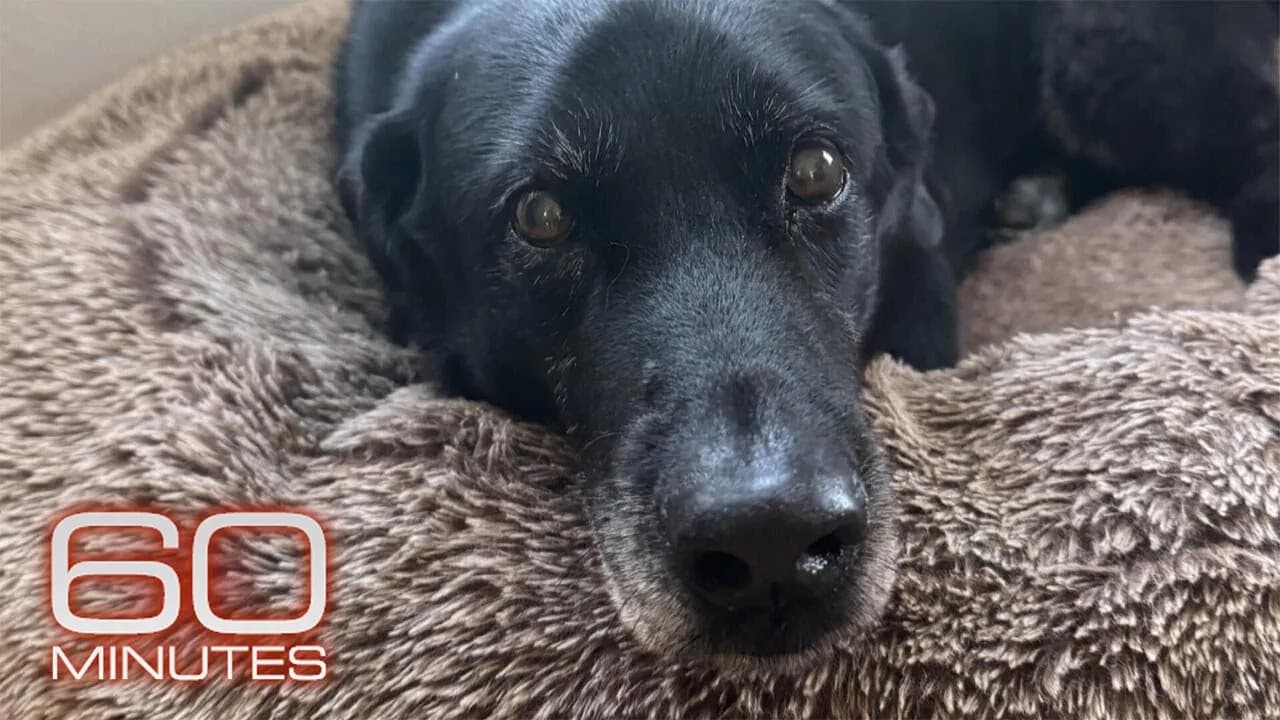
McGrath tracks hundreds of dogs, including 12-year-old Murphy, a German Shepherd poodle mix. In games, dogs are shown where a treat is hidden and seconds later allowed to find it if they remember. Murphy struggled, showing anxiety, which is a potential sign of dementia. He has progressed in challenges with tasks both at the clinic and home.
For Pat Schultz, enrolling Murphy was personal. Her husband Bill suffered from Alzheimer's disease, progressing to not recognizing Pat. Murphy was Bill's constant companion and caregiver, like a nanny dog. Pat used Murphy's tracking collar to locate Bill when he forgot his phone. Pat found the Dog Aging Project while looking at clinical studies. Murphy, a big dog, has undergone testing for three years to assess physical and mental fitness.
All information, including tests, goes into a public database accessible to researchers worldwide, used in more than 50 scientific studies. Correlations found between lifestyle, environment, and disease risk:
- Dogs that live with other dogs suffer from fewer diseases.
- Dogs that don't exercise have a six times greater chance of developing dementia. When dogs die, brains are donated and examined.
Dr. Dirk Keene, neuropathologist from University of Washington, studied thousands of human brains for Alzheimer's causes over 20 years. Motivated by his mother's Alzheimer's and his dog Spring's decline from doggy dementia.
So that Spring when she was a healthy happy dog, tongue out, tail wagging. She's she was a happy dog. And this is Spring near the end of her life. She would get confused and sort of lost. She would stare at walls. She would just stop and stare into space. She would lean against things. This happens to people. It's not just memory. When we start to have dementia, dementia is a very complex thing that includes confusion. It includes loss of the ability to remember sort of spatial references. Very similar to what we're seeing in dogs happens in people. Dog brains have the same frontal lobe, temporal lobe, occipital lobe as human brains, same basic shape. Dementia changes brain size and structure similarly: healthy vs. demented brains differ strikingly in size and weight due to neuron loss, enlarging middle cavity. Spring's brain showed beta-amyloid plaques, a hallmark of Alzheimer's, strikingly similar to human brains.
Progress in preventing Alzheimer's and dementia, affecting an estimated 40% of Americans over 55, has been slow. The Dog Aging Project tests rapamycin. In mice, it slows cognitive decline and increases life expectancy by 60%. Julie Moreno, molecular biologist from Colorado State University, conducted a pilot study of 12 dogs with dementia signs. 10-year-old Cubert got placebo; 13-year-old Monkey got rapamycin. Monkey's brain showed fewer microglial cells producing inflammation. Two other dogs, including Ralph, showed fewer inflammation-associated cells.
So if you just kind of focus in on this side, you see quite a bit of those teal colored microglial cells. And then if you look over here, you just see less, right? Like there's just less number of them. So rapamycin at least in this study worked on dogs. Yeah. What do you think when you first saw this? I was super excited. What's your hope in doing this study? If it works in a dog and it's safe and it's helping their cognition, then maybe it would help humans. Larger clinical trial funded in part by National Institutes of Health, giving hundreds of dogs, including Murphy, either placebo or rapamycin to see if it extends life.
Loyal, for-profit biotech startup founded in 2019 by Selene Holbrook (31 years old), develops three drugs. One in clinical trial for dogs over 10 years old, monitored for aging signs. FDA signed off on safety data with reasonable expectation of effectiveness; final results in several years.
My vision is that this is, you know, it's a daily beef flavored pill that are given preventatively to keep them healthier longer, similar to a statin, you know, for older Americans. And you think you will actually help extend a dog's life? Yeah. How long? Approximately one healthier year of life. Maybe it'll be more, maybe it'll be less. That extra year would be a healthier year than otherwise. An aging drug is about delaying and slowing the rate of decline that a dog or a human has over time to give them more healthier years. It's not something that you would give to a dog or a human on their deathbed to give them another year. It it doesn't work like that. Loyal raised more than $250 million. If we can achieve this, this is a massive multi-billion dollar company. If we only do that, we're all happy. But oh by the way, this also unlocks the possibility of us working on human longevity one day. I think going dogs first is the fastest way to work on and understand the biology of human aging.
Bill died two years ago from Alzheimer's complications. Pat won't know for a few years if Murphy got rapamycin. She focuses on aging as best they can.
You've cared for a human with Alzheimer's. You're caring for a dog in this study who, you know, is aging. What have you noticed in terms of similarities? The thing I noticed is that they both need to be loved and cared for. Just holding Bill's hand and patting his hand was enough just to decrease that anxiety, decrease that fear that, you know, was there. And that works with Murphy, too.
Keep 60 Minutes in your library
Save the videos and channels worth coming back to, and find them again in one place.