Essentials: The Science & Practice of Movement | Ido Portal
These notes were generated by AI and may contain inaccuracies.
Andrew Huberman introduces Huberman Lab Essentials, revisiting past episodes for science-based tools for mental health, physical health, and performance. He is a professor of neurobiology and ophthalmology at Stanford School of Medicine. He welcomes Ido Portal as a true intellectual of movement, defined as understanding a topic at multiple levels of granularity.
Ido Portal describes movement as an open system with no center, decentralized, approachable from anywhere. Entry points include the body or playfulness. Movement practice involves education and self-inquiry: awareness of living in a body, in motion, mind as movement, life as movement, emotions as movement. Bringing attention to motion in all layers. Even while sitting, be aware of body, feelings, facial communications, beyond verbal states to capture flux.
Huberman shares injecting playfulness into stair climbing in anticipation of Portal, questioning if that's part of movement practice beyond dedicated sessions.
Portal recommends nonverbal experiences and awareness of motion to clarify that layer, providing a safe haven, unlocking potential, attributes, strengths, freshness. Influenced by Moshe Feldenkrais, views body as three core elements: nervous system, mechanical system (muscles, skeleton), environment. Nervous system receives info from outside and inside; early life differentiates self from non-self. Feel external and internal movement, same for stillness.
Practice recognizing dynamic nature, flux, motion across layers; find it multiple times to make it yours.
Pragmatic examples:
- In Hong Kong, walked crowded streets avoiding touching anyone: 2 hours of full-body involvement, enjoyment, development.
- Rocking chairs for motion; recommends for kids in schools, more mobile chairs to support motion while focusing elsewhere, preventing staleness.
Movement allows long focus periods with skin in the game, keeping honest, humble, fresh, protecting.
Huberman asks about categories like strength, speed, explosiveness, suppleness for daily or dedicated practice: ballistic, smooth movement.
Portal discusses unique postures in movement, thought, emotions: people repeat same postures despite new sports/techniques. Problematic as it scaffolds thinking, focusing on habitual forms over content. Emotional postures same. Invade early system slightly or free beyond all postures toward postureless movement where techniques fall apart, phase change occurs—a binary jump, rare, like enlightenment shadows.
Exploration of degrees of freedom leads to advancement: unskilled to skilled to mastery to virtuosity, inviting variability/chance for new things within the 'sleeve' of achieving results. Diversity leads to true freedom; don't point at moon, look at finger.
Huberman asks about vision focus: narrow, panoramic, regimented way for beginners.
Portal: Eyes lead movement, inner eye, affect body/cognition. Trainable, far-reaching effects. Teach boxing bob from head, not feet—head organizes feet (demo: pulling head organizes feet underneath).
Use eyes via checklist for posture, stance, state. Flavors: peripheral soft open awareness vs. focus (opposites, often confused). Placement: lower chin to see better, raise eyebrows exposes top light; tilt chin for distance, side for scenarios, dominant eye.
Cerebrally jump practice forward.
Huberman: Eyes up increases alertness; down, calm/quiet. Panoramic via magnocellular pathway (thicker neurons, 4x faster reaction time vs. narrow focus). Driving uses peripheral vision for speed. Explore extremes and in-between.
Portal: Culture overemphasizes focus (reading); balance with panoramic. In nature: immersed open, then focus on bird, return. Modern life: mostly focused, daydream as balance.
Huberman mentions cone of auditory attention.
Portal: Play with hearing parameters. Different people excel in systems; same results via different paths promotes mutation/change. Culture homogenizes; difference is hope. Works with corporates/governments for freshness in workdays, kids' education, productivity via habits—improves lives.
Ear use: head placement/posture, angling (chin down), ear shape (closer/further). Face shape, vocal cords affect listening/motion; people enlarge ears to capture sound waves.
Huberman: Sound localization via brainstem interaural time differences.
Huberman: Body types (short torsos, long arms) facilitate some movements; challenge edges or lean natural?
Portal: Many walks explore emotional aspects (into meeting, out of bad situation). Approach: chin down linear efficient straight line vs. rounded side tilt—different communications/results.
Body proportions invaded by math/trigonometry/architecture: linear efficient walks misguided (straight line shortest path). Biomechanics not mechanics. Walks coil/uncoil, sway; coordinate breathing—linear less natural pumping, wasteful. Recent long-distance runners pronate, defy prior technical thoughts.
Evolution: Repurpose cell types/circuits via playful exploration of possibilities. At mastery thresholds, limit evolution without variability.
Humans biggest improvisers; keep openness. Leaders: less specialist, more open. Scientists report; laypeople treat as gospel—play with it.
Practitioner makes knowledge own: try heat, cold, light, movement, awareness. Responsibility to experiment vs. guaranteed tools.
Huberman: Reliable tools grounded in innate physiology, not biohacks (inefficient repurposing).
Huberman references earlier practice invading personal space, torsos touching, attention to feelings, reactivity. Many anxious in conversations/proximity.
Portal: Touch/proximity limited; cultural bubbles, political correctness issues. Practice removes reactivity, controls volume for performance/clear thinking. Reactive = slave. Fighters know what to sense vs. react to.
Disarm in scenarios: Huberman's boxing background carries martial tone/strength unconsciously. Explore non-competitive play, e.g., contact improvisation, Steve Paxton. Vary distances/spaces/touch ways, not always same context. Can touch chest differently.
Touching the chest with the exact same pressure and speed can feel very different based on intentions, combinations of postures, or ways of moving. Explore discomfort, such as being with a man or woman in certain scenarios, to build true strength without fear, improving culture. Always with agreement—never force. Meet someone interested in mutual exploration: moving together in all kinds of ways—walking, games, playful, romantic shades. Sex is a continuum, not rigidly defined. This unlocks strength, reduces abuse, and opens other aspects of being.
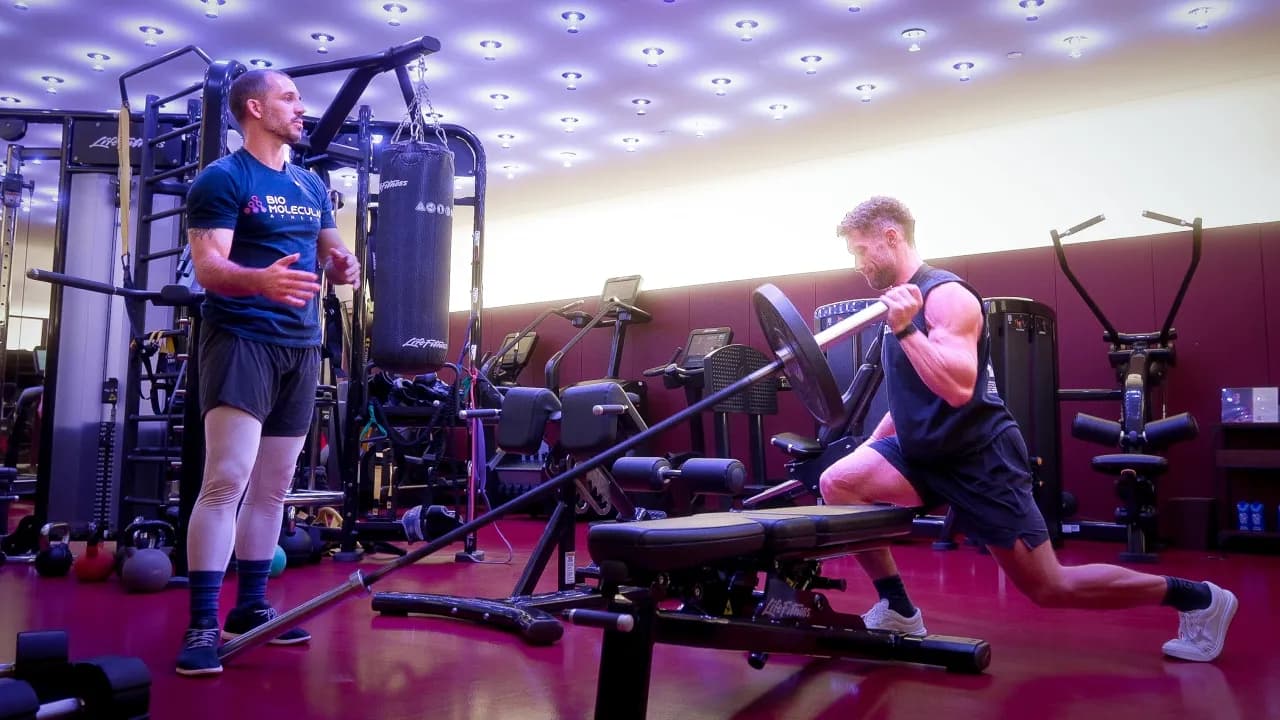
Many approach movement via weight training, yoga, running, Peloton, rowing—mostly linear. Example: Instead of static standing for bicep curls, walk while alternating reps, or do curls with one foot in front of the other. Standing parallel for curls is ridiculous. This draws strange looks in the gym, but return them.
These linear forms are a problem. People seek quick hacks, just icing without cake. The body is a dynamic entity for communication, shaped by genetic layers, personality, essence. Practices like these are good but not for the intended goals; they orient elsewhere.
Yoga's Modern Linearity
Yoga today is very linear, influenced by Swedish gymnastics and Mongolian contortionists, not ancient asana postures. Read Yoga Body to understand this history—Western influences shaped modern yoga. Traditional dances (Thai, Chinese, martial arts) are rounded, curly like nature and animals, unlike yoga poses.
These practices shape you, placing you in forces of change. Good intentions backfire unknowingly. Movement practice starts with education: think deeply. No magic powder—begin investigation.
Pragmatically, placing foot in front during curls is about examination. Continue: eyes closed, different head posture—unrelated things emerge. Associative mind misses the heart. Adopt playful, researcher approach without preconceived truth or motive. Without inherent worth, agendas create lies and problems.
Traditional practices challenge to generate states internally (e.g., gratitude harder than sensing it in a movie). Benefits like hormonal effects, cognition come from challenge. Opening up reveals less delusion.
If no weird looks, not moving right. Try same workout with smile vs. frown.
Explore constantly. Greatest scientific compliment: N of one—embrace, evolve, create, share practices generously. Ido Portal is wild and wise.
Thank you very much. Thank you.
Keep Andrew Huberman in your library
Save the videos and channels worth coming back to, and find them again in one place.