Movement Practice to Strengthen Your Mind-Body Connection | Ido Portal
In a Nutshell
Ido Portal argues that real transformation comes from practicing in liminal states—sleep transitions, moments of resistance, emotional contradiction—where rigid mental and bodily models can be disrupted and recalibrated. Discipline and motivation are useful scaffolding but insufficient alone; they must be paired with playfulness, micro-practices, and deliberate attention to transitions and multistability to develop genuine will and prevent the body schema, emotional schema, and conceptual models from deteriorating into oversimplified, black-and-white states. The core practice is turning daily life itself into training—using any tool, from handstands to traffic to grief, to maintain high-resolution awareness and keep the system adaptive rather than defaulting to rigidity.
These notes were generated by AI and may contain inaccuracies.
Discipline is very important, but it is similar to using the wall in learning to do a handstand. If you use the wall one way where you're all the time pushing yourself off of the wall to try to catch your handstand, you become reliant on the wall. There is a different approach. You can use the wall but pull off of it which comes from the other end from our hands from the connection to the ground. That does not necessitate the wall. This is the correct way to use discipline. You should use it as a scaffolding as a way to get things going like write that book. But inside the process, you must make sure you don't lean hard into it. You don't leave everything for it to dictate and you bring some playfulness, some relaxation, some deep choice.
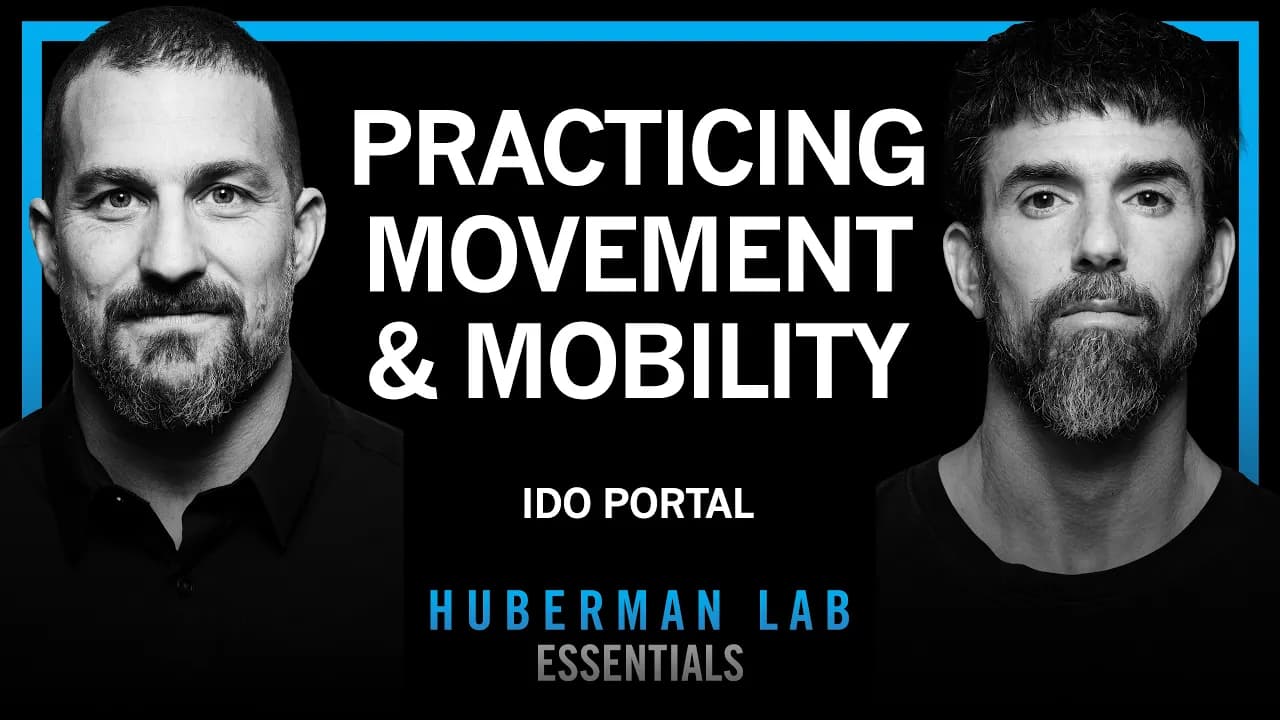
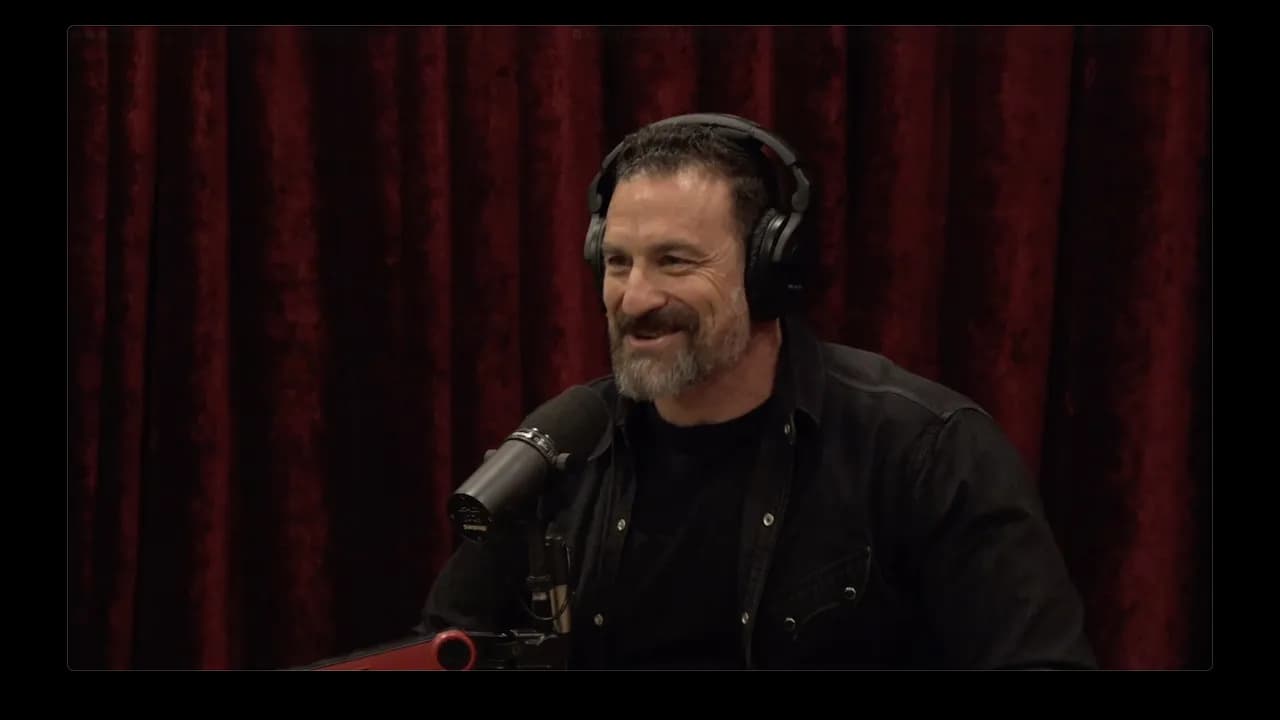
Welcome to the Huberman Lab podcast, where we discuss science and science-based tools for everyday life. Andrew Huberman is a professor of neurobiology and ophthalmology at Stanford School of Medicine. His guest is Ido Portal, a world-renowned movement teacher and the founder of movement culture, which is an integrative practice for developing the self that combines physical and mental practice. They discuss how anyone can practice movement, deliberate awareness, and even language and other forms of communication in ways that explore and expand your capabilities and your understanding and sense of self. Ido is not anti-exercise or anti-fitness, but what sets him apart as a movement teacher is his ability to show people unique ways for how to go about their daily life in ways that truly expand both their mind and their body as well as their athletic performance. They discuss unique meditation practices, ways to build discipline and access willpower, and the difference between discipline and willpower, and how to use play as an extremely potent way to rewire your default operating systems in everything you do.
If you like so many other people typically think about movement practices as for strength or endurance or mobility, Ido explains how the transitions between brain states and physical states are linked and are fertile ground for extremely rapid neuroplasticity and that they can help you truly understand how your mind and body are organized and can function better. Today's conversation is a truly special one. It's not philosophical. It's not theoretical. It's a practical exploration of movement, awareness, language, and cognition that is rooted in science and has real world implications for all of us.
Ido Portal's first thought on waking most consistently over the last year is the same thing always, the most important thing that exists, that that's how his system operates but getting that change, that deep transformation in people in himself. Why are we missing it? What is required that's always been there and changes its face, but it's the same one. Ido sometimes spends time in the liminal state between asleep and awake. He has experienced sleep paralysis before and various in-betweens where you're wide awake but the body is still paralyzed. When you sit a lot, when you meditate a lot and other practices and somatic practices, you get to know the territory and you can stabilize fragile states more easily. So crossing into that boundary of the sleep it becomes a slow-mo journey that you can pause, that you can spend time at any point in.
Ido practices yoga nidra, non-sleep deep rest, and there are moments where he can feel himself falling asleep and it literally feels like falling and then you can kind of catch yourself in these liminal states. Rick Rubin once said that if you wake up from a bad dream, a nightmare, just move your body and look around the room. If you wake up from a dream you were really enjoying and you want to go back in, keep your eyes closed. This is about the ability to kind of forward and reverse out of these transition states. Usually the common way that people live and the common person has a very simplified perception of these states, of the granularity. So they're difficult to stabilize. So it becomes very binary, black white, sleep, like you relax someone they fall asleep. That's what happens when there is not a lot of experience. Everything is immediately going there. But there is a lot of benefit in heading to sleep and taking a sharp left just before.
The sleep state is discussed in various authors, the waking sleep, and then the sleep has a benefit because there is an openness towards something else. So heading directly to sleep and then navigating from there is very powerful to reset the system, to change the schemes, these rigid schemes that we sometimes have, the rigid schemas, the models that we're running when they become too rigid, when they're surrounded by a hard membrane, when they oversimplify and there is this Bayesian reduction. You got to pop out of it somehow. So psychedelics is one way and there are other ways but the sleep every day is key because it's a very different status and way of being and way of experiencing which we experience daily and we can use that transition part and the thing itself as well.
Ido has intentionally gotten up in the middle of the night to just experience being mostly awake but somewhat asleep just to experience what that's like. Various practices use that kind of instruction. People might be familiar with the lucid dreaming or the dream yoga or the sleep yoga. Waking up in the middle of the night also allows you to appreciate something else, something different. Sometimes it happens and you can manipulate it into somewhere and sometimes you can do it on purpose. Nowadays with all the longevity talk and all this direction, we sometimes don't capitalize on such things but sometimes there is more to be gained with a bad night's sleep than with a good night's sleep.
In 2015 to 2018 Andrew Huberman was very busy but he was mourning the death of his graduate adviser. He was very close with her, unusually close for a graduate adviser and student. She knew her kids, he is friends with her husband and kids still, and she died in 2014 and he was really distraught about it. Someone recommended that he set an alarm for the middle of the night somewhere between 3:00 and 4:00 a.m. and just get up and try grieving then. At first he thought that sounds like the worst thing to do. He had no protection then, his forebrain is shut down. That's when he normally would be entering more REM sleep. He tried it. It was very interesting. It definitely allowed for more intense mourning but it had a very interesting effect where he no longer had the challenge of falling asleep and waking up. He had this designated period in his sleep. He did a lot of crying between 3:00 a.m. and 5:00 a.m. and in many ways it worked. In some cultures it's like the veil of suppression is pulled back. Our defenses are way down in those hours.
These membranes that are surrounding various systems inside of us and models that we are running that are protecting them, this filters that can rigidify and don't allow a lot in to simplify things for the model so we can survive so we can do things. And then when you change, when you go into those times, to those change the scenario radically, you increase your chances of opening up, of recalculating, of allowing the model to recalibrate. People nowadays use extreme means, it doesn't necessarily mean that it works. Sometimes you need the micro dosages and a practice around it, repetition, not a huge event of intensity, but a repeating mellow event, gentle event.
Andrew Huberman started a prayer practice before sleep over two and a half years ago, and he hasn't missed a single night. Some nights he falls asleep while he's praying and wakes up and continues. He tells himself that the consistency is worth something on those nights because he feels sort of badly like his mind's drifting and then okay but he hasn't missed, it's all in the if he falls asleep get out of bed and do it and then get back in bed. With respect to these micro practices, micro doing as it were, Ido is a proponent of meditation. People often will talk about how long they meditate. There are advantages to both ends of the spectrum because the long meditation thing, the retreats, the strong determination sits, many hours or many days, they definitely load the trampoline and create an effect. But also you become dependent on it and it's hard later to drag this into other areas of life which is not often discussed and mentioned in relation to meditation.
Ido didn't start to meditate because he wanted to sit. He wanted to take the state and to apply it into his life. So that is a moment where you can integrate. You can take the depth and you can take also very short periods of practice and apply these micro dosages and try to get a change in the defaults of your state and your way of being. Eventually people ask him why he practices so much is because he's aiming for 24 hours a day. So if you're practicing 8 hours a day or 10 hours a day, this is the unofficial side of the practice. And these micro practices are very helpful for that.
A good practice to do is not to take your mind off of something like a problem that you have to solve, to walk around and try to remember that thing. Try to keep it in front of you as much as you can. Which means the only thing you can be blamed for is if you caught yourself not focusing on that and you didn't bring yourself back to the problem at hand. Then you are to be blamed. Anything else is fine. And that is a very powerful practice. We can solve incredibly difficult problems, overcome obstacles, transform ourselves. And we've moved away from such ways of doing and ways of being.
Tap water often contains contaminants that negatively impact our health. A 2020 study by the Environmental Working Group estimated that more than 200 million Americans are exposed to PFAS chemicals, also known as forever chemicals, through drinking of tap water. These forever chemicals are linked to serious health issues such as hormone disruption, gut microbiome disruption, fertility issues, and many other health problems. The Environmental Working Group has also shown that over 122 million Americans drink tap water with high levels of chemicals known to cause cancer. Rora's filtration technology removes harmful substances, including endocrine disruptors and disinfection byproducts, while preserving beneficial minerals like magnesium and calcium. It requires no installation or plumbing. It's built from medical grade stainless steel. And its sleek design fits beautifully on your countertop.
Roka and Andrew Huberman recently teamed up to create a new pair of red lens glasses. These red lens glasses are meant to be worn in the evening after the sun goes down. They filter out short wavelength light that comes from screens and from LED lights, which are the most common indoor lighting nowadays. Roka Red Lens glasses are not traditional blue blockers. They do filter out blue light, but they filter out a lot more than just blue light. They filter out the full range of short wavelength light that suppresses the hormone melatonin. You want melatonin high in the evening and at night. It makes it easy to fall and stay asleep. And those short wavelengths trigger increases in cortisol. Increases in cortisol are great in the early part of the day, but you do not want increases in cortisol in the evening and at night. These Roka Red Lens glasses ensure normal, healthy increases in melatonin and that your cortisol levels stay low.
We've done a few episodes in the last year on meditation. Richie Davidson said that when people start a meditation practice, traditional sitting meditation, close their eyes, focus on third eye center, breathing, redirect attention, that they see a statistically significant increase in anxiety across that early phase and in some ways he said that's a real value of the practice. It's really about stress inoculation, the stress that comes from forcing oneself to sit still. But eventually it does seem to give way if people practice regularly to some other kind of channel of consciousness that is very useful to apply in the rest of one's life. This anxiety, this under reduced state in a way, the failure to adjust the membrane, this protective membrane around the model, whatever model it is, if it's the body scheme, if it's the emotional schema or the conceptual schema, you're in an under reduced state. So everything bombards you and you're bleeding resources metabolically, right? And that's anxiety. That's why almost always anxiety over a long duration will turn into depression. You're bleeding resources. So adjusting, simplifying, that's a critical moment. Of course lowering the bar of the task is a very important tool. Micro tasks.
I'm not just talking about the classical sitting meditation. I'm using everything. For me, it's all the same tasks with tennis balls, with a stick. I'll use anything because my intention is not to get the success in the specifics, is to get the transformation much deeper. So, it's almost irrelevant. I'll use whatever I need to use to get that going. And so I think meditation many ways sometimes becomes too dogmatic in that sense.
We've already touched on liminal states, transition from sleep to waking or waking to sleep and trying to just catch oneself and pause in those like you said maybe reverse, maybe pause there, hover there. There's a peculiar place we are with science where we know a lot more about sleeping states, can describe phase one, phase two, phase three, slow wave, deep sleep, REM sleep, the fraction that you get depending on the night before, vivid dreams versus non vivid dreams. We know barely anything scientifically about waking states in comparison to sleeping states. We talk alpha waves, beta waves, theta waves but it's very rudimentary. Like right now, there's no scientific paper that could describe the state that we're in. We could say the alpha waves or percentage of activity in one brain area or another. The definition of different waking states is going to come into science from outside of science.
There's a mistake or a direction that we took asking who we are instead of asking what we are which can really serve this. There is a need of almost a rudimentary map of what is needed, what is here, how do I map this, what am I observing. Even you can't refine what you can't define but not in the sense of this verbal definition but some kind of an internal definition, some kind of a boundary drawn, some kind of a selection, the selected thing, the selected state, the differentiation. Without this what am I seeing when I look inside, listen to your body, I don't believe in that. Portal doesn't believe in listen to your body. What do you listen to? Your heartbeat? What does that mean? It's corrupted. You're too corrupted to listen to your body. Those are the most corrupted people usually, the people who are saying listen to your body.
That whole verbiage comes from this notion and the quite pioneering although somewhat out-of-date book The Body Keeps the Score. It was an important book, best title of any book you could imagine in the psychology space because it's so catchy. There is proper respect to Bessel for doing that book and it was early but embedded in people's minds that experiences we have live as pain, discomfort or blockages and that the solutions come from releasing that pain, discomfort and blockage. Ergo, if I'm feeling good, things are moving through. I'm making progress. I'm moving away from that historical bad thing. And if I'm feeling it again, it's still alive in me and it needs to be released. And there is a lot of data to support that chronic stress can harm the body and so forth. So those things, those ideas sort of took off. But they sort of hit a wall in 2020 or so. We go well what do you mean? Well it's in the fascia really, like is it in the fascia or are we just talking about fascia? And we love all of that stuff as an exploration but we are at a place where we really need to ask better questions.
It's corrupted again. And we know so much about the framing of things, excitement versus very negative states that it's so similar, it's so close that it cannot make sense. We cannot work from that place. And also working from our likes and dislikes. What do I want to do? We just watch this thing. You just need to do what you want to do. I believe that's the last thing for you to do.
Before coming in here, two short films were watched. The first one was put out in 2014 about this guy, real life guy Slow-Mo, who essentially gave up his life as a physician and rollerblades very slowly on one leg down the boardwalk in Pacific Beach, San Diego, to touch into what he describes as a mild euphoria and altered state. He's totally sober, clearly very smart. The other film is a beautiful film that's being made about Ido and movement culture called The Architecture of Practice, or Internal Architecture of Practice. For some people it would be helpful to try and operationalize a bit of what we're going to go to today. And I'm not a fan of morning routine or this or that, but I can imagine walking toward a practice of any kind, a workout of any kind, making scrambled eggs as either I'm going to approach this from a sense of play or I'm going to approach this with a sense of discipline. I'm going to try and find some friction, some edges that force me to rewire something. Now, play can help rewire, discipline can help rewire, but of your waking hours, what percentage of time do you spend in kind of a playful explorative state, like keep it light and loose versus there's really value to putting up mental or physical or both corridors so that your system, your whole system improves because at those friction points is where plasticity can be triggered.
Both of these things and also the relation to motivation in both of them are required scaffoldings that we have to use at certain points in time but are not the essential will, that connection to what we don't know nothing about that we have researched that deeply in various spheres but often we just replace pure will with discipline or with motivation but once I motivated myself I don't need will anymore and if I discipline myself into doing something I also hijack the opportunity. Playfulness brings a direction and a flavor of something else, a different way to interact with something. How do we start to look at that? What is the basic requirement? I don't want to do this. Without this requirement, I can't research will now if I hijack it, if I take the process and I distort it, I use discipline, then again, I'm out of the game. Or if I motivate myself, same problem. Playfulness try to walk a different path a little bit. Maybe it's not it quite. It's not the will that search for a will that you know many authors and practitioners have looked for because it's so elusive. But it's definitely something to cultivate and we've talked about it the last time we met and it brings about so many positive things.
People should first develop discipline and use motivation and also research playfulness which is a lot more tricky for people these days. It brings with it incredible benefits. The aesthetic intensities that are missing from our lives, awe, curiosity, this deep sense of curiosity, these things can allow us to totally transform the emotional schema which is stuck rigid. This model of ourselves that is often times rigidifies all the way to depression. The most tricky situation of all, the total bankruptcy of that budget of those resources. So something like awe which happens also in psychedelics. Isn't this a huge part of the psychedelic thing? What about experiencing awe regularly in a directed targeted and practiced way? It can be cold showers and hot shower an experience on the sensory level. It can be something that is more related to the environment like sky gazing. Incredible practice. 10 minutes a day. Your eyes cannot grab onto things.
Playfulness is a very important conceptual element that comes through reading poetry, certain types of stories, or literature. The speaker treats interactions as playful things that prevent rigidifying in front of challenges. When working with athletes, cinema projects, government bodies, or military organizations, playfulness allows going much further and deeper than discipline alone would permit. Discipline gets one to certain places, but playfulness brings the totality of self into the process.
During a commute in San Diego with brutal traffic on eight-lane freeways, the speaker decided to slalom the car while listening to music without speeding. This transformed an ordinarily frustrating experience into a standout memory. The commute remained exactly the same in duration and conditions, yet energy was not lost and may have even been gained. This represents a heightened presence that playfulness opens the door for.
Memories of urinating in the woods during hikes in Yosemite have flashbulb quality with distinct flavor, texture, and resolution compared to other experiences. These micro-experiences lasting 10 to 15 seconds or a minute occupy real mental real estate. The quality of these memories differs from experiences that should have been more detailed. Playfulness enables this heightened presence.
The speaker tried approaching book writing with a languid intentionality, relaxed but with direction, following Cal Newport's deep work principles. This proved difficult due to technical aspects requiring precise communication. The disciplinary approach is a self-fulfilling prophecy that leaks into the words produced. Writing something like Don Quixote cannot happen through that rigid approach.
Discipline is essential as the first thing needed to get work done. The practice person does things rather than talks about them. However, discipline should function like using a wall for handstands: one can push off the wall and become reliant, or pull off it from the connection to the ground, which does not necessitate the wall. The correct way uses discipline as scaffolding to get things going, but one must not lean hard into it or leave everything for it to dictate.
The will never gets developed; it only gets exposed. Discipline gets developed, which is what gets mistaken for will or willpower. When facing situations like a child born with problems or lacking feelings of love for a newborn, discipline may not suffice. The will represents the totality and harmonious combination of all that one is. Sequentiality means always doing what one said they would do, not through disciplinary action but through finding a beautiful evasive sequence.
The first requirement for practicing will is to wait for a moment when one does not want to do the task. This differs from going to an ice bath. The task should be one that only sometimes one does not want to do. In that moment, catch oneself and investigate without forcing, jailbreaking, or pushing hard. Do not motivate yourself with YouTube clips or slogans. Relax and do not rigidify in front of the task. If rigidification occurs, lower the bar and find the right dosage task, building up gradually.
Holding arms straight out for 5 minutes or doing a horse stance provides useful practice. These should be practiced at the end of the day when checking out. Research and find a thread to get this going again and again with gentle quality, playfulness, and softness, then slowly increase the bar. The will of even incredibly powerful people is like a mosquito's fart because they only use discipline and do not know how to identify or assemble will.
Stand at the edge where one is almost not sure if the chosen task is difficult enough. This is not the only practice but an important flavor. The speaker still practices discipline and extremely difficult things, but this missing component is crucial. The point is not in the task itself but in the quality and attribute that develops inside, making one reliable without caffeine or discipline.
While extremely jet-lagged and tired, the speaker plays an internal game by paying attention to what is going on in the internal realm through interoception. Previously, the approach was to push against tiredness and harden through it. This new way of practicing taught significantly. Resistance presents opportunities for will to visit, which only comes when resistance exists.
Neuroplasticity is triggered by friction points and some level of autonomic arousal. Play can generate the necessary change in the chemical environment without the energetically costly cocktail of catecholamines including adrenaline and norepinephrine required for discipline. Play includes some of those elements plus other substances, representing a different neurochemical cocktail. The rigidity from discipline is almost instantaneous and removes something from engaging.
Transforming oneself happens by choosing to do something deeply while saying one wants to do it in the moment one does not want to do it. This paradoxical multistability requires glimpsing both things, feeling the emotional contradiction, and remaining functional while moving forward and leaning into the direction. This has been a big passion in recent years as a crucial missing component.
The anterior midcingulate cortex gets activated when one does not want to do something and forces oneself to do it. This structure enlarges and becomes easier to access through discipline. There is no known neural correlate structure for the play piece yet, which may be distributed as circuit phenomena rather than localized in a single structure. Playful spirit in people in their 70s, 80s, and 90s appears crucial for longevity but is rarely discussed.
Everyone meets this quality of playfulness even if many believe they never experience that state. Investigating yesterday reveals it was present for brief moments. Even in extremely depressed people, the quality is present, though depression involves rigidity preventing recognition of these positive moments. Without learning the flavor and texture of playfulness, there is no chance of approaching or developing it.
People default to thinking in terms of discipline, will, or laziness and sloth. Many aspects of having a good life involve not doing certain things, particularly avoiding having consciousness and body pulled into algorithms. Social media functions as a wheel of infinite stimuli, similar to keeping a rat engaged in experiments. The speaker uses social media intentionally to learn and follow up on philosophers and authors mentioned, finding inspiration in strength training content like Tom Haviland's zer squat posts.
Allocation of energy represents 90% or more of the game of life. Practices for resisting stimuli, the no-go tasks, involve pulling back in a playful way. Deleting apps or throwing phones on rooftops represents paying upfront in a painful and costly action. This reminds of bungee jumping despite great fear of heights.
Ido Portal describes an experience climbing a crane above a tiny swimming pool where he realized he could neither jump nor climb down safely. A girl was screaming below. He stood frozen before throwing himself forward. Years later he redid the movement with a different quality, softening into it and finding a way to come down while experiencing great physical pain alongside a wave of softness passing through him.
When pulling back from difficult actions, Portal emphasizes not forcing oneself in a sadomasochistic way. The initial approach may be necessary as a stepping stone, but the process involves learning to soften into the action over time. Eventually one can leave the old pattern without deleting it, keeping it present while continuing to soften as the stimulus calls repeatedly. This develops feedback that transforms the model and creates a new reaction to the stimulus.
When a stimulus calls, the first response should be to soften, relax, and put on a small smile before returning to the task. Rather than forcing oneself away from social media back to work, one notes the distraction, recognizes it, softens, and only then returns to the task. The outcome differs dramatically when this extra step is taken repeatedly.
Portal introduces the concept of bodily resolution as a refinement and complexity in physical practice that is missing from modern movement culture. This is not about mobility or flexibility. Without challenge through novelty and certain qualities of attention, the model deteriorates, simplification occurs, and the body schema hardens into something more black and white. Living in the physical form then becomes hell.
The same deterioration happens in the emotional schema, the conceptual or intellectual abstraction model, the social schema, and the spatial schema. Without continued effort to make these detailed and appreciate the details, deterioration follows. There is no status quo; one is always moving up or down.
Most people going to the gym or doing runs have lost something they don't recognize. They are not as they were as children. Portal contrasts this with a Kung Fu master in Beijing walking at 5:00 AM with the stout of a child. The refinement of fine things is very important, including emotional granularity.
Depression reduces everything to black and white extremes. High resolution of emotional appreciation can turn against a person only when the conceptual layer manipulates that information. As long as it stays within the nondiscursive, raw experience from the allostatic system, it remains poetry. Reading poetry and literature increases complexity, moving beyond good or bad into a different game where playfulness returns.
Portal often sends people back to the body, noting that the eye is far more embodied than commonly thought. Embodied people show signs and cues in how they move and how they are present. When these clues are absent, great deterioration has occurred.
Portal cares less about structures, muscle mass, joint protection, or connective tissue because the model deteriorates before structural consequences appear. Once the model has degraded, structural effects follow years or decades later. Words are dangerous. The term "spinal column" has destroyed countless spines by modeling it as a column. Different languages contain clues, and there is a lack of appreciation for fine micro actions inside the torso between the ribs. Distribution of pressure in the body is not given room in current practices that favor quick, crude execution.
Portal identifies three key areas: language, movement, and awareness. Psychologist and neuroscientist Lisa Feldman Barrett has shown that cultures with many words describing different aspects of sadness, happiness, and specific circumstances are less likely to default to broad categories like "I'm sad" or "I'm depressed." Portal refers to the emojification of mental life where people categorize themselves as happy, sad, or depressed.
Intellectuals can work with concepts at multiple levels of granularity appropriate to the conversation. Reading more challenging books or simple kids' books builds this capacity to move up and down the ladder of language.
Another practice involves bringing about ambiguity and incompleteness, not needing everything resolved. This applies beyond problem solving to physical kinetic coins that develop movement intelligence. Reading puzzling symbolic texts, watching difficult-to-resolve movies like those by Tarkovsky or Jodorowsky, or experiencing contemporary dance that defies definition creates this experience.
Portal initially disliked contemporary dance but returned and developed appreciation. The connection between birds that can talk and dance is noted, with bodily movement suggested as the fundamental language.
Words are corrupted and corrupting. They are supposed to be containers but function more as pointers, with the pointed-at often lost. The simulacrum versus simulation distinction is discussed: simulation creates a model of something real, while simulacrum becomes disconnected from the real. Portal does not believe there is an inherent difference but recognizes critical masses can be achieved. The sensory-motor system is less corrupted than the conceptual schema, though senses themselves are simulation machines that model reality by ignoring uniqueness and erasing differences.
Psychedelics can expand the bandwidth, allowing too much input and cross-talk. In psilocybin therapy-assisted studies for major depression, increased connectivity between previously non-communicating brain areas offers new insight and integration opportunities, though this can also be problematic as seen in psychosis with clang associations.
People not exercising enough approximate a C-shape with internal rotation. Portal pushes back on the question of whether to add subtle movement awareness after checking heart health and muscle health boxes. The question itself is corrupted by an exercise approach to physicality. The real issue is what occupies the rest of one's time and whether presence is maintained while listening, cooking, or doing daily activities.
A paradigm shift is needed in viewing physicality throughout the day. Highly productive people often fail to use time well in terms of presence. The body and sensory symbols are the raw currency of cognition. The most basic element is drawing a boundary, selecting something from the environment, creating differentiation. This is the root beneath language.
This work transforms the body schema and should be taught to children. Some cultures maintain it to a larger degree. It operates below exercise and makes exercise more efficient when the model is addressed. Portal works with athletes, grandmothers, Alzheimer's patients, and musicians. The approach cannot be fit into a corrupted fitness or exercise framework. The 30-minute-a-day idea limits potential.
The practice should become the unofficial practice of daily life, turning everything into practice: the way one drinks from a cup, sits, or listens. This is more important and potent than learning to meditate because it is meditation in the deep sense.
Alzheimer's research shows loss of vision or hearing can accelerate deprivation symptoms. Even when feedback is damaged, the system must continue to be challenged rather than cast. Portal rehabbed his torn rotator cuff by returning to motion, not immobilization. The same principle applies to Alzheimer's and osteoporosis, where loading the skeleton is more potent than nutrition alone.
Life is a school for practicing, not merely living. Neurologically, viewing oneself this way is potent and enriches current life without requiring more than 30 minutes daily of structured work. One must educate oneself and go deeper into these concepts to apply them correctly.
Portal observes that when meeting people, it is clear who is practicing and who is not. Practice involves conscious interaction with suffering, friction, and difficulties alongside awe and curiosity in a directed way that does not hold onto current identity. The multistability must be held so that one practices oneself into the next day and next moment. Podcasts and other situations are manipulated for practice because life depends on it.
Movement exists across scales from large spatial movements like flapping elbows to subtle finger motions. The same principle applies to language, moving from grunts to sophisticated articulation built through experience. Awareness operates similarly, allowing one to grasp large portions of a room at once or focus on small details. The time domain adds another layer of choice in how experience gets segmented, whether watching a cloud move over minutes or observing subtle leaf ripples.
Dacher Keltner at UC Berkeley studies awe and notes that everyday awe experiences become accessible by moving between fine scale and large scale in both space and time. This transition between scales shapes how life gets experienced and represents something people have control over.
Online content consumption raises questions about whether experiences are low-resolution or high-resolution. TikTok was described as low-resolution due to its abrupt, pixelated auditory quality compared to rich natural sounds like red-wing blackbirds settling in California evenings. The concern is that low-resolution information consumption may diminish cognitive capacity over time.
The principle extends beyond social media to all sensory input. While punk rock music with simple three-chord structures has value for its rawness, classical music provides contrast. The approach involves stepping through from coarse to fine across different domains.
Emotional and intellectual faculties require feeding similar to digestive systems, needing both gross and fine nutrients. Discomfort serves as an important emotional nutrient. Emotional contradiction, described as the simultaneous experience of "I love you and I hate you," creates multistability that can be practiced through boxing training.
Aesthetic intensity brings moments of awe, curiosity, and melancholy that have been removed from movies, books, and online content. Restraint represents another crucial quality that stimulates growth. These become deliberate practices for feeding emotional states.
Thought extends beyond knee-jerk reactions, associative levers, and automatic responses. Carl Deisseroth, a neuroscientist, practices forcing himself to think in complete sentences each night after putting his five children to sleep. This represents deliberate development of thought as a tool rather than falling into disjointed groove patterns that resemble psychotic thinking without being expressed.
Gym practices and weightlifting represent very low quality movement according to dancers and high-level athletes. A problematic inversion has occurred where athletes learn from fitness people rather than fitness practitioners learning from athletes and movement specialists.
Olympic track and field reveals personality differences between sprinters, who sometimes wear flashy jewelry despite aerodynamic costs, and distance runners who avoid such accessories. The margins in distance events allow for different competitive dynamics.
Boxers increasingly train like fitness athletes rather than boxers due to social media dynamics and what calls attention. The human curiosity system drives social media engagement, but low-resolution content affects the signal-to-noise ratio. Sensory apparatus operates at different granularity levels, from fine to coarse, and experiences like hugs and light caresses matter as part of human experience.
High signal-to-noise content requires care and effort. The conversation addresses exposure challenges where certain topics and scales become harder to discuss publicly, with concerns about younger generations whose brains are more plastic during periods of low-resolution overload.
A meditation practice involves focusing on the pause between inhale and exhale for five minutes rather than the breath itself. This develops awareness of transition points and dials in the spotlight of attention. The discovery within this practice is that no transitional moment exists where the pendulum changes direction at a zero point.
Kumbhaka, the retention of breath, offers similar multistability practice. Holding urine creates a sensation containing both discomfort and pleasure, similar to the multistability of first orgasm experiences where pain and pleasure remain undifferentiated. The same principle applies to goosebumps, cold sensations containing underlying heat, and poly-rhythms.
A standing meditation in shallow water in Australia during sunset demonstrated how sustained investigation of cold sensation revealed internal heat, allowing switching between perceptions. This multistability practice extends to rhythms, poly-rhythms, movements, conceptual materials, and meditation, requiring keen observation.
Push-ups can be experienced as either push or pull, with the pull sensation being closer to reality. Neural circuits demonstrate antagonistic relationships where flexors and extensors relate intricately, and the ability to see dark edges depends on seeing light edges.
Research by Dayu Lin with David Anderson on the ventromedial hypothalamus demonstrated that stimulation produced either rage or sexual mounting behavior. Genetic tools revealed these as two antagonistic neuron sets in the same structure. When mating activity is driven, aggression potential gets suppressed then returns higher, and vice versa. This push-pull dynamic appears across brain circuitry including eating versus other drives.
Fighters benefit from hearing various rhythms in footwork, breath, body, and eye blinking to become the controller rather than being controlled. Borges' short stories provide multistable conceptual material that transforms readers, used in combination with physical discomfort like hot water immersion to create awe experiences.
Real remorse involves genuine recognition that actions were wrong without self-flagellation, hitting a rock bottom and immediately climbing from it. This differs from beating oneself up. Grieving represents another difficult practice that people often push away for lifetimes, as illustrated by a meditation teacher who grieved his father's death in twenty minutes.
Allowing grief over the passage of time has become a recent practice, separate from regrets about specific decisions.
Acknowledging the passage of time without dwelling on the past is important. At 50, vigor and understanding of life feel stronger than in the 30s, yet recognizing there is no do-over and rejecting the delusion of having forever is critical. This realization came through confronting a suppressed internal lie about time representation. The process involved acknowledging cowardice in certain or many circumstances, which paradoxically enabled greater bravery in facing difficult situations. The key to this acknowledgment is approaching it without the goal of immediately escaping the feeling—entering with near-acceptance that one might remain there forever, even though that will not happen.
Charlie Gilbert, a renowned neuroscientist at Rockefeller University, illustrated sensory tuning during a graduate student lunch. He declined the provided meal to preserve his senses for a subtle dinner at a favorite Napa restaurant. He explained that hunger heightens the ability to perceive subtleties, pleasures, and aversions in food. At expensive restaurants, one is especially permitted to send back unsatisfactory dishes. This principle extends beyond food to most experiences in life: dulling the senses causes one to miss distinctions between crude and refined. This conversation occurred before intermittent fasting became widely discussed.
Relationships offer opportunities to explore dimensions and transitions between them, forming a vast, possibly infinite landscape between people. Being involves rubbing against things to map oneself; relationships serve this powerfully, while solitude provides different friction—both practices matter. Everything exists only as a form of relationship.
In human relationships, the make-or-break element is operating together in an infinite game aimed at sustaining play rather than winning or finishing. This requires a shared practice of evolution, transformation, and insight. Fixed self-concepts as finished products prevent this dynamic. The essential factor is not sexual attraction or romantic chemical love but the willingness to engage in ongoing mutual practice.
Around this core, physical/sexual love, romantic/emotional love, and a higher meta-concept of love must be cultivated. The meta-love does not fracture over minor conflicts after decades. Relationships function as mutual cultivation where partners use and help each other through life's experiences and crises, whether or not children are involved. A good long-term partner is one who loves to practice, requiring sustained attention and presence.
The Grateful Dead exemplified powerful band chemistry that drew followers worldwide. Chemistry deteriorated when cocaine shifted focus toward individual goal-directed behavior despite shared knowledge of songs. Cocaine, primarily dopamine-related, illustrates how excessive self-advancement focus prevents group progress. Effective dynamics involve dynamic subordination, similar to a flock of birds where leadership shifts fluidly. This applies across work, romantic, and group relationships.
Neurologically, relationships involve sharing allostasis and body budget, metabolically bringing in more resources. Grief devastates partly because it suddenly removes these shared resources, leaving the individual to face challenges without that integrated support.
Certain music—Bob Dylan songs, Joe Strummer's Clash vocals, Tom Waits—contains lyrics that make little literal sense yet convey fundamental truths people recognize as important. These works may access nervous system language or human experience lacking precise verbal concepts. An analogous phenomenon exists in movement.
Aesthetic value in movement exists beyond symbolic significance. Approaching everything intellectually creates a glass ceiling; certain elements cannot be reached through intellect alone. Understanding is visceral, bodily, emotional, musical, and rhythmical. Good music demonstrates rhythmicality and correctly placed silences. Mastery involves elements beyond extractable recipes—AI-generated versions lack missing components. The magic resides in doing and practicing rather than intellectual reconstruction.
Live shared presence engages bodies, senses, and aligned rhythms differently than screen-based interaction. Human movement carries critical mass that video cannot replicate. Changing focus of awareness during the same movement transforms its neurological effects on self and environment. Models must leave room for unknown quantities.
Great artists realize truths through direct experience before scientific validation. They understood that eyes do not operate like cameras—all pixels are not equal when viewing a face; eye movements construct perception. Artists created deformed or perspectivally incorrect works that nevertheless respect how the brain actually looks, rather than pursuing hyper-realism.
The neuromuscular model, skeletal neuromuscular model, and fascia skeletal neuromuscular model are all replaceable. All models are wrong but some are useful; switching to currently useful models is necessary despite their eventual limitations. Fluid mechanics, pressure changes, and bodily liquidity proved a major leap beyond the balls-and-levers model, transforming movement for the better. The fault often lies not in structure or practice but in the initial model of movement itself—changing the model can resolve issues like back pain.
Organization of pieces and relationships between them matter more than isolated components. Body schema is immediately changeable; emotional and abstract schemas change more slowly. Holding an object instantly alters bodily mapping. Moshe Feldenkrais realized the power of this work: rather than being told how one is built, one builds and models oneself. A shoulder can be refreshed through the right approach.
The Pinocchio illusion demonstrates immediate availability of change: vibrating the bicep tendon while touching the nose creates the sensation of nose elongation. Mutual nose-touching or tapping between people produces boundary distortions. These show that desired changes are immediately accessible, not requiring chemical intervention, and can produce long-lasting transformation when practiced with proper quality built through education and connection.
Movement and sensory maps are highly dynamic due to fast plasticity that reveals ordinarily cloaked existing connections rather than requiring new growth. Practices like hot baths combined with reading can create transition points that unmask capacities. Repeated engagement strengthens this unmasking.
A moment of freshness can transform irrevocably without requiring high volume or intensity. Noting and paying attention to these moments gives them power—what receives attention grows. A single fresh experience of the body can address issues like shoulder pain perceived as impenetrable hardness. This approach can surpass discipline, volume, and intensity methods for people facing significant challenges.
People often gravitate toward sets and reps because they eliminate ambiguity, yet the real power lies in the gaps between established concepts. What appears complex is often simple when properly understood. The idea that subtle elements can be extremely potent is crucial. Peak experiences cannot occur frequently by definition, and much depression and lack of meaning stems from waiting for the next big event rather than recognizing that life itself holds the potency.
Movement practice can be incorporated in small amounts throughout daily life, even just with hands or toes. The perspective shift transforms everything into an opportunity rather than requiring separate exercise sessions. During bench presses, directing attention to pulling the bar close while pushing transforms the movement without changing the exercise itself. The corrupted self demands immediate results and resists these subtle shifts.
Playfulness, observation, and presence clear away scatteredness. Indifference to small moments is more destructive than recognized forms of evil because these moments steal lives. Every moment contains promise when approached with attention. Investment in concepts determines their presence in life. Without deliberate investment through attentive watching, note-taking, and repeated engagement, change will not occur. The corrupted self correctly predicts failure without this foundation.
Hang, squat, and spinal waves serve as foundational practices that open and compress the body while connecting movement. These are valuable tools, but the approach itself generates these practices and many others. The make-or-break element is investing in remembering what matters and making it important.
Air sense describes the ability to orient and move effectively while airborne. Trampolinists represent the most extreme example, and high-level skateboarders increasingly use trampolines and foam landing pits to develop this capacity. The question arises whether this relates to vestibular system function or represents a distinct gift.
Tom Char and Jimmy Wilkins represent the current generation of greatest vertical skateboarders. They perform street tricks like kick flips and heel flips on vert at greater speeds and heights without grabbing the board. Jimmy Wilkins guides the board with his back knee during handless airs, demonstrating exceptional hip mobility. The height achieved comes primarily from speed rather than raw power. Danny Way and Bob Burnquist were willing to spend more time in the air even on simple tricks.
Physiological strength and power differ from functional speed in these contexts. Soviet gymnasts achieved vertical jumps comparable to what average 13-year-olds could perform, yet they excelled through superior use of floor springs. Skateboarding similarly depends on willingness to enter speed and exit ramps confidently. This willingness stems from spatial orientation capacity rather than raw strength.
Nikolai Bernstein, father of biomechanics, discovered that the worker producing the most perfect pieces showed greater variety in joint trajectories during motion capture studies, while the end result demonstrated less variety. This relates to skateboarders developing a meta-movement capable of achieving tasks under any conditions.
A boxer's jab develops from day one under chaotic conditions with interruptions, parries, and misses. This creates adaptability absent in techniques practiced only in air or against static targets. Instagram culture destroys real movement by allowing perfect captures after hours of attempts, presenting a false version when actual performance is required.
Many contemporary skateboarders appear robotic in their perfection. True magic emerges in continuous lines without editing breaks, where adaptability between tricks becomes necessary. Reese Nelson demonstrates distinctive style differing from flippity, big-air approaches. John Cardiel embodied chaos harnessed into greater distance and height, with variety in entry points rather than sterile perfection.
Beauty should emerge as a side effect rather than a pursued cause. Attempting to beautify movements destroys them. Aesthetics and performance walk together to a degree but not beyond that point. The pursuit of aesthetics without function produces pirated products that appear impressive but lack real capability.
Tricking and juggling phenomena produce skills no soccer player can replicate, yet these practitioners cannot compete in the World Cup. Diego Maradona warmed up with shoelaces open, demonstrating functionality across all conditions. Real fighters solve problems without high movement quality. They drive a Toyota to defeat a Lamborghini. Skateboarding originates from street conditions where sidewalks, heights, moods, and equipment constantly change.
GX1000 videos of skateboarders bombing San Francisco hills demonstrate chaos harnessed into something functional, though the activity carries extreme risk. The willingness to embrace uncertainty rather than control all parameters distinguishes real movement from robotic perfection.
The best way to support this podcast is to put questions, comments about the podcast, guests, or topics to consider for the Huberman Lab podcast in the comment section on YouTube. All comments are read.
A new book is coming out, the first book, entitled Protocols, an operating manual for the human body. The book has been in development for more than 5 years and is based on more than 30 years of research and experience. It covers protocols for sleep, exercise, stress control, focus, and motivation, and provides the scientific substantiation for the included protocols.
The book is now available by pre-sale at protocolsbook.com, where links to various vendors can be found to pick the preferred option.
Huberman Lab is followed on all social media platforms: Instagram, X, Threads, Facebook, and LinkedIn. Science and science-related tools are discussed on these platforms, with some overlap and much distinct content from the Huberman Lab podcast.
The Neural Network newsletter is a zero-cost monthly newsletter that includes podcast summaries as well as protocols in the form of one to three-page PDFs covering how to optimize sleep, how to optimize dopamine, deliberate cold exposure, and a foundational fitness protocol that covers cardiovascular training and resistance training. All content is available completely zero cost.
To access the newsletter, go to hubermanlab.com, go to the menu tab in the top right corner, scroll down to newsletter, and enter an email. Email addresses are not shared with anybody.
Thank you for joining for today's discussion with Ido Portal. Thank you for the interest in science.
Keep Andrew Huberman in your library
Save the videos and channels worth coming back to, and find them again in one place.