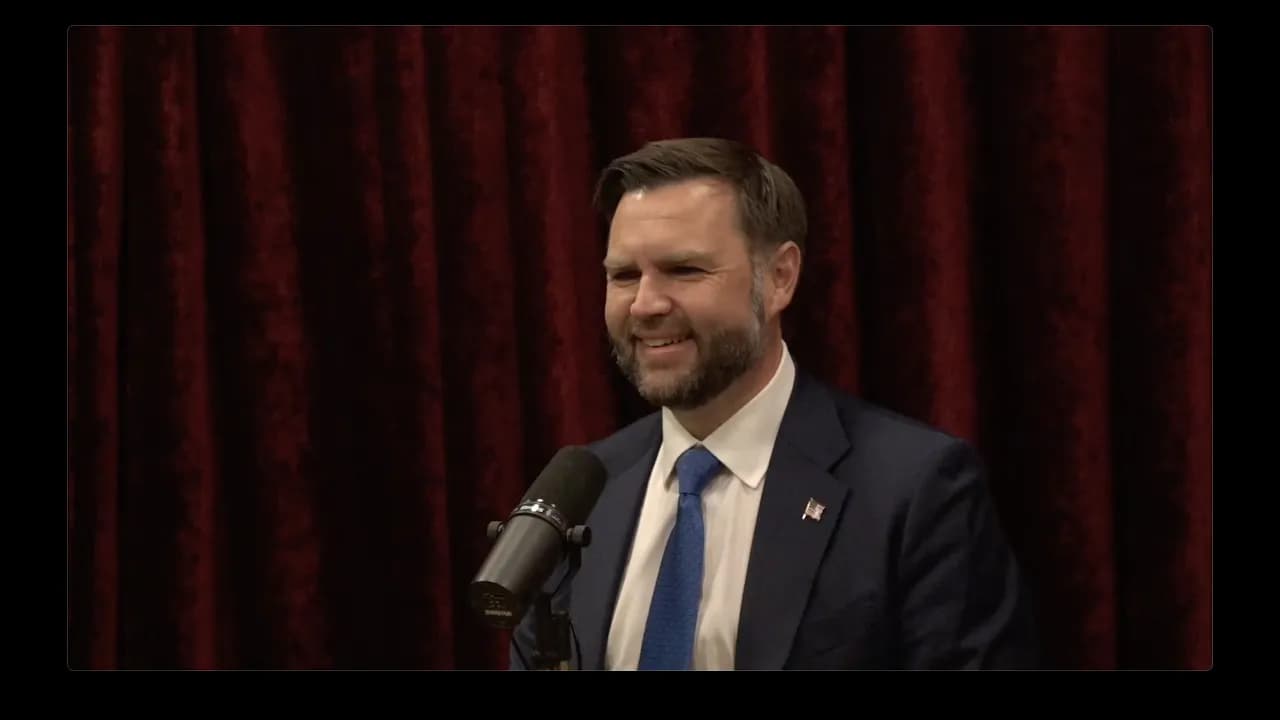
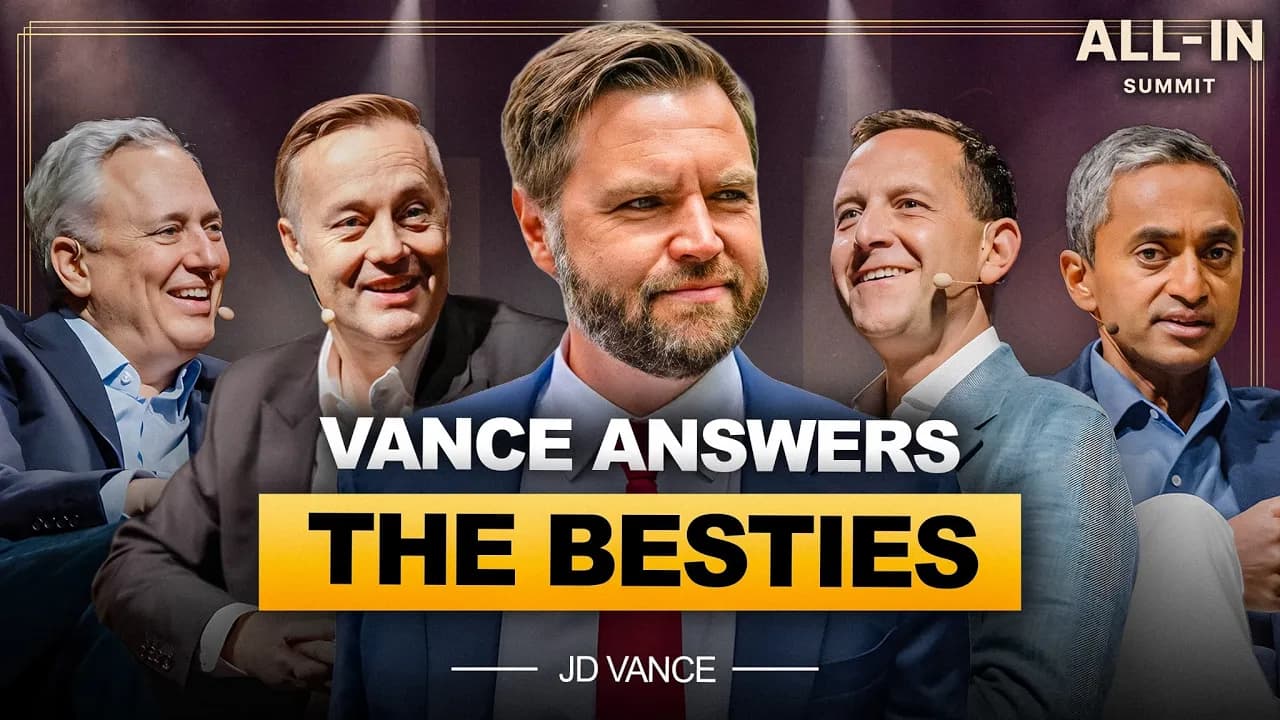
EXCLUSIVE - Vice President JD Vance: They Tricked Me About Donald Trump, But Everything Changed!
In a Nutshell
JD Vance recounts his transformation from Trump critic to vice president, revealing how his chaotic upbringing with an addicted mother and revolving father figures shaped his empathy, mistrust of institutions, and political worldview. He defends Trump's immigration rhetoric as having greater context than media portrayals suggest, while arguing that rapid demographic change itself creates division rather than politicians manufacturing it. Vance details a newly negotiated peace deal with Iran involving nuclear dismantlement and sanctions relief, and warns that AI's greatest risks are extreme wealth inequality and surveillance rather than mass unemployment.
These notes were generated by AI and may contain inaccuracies.
The Biden administration screwed up immigration policy in a profoundly dangerous way. Even when agreeing that immigration is a problem, division serves as the most compelling narrative for politicians. A specific quote about the Black community was referenced: "What do you have to lose?" The interviewee, identifying as a Black man, stated "I feel like I've got things to lose." Concern was expressed that when the Western narrative frames brown people, Mexicans, and murderers as the reason life is hard, it could cause anger toward neighbors who have done nothing wrong.
Often what the president is accused of saying, he did not say, or there was much greater context. Donald Trump is much different as a human being than the media makes him out to be, though the two have very different styles.
In 2016, a private message between JD Vance and a roommate stated Trump was either a cynical asshole or America's Hitler. Vance thought Donald Trump would be a failed president, but he was not. Vance thought America's institutions were fundamentally functioning, but they were not. One must acknowledge when right and when wrong. Trump is so non-conventional that things previously unimaginable are now on the table, such as a peace deal with Iran. Vance stated this particular deal is real. Trump called Netanyahu a very difficult guy. The countries are different with different interests. Vance does not really trust anybody, but having seen the president operate, he feels confident the US is the senior partner and the world's superpower.
Vance believes aliens could be real. The interviewer had no idea about Vance's earliest context, which informed what was later seen in adulthood.
Vance's book states: "Of all the things that I hated about my childhood, nothing compared to the revolving door of father figures. I hated the disruption. And I hated how often these boyfriends would walk out of my life just as I began to like them." Understanding the person requires getting a picture of their early context.
Vance was raised in a very working-class town and working-class family. The family struggled to adapt to middle-class life. His grandfather had very low formal education and graduated from high school. His grandmother left school when she was 13. They were very religious, particularly the grandmother, and struggled economically for most of their lives. The grandfather died when Vance was 13. The grandmother died when Vance was 20. A photo showed Vance about to go to Iraq with his grandmother, who was very old and frail—this was one of the last photos of the two of them.
The grandmother was really the woman who raised Vance because of the revolving door of father figures. His mom is an amazing person who has been clean and sober for 11 years, but she was in the throes of a pretty bad addiction problem for much of his childhood. The grandmother was the person who stepped in and made sure Vance had a stable life.
The grandmother got pregnant at 13 and had a miscarriage at that age. In Eastern Kentucky, in the hills of an extremely impoverished, very rural part of the United States, she was dating the grandfather who was 16 at the time. These were children. They moved to Ohio for more opportunity because they could not build a good life in that part of the world. The unplanned pregnancy hastened them getting married. They had a very chaotic marriage, an abusive marriage in a lot of ways. They had three kids: Vance's mom, uncle, and aunt. The story of the families is that some were able to break the cycle and some were not. Part of what motivated Vance to write the book was trying to understand why life worked out for some and not for others.
Vance's biological father put him up for adoption. Vance was adopted by a man named Robert Hamill when he was five or six years old. Hamill is still technically listed as the legal father on the birth certificate. He was in the picture from age seven until ten or eleven. Then he and mom got divorced. He stuck around for a little bit after that, but by the time Vance was 12 years old, he was just gone. Vance never talked to him again or saw him again.
This was the third man in Vance's life at that point. His sister Lindsay comes from a different father. Her father was a very good guy. She is five or six years older than Vance. Her father was the first of the mother's husbands. The biological father was number two. The legal father was number three. Things got quicker from that point forward with more turnover in the relationships.
There was also a guy called Matt thereafter, when Vance was 13 years old, that his mom had met. Matt was a good guy and very close to Vance. Matt is very political, so they reconnected over shared interest in politics. He was only around for maybe a few years, probably less, but he was a significant and positive force.
In the book on page 124, Vance wrote that living with mom and Matt when he was 14 years old was like a front row seat to the end of the world. It was just chaotic. Things thought of as normal were later realized, through talking to his wife or friends, to be a level of relationship instability—fighting, people throwing stuff, plates thrown at each other if fights got really bad. It was pretty normal back then. Sometimes it was worse and sometimes it was better, but relationships were always just kind of chaotic.
As an adult, the craziness being normal is understood, and one does not realize it until seeing into someone else's world. The way that shaped Vance must be examined. It was very unhealthy. It was hard to feel a sense of stability. It was hard to attach to people because one always assumed they were going to be gone.
Years later at a conference, a child psychologist approached Vance after a speech and stated that the literature shows people who come from traumatic or chaotic environments and end up doing pretty well always have one person—whether a teacher, social worker, grandparent, aunt, or uncle—who serves as their anchor. That seems to be the difference for a lot of these kids. Vance was lucky enough to have that. Sitting as vice president of the United States, what his life would have turned out to be with all that chaos but without those stabilizing forces is unknown.
The grandmother was the safe place Vance would retreat to over and over again. It is very important for boys to have male role models and father figures, but she was in an unconventional way both a mother figure and a father figure. She was extraordinarily tough. When Vance was 12 or 13, he was hanging out with a kid in the neighborhood who was going down a bad path, getting into drugs, starting to smoke weed. The grandmother found out and told Vance that if he kept hanging out with this kid, she was going to run him over with her car. She said, "JD, I promise you and no one will ever find out about it." For the sake of the kid, Vance pretty much stopped hanging out with him. That toughness was a necessary part—it was through sheer willpower that she kept Vance on the straight and narrow.
Over the next couple of decades, the mother's addiction seemed to get worse and worse—from prescription drugs to heroin and everything in between. It ravaged not just her life but the family's life, nearly making the grandparents bankrupt. Mom has been clean and sober for 11 years, which is an amazing thing. When the grandfather died, Vance realized that what the grandmother was for him, the grandfather was for mom—she already had some addiction problems, but it accelerated from there. Things went off the rails. The grandparents tried various ways to help her before the grandfather died. It got worse and worse, harder and harder drugs, a few bad overdoses. By the grace of God and some miracle, she is transformed. It drives home how for some people, drugs take so much away from a human being. In the same way they took so much away from her, sobriety has given her a whole lot back.
If asked how this season of life, the most formative season, has changed him, Vance referenced interviewing Michael Jordan's coach who said people's dark sides and light sides are fundamentally interconnected. The things people might clap for or applaud about are also fundamentally linked to the things struggled with or that make one sometimes not the most normal person.
On the dark side, there is an extraordinary mistrust of people not known particularly well. There is sometimes an assumption of the worst about circumstances and things outside of control, but maybe the assumption of the best about the people themselves. There is an inherent sense that the world is going to fall apart. Even in the marriage, which is extremely successful and happy with kids doing great and being healthy, and with Vance and his wife loving each other very much and her being his best friend and closest confidant, there are times during the 12-year marriage where the thought arises that there is no way this is going to last—either because she is taking the kids to the grocery store and the thought of a drunk driver having a head-on collision comes up. There is a sense of instability that is very much built in.
The light is that because a lot of people have been seen at their very best and their very worst, the best is assumed about the human beings themselves. Even though circumstances are crazy and even though shit hits the fan sometimes completely outside of control, there is probably a higher empathy quotient than any person his wife knows. There is a real attempt to understand what makes people tick. The light and the dark are together.
Vance was a lot of work when looking back at the early relationship. Before they were ever married, during an argument he would say, "Okay, well, fine. Let's just break up." Her response would be, "Well, that's crazy. Why would we break up? Let's just like have a rational conversation." Vance noted he does not do rational conversations in that context. So long as one is self-aware about that, it is a problem that can be solved. Compared to 14 years ago when they first started dating, it is night and day, but very early on it was a chaotic relationship itself.
There is clearly an avoidant attachment style, which makes a ton of sense. Vance did not have the vocabulary to describe that but that is exactly what it was. He went to therapy a couple of times but found it way too uncomfortable to talk to a stranger. The other thing disliked about it was that it felt almost too self-referential and almost encouraged blaming others, blaming the past, blaming mom—it created a feeling of giving up agency over one's own life. They have just gotten better at how they relate to each other. Vance's wife grew up in a very stable situation. Her parents are South Asian immigrants to the United States. She was born and raised in San Diego, California, in a very normal middle-class Southern California life, and had much healthier relationship practices.
The point about understanding the person on the other end and having empathy for the human being appears almost exact in politics. Watching the election campaigns, how Vance and the president went against people like Kamala Harris, one must with that logic think that Kamala Harris is actually a really good person. Vance would not say that he understands her. He would say that he just does not have this animosity towards people on the other side. It is sort of implicit in the job that faults must be pointed out. One can be rational and cerebral about it. There are things the other side does that annoy him, but the fundamental bias is that most people are good people. To the extent they do something disagreed with, it is either because they screwed up or made a mistake. Vance has always been more charitable about other human beings. He would rather be too charitable than too cynical about human beings because being always cynical about other people's motivations puts one in a very bad spot in politics.
The same applies to interviewing because so many people from so many different backgrounds are met. One of the things learned is to try and meet everybody as experienced versus thinking about how they have been framed. This has made Vance much more empathetic because preconceptions exist, but when meeting someone, it is realized they are a family person who cares about the same things and just disagrees about pathways.
Politics seems to be the game of painting the other side to be malicious. The game of politics is fundamentally making a pitch to people—it is about the American people. To make that sales pitch, one has to say what is better about this product and what is worse about the other product. That is inherent. One can talk about policies that are really bad and the reasons why something is screwed up or why mistakes were made. It is weird being in a position trying to point out the faults in other people, even if just their conduct as opposed to their character. There are people in politics who fundamentally just really hate the people on the other side. That is not Vance and never will be. Even when being very pugilistic and having to drive home a point, he does not hate Kamala Harris because she had a bad immigration policy.
Something the Biden administration screwed up in a profoundly dangerous way was immigration policy. There are all kinds of reasons why that might have happened, but it was a very, very, very bad screw up. It is important to point out the flaws on the immigration policy.
On immigration, division is created. Watching Trump, the president demonizing Mexican people and brown people was remembered. A particular quote struggled with was Trump saying about the Black community "What have you got to lose?" The interviewee, as a Black man, felt like he had things to lose. That kind of narrative about those individuals, that broad strokes demonization, would make people's lives harder and feels unnecessary. Even if agreeing that immigration is a problem, the skin color or religion or Mexicans as rapists and murderers might galvanize in the near term but in the long term is probably going to sow division and is probably net negative for society.
About anything heard the president say that is refracted through the lens of social media or non-social media, very often what he is accused of saying he did not say, or he said it in a totally different way, or there was much greater context. Back in 2016 or 2015, being offended at the rapists and murderers line occurred, but then looking at what was actually said revealed it was true—that some of these countries are actually encouraging prisoners to come into the United States of America. That does not mean every person who comes into America is a rapist or a murderer or a prisoner. He did not say that. This goes back to the point about being charitable—trying to understand fundamentally why a person said that, what they are actually thinking, what they are trying to get across. If one disagrees, that is fine. One would not have said that.
The president and Vance have very different styles. The way Vance thinks about immigration is that as a country, one is the people who live in the nation. America's 330 million souls, most of them whether they voted for him or not, are really good people who want really good things for their families and themselves. There are some bad apples in every
There are some bad apples in every crew among 330 million people, but most people are fundamentally good and decent. However, letting people into a country too quickly can change the equation in problematic ways. Using a dinner party analogy, inviting 10 people over is probably fine, but if every single one brings three strangers, it totally changes the character of the conversation and the room. A country functions the same way, just on a much more massive scale.
The president was prescient about immigration even if the blunt way he described it offended some people, making an important contribution to both America and the world. Most people recognize the need for borders and policies around borders, similar to how homes, festivals, and venues maintain boundaries.
A rising narrative across the West, including the UK, uses division as the most compelling narrative for politicians. The downstream consequence is seeing certain communities demonized and victimized on the streets, particularly brown, black, or Muslim communities in the UK. Political narratives used to gain power create real consequences for ordinary people.
When discussing immigration and legal immigration, the focus should be on not demonizing people but rather holding leadership accountable for being immune to thinking about consequences. Division itself is bad because cohesive communities where people get along regardless of appearance or thoughts are preferable.
Division may not result from politicians demonizing groups but rather be the inevitable consequence when population changes too quickly in a given society. Politicians may be articulating a feeling that people already have, even if expressed in offensive ways.
A working-class person in Britain or the United States may react when someone moves into their neighborhood. Personal experience of moving into an all-white neighborhood as a child from Botswana with a Nigerian mother included being called racial slurs a couple of times, though many people were welcoming. As a child, one remembers standing out more than being welcomed.
A grandmother without progressive views about race or gender expressed her highest compliment about the black preacher who lived next door, saying he had a good heart. The family was stable with both parents and children, and the experience was not substantially different from other neighbors. Racism was experienced but not a common fixture of daily life.
Neighborhood changes occurred when people moved in with different habits, including a woman who passed out drunk in the bath and ruined her house. The question arises whether it was wrong to feel offended that a neighborhood changed so quickly that one no longer felt comfortable, or that new residents had different values making conversation difficult.
It is acceptable for an English native speaker to want neighbors to speak English, not from racism or xenophobia, but because one wants to talk to people in the shared community. Division gets magnified when statesmen fail to ensure integration is possible. Integration requires slow movement, careful pacing, and ensuring everybody has economic opportunities. Welcoming newcomers when people have access to good jobs differs from welcoming them during economic distress.
The job of elected leaders is to create environments where division happens less, not to pretend division does not exist. People naturally feel reactive when things change too quickly.
The instinct toward xenophobia exists, and wanting neighbors who can connect is natural. When neighbors cannot speak the same language, connection becomes difficult, but the concern is political leaders telling people that brown people are the reason their lives are hard. This can cause resentment toward neighbors who have done nothing wrong, creating cultural wars.
Anger should be directed at the political system that encourages people to break immigration rules, sows division, and then criticizes the native population for saying they did not sign up for rapid demographic change. Every human being has an instinct to share community with people who have something in common. A little bit of spice is good, but too much spice changes the dynamic. Most people accept change, but change that happens too fast is very bad for a country.
If family were struggling and another area offered better chances, the instinct would be to move for family survival. However, wanting people to feel rootedness and devotion to their country is important. America differs from Europe in that polls showed approximately 70% of young Americans would die for their country if necessary, compared to 20-35% in other Western countries.
Love for country exists independent of economic opportunities, involving deeper connection to places, memories, and folkways. Eastern Kentucky's rolling hills and mountains, and West Virginia's mountains, rivers, and green richness create unique attachments. Family moved from Eastern Kentucky to southern Ohio for economic opportunity despite not wanting to move far.
After joining the Marine Corps in 2003 following boot camp, service in Iraq occurred in 2005-2006 during a difficult period of the war. The decision to join came from a sense that the World War II generation was dying away and a patriotic feeling that September 11th represented a generational call to service, analogous to standing against Hitler.
The patriotic reservoir that exists in any country, most powerfully in America with over 70% of young people willing to die for their country, is valuable. Statesmen should cultivate it but only tap into it when truly necessary and justified. Iraq was problematic because leaders were not careful with this reservoir.
George W. Bush was not careful with the patriotic reservoir, calling the nation to do something not in the national best interest by drawing on patriotism for unjustified purposes, whether from bad information, negligence, or incompetence. Post-9/11, dealing with terrorist networks that had festered was necessary, but the war on terrorism was not existential to the United States in the way World War II was existential for Britain.
Leaders must be careful describing what they ask young people to do. Asking people to do something honestly builds the patriotic reservoir, while lying or being perceived as lying draws it down. The number of young Americans willing to die for their country is likely much lower in 2026 than in 2003.
A social contract built on trust exists between citizens and nation. Violating that trust has very bad consequences.
A ceasefire and peace agreement with Iran was announced. When bombs start dropping, politics changes both where bombs fall and at home. The Iran conflict appeared straightforward initially with expectations that people would rise up after leadership was removed, but the country fractured into pockets of militia and military. Negotiations became difficult without central leadership remaining, and approval ratings at home began to plummet.
Donald Trump learned lessons from the Iraq War era when he called it stupid and advocated getting out. Objectives in the recent conflict were defined narrowly with clear intent to accomplish the objective and then reassess, avoiding multi-year expeditions without end in sight.
The main goal was to degrade Iran's conventional military power so that whoever controlled the country would no longer have a loaded gun pointed at the United States. While President Trump discussed the possibility of Iranians rising up, the core objective remained weakening their military capabilities. After achieving military degradation, the administration focused on determining next steps and presented Iranian leadership with options for moving forward.
Two months prior, there was uncertainty about who held negotiating authority in Iran. By mid-June, confidence had grown in understanding the key players and their priorities. The Iranian system consists of three interacting poles: the political pole (foreign minister, president, speaker of parliament), the clerical pole (clerics holding authority via the supreme leader), and the military pole (particularly the IRGC). The system has coalesced, and Iranian representatives have indicated willingness to make a long-term commitment never to develop nuclear weapons while seeking a fundamentally different economic arrangement with the West.
Donald Trump has made previously unthinkable options viable in foreign policy. When Trump told Iranians that if they meet nuclear requirements, sanctions would be lifted to allow prosperity, this represented a departure from past administrations. The approach rejects previous methods as ineffective and offers new possibilities. This creates potential for a better relationship with Iran and a guarantee they will never possess nuclear weapons.
The possibility of Iran cutting off the Strait of Hormuz was a major factor in pre-operation discussions. The expectation was that Iran would attempt to close the strait and drive up energy prices while trying to keep it open for themselves. Brent crude reached a high of $126 per barrel before falling to around $82 per barrel. The blockade prevented Iran from maintaining selective access. The United States and Gulf Coast coalition increased oil traffic from near zero on April 1st to many millions of barrels per day by late May/early June, reducing Iran's leverage point over time.
With two and a half years remaining in Trump's term, Iranians recognized they lacked time to wait out the administration. Persian culture and Iran's status as one of the world's oldest civilizations make them unwilling to become a Libya-style failed state. There is recognition that their geographic leverage point is weakening and cannot be played repeatedly without losing effectiveness.
A term sheet has been agreed upon with the following elements: the Strait of Hormuz will open effectively immediately with the blockade lifted; demilitarization of the strait including removal of mines; Iranians will give up their highly enriched nuclear stockpile and commit to long-term inspections; in exchange, Iran receives reintegration into the world economy through removal of the approximately 60-page sanctions regime. The Iranians, Americans, and International Atomic Energy Agency will work together to destroy the nuclear material. Verification mechanisms for preventing new nuclear development are still being detailed.
The agreement includes permanent cessation of hostilities and aims to establish a regional era of peace. Israel remains a factor in the equation.
The United States and Israel are different countries with different interests, geographies, and needs. Israel is described as the junior partner while the United States functions as the senior partner and world's superpower. Trust is not extended to any party in international affairs. The president maintains the ability to have frank conversations with Israeli leadership when necessary to accomplish American objectives.
Israel is the only democracy in the Middle East with an advanced economy, high-skilled population, and significant technological innovation despite having only 9 million people. They excel at intelligence collection. While there are shared interests, including cooperation against Islamic radical terrorism in the early 2000s, differences exist. Israel was more concerned about Iran while the United States focused on al-Qaeda. The relationship involves both cooperation and moments of conflict, similar to other alliances.
Israeli and American interests aligned in wanting to weaken Iranian conventional military power. Some within Israeli society may want Iran to become a failed state similar to Libya, but this would not serve American interests. The US approach focuses on eliminating the nuclear threat and changing the dynamic with Iran rather than state collapse.
In 2016, criticism was written stating that Trump offered easy escapes from pain with simple solutions to complex problems, made promises without credible military endorsement, and functioned as a cultural hero rather than offering substantive fixes. The statement that no credible military leader endorsed Trump's plans is now viewed as absurd. The fact that Trump was misaligned with military leadership from the early 1990s to 2016 was actually positive, given that America had not won a war in 30 years during that period.
JD Vance explained his shift from viewing Donald Trump skeptically in 2016 to becoming his vice president. He initially believed Trump would be a failed president, that American institutions were fundamentally functioning, and that military and scientific experts were mostly wise. All three assumptions proved incorrect.
Vance emphasized that his changed view came from external observation rather than insider knowledge. He noted the Atlantic piece misrepresented Trump, who is far warmer and more multidimensional than media portrayals suggest. Trump shows genuine hospitality, frequently giving gifts like water bottles, MAGA hats, coins, or pins in the Oval Office. He is described as loving toward his children and grandchildren and exceptionally generous.
Vance rejected the 2016 media narrative that Trump was unintelligent. He described Trump as exceptionally smart, a voracious reader who understands people at an instinctual level better than anyone Vance has known. He predicted that on an IQ test compared to the other 45-46 U.S. presidents, Trump would rank near or at the top.
Vance endorsed Trump very early in 2023, one of the first senators to do so when conventional wisdom held Trump's political career was over. Their relationship developed through shared work on issues, advice on Senate bills, and collaboration following the East Palestine, Ohio train derailment. They grew close but never discussed the vice presidential role until one or two days before the selection.
The conversation occurred in person the morning Trump was shot at the Pennsylvania rally. Two days later, after Vance arrived in Milwaukee for the RNC convention around 11 a.m., Trump called. Vance missed the call due to high call volume, received a text from a friend (now White House Chief of Staff), and called back. Trump joked that Vance had missed an important call and would need to pick someone else, then offered him the nomination.
Vance had no idea what becoming vice president entailed. He cited the intense security presence, noting roughly 50 armed personnel when arriving for the interview, and the complete transformation of daily life. The moment he was informed, Secret Service arrived at his Milwaukee hotel room and required the family to relocate immediately to the president's protective bubble.
The transition proved hardest on the couple's oldest son, then around seven or eight. The boy disliked the attention and being treated differently, wanting to remain a normal child. Vance expressed significant guilt, writing in his book Communion on page 198: "Sometimes I feel like I've ruined his life without even asking him." The son once told his father he wanted everyone to treat the family as they used to.
Vance initially felt extreme guilt but later worked to contextualize the experience for his children without minimizing negatives. He highlights benefits including extensive travel, seeing the country uniquely, and living at the Naval Observatory. Roughly a year into the role, the oldest son shifted from saying he was "absolutely" unhappy about the vice presidency to acknowledging it was "pretty good."
A photo shown was taken at the High Line in Manhattan the weekend Vance met his wife's mother. They began dating in March 2011. While Vance was working in New Haven, Connecticut, he traveled to New York frequently despite finding the city intimidating and not knowing how to use the subway.
Usha Vance was most surprised by the extent of Secret Service protection. During a trip to Rome for the new American pope's inaugural mass, security shut down intersections and deployed helicopters, preventing normal walks. Statutory obligations prevent the vice president from fully waiving protection, though accommodations have been developed to allow walks without major disruption.
Vance was raised in an evangelical household but became an atheist in his early twenties. His grandmother read and prayed multiple times daily, though the family was largely "unchurched." He viewed religion as irrelevant superstition and embraced a new atheist stance tied to intellectual arrogance and ambition. He realized his focus on credentials, Yale Law School prestige, and status had not made him a good or happy person.
Vance observed that the most virtuous people he admired were Christians whose faith drove character development rather than status-seeking. This led to an intellectual re-engagement with Christianity, followed by emotional and practical commitment. He was eventually baptized and now takes his three children to church weekly, though his wife is not Christian.
The conversation shifted to AI's potential to cause significant job disruption. Vance noted that statements from AI leaders like Sam Altman and Elon Musk have been dystopian. He referenced Eric Schmidt's recent commencement speech, which drew boos whenever AI was mentioned, highlighting widespread public unease comparable to views on ICE.
Vice President JD Vance expressed being less concerned about AI-driven job displacement than other potential consequences. He noted that AI company CEOs have an incentive to promote dystopian narratives as a form of viral marketing, making pessimistic predictions serve their commercial interests.
Vance reflected on his earlier belief from the early 2010s that manufacturing job losses in the United States were an inevitable result of technological automation and the natural progression from agricultural to industrial to service-based economies. He now considers this view preposterous and false.
Vance argued that robots in manufacturing did increase productivity and changed the nature of manufacturing work between 1955 and 2005, but this did not cause net job loss. Instead, manufacturing employment grew globally—it simply shifted away from the United States through outsourcing and immigration rather than pure technological replacement.
He warned against the narrative that technology inevitably causes job loss, suggesting this story masks the real drivers of job displacement: shipping jobs overseas or having immigrant workers take existing positions.
Drawing parallels to the Industrial Revolution, Vance noted that employment actually increased after that major labor market disruption despite job changes. He does not see mass unemployment as the most likely outcome of AI, predicting instead that people will become more productive, some jobs will change, and some individuals will lose their jobs—but without evidence supporting mass unemployment scenarios.
Vance identified inequality as the primary concern with AI development. During the Industrial Revolution, the main consequence was not mass joblessness but extreme wealth concentration among the rich, which contributed to the rise of fascism and communism in Europe. The United States and Britain were among the few nations that avoided such revolutions.
He referenced Pope Leo XIII's encyclical advocating for collective bargaining and social harmony between capital and labor as a Christian model for preventing class division. Vance warned that without similar mechanisms, AI could create a society where the wealthy become vastly richer while average citizens stagnate, leading to significant social problems.
The second major concern Vance raised is AI-enabled surveillance. He described AI as fundamentally a "communist technology" because it enables governments and corporations to monitor people in unprecedented ways. He specifically fears AI-powered social credit systems where individuals could be denied basic activities like purchasing beer based on opaque algorithmic scores.
The discussion referenced 2026 Federal Reserve and Census Bureau data showing financial inequality in the United States at its highest level in nearly four decades, alongside news of the country's first trillionaire. The conversation addressed Elon Musk's robotics initiatives, including plans for a million humanoid robots and projections of eventually having more humanoid robots than humans.
Vance acknowledged that frontier AI companies like OpenAI, Anthropic, and Meta will accumulate significant wealth, exacerbating existing inequality.
Vance distinguished between redistribution (taxing the wealthy and giving to the poor) and predistribution (giving workers a seat at the bargaining table from the outset). He expressed skepticism about post-hoc redistribution, calling it a "liberal concept" that turns recipients into dependents rather than stakeholders.
He emphasized that workers need collective bargaining power, noting individual workers cannot effectively negotiate against major AI companies. Vance advocated giving everyone "a seat at the table" both economically and culturally.
Vance discussed how Hollywood in the 1950s and 1960s consulted with religious leaders to align content with audience sensibilities—a non-coercive mechanism ensuring powerful institutions engaged with broader society. He argued that the decline of institutional Christianity has removed such mechanisms, leaving no framework forcing powerful entities to work with everyone else.
Vance confirmed that President Trump supports the concept of the United States taking a stake in major AI companies through a sovereign wealth fund approach. He described Trump as a "radical pragmatist" who evaluates ideas based on merit rather than ideological constraints, despite conventional Republican positions.
Vance stressed the importance of giving workers ownership stakes upfront rather than attempting redistribution after wealth concentration occurs.
Vance discussed his grandmother, Mamaw, who passed away at age 72 from a collapsed lung when he was 21. He described her as the most important figure in his early life and acknowledged not fully processing her death initially because his family was on the verge of collapse.
He shared that Mamaw was a deeply patriotic person who would be amazed by the pageantry of the vice presidency but would warn him against getting "too big for your britches"—not letting success create a sense of superiority over others.
Vance confirmed he did grieve his grandmother's loss, crying two days after her death despite not crying initially. His primary regret is that Mamaw never met his wife Usha. He noted striking similarities between the two women—both highly intelligent and blunt—despite coming from vastly different backgrounds, with Mamaw leaving school after middle school and Usha attending law school.
Vance recounted his mother's confusion when learning Usha is ethnically Indian, asking which tribe she belonged to, illustrating their different worlds.
When asked whether aliens are real, Vance stated he does not know and has not yet reviewed highly classified UFO information due to the demands of his position. He expressed belief that mystical experiences occur and that a purely rational worldview is incomplete.
Vance cited his Christian faith in the resurrection as an example of believing something that sounds extraordinary, and mentioned personal experiences including a light bulb exploding after his grandmother's death and a glass falling during a conversation about the Pope—events he and others interpreted as potentially supernatural.
Vance discussed his book Communion: Finding My Way Back to Faith, describing a path from rational skepticism to openness to spiritual experiences. He acknowledged that hyper-rational perspectives fail to account for unexplainable phenomena and that humility about one's own certainty is valuable.
The conversation concluded with acknowledgment that many people rationally dismiss faith before feeling something is missing and returning to questions of meaning and purpose.
Keep The Diary Of A CEO in your library
Save the videos and channels worth coming back to, and find them again in one place.