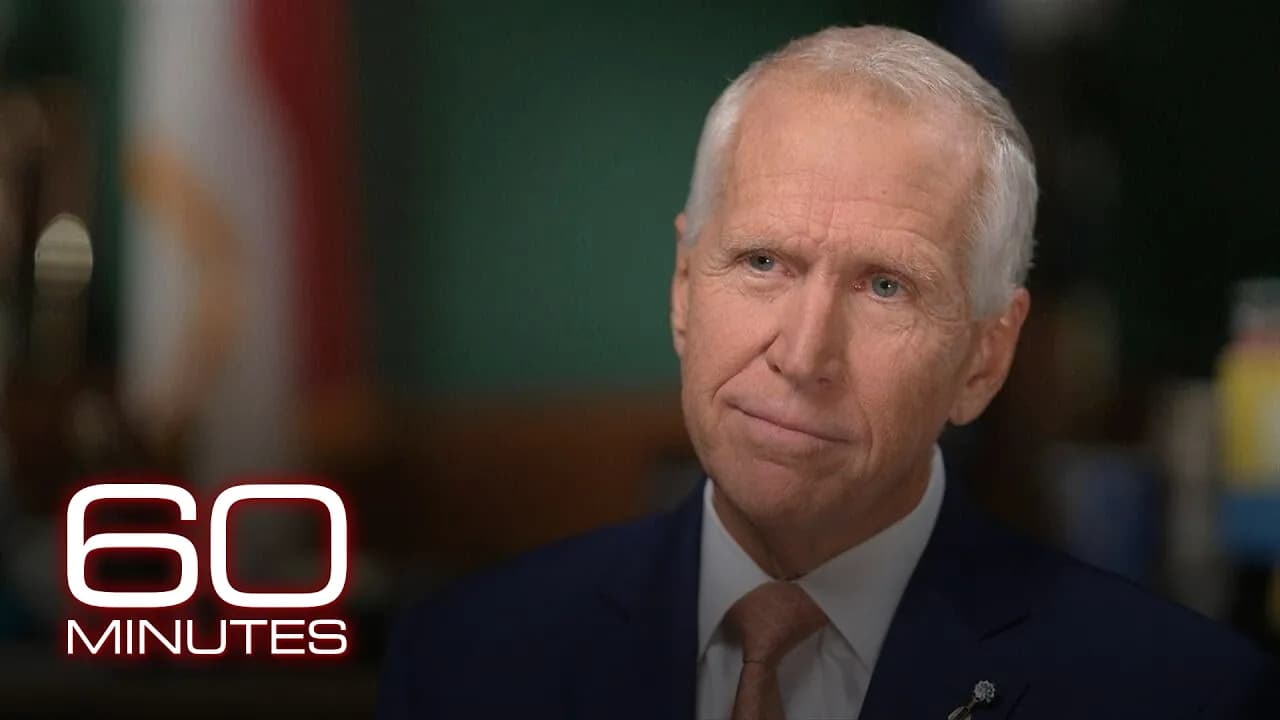
Extended Interview: Senator Thom Tillis
In a Nutshell
Senator Thom Tillis criticizes Trump administration officials like Pete Hegseth, RFK Jr., and Stephen Miller for incompetence and sycophancy, arguing they prevent the president from hearing necessary criticism. He identifies major policy failures including tariffs, immigration overreach, and DOGE's failed government efficiency efforts, while defending his votes against certain nominees despite party pressure. Tillis warns that Republican midterm losses are likely unless the party stops doubling down on unpopular policies and restores honest governance.
These notes were generated by AI and may contain inaccuracies.
Senator Thom Tillis from North Carolina has been navigating a difficult political position during the second Trump administration. He has consistently voted with his party and supported many of President Trump's policy priorities while serving as a critic of key Trump appointees and what he calls the president's "WTF moments." He maintains that his criticisms are intended to help the White House succeed. Tillis has written a book titled "How to Lose Friends and Antagonize Presidents," which blames what he calls sycophants in the President's inner circle for the administration's struggles.
Tillis moved frequently as a child because his father was a draftsman who worked on boats and moved between port cities including Jacksonville, New Orleans, and Tennessee where there was significant dredging industry work. His father left the profession in his 40s, and the family moved from a trailer into a house they owned, though they sometimes rented or lived in trailer parks depending on economic circumstances.
Tillis states that his background makes him react quickly to claims that there is no affordability problem, arguing that some segment of society always faces affordability challenges, and denying this means failing to recognize and solve the problem.
After being discharged from the Air Force due to a car accident in May 1978, Tillis took a professional job in Chattanooga, Tennessee. He moved approximately every two years, spending time in New England where he entered high-tech, then worked at Price Waterhouse where he became a partner six years later. He earned his four-year degree at nearly age 37, one year after being admitted to the partnership.
While working at Price Waterhouse in North Carolina, Tillis became involved in local government after creating a polished PowerPoint presentation about developing single-track mountain biking trails on government-owned land. The chair of the parks and recreation board suggested he volunteer, which launched his legislative career. He became the second Republican speaker in North Carolina since the Civil War after challenging the long-term minority whip when Republicans were expected to remain in the minority for years after Obama's election.
As speaker, Tillis successfully passed legislation providing restitution for victims of North Carolina's eugenics program, which used sterilization as a condition for receiving welfare benefits. The program disproportionately affected African-American populations and was among the worst in the country, with the last sterilizations occurring around 1973-1974. North Carolina allocated $10 million for restitution to living victims, making it the first state to do so. Tillis rejected comparisons to slavery reparations, emphasizing these were living people who had body parts removed by government action.
In 2014, Tillis ran for Senate because he didn't want a Democrat to win and believed the race would be expensive and require a viable candidate. He wanted to help turn the Senate to Republican majority, which occurred that year. He describes himself as a consistent conservative supporting Second Amendment rights, pro-life positions, limited government, and fiscal restraint, differing from some conservatives by supporting ratified agreements.
Tillis named his dog "Little Mitch" after Mitch McConnell. Regarding Trump's 2016 victory, he credits Trump's brand management and ability to voice frustrations that existed after Obama's overreach with Obamacare and other policies. Tillis notes that social media amplification made populist messaging a permanent feature of politics. He believes Trump awakened a necessary part of the Republican base, though he acknowledges that 10-15% of both parties' extremes have been "exposed to guano."
Tillis's book "How to Lose Friends and Antagonize Presidents" features cover images of Trump cabinet officials Pete Hegseth, Robert F. Kennedy Jr., and Kristi Noem, along with White House Deputy Chief of Staff Stephen Miller. He argues that Trump 1.0 succeeded because advisors were willing to tell the president what he needed to hear, delivering good economic policies including tax cuts and regulatory reform, while foreign policy was directionally effective in holding NATO accountable for defense spending.
Tillis emphasizes that most issues with the current administration concern "how" rather than "what" the president wants to accomplish. He cites immigration as an example where Trump had an opportunity to codify successful border policies but instead pursued overreach that alienated supporters. He argues the administration failed to codify policies that would harden them against future Democratic administrations.
Tillis identifies sycophants who tell the president bad ideas are good ones, mentioning examples like renaming efforts or building an "arc." He believes the assassination attempt in Butler, Pennsylvania created a sense of mortality that led the president to charge through and accomplish everything possible. He notes concerning posts including a "Dr. Jesus" picture and divine imagery.
Tillis calls his vote to confirm Hegseth his biggest regret, describing him as incompetent and criticizing his "superhero Department of War machismo" approach. He points to policy inconsistencies including vaccine policy reversals and mandatory testosterone testing. Tillis believes Hegseth removes more competent advisors due to insecurity and creates an environment where staff feel they must "shut up and nod" rather than provide honest advice. He has communicated his concerns directly to President Trump.
Tillis voted to confirm RFK Jr. based on recommendations from Republican medical doctors on relevant committees but has become concerned about vaccine policy. He argues that RFK Jr., who has never lacked medical care, fails to understand how his statements about spacing out vaccines affect low-income families who cannot easily make multiple medical visits. He criticizes cuts to NIH funding as irresponsible and potentially lethal.
Tillis calls Miller the architect of the "dumbest proposals" and "worm tongue" of the Trump administration, referencing Tolkien's toxic counselor. He criticizes Miller for focusing on deportation numbers rather than codifying successful border policies, alienating Latino voters and legally present people, and failing to recognize the political opportunity to secure immigration gains permanently.
The election made immigration and the border an important issue for the first time in getting out the vote. The administration should have implemented and codified the policies that were working in the first six months, as there was plenty of time to do so, but the White House never put forward a serious proposal.
The second Trump administration has shown a pattern of preferring executive orders rather than going through Congress. The president has broken records for rescinding executive orders and implementing his own, and a future liberal president will likely use the Trump precedent as justification for doing the same.
Senator Tillis likes a majority of the cabinet members. He specifically mentioned Besson as a great Treasury Secretary, Wright doing fine in energy, and Bergam doing fine in interior, providing these as examples of a majority of the cabinet he supports.
JD Vance's politics today bear no resemblance to the JD who campaigned to be a senator. He was supposed to be a limited government, no wars kind of person, but he's now excusing wars and cozying up with Russia, moving far away from laissez-faire economic theory. Vance hasn't said a single negative word about the equity stakes the government has taken in ten or more companies, essentially creating state-owned enterprises. If the US government has an equity stake in these companies, other board votes likely don't count.
Vance is a populist with some conservative leanings, but he won't let that stop him from looking the other way on equity stakes and other big government policies. He also hasn't said anything about promising people $5,000 checks and a trillion dollar expenditure.
There's a difference between the vice president and the rest of the administration - all the rest can be fired. Tillis doesn't take any of this personally and is giving an organizational assessment, noting that he fired his best friend and they managed to stay friends.
Some people in and around the president have an outsized influence over him. The people who have the last word with the president have the heaviest weight, particularly in his inner circle. Some cabinet members are likely saying the president needs to look around the corner, but then get into a room where either the president is dismissive or his inner circle says they don't believe that and they move on.
Howard Lutnik is one person with outsized influence who Tillis is no fan of. Lutnik apparently thinks they have money genies that can create a trillion dollars without using taxpayer expenses. Tillis needs to figure out how that works because they need about 40 trillion of those to retire the debt. Lutnik is treating this like a business, but this is not a business.
The Senate is a co-equal branch and they're at their best when treated like a peer. This runs both ways - they're more likely to treat the Senate as co-equal if it acts like one. Tillis thinks the Republican Senate in Trump 2.0 has acted like a co-equal branch in some cases but in most cases no, and he would say the same thing for a Democrat-controlled Senate under Biden and Obama.
The Senate always makes the mistake of conveying power to the White House when their guys are in office, and Tillis has had a real problem with that because it almost always comes back to bite you. The power over nominations is one of the key obvious powers the Senate has.
All the nomination decisions were happening in the first quarter of the president's administration. Tillis believes the president is entitled to have the people he wants in office, so he strikes a balance between his own idealized view of a nominee and what the president wants. On the margins, he goes with what they want even if he has some misgivings, unless he can find something compelling and concrete that he considers disqualifying.
At least 30 Republican colleagues in the Senate expressed reservations about many of the president's actions in private. Some don't want to bear the weight of the president, especially if they're up for reelection and he might target them in a primary. All martyrs have in common that they're dead.
The pressure exerted on senators when thinking about casting a vote against a presidential nominee or policy can be intense, with ads and calling over to the White House. House members are far more susceptible than senators to primaries in any given cycle. They use the Jedi mind trick of saying you will vote for the big beautiful bill - it's called whipping.
Tillis didn't want to run a second time and decided not to, but talked with a few people who convinced him that if he didn't run, they would probably lose the seat. He didn't want that weight on him, but doing that every cycle is how you become 120 in the US Senate. He can find other ways to contribute and thinks it's time for somebody else to step up. With a state of 10 million people, he's not so arrogant as to think he's the best possible option.
Tillis was asked about his public grillings of President Trump's officials, including former Department of Homeland Security Secretary Christy Gnome.
An outcome makes the difference between a really good grilling and just berating someone. Tillis doesn't take the oversight role lightly and doesn't like abusing the power with witnesses. When he does that, it's not for viral - it's to shed light on a problem. He did that with Christine Nolan, pointing out that the fact she can't admit to a mistake which looks like under investigation is going to prove that Miss Good and Mr. Pretty probably should not have been shot in the face and in the back.
Tillis was thinking about the $200 million that the Department of Homeland Security was spending on an ad campaign with her riding a horse, and her calling people that were shot potentially domestic terrorists, which has proven not to be true. He believes there are some people in the cabinet because, to use the president's term, they're right out of central casting. Gnome and Hegseth are probably the poster children for men and women who should never have the authority they've been granted.
Tillis knew DOGE was doomed from the beginning. Elon Musk is brilliant and Tillis is a huge fan of what he's done to advance rocket research in the private sector, but just because you're a billionaire or almost a trillionaire or successful in one field doesn't mean you know how to do enterprise transformation or drive efficiency. He doesn't know of a single dollar that's been booked as a result of DOGE, and there were multiple instances of reduction in force by email that had to be withdrawn and bring people back. The really talented people probably aren't going to come back or they're only going to come back long enough to get out of government.
Tillis was not in favor of the tariffs the Trump administration raised on just about everybody. He wrote a letter to his conference the week after so-called liberation day saying this is going to end badly. You can't declare using emergency powers to impose a 50% tariff on a country that has a trade surplus with the United States, as was done to Brazil. The tariff amounts themselves and the countries were nonsensical.
Howard Lutnik thought tariffs were going to be found money and that he was going to find a trillion dollars that could be invested to invest their way out of the debt. They've created more uncertainty - people don't even know when they buy something how much it's really going to cost. They should have tailored and used sanctions to go after bad actors like China, India, and even some European allies, and there are valid reasons for Canada in some cases. But the shock and awe approach without anticipating counters and people rethinking whether they should depend on the United States created unintended consequences of a half-baked idea.
Republicans campaigning are mindful of affordability problems. The situation Tillis has with the president and some of his advisors saying affordability is a hoax is problematic. The president needs to understand that not everybody grew up in the circumstances that he did, and they need to show empathy to people trying to figure out how they're going to pay for food when they see the president saying the affordability thing is a hoax.
If you took away the Iran war and the Strait of Hormuz moves were fully open, there would still be affordability issues, but things would be a lot better. They would probably have more of the traditional headwinds in a midterm than the kind of headwinds that are almost 2010-like.
Tillis supported the Iran intervention when it started, but he's not sure he would have if he'd known it would still be going on as an open-ended conflict six months later. Everybody, even Democrats, were struggling to criticize the president for the exquisite capabilities their men and women in uniform executed to degrade Iran's nuclear capabilities. The problem is that people like Hegseth thought every engagement was going to be that way.
The Ukrainian people are doing an extraordinary job. Putin can be defeated in Ukraine and must be defeated there - there's no such thing as a win-win outcome in Ukraine. Tillis respectfully disagrees with Kushner on that characterization. Sanctions bills are at the president's desk now. Putin is already planning on freezing Ukrainians to death this winter by attacking the electric grid and trying to eliminate steam distributed in places like this winter to literally freeze civilians to death.
Tillis doesn't think the president has done enough and hates the deference that was paid to Putin in Alaska. The president is a dealmaker who wants to make things come to the table, which is great in the business world, but they're talking about a murderer.
If you've got a country that's now gone from being attacked to the largest most powerful military in Europe, you don't really want that to fall to Russia. Tillis doesn't know if the president really understands just how profound that is. With defense guarantees and pushing Putin further back and denying him his vision of reestablishing the Russian Empire, that should be his legacy - not creating a win-win with one of the most vicious, murderous, desperate people that's ever lived.
Congress is not equipped to do something reasonable on AI. They need to act but should create almost a project warp speed like they did to develop a vaccine, with a lot of smart people in the room from industry. Industry is saying they need to be regulated, which almost never happens. They need to figure out at a level that all congressional members can understand what they should or should not do, and to what extent companies can self-govern and create a standard that says if you can't certify you're doing this, you're an outlier.
A fair amount can be handled by internal industry scrutiny, but there's still going to be some gaps that probably require congressional oversight. The malign actors aren't going to stop, and China isn't going to adhere to any industry standards for child safety.
Tillis gained access to OpenAI within 48 hours of being available in the developer program. He wasn't a developer - he was trying to use the tools that existed at the time. He uses three different LLMs on any given day and considers himself still a neophyte in terms of the technology's capabilities.
Tillis has a robotic lawn mower on his property that he doesn't appreciate being characterized as a potential killer robot - he thinks of it as a kind of an electronic member of the family that's doing a great job on the pasture.
One breaking point was Donald Trump Jr., not an administration official but a member of the family, allowing a Russian oligarch to pay for part of his wedding celebration. Tillis was disgusted by it - the dude is worth somewhere between 300 and $400 million, so why on earth would he think it was a good idea to receive money to pay for a wedding he could have easily paid for. Tillis grew up in an environment where you stayed away from that, knew where the line was, took a step back, and never navigated to gray areas.
There are cases like Don Jr. and the Trump family, and people connected to the family of Commerce Secretary Lutnik who seem to be doing very well in this administration.
Tillis can't speak to corruption as he's not an attorney and doesn't have the facts before him, but the appearances are disturbing. This one is probably the most disturbing because everybody's admitted that it occurred and now they're trying to justify it. He would be writing a check back to that oligarch and apologizing for whoever allowed that to happen.
Another breaking point was when the Department of Justice seemed to be opening an investigation of the chairman of the Federal Reserve for improper spending on renovations. Tillis had developed a relationship with Jay Powell that dates back years since he's been on the banking committee. He was becoming really concerned with them trying to politicize the Fed and threaten its independence.
Tillis told his staff to be ready within minutes of the investigation becoming public to make it very clear where he was going to be on Powell and his nomination and not allowing anybody to replace him. He really believed if the market thought that the Fed was going to be controlled by President Trump, it was going to have dire consequences in the market. They moved quickly to try and tie that off, and eventually the investigation was withdrawn.
This was 100% a case study in how the Senate can use leverage successfully. Tillis was already working behind the scenes to get it done and hates when stuff gets the attention of the press. Some of the most fun he's had are the things they've gotten done that nobody knows about.
Another breaking point was the proposal to pay out 1.776 billion dollars in taxpayer money to people who were in the president's view persecuted for their political beliefs or loyalty in the Biden administration. Tillis came out when he first saw it and said it was stupid on stilts. The fund itself was a payout pot for punks because it was going to allow somebody who admitted to destroying the Capitol going into it, causing harm to a Capitol police officer, to possibly seek restitution after they admitted their guilt.
Tillis negotiated with then acting attorney general Todd Blanch over this fund. The agreement was to torch them and basically render it completely useless - not able to like those zombies in the Walking Dead that you thought you killed and all of a sudden they pop out of the closet. He didn't ever want to see it again, and Blanch was satisfied in his mind that it would go away.
Senator Tillis described the collapse of the "big beautiful bill" as a critical breaking point. The legislation contained language air-dropped by CMS or DHS that would cut direct payments to healthcare providers in North Carolina, exceeding the Medicaid cuts the state had already anticipated. Tillis supported the original Medicaid cuts, viewing them as necessary, but the additional provisions nearly doubled the overall cuts to states like North Carolina. He warned that such steep reductions would create "unintended consequences" and generate damaging political ads, making the bill politically and practically unsustainable.
When asked how to determine when a cut becomes too steep, Tillis explained his approach mirrors his business experience: program out the consequences and examine the ripple effects. He cited home health services as a classic example, noting that states facing budget pressure would prioritize more costly programs first, creating cascading disruptions. These types of cuts resonate personally with voters who fear "that could be me."
Tillis acknowledged Trump's impulsive statements, including threats to seize Greenland, casting himself as Jesus, Easter musings about annihilating Iran, and commands to "open the strait." When asked whether he feared carpet bombing of Iranian civilians, Tillis responded no, but stressed the president must understand "the weight of your words and how literally people take you." He argued the president should be surrounded by advisers willing to say "Mr. President, if you do that, I'm walking out this door."
Tillis rejected the Russian concept of "if only the tsar knew," which deflects blame from leaders to their advisers. He emphasized that "in the end, whoever he has around him, he's the tsar," and that "the buck stops here" with the president. Tillis criticized advisers who privately acknowledge bad ideas while publicly praising them, arguing these people should be held accountable in history and future elections.
Tillis predicted Republicans would face a historically difficult midterm cycle. He argued the party could mitigate losses by being honest with voters, noting the electorate is "very forgiving" when politicians apologize and explain course corrections, but will punish those who "double down on something that's clearly not resonating with the voters." He acknowledged the numbers in North Carolina work against Republicans, with the next couple of weeks representing a "make or break" period.
Tillis described the post-2026 landscape as requiring "a serious discussion" about what profile can win a national election in 2028. He warned against candidates who perform well in "red mega states" but cannot succeed in general elections. Tillis specifically referenced the Texas "Trump of Palooza" event where a candidate was introduced and endorsed by Turning Point, suggesting this trajectory would not work nationally. He argued the president "should have a say" in succession but should not handpick his replacement, since "by definition" the president will be retired when the next person takes office.
Tillis outlined his vision for Republican recovery after anticipated losses. He expects the party to maintain a Senate majority but lose the House, creating an opportunity for reflection. The party should acknowledge mistakes, stop partisan approaches, engage Democrats, push aside "partisan voices," and position itself as "the adults in the room." He committed to remaining involved in the process despite not running for office again, warning that anyone making decisions that "undermines our brand and undermines our chances for success will be in my crosshairs."
Tillis acknowledged that when a president is unpopular nationally but popular within his party, criticism often targets advisers rather than the president himself. However, he conceded that the president's bad approval ratings and administration failures are ultimately "his fault," since "you can't fire the president" and the only changeable element is the people around him.
Tillis contrasted the sycophantic atmosphere in cabinet meetings with genuine corporate boardroom culture. He played a clip of excessive praise directed at the president, noting "I've never had enough drama to go forward" in business settings. He argued Americans want "honesty" and "people on the field doing the work," not "cheerleaders." Tillis suggested the president may need professional help if he requires constant validation, stating successful people "should feel comfortable in [their] own skin."
Tillis revealed he was the last senator to leave the chamber during the January 6 Capitol riot, motivated partly by anger and a desire to confront the intruders "not in a hospitable way." He described hearing increasing noise from outside, initially believing it was external, until it grew loud enough to indicate the rioters were inside. He characterized most participants as "hateful, disrespectful of our democracy" rather than sincere patriots, though some were genuinely concerned. He called it "disgusting" that the riot occurred for the president and stated it was "the first time in the history of this country that we had not had a completely peaceful transfer of power."
Tillis defended his vote against convicting Trump in the impeachment trial, arguing the House "cheapened the impeachment process by not having witnesses" and rushed the proceedings. He maintained that "every person, even a serial killer, is entitled to due process" and that the House failed to provide it. When asked whether a full trial with proper evidence would have changed his vote, Tillis stated he was "open to it" if evidence had been presented.
Tillis emphasized the profound debt owed to Capitol Police, citing their role in safely evacuating senators and providing immediate care including hot meals within two hours. He recalled seeing officers "red and bleeding" holding the line against rioters just 75 yards away. He expressed disappointment that legislation to install a commemorative plaque faced delays due to fear of presidential repercussions, calling January 6 "one of the most disgraceful days in US history."
Tillis described the plaque honoring Capitol Police sacrifice, installed in the hallway every future president walks through before inauguration on the West Front. He viewed this location as "absolutely appropriate" to remind presidents "to never repeat that day again."
Tillis expressed concern about the "imperial presidency" and executive branch threats against members in primaries, which he warned could eliminate congressional independence and create "a one institution country." He invoked the revolutionary origins of American democracy, stating "we will have a sort of dictator king if we're not careful." Tillis positioned himself as working for "the American people, the voters of North Carolina" rather than the president, describing senators as "a board of directors for this democracy" who must assert their institutional role. He warned that ignoring Congress across four administrations represents dangerous escalation that threatens the 250-year system of checks and balances.
Keep 60 Minutes in your library
Save the videos and channels worth coming back to, and find them again in one place.