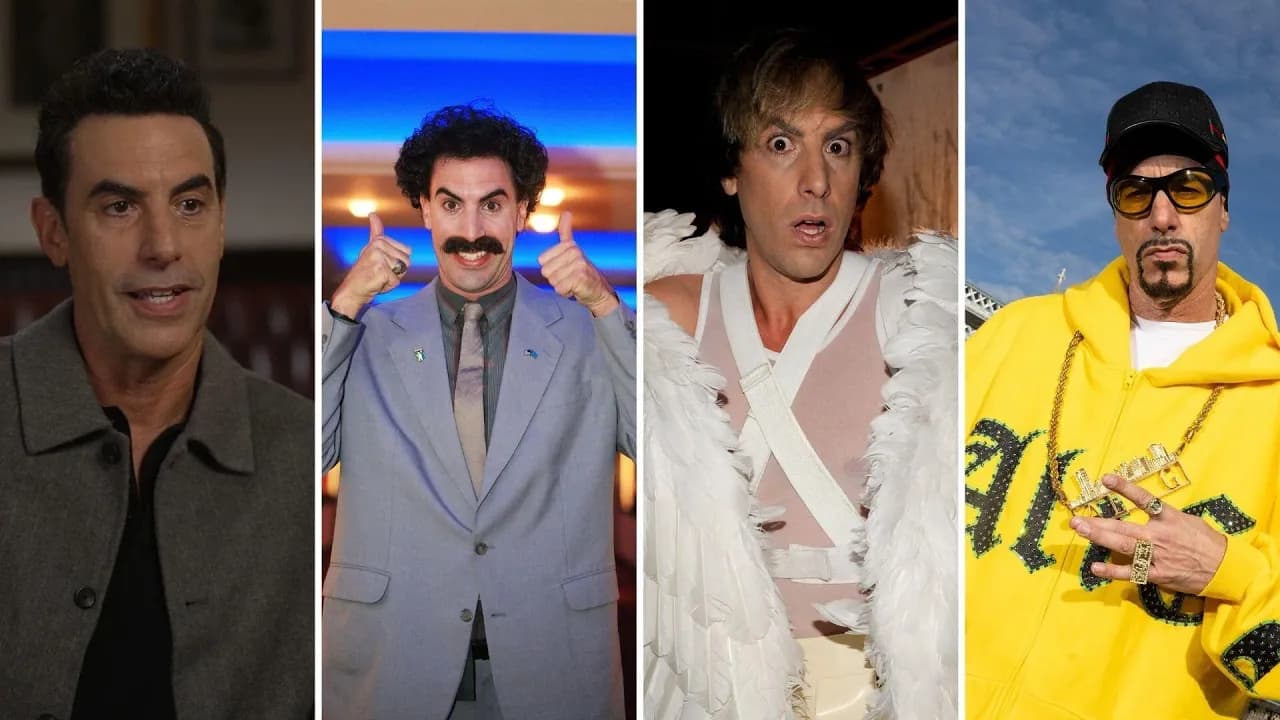
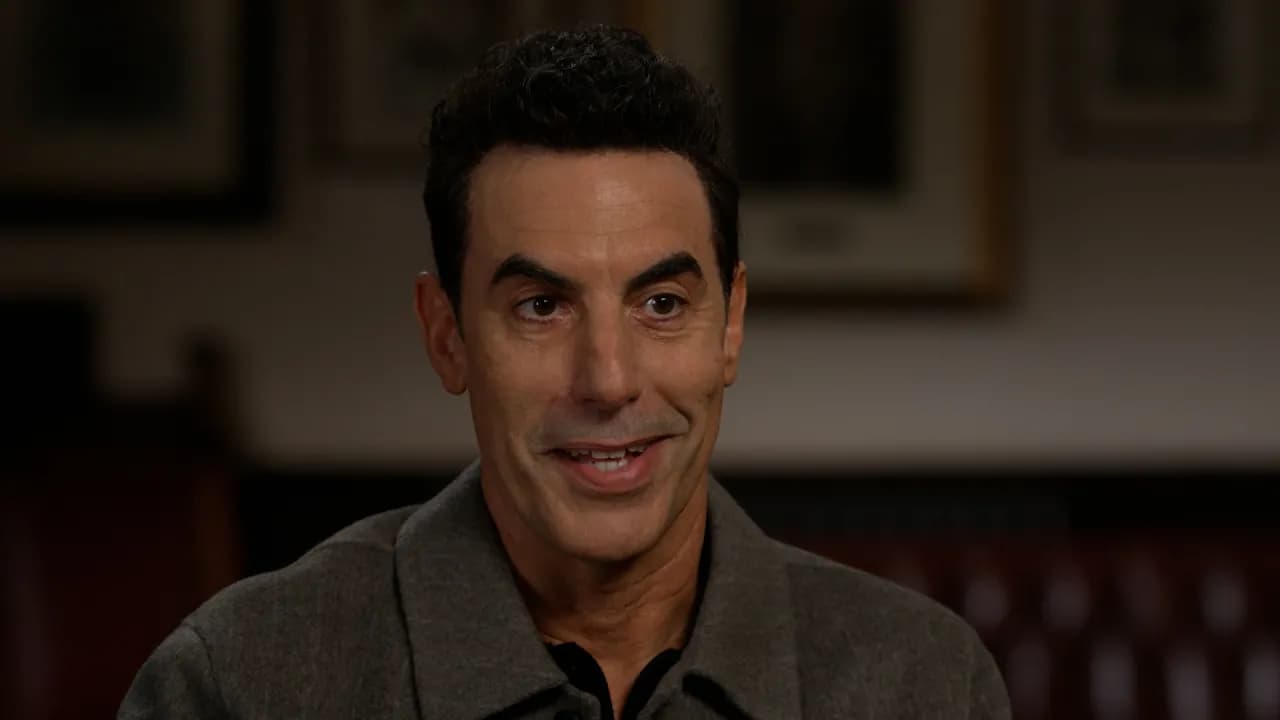
Extended Interview: Sacha Baron Cohen
In a Nutshell
Sacha Baron Cohen built his comedy career on characters like Ali G and Borat that expose prejudice by putting real people in moral tests with the world's biggest idiot. His training at clown school under Philippe Gaulier and early influences from Peter Sellers and Monty Python shaped his approach of inhabiting ridiculous characters to make audiences laugh while revealing societal flaws. Cohen's work deliberately targets bigotry and indifference, with characters serving as "control experiments" to show how easily intelligent people can be manipulated into harmful beliefs.
These notes were generated by AI and may contain inaccuracies.
Sacha Baron Cohen was about nine years old when he first saw The Pink Panther and found it absolutely hilarious. He considers Peter Sellers his favorite comedian of all time because Sellers completely inhabited characters and was laugh-out-loud funny through silly voices. Cohen notes that in films like Dr. Strangelove, Sellers is subsumed by the character, similar to how audiences experience Bruno, Ali G, or Borat.
Cohen describes his own work as essentially doing silly voices when boiled down, and admits uncertainty about bringing elements of his actual self to characters, stating: "If I knew who I was, then I could answer that. But I don't know."
Cohen reveals that Ali G was partly inspired by his own experiences at age eleven, when as a Jewish kid living a nice life, he brought his linoleum to Covent Garden to breakdance. His mother would take him to perform. The character emerged from Cohen seeing someone doing the robot on TV (two robots called Tick and Talk), which led him to become obsessed with early electro music and hip-hop, which was more exciting than his actual life.
Cohen and friends would practice in classrooms with the slippiest floors, teaching themselves to break and pop, then perform on weekends at Covent Garden to make money.
Cohen's mother was a fitness teacher with a distinct voice that everyone at his high school could imitate. She would answer the phone saying "Sasha, telephone," and was a larger-than-life character who was unintentionally hilarious. Cohen describes her as having Borat-like qualities in saying whatever was on her mind without intending to harm anyone.
His father was a magazine editor turned accountant who was an incredible wit - every single sentence was funny - and an amazing intellectual who was very courageous. His parents created a house full of love where the children were told they could be whatever they wanted to be.
Cohen believes he was six, seven, or eight when his brothers brought him to see Monty Python's Life of Brian, which was rated 18. It was the first time he experienced hundreds of people laughing and screaming in shock in a cinema. He describes his career as partly an attempt to replicate that experience of being in a theater with hundreds of people screaming with laughter.
Though he didn't understand the satire at the time, he loved the communal experience and became obsessed with getting audiences to laugh as hard as possible.
At Cohen's bar mitzvah, the entertainment was himself and his breakdancing partner, with his middle brother (who later studied history at Cambridge) providing the music. At Cambridge, Cohen realized he loved making people laugh but also making them cry on stage, wanting to give audiences "the full emotion" and "bang for their buck."
Cohen's parents thought becoming an actor after Cambridge was a ridiculous idea and an impossibility. He gave himself five years to "make it" - meaning to have enough money to live, not necessarily to become famous.
While at Cambridge, Cohen learned about a clown course taught by Philippe Gaulier (noted as "Philip Golier" in the transcript). Gaulier's concept of clown was "the stupidest creature that can ever be on stage" - he would tell students "more stupid than this and you die." The training involved putting on a red nose and pretending to be an idiot.
Gaulier served as Cohen's mentor and gave him confidence, telling students they could do anything or nothing. The training was brutal - students would perform to accordion music and had to make Gaulier laugh, or he would hit a drum. Cohen sometimes stayed on stage for 10 minutes, 20 minutes, or an hour experimenting as a clown, which transformed everything for him.
Cohen explains that Ali G is a white imbecile and cultural appropriator who steals language and dress from music stars like Tupac Shakur (hence "Westside") and Jamaican dancehall stars. His full name is Alistair Leslie Graham. The shortened name "Ali" created assumptions among the predominantly white establishment that there might be some ethnicity, potentially leading to prejudice that could explain his stupidity.
Cohen never wore makeup and Ali G never spoke about his ethnicity except for a couple of instances where he said "Is it because I was black?" This catchphrase originated during an environmental protest on The 11 O'Clock Show when a policeman stopped him and Cohen improvised the line.
Cohen describes his comedy theory: the brain expects certain lines when hearing sentences. When audiences heard "Is it because I was..." they expected "white," but hearing "black" instead created distance that made them laugh.
A breakthrough moment came when Cohen approached skateboarders as Ali G. He had been hosting F2F but wanted to be a comedian secretly, comparing it to saying "I want to be a supermodel" when you're not conventionally attractive. During one-minute breaks in filming, he created the character MC Joscelyn Cheadle-Hume, an upper-class kid using the same catchphrases as Ali G.
The skateboarders initially believed the character, calling his terrible skateboarding "whack." When Cohen revealed he was pretending, they were shocked. The head boss threatened to fire him if he tried it again, which Cohen took as confirmation he was onto something.
The core idea of Ali G was having the world's expert in something interact with the biggest idiot in the world, with the juxtaposition becoming funny if the expert took it seriously. This worked in interviews like when Ali G called the Surgeon General a "player hater" for saying everyone dies.
For the first five, six, or seven years of fame, Cohen gave no interviews to avoid revealing his identity as a Cambridge-educated middle-class Jewish guy. All Ali G imagery showed him covering his face or in close-ups. He became very famous but nobody knew what he looked like - people would discuss Ali G on the tube while sitting next to him.
The controversy about whether Ali G was racist was the worst insult possible. Cohen wanted to explain the character was a white idiot appropriating culture, but the team advised staying in character.
Cohen spent several days working with James L. Brooks (creator of The Simpsons and Taxi) on narrative structure for Borat. He also worked with Matt Stone and Trey Parker from South Park on a scripted version, but director William Friedkin advised making it in the real world with real people.
The movie was pitched to Fox as one where real people move the narrative forward without knowing they're in a movie. They received $14 million to try it. The first scene - Borat buying a car - proved the theory worked when a real person suggested an ice cream truck instead.
Cohen notes that Borat shows both the kindness of people and exposes layers of hate and bigotry below the surface.
Cohen addresses whether he feels conflicted about baiting people into making fools of themselves, stating that many interviewees (particularly in Ali G interviews) actually come across well. The team would often shoot in places famous for civil rights abuses like Little Rock, Arkansas, and Atlanta, seeking people with views they didn't agree with.
Cohen describes his work as putting people through moral tests, with Bruno specifically designed to expose homophobia and the vacuousness of the fashion world. The characters are designed to expose different things - Bruno shows how homophobia could turn violent, made as a romantic comedy set in a cage match where Cohen kisses his love interest to test crowd reaction.
After 20 years, Ali G returned in Who is America?, which Cohen directed. Ali G serves as a "control experiment" - unchanged while society has transformed. Cohen wanted to examine conspiracies and lies, testing whether intelligent people who believed in race replacement theory could be turned into murderers within hours.
Cohen references his earlier experience with "Throw the Jew Down the Well," which revealed indifference to antisemitism. He quotes historian Ian Kershaw: "the path to Auschwitz was paved with indifference." He notes that shocking beliefs have become commonplace, with people expressing racism openly on social media.
Cohen describes his primary objective as getting people to laugh really hard, with satire "smuggled in." He reflects on his unlikely journey from someone who probably should have been a lawyer to creating classic comedy with Borat, considering anything else "gravy" and feeling very lucky.
Keep 60 Minutes in your library
Save the videos and channels worth coming back to, and find them again in one place.