French protests could benefit far-right political leader Marine Le Pen
In a Nutshell
French protests sparked by school funding and cost-of-living grievances have escalated into widespread violence, damaging thousands of businesses and injuring over 1,500 police, eroding support for President Macron. Marine Le Pen’s National Rally party is gaining ground as voters lose faith in centrist governance and turn toward her hardline stance on immigration, law and order, and rejection of multiculturalism. The unrest highlights deep economic inequality and a rejection of both mainstream left and centrist solutions, positioning Le Pen as the frontrunner for France’s next presidential election.
These notes were generated by AI and may contain inaccuracies.
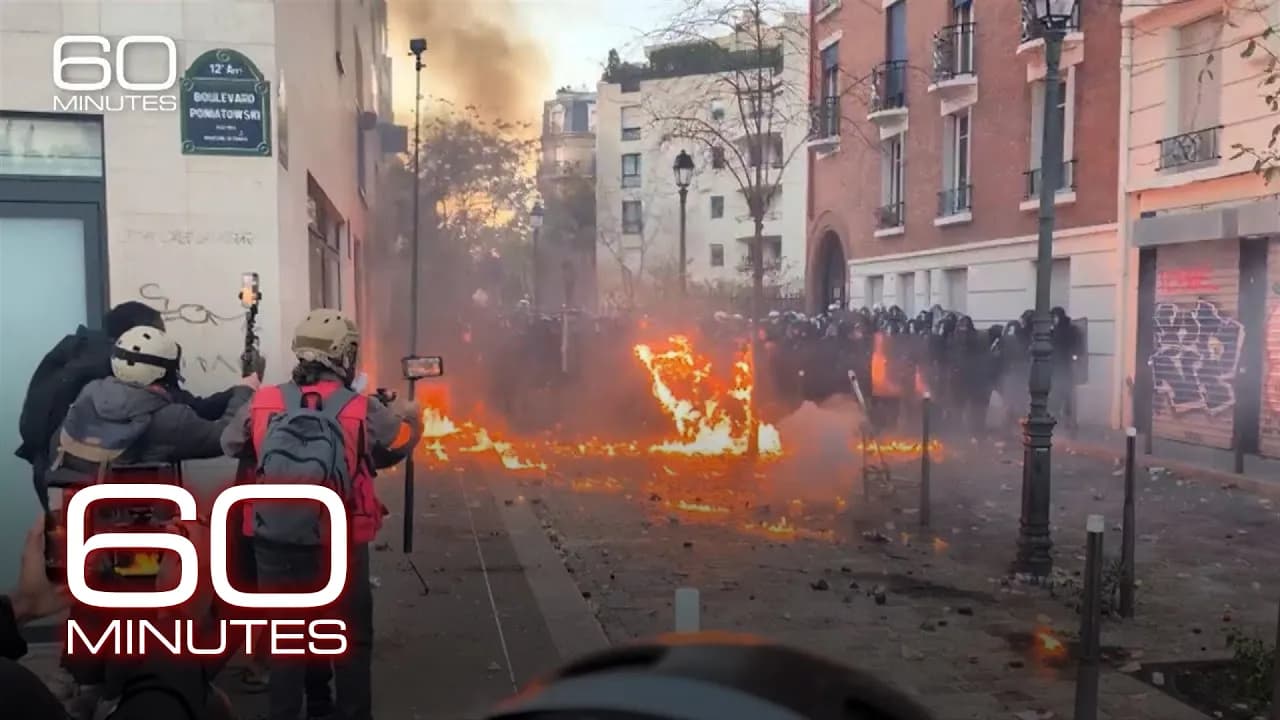
Protests are tearing across France with violence erupting in romantic boulevards and looters invading chic boutiques. The sense of warm croissants and fresh baguettes has been overwhelmed by the whiff of tear gas. For many across Europe, particularly the young, conventional centrist political parties are failing to revive the continent's stagnating economies. Support for extremist politicians has risen dramatically.
Marine Le Pen is the longtime leader of the National Rally Party and now the favorite after three failed attempts to win the keys to France's presidential palace next April. Since the protests began, Le Pen's popularity has risen. Le Pen states: "I have a simple rule. If you don't stop criminals, they won't stop. That's it."
For weeks, France has been in turmoil. 2,500 businesses have been damaged. More than 1,500 police injured, and the bill for damage to property is said to have climbed to more than a billion dollars. This nation is used to street protest, but the French have been jolted by the violence and bewildered by their government's failure to get the chaos under control. More and more voters are turning to a political alternative that for decades past they regarded as beyond the pale.
Le Pen states: "The extreme left creates chaos. They generate violence against people, against the police, against public property. It's the same phenomenon all over." Le Pen and the protesters may be political opposites, but both agree on one thing. The way that France has done politics for the past few decades has failed.
The turmoil didn't start in the city, but back in mid-September in a quiet working-class suburb home to many immigrant families, the cause being a dilapidated school and a shortage of teachers. A student states: "I want to go to the bathroom and I see there's no toilet paper anywhere and I'm just pissed off."
Malia Garin joined an early morning demonstration at her high school on the edge of Paris. She states: "Naturally, the students captured the protest on their phones. Some people had the idea like me to post it on social media and it came viral and after we have protest in Paris, Marseille, Lyon, a lot of big cities in France." The students at Santex never imagined that they'd become the spark that lit a fire across the nation. Within weeks, the demonstrations were drawing half a million people.
Parents came out to back their sons and daughters. Workers to protest the cost of living and black and Arab youth frustrated at job discrimination. What started as a campaign for better funding of education has broadened into a wider protest about economic inequality. A protester chants: "There's money in the billionaire's pockets, in the boss's pockets, in big corporations pockets."
A protester states: "The problem is the government. Macron is the worst president we had since a lot of times." Elected nearly 10 years ago, Emmanuel Macron seemed like a fresh face, promising centrist leadership. A decade later, he's a lame duck who voters think has left France with too many bills and too little money.
Many of the young activists see France's salvation in Jean-Luc Mélenchon, a 75-year-old former communist. He declined requests for an interview, but his supporters say that only he stands between them and what they would call a right-wing tyranny. A supporter states: "I am terribly afraid of fascism. The people of France are not for fascism."
A protester states: "And I'm here because everything is up right now. Fascism is here." When asked about voting for a new president in a democracy, the protester responds: "No, this is not how I work. Democracy. Democracy. This is the vote because WHEN IT'S UNFAIR, YOU HAVE TO FIGHT."
20 years ago, young people from the poverty-stricken Paris suburbs were setting cars alight. They were angry about job discrimination, about the treatment of minority communities by the police. These latest demonstrations feel very different, becoming much broader, more political. People are talking about inequality, about the failures of capitalism. There's even a very small minority that appears to believe that before you can build a better society, you need to smash this one apart.
Exactly a month after the first school protests on October the 17th, all hell broke loose across France. Arsonists in the city of Limoges set fire to its iconic town hall which first opened its doors on Bastille Day in 1883. The inferno obliterated more than a century of local history in a single night. That same day, 250 miles away in Paris, Jimmy Mashila's bakery had been ransacked by looters.
Jimmy Mashila immigrated to France from the war-torn Democratic Republic of the Congo as a 9-year-old and created her successful bakery business with her husband. She now employs dozens of people. She states: "It has cost me 5 years of hard work. It has cost me the time I couldn't spend with my children. But what it's costing me today, it's having to ask myself, if I do start again, will it last? How long before it happen again?"
22-year-old Lola Flécheux Whitaker is half British, half French, and hellbent on ending capitalism. She states: "The system we're in is literally burning our planet, is burning our home, is killing so many people." Whitaker was accused of playing down the destruction by the looters, stating: "I mean, sure, let's just say how bad it is to break a window, but that's just not going to solve any issue."
The person most likely to gain from the strife in the streets is Marine Le Pen. She states: "Today, France is facing very serious difficulties. We're at a point where all the bills are coming due at once." In 2011, Le Pen took over leadership of what was then a fringe movement from her father, a tough army veteran, convicted and fined for Holocaust denial and hate speech. Four years later, she ejected him from the party he had founded to rid the movement of the stain of bigotry.
When asked if she is a fascist, Le Pen responds: "No, absolutely not. We support political pluralism. There is no element of fascism in our political program." Her opponents thought Le Pen's conviction last year for embezzlement would dent her popularity, but it has not. Le Pen states: "I am innocent. That's why I have taken the case to France's highest court."
Le Pen states: "When you take in too many immigrants, you create the conditions for destabilizing your society. And that is what has happened in France." She also states that too many immigrants are too reliant on welfare, noting: "The unemployment rate among foreigners in France is twice the unemployment rate among French citizens. We can no longer import unemployed people."
When told that immigrants claim discrimination causes higher unemployment, Le Pen responds: "No, that doesn't exist. You're not going to import those ideas here. There is no discrimination in France. Discrimination. No, there is no discrimination in France, sir. It's not true. And I'll go even further. It's the least racist. France is the least racist country in the world."
Le Pen states: "Your world approaches immigration through integration. We believe someone who comes to immigrate to our country must blend into the national community. You have something more like a layered cake. Each community can live alongside the others while keeping its own customs. That is not how we see things." Regarding remigration, she states: "If someone comes and says, 'I hate you. I despise your culture. I don't want to respect your laws.' Well, we say to him, 'Listen, sir, the door is wide open.' And we might even for that matter force you to leave."
When asked if she or France has changed, Le Pen responds: "I will not allow people to say that France has become extremist. Over time, French people have got to know me. Has France changed? I think it's the end of a chapter. It's the end of a world, a world built on unrestrained globalization. We've been seeing the great return of nations for several years now. And I think that's a good thing."
Keep 60 Minutes in your library
Save the videos and channels worth coming back to, and find them again in one place.