How Did Ancient Humans Survive Deadly Winters?
In a Nutshell
Ancient humans survived Ice Age winters through a combination of fire, sewn fitted clothing from animal skins, and insulated shelters built from mammoth bones. They preserved food by smoking, drying, and storing it in cold pits or ponds, and organized hunts to stockpile meat before winter. Body heat from close living and possible biological adaptations further helped them endure conditions their bodies were not evolved for.
These notes were generated by AI and may contain inaccuracies.
Right now you're warm and you didn't even have to try. The heat just runs. There's a coat by your door you didn't have to kill anything to make. There's food in your kitchen that'll still be there next week no matter how cold it gets outside. Now, take all of that away. Just your bare skin and a winter so cold it could kill you in your sleep before you even woke up. That used to be normal. Not for one bad season, for hundreds of thousands of years your ancestors lived through real ice ages where giant sheets of ice covered whole continents and the cold could kill a person in a few hours. And somehow they made it. You're the proof. Every one of them lived long enough to pass life down to you, which means every single one of them won a fight against winter they couldn't afford to lose.
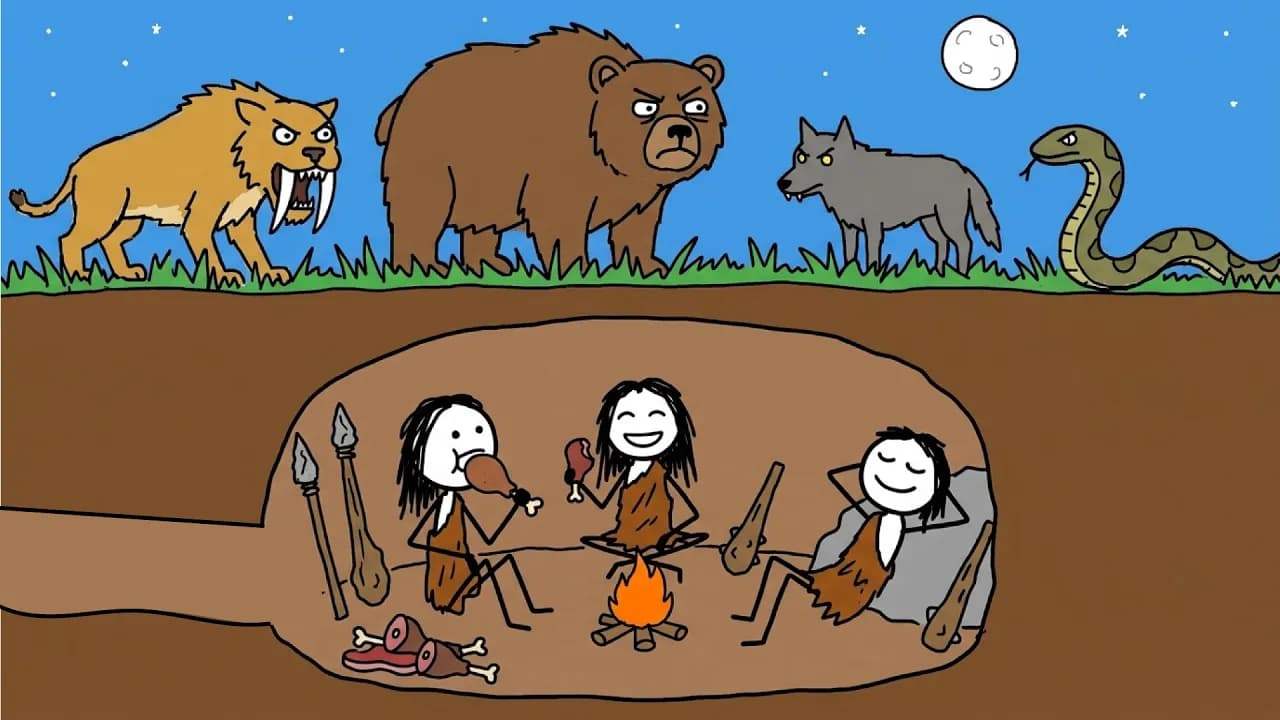
So, how did they do it? How does a soft hairless animal that grew up in the African heat survive the coldest weather this planet has ever thrown at a human? Because it's one of the best survival stories we have and almost nobody knows how close we came to not making it at all. Let's be honest about what they were facing because winter makes it sound like a cold afternoon and a campfire. It was nothing like that.
The last ice age was worst around 26,000 to 19,000 years ago. Ice sat on top of Europe, Asia, and North America. The land was flat, frozen, and open with nothing to stop the wind. Trees were hard to find. Food vanished for months at a time and humans just aren't built for that. We come from warm places. Our bodies still act like it. We don't have thick fur, we don't have a fat layer like a seal, we can't slow our heartbeat and sleep through the cold like a bear. Take a person's clothes off in real cold and they've got hours, not days. The body shuts down and that's the end.
The animals around them were made for the cold. Mammoths had fur and fat. Cave bears could hibernate. Reindeer could just walk far away to somewhere warmer. Humans had none of that. On paper, we should have been one of the first things to die when it got cold. Wrong body, wrong place, worst possible time, but we had a brain that could plan and hands that could build the things our bodies were missing. That turned out to be enough, just barely. There wasn't one trick that saved us. It was a whole pile of them and each one fixed a problem that would have killed them.
It started with fire. Nothing works without fire, so that's where it begins. Humans had been using fire for a very long time, at least 300,000 to 400,000 years. By the Ice Age fire wasn't a nice extra, it was the whole thing and they were good at it. People digging up Ice Age fire pits in Ukraine expected to find rough little fires. Instead, they found carefully built fireplaces and one of them had burned at over 600° C. That's hotter than 1,100° F. When wood ran low out on the open land, they burned fat and bone instead. Fire gave them heat, cooked their food, hardened their tools, and added hours of light when the sun barely came up.
Then they learned to carry warmth with them. The problem with fire is you can't take it everywhere. Step away from it and the cold is right there. So, humans did something no other animal could do. They took the warmth off other animals and put it on themselves. At first, it was simple, skins thrown over the shoulders. And here's a wild fact, people were skinning bears for their fur in northern Europe at least 300,000 years ago. We know because of the cut marks left on the bear paw bones, right where you'd cut to pull a skin off clean. Those bear hides made wind and waterproof winter cloaks, but a loose skin leaks heat through every gap and that's not enough for a real Ice Age.
The fix showed up around 30,000 years ago and it's so small it sounds silly. The sewing needle, a thin piece of bone or ivory with a tiny hole drilled through it. One scientist called it maybe the most important invention in human history and he's got a point. The needle meant you could sew. Fitted clothes, sealed seams, layers, sleeves that closed at the wrist. A blanket on your shoulders and a coat that fits are two very different things and the needle is what turned one into the other. Early modern humans may have had better fitting clothes than Neanderthals did, which might have helped our kind through the worst of it.
They didn't stop at fur either. Deer hide cut the wind and stayed soft enough for mittens and waterproof boots. And before heading out into the cold, hunters would rub animal fat called tallow over their faces and necks. It sealed the skin, held in heat, and stopped the wind from pulling warmth away. Simple, a little gross, and it worked.
Out on the bright snow, there was another danger most people forget about, snow blindness. The glare off the snow can blind you. So, northern hunters carved thin slits into bone or wood and tied them over their eyes. The little slits cut way down on the glare. The first sunglasses, basically, made of bone.
Everyone pictures cavemen hiding in a deep cave. The truth is better than that. A lot of these people built their own shelters out on the cold land in what's now Ukraine and Russia, there were no caves and barely any wood. So, they used the one thing lying around everywhere, mammoth bones. At a site called Mezhyrich, people found round houses made almost entirely from mammoth bones and tusks. Skulls and big leg bones went into the ground as the base. Ribs and tusks curved up to make the frame. Hundreds of bones in just one house. They were sunk partway into the ground and packed with hides, moss, and earth, which held the heat well enough to keep a whole family comfortable. The biggest one is about 18,000 years old, right in the coldest part of the ice age, and the site looks like it was used again and again over hundreds of years. That's some of the oldest building we've ever found.
People made homes out of giants, and the design was clever in ways you wouldn't guess. Many winter homes had a cold trap doorway with the door dug lower than the sleeping area. Cold air is heavy, so it sank down into the entrance and stayed there, while the warm air rose up to where the family slept. They figured that out tens of thousands of years before anyone wrote down how it works.
They also used snow, which sounds backwards until you felt it. Snow is a great insulator. Pile thick walls of it around a shelter and the inside stays close to freezing even when the air outside drops to 30 below. Long before anyone perfected the igloo, people already knew that under a snowbank was far warmer than out in the open air above it.
Where you built mattered, too. People in forests had it easier than people out in the open because a group of trees blocks a huge amount of wind. A walk through the woods on a brutal day is surprisingly calm compared to standing in a field. And for the small gaps and drafts where we'd use foam or caulk, they packed in moss, mud, and pine pitch. The sticky sap from pine trees to seal everything up tight.
Staying warm keeps you alive tonight. But winter's slower killer is hunger. For months, there was almost nothing to gather and not much to hunt. So, they got very good at saving food ahead of time. When they made a big kill, they didn't just eat it. They saved it. The cold did half the work freezing meat after a hunt so it kept for later. They smoked meat, dried it into jerky, and kept dried fruit. They stored food in pits dug into the ground and in cool underground cellars where the earth kept it cold and safe through the winter. There's even evidence they weighed mammoth meat down and sank it in cold ponds to keep it fresh longer, like a natural fridge. None of this needed power or anything that could break. It couldn't go out like a freezer in a storm, and they wasted almost nothing. Every part of an animal got used. They were very good at squeezing every calorie out of a carcass, which is hard to picture in a world where we throw out half of what we buy.
The hunting was organized, too. At a spot in Eastern France near a tall limestone rock, Ice Age hunters used fire and teamwork to push whole herds of wild horses and reindeer into a natural trap. Not once, for tens of thousands of years, the same place over and over. Kill big, dry the meat, save it for the cold. That plan is most of the reason they lived.
Here's something easy to miss. These people expected winter. Their whole year was built around getting ready for it. We're the ones who get caught off guard. We just assume the power will come back on. And when a bad storm hits, we're surprised. They were never surprised. A huge part of their year was preparing, and they used each other. Way more people lived under one roof than we'd ever put up with in way less space, and that was on purpose. Body heat is a real heat source when you pack enough people close together. The person with a room to wasn't lucky, they were cold and exposed. It was usually the ones living alone, especially the old, who died first in a hard cold snap because there was nobody next to them to share warmth.
But that doesn't mean Ice Age people were always peaceful. Life was brutally hard. Resources were limited and sometimes humans became a threat to other humans. We know this for a fact that some ancient humans got into cannibalism to survive. When food became scarcer than an honest politician, Ice Age people sometimes had no choice but to turn to the most desperate measures for survival.
They also used animals for heat. In the worst winters in medieval Europe and Russia, peasants brought the livestock, cows and sheep, right into the bottom floor of the house. The animals gave off a huge amount of heat and it rose up and warmed the family living above them. You basically lived on top of your own furnace and the furnace was a cow.
Sometimes the cold went so deep that people's bodies adapted. The Yaghan people, at the southern tip of South America, lived somewhere freezing while wearing almost no clothes. To survive that, their bodies ran hotter than ours and made more heat from the inside. They also used a deep squatting position to rest, which tucked in their arms and legs and cut down how much warmth they lost. Their answer to the cold wasn't a coat, it was their own body turned up high.
And then there's the strangest idea of all. There's a chance some early humans got through winter in a way that sounds made up, by hibernating. At a Spanish site called the Pit of Bones, scientists studied early human ancestors from around 430,000 years ago who lived through a cold icy time. And the bones are strange. The damage in them comes in cycles, like clockwork. Seasonal marks, growth that stops and starts, signs they weren't getting enough sun. Teenagers with strange interrupted growth. It's the same pattern you see in animals that hibernate, when the body slows way down, stops eating properly, and starts feeding on itself. The scientists suggested that these people, without enough fatty food to get through a brutal winter, might have gone into caves and slowed their bodies down into a kind of deep sleep to wait it out. It's not settled. Plenty of scientists argue against it and say there are other reasons for that bone damage. We can't truly hibernate now, but the idea is strange enough that serious people are still arguing about it. So, your ancestors sleeping through winter like bears isn't something we can just wave away.
For hundreds of thousands of years, making it to spring was never a sure thing. Every winter was a test you could fail, and failing meant dying. Here's the part that gets me. In a couple thousand years, which is nothing on this timeline, we went from stacking mammoth bones into a house to tapping a button for heat. The deadliest thing our ancestors ever faced is now something we complain about on the walk to a warm car. We beat winter so completely that most people forgot it was ever a war we were losing.
Keep Axen in your library
Save the videos and channels worth coming back to, and find them again in one place.