How Did Ancient Humans Survive the World's Deadliest Predators?
In a Nutshell
Early humans survived as prey to apex predators like saber-tooths, short-faced bears, and cave lions through three key innovations: controlled fire for safety and cooking, endurance for persistence hunting, and social cooperation including long-term care for the injured or elderly. Pattern recognition and language enabled strategic group hunting and knowledge transmission across generations. These adaptations, combined with throwing spears from a distance, allowed humans to outlast and ultimately drive many megafauna predators to extinction.
These notes were generated by AI and may contain inaccuracies.
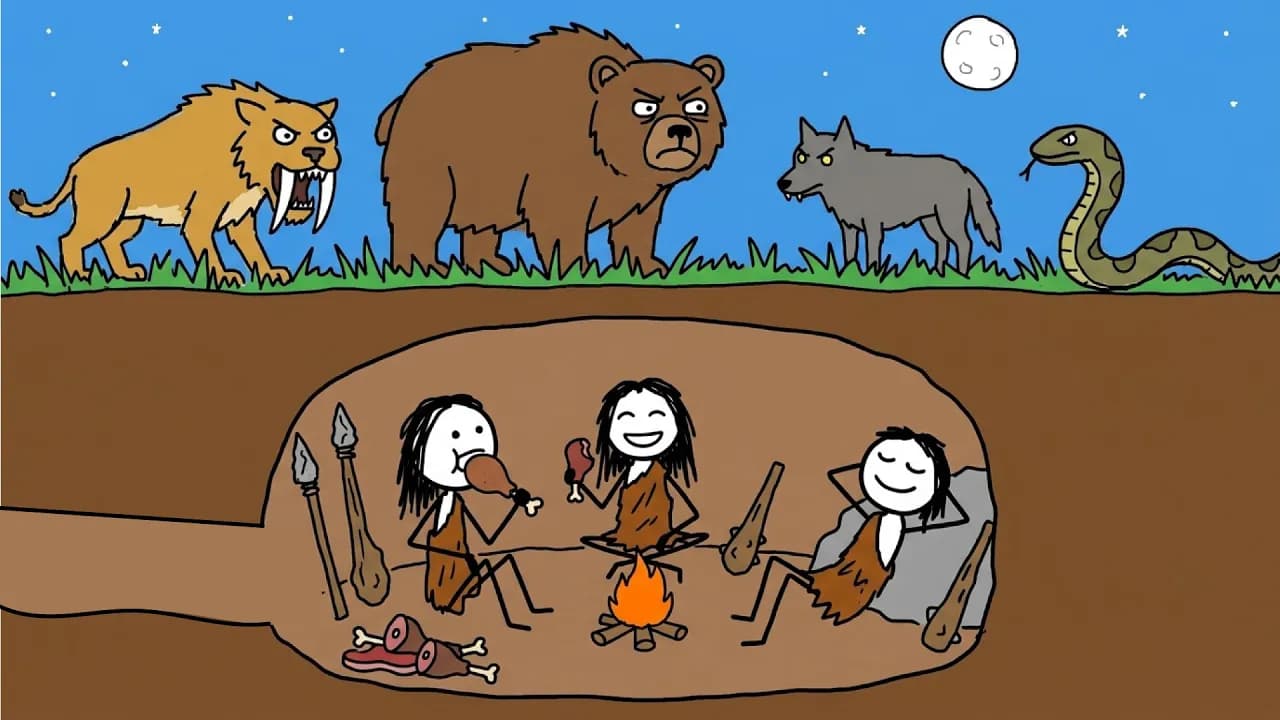
You're walking through tall grass 100,000 years ago. The sun is setting. You hear something move behind you. You turn around and see two yellow eyes reflecting the last bit of daylight. A cave lion twice the size of any lion alive today. 700 lb of muscle, claws, and teeth. And it's looking directly at you. You have no gun, no knife, not even a sharp stick. Your teeth are flat. Your nails are useless. You can't outrun it. You can't outclimb it. You can't fight it. So, how are you still here? How did your ancestors survive when everything on Earth was built to kill them?
In 1924, Raymond Dart discovered a skull in South Africa that changed everything. It belonged to a child, an early human ancestor about 3 years old. And punctured through the eye sockets were two holes perfectly spaced to match the canine teeth of a leopard. This child was prey, not a tragic accident, prey. For millions of years, humans weren't hunters. We were hunted. And the predators we faced weren't just dangerous. They were apex killers that had spent millions of years evolving to hunt large mammals.
Starting with the saber-toothed cat, Smilodon fatalis, 11in canines, 600 lb, built like a tank with a bite designed to puncture the throats of bison and camels. It didn't chase, it ambushed. It waited in tall grass or near water sources and exploded out at 30 mph. One bite to the neck and you were done. And it wasn't alone. The short-faced bear Arctodus simus, the largest mammalian land predator in North America, 12 feet tall when standing, 2,000 pounds, long legs built for endurance running. Most bears today are opportunistic. They'll eat berries, fish, whatever. The short-faced bear was a hyper carnivore. It ate meat, only meat, and it could run 40 mph. If it saw you, you were already dead. Then there were the cave hyenas. Crocuta crocuta spelaea, larger and stronger than modern hyenas with a bite force of 1,100 lb per square inch. For context, your bite is about 162 pounds per square inch. A cave hyena could crush bones to get at the marrow inside. They hunted in packs of 20 or more, coordinated, relentless, and they hunted at night when early humans could barely see. Dire wolves ran in packs of 30. Cave lions were 25% larger than African lions and hunted in groups. Giant cheetahs, scimitar cats, terror birds in South America that stood 10 feet tall with beaks that could shatter skulls. Everywhere humans went, something was trying to eat us.
And here's the thing, we had nothing. A chimpanzee, our closest relative, is three times stronger than an adult human. Chimps have fangs. They can climb 30 ft in seconds, and they still get killed by leopards regularly. We were slower than chimps, weaker than chimps. We couldn't see well in the dark. We couldn't smell predators from a distance. Our hearing was mediocre. We were upright, which made us visible from far away. And our baby screamed constantly and couldn't even walk for a year. By every biological measure, we should have been extinct in 100,000 years. But we're not. They are. Every single predator I just listed is gone. And we're here.
So, what happened? The first weapon was fire in Wonderwerk Cave, South Africa. Archaeologists found evidence of controlled fire dating back 1 million years. Burned bones, ash layers, hearths, and fire changed everything. A campfire creates a safety zone roughly 30 feet in diameter. Inside that circle, predators will not enter. It's hardwired into them. Even today, lions in Africa avoid fire. It gave us light when we couldn't see. It gave us warmth in climates our hairless bodies weren't built for. But most importantly, it gave us time. Before fire, when the sun set, you found shelter and stayed completely still until morning. After fire, you had 3 to four extra hours every night. Time to make tools, time to plan, time to talk. And fire did one more thing. It let us cook. Cooked meat has more calories and is easier to digest. More calories meant we could afford to grow bigger brains, and bigger brains meant better problem solving.
But fire alone didn't save us. The second weapon was endurance. We're terrible sprinters. A saber-tooth could hit 30 mph in 3 seconds. We top out at 28 and only for a short distance. But here's what no other predator could do. Run for hours. We have something called persistence hunting. You don't chase an animal at full speed. You track it at a jog, just fast enough to keep it moving. You follow it for three, four, six hours. The animal runs, stops, overheats, runs again. It can't sweat like we can. It can't cool down while moving. Eventually, it collapses from heat stroke. And you walk up and kill it with a rock. Humans are the only species on Earth that can do this. This endurance is what drove our hunt and secured our survival.
The third weapon was pattern recognition. Human brains evolved to see patterns everywhere. Broken twigs means something walked here. Disturbed dirt means something dug here. The shape of tracks tells you what animal, how big, how long ago. We started tracking predators the same way we tracked prey. We learned their schedules. Saber-tooths hunt near water at dusk. Cave lions avoid fire. Short-faced bears are solitary and territorial. We observed, we remembered, we taught each other. And every generation that knowledge compounded.
But the real weapon, the one that actually saved us, was each other. In 2001, archaeologists found a skeleton in Dmanisi, Georgia, dating back 1.8 million years. It belonged to an old human ancestor who had lost all their teeth years before they died. No teeth means you can't chew meat. Can't process raw food. This person survived for years after losing their teeth. Someone was feeding them, chewing food for them, or cooking it soft enough to eat. No predator does this. A lion with no teeth dies. A human with no teeth gets taken care of. In Shanidar Cave, Iraq, researchers found a Neanderthal skeleton from 60,000 years ago. He had a healed, broken arm, was blind in one eye, and had severe arthritis. He lived to about 40 years old. He couldn't hunt, couldn't fight, but his group kept him alive anyway. This is what separated us. We didn't just cooperate, we cared, and we didn't just hunt in groups. We strategized. Wolves hunt in packs, but it's instinct. Humans hunt in packs with roles. You drive the animal toward the cliff. You wait at the bottom with spears. You cut off the escape route. We used language to communicate complex plans. We threw spears from a distance, something no predator could defend against. Five humans with spears and a plan could kill a saber-tooth. And we did.
Around 400,000 years ago, the Schöningen spears were crafted in Germany. Wooden throwing spears, aerodynamic, balanced, designed to kill from 30 ft away. We stopped running. We started hunting. And then around 50,000 years ago, something shifted. Humans migrated out of Africa into Europe, Asia, Australia, the Americas. And everywhere we went, the megafauna started disappearing. Saber-tooths went extinct 10,000 years ago. Cave lions 14,000 years ago. Short-faced bears 11,000 years ago. Woolly mammoths, giant sloths, terror birds, all gone. There's debate about how much humans contributed versus climate change. But the pattern is undeniable. Every continent we reached, the large predators vanished within a few thousand years. We didn't just survive them. We outlasted them, outthought them, eliminated them.
Because here's the truth. Evolution gave every predator one advantage. Speed, strength, venom, camouflage. But evolution gave humans adaptability. We couldn't outrun a short-faced bear, so we threw rocks at it from a distance. We couldn't outbite a cave hyena, so we worked in groups and surrounded it. We couldn't see in the dark like a cave lion, so we made fire and turned night into day. Every biological weakness forced us to invent a solution. And those solutions compounded over thousands of generations until we became something no predator could evolve to fight. For two million years, we were prey. We hid in trees. We ran from shadows. We lost children to leopards and couldn't do anything but grieve. But we had one thing no predator had. We could learn from our mistakes and teach the next generation not to make them. And over time, that was enough.
Keep Axen in your library
Save the videos and channels worth coming back to, and find them again in one place.