How To Build A Company With AI From The Ground Up
In a Nutshell
AI fundamentally transforms startups by making the company an intelligent closed-loop operating system: render everything queryable via artifacts like meeting notes, dashboards, and tools (e.g., Linear, Slack, GitHub), enabling agents to analyze outcomes and propose optimized plans, such as sprint planning that halves cycle time and boosts output 10x. Adopt AI software factories where humans write specs/tests and agents generate/iterate code, enabling "thousandx engineers" with repos of pure specs—no handwritten code needed. Flatten hierarchies into ICs (builders/operators), DRIs (outcome owners), and AI-founder types; maximize tokens over headcount for lean teams that outpace incumbents by 1000x.
These notes were generated by AI and may contain inaccuracies.
Hi, I'm Diana and I'm a partner at YC. Over the past few months, it's become clear that AI is not just going to change how quickly software gets built or what workflows get automated. It's going to fundamentally change the way startups should be run from what roles will exist to what products are possible to build. In this episode, I discuss how founders should think about building an AI native company, what roles their team should have, and concrete internal practices they can adopt right now to move much faster.
Currently, most people talk about AI in terms of productivity, like making engineers more productive or adding Copilot to existing workflows to ship more features. This framing misses the shift, which is less about productivity boosts than entirely new capabilities. The right person with AI tools can now build features that used to require an entire team or were just impossible.
Thinking about AI in terms of new capabilities has several implications for how founders should run their companies. At a high level, AI should not be a tool your company just uses. It should be the operating system your company runs on. Every workflow, every decision, and every process should flow through an intelligent layer that is constantly learning and improving.
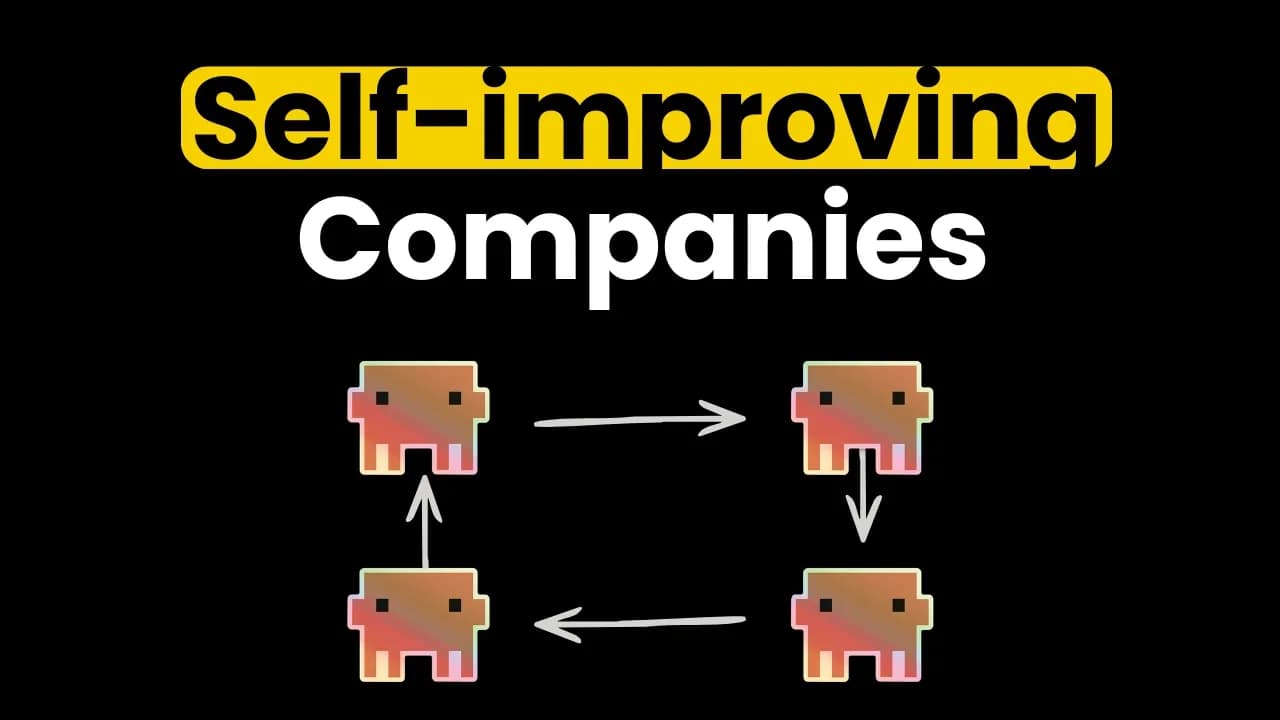
What this means concretely is every important process in your company should be captured by an intelligent closed loop. A closed loop captures information, feeds it back into intelligent systems, and improves the process over time. If you've studied control systems, open loops are controlled systems without feedback loops. In the old world, companies ran as open loops: you made a decision, executed it, and didn't always systematically measure the outcome and adjust the process. Open loops are inherently lossy.
A closed loop is self-regulating, continuously monitors its output, and adjusts its process to better meet the stated goal. Closed loops are extremely powerful for correctness and stability. With self-improving agents, your company should run as a closed loop.
To build these closed loops, make your entire company queryable. The whole organization should be legible to AI. Every important action should produce an artifact that the intelligence at the center can learn from and use to self-improve. This means:
- Recording meetings with AI notetakers
- Minimizing DMs and emails
- Embedding agents throughout communication channels
- Building custom dashboards with everything: revenue, sales, engineering, hiring, ops
Engineering Sprint Planning Example
Take engineering management and sprint planning. If an agent has access to Linear tickets, Slack engineering channels, customer feedback from emails or tools like Pylon, GitHub, high-level plans in Notion or Google Docs, sales calls, recordings from daily standups, it can analyze what was actually shipped in the previous sprint and how well it met customer needs for real.
Agents can propose sprint plans for engineers that are more predictable, accurate, and on track. The days of anchor manager status rollups that are super lossy are gone. Having managed engineering teams myself and seen this across multiple YC companies, this is a game changer. Teams that do this cut engineering sprint time in half and get close to 10x more done in that time.
The overarching principle is to provide models with as much context as you would provide an employee. Your company stops operating as an open loop where information is fragmented and manually interpreted. It becomes a closed loop system where status, decisions, and outcomes are continuously captured and fed back into this intelligence layer, always having an up-to-date view of what's happening.
A new paradigm for highest velocity companies: AI software factories. If familiar with test-driven development (TDD), this is the next evolution. Humans write a spec and set of tests that define success, then AI agents generate implementation, code, and iterate until tests pass. Human defines what to build and judges output; actual code is agent's job.
Some companies have repos with no handwritten code, just specs and test harnesses. Strong DM's AI team is an example: built software factory where specs and scenario-based validations drive agents to write tests, iterate on code until it meets probabilistic satisfaction threshold and works. This achieves the thousandx engineer Steve Yegge talks about by surrounding a single engineer with a system of agents enabling them to build things they couldn't before. The era of the thousand or even 10,000x engineer is here.
One implication of AI loops everywhere, queryable organization, and software factories is the classic management hierarchy no longer makes sense. In the old world, middle managers routed information inefficiently. In the new world, the intelligence layer serves that purpose. If queryable, artifact-rich, and legible to AI, have almost no human middleware.
Company velocity is only as fast as information flow. Every layer of human routing removed is direct speed gain.
Jack Dorsey at Block example: after going deep on tools, same conclusion—this is more than incremental productivity. If you keep same org chart and management, you've missed the shift. Company rebuilt as intelligence layer with humans at the edge guiding it. Jack suggests every company will have three employee archetypes:
- IC (Individual Contributor): builder/operator who directly makes and runs things—not limited to engineers. Everyone builds/ops support/sales. Comes to meetings with working prototypes, not pitch decks.
- DRIs (Directly Responsible Individual): focused on strategy and customer outcomes—not classic manager. One person, one outcome, no hiding.
- AI Founder type: builds, coaches, leads by example. Founders must be this, at forefront showing massive capability gains, not delegating AI strategy.
With this structure, companies get outsized results with much smaller teams. Maximizing token usage, not headcount, is critical. Best companies token max. One person with AI = large pre-AI team, so leaner engineering/design/HR/admin. Run uncomfortably high API bill—replaces expensive headcount.
Don't outsource conviction on power of these tools. Develop it by sitting with coding agents until you break priors about what's possible.
Early-stage founders have huge advantage: no legacy systems/org charts/thousands to retrain. Small enough to build right from day one.
Existing companies harder: maintain/grow live product while unwinding SOPs/assumptions. Some spin up small internal skunkworks like Mutiny. Most changes risk breaking what works, so large companies have harder time going AI native.
Startups' edge: design systems/workflows/culture around AI from start, operate thousand times faster than incumbents.
Keep Y Combinator in your library
Save the videos and channels worth coming back to, and find them again in one place.