How to Build a Self-Improving Company with AI
In a Nutshell
AI replaces traditional hierarchies by turning companies into recursive self-improving loops that extract domain knowledge, monitor performance, write and deploy code, and optimize operations overnight with minimal human input. Token usage—not headcount—becomes the constraint, middle management disappears as coordination shifts to AI, and everything must be recorded to make the organization legible for continuous learning. Humans shift to edge roles handling novel, ethical, or high-stakes decisions while software becomes ephemeral and only business context remains durable.
These notes were generated by AI and may contain inaccuracies.
The Roman legions were designed to project power over two continents from Rome at the center to Hadrian's Wall in Scotland. The structure relied on nested hierarchies with consistent spans of control, where named individuals passed orders down and sent information back up the hierarchy. Most companies today are organized like Roman legions, with human beings serving as the conduit for information flowing up and down.
Jack Dorsey's tweet highlighted the underlying assumption that hierarchically organized companies are the way economic units of value should be organized. AI fundamentally breaks this model. A year ago, people discussed AI usefulness in terms of productivity, co-pilots making engineers 20% more productive, and adding co-pilots to workflows. This approach is broken because it simply takes the old way of working and adds a more powerful engine onto it.
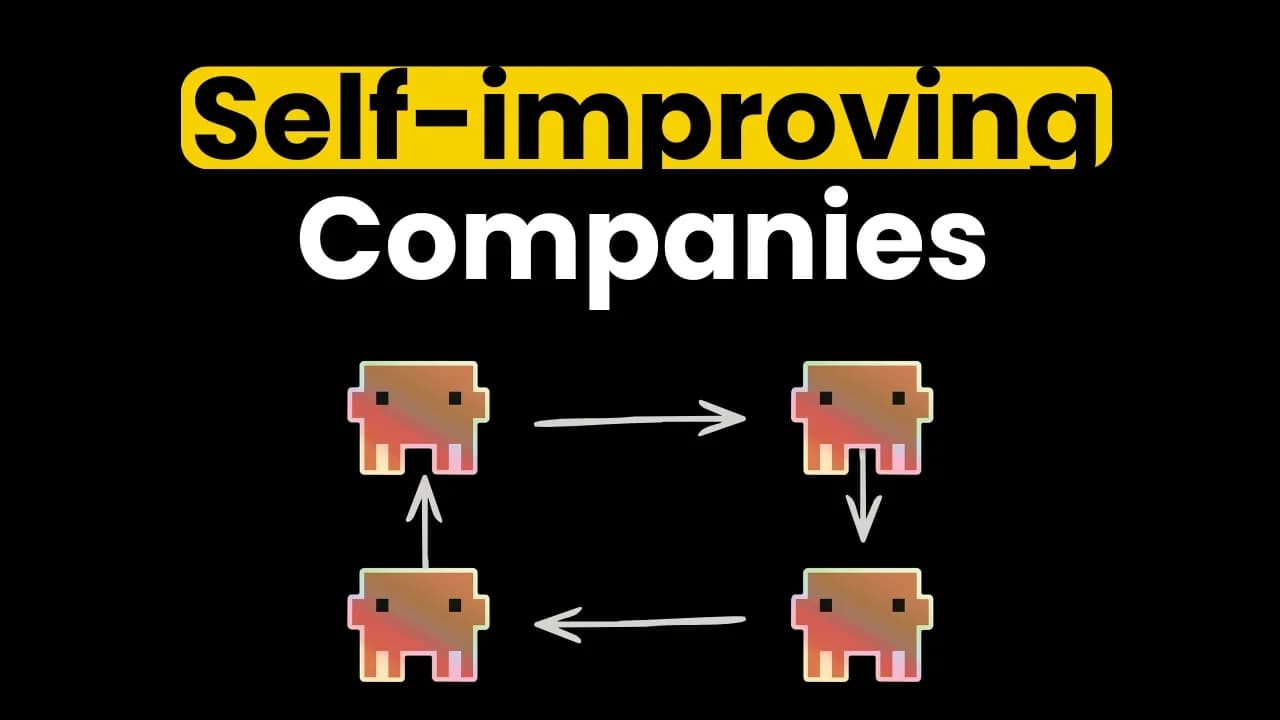
Instead of bolting AI onto the side of a company as a tool, companies can reimagine what a company is as a set of recursive self-improving AI loops. The company starts to self-improve even when people are sleeping.
The key is extracting domain knowledge from the company and defining it as context or a set of skills. This domain knowledge, business knowledge, or knowhow exists in people's heads, Slack messages, emails, and Notion. All of this information together defines how the company works. Making this information legible allows movement from hierarchical organization to an intelligent AI-powered organization with AI-native software.
AI is not something bolted onto the side of a company or a tool given to engineers to make them more productive. The company can be reimagined as recursive self-improving AI loops.
The AI loop consists of several layers:
- Sensor layer: Emails from customers, support tickets, code changes, subscription cancellations, and product telemetry that provides information from the outside world
- Policy layer: Decision rules about what the system can do, what requires human permission, and what must be logged
- Tool layer: Deterministic APIs such as querying databases or checking calendars
- Quality gate: Evalistic checks, safety filters, and human review for high-risk activities
- Learning mechanism: System interaction with the real world, identifying where it doesn't work, and looping back to the top
When every step runs with minimal human intervention, the system improves while people sleep.
An agent was built with deterministic tools to query the database, such as checking when the last office hours with a company occurred. It became smarter by querying the database in different ways, using RAG to generate relevant founder introductions for companies in specific industries like petrochemicals.
The breakthrough came when a monitoring agent was placed on top that examined every query from every YC employee, identified when queries worked or failed, and determined what would make failed queries succeed. This included needing different deterministic tools, updating the skills file, creating different database views, or adding new indexes. The system writes code, creates merge requests to the YC codebase, has an agent review it, merges it, and deploys it overnight.
When a human asks the same query the next day, it now succeeds. This represents AI going through the loop to self-improve, not just making humans 20-30% more effective.
Product analytics can have an agent identify the highest-friction part of the sales funnel, research best practices, implement an A/B test, run it for a week, select the best version, and deploy it repeatedly for continuous product optimization.
Customer service queries can be triaged by an agent acting as chief product officer and chief technology officer making judgment calls about which suggestions to discard versus which align with the roadmap. The system can write code, deploy it, and ship to customers overnight without human involvement.
Companies are reaching demo day with approximately 5x more revenue per employee than 18 months ago. This trend will continue through Series A and Series B. Organizations will be constrained on token usage rather than headcount. The blunt measure is tracking everyone's token usage, which is directionally correct though gameable at extremes.
Experimentation should be maximized to determine what is possible with the new intelligence. Leaderboards for promotion or firing decisions lead to gaming, but identifying who is token-maxing versus not provides useful signals for where to invest time.
Middle management is over because the coordination problem no longer requires it. AI can handle coordination. Two roles matter: everyone must be an IC (individual contributor), a builder, and an operator. Directly responsible individuals are essential for getting anything done. Named humans, not committees, should be responsible. Companies can be built effectively based on ICs.
The entire organization must be made legible to AI by recording everything. All partner emails are stored in the YC database. Every Slack message, every DM, and every office hour has been recorded for the last three or four months. What gets recorded happened to the AI; what does not get recorded did not happen to the intelligence.
Conversations should be recorded via phone, clips, smart glasses, or microphones in every room. Everything needs recording so it becomes legible to AI.
Recordings cannot be pumped directly into context windows. Diorization aggregates recordings down, synthesizes them into important parts, and provides breadcrumbs to the AI. An example is regenerating the YC user manual using 2,000 hours of recorded office hours from the last three months. The system categorizes content into areas like fundraising, hiring, and co-founder disputes, then generates a new user manual.
A 150-page user manual was created over a weekend that is dramatically better than the existing one. It can now be updated every month, making the user manual self-improving. New advice is compared with existing content and either incorporated or discarded. The user manual becomes a living brain of advice given to founders and can be pumped into AI agents as context.
Every function can generate on-demand software, not just dashboards. Code generation is now good enough to one-shot most internal software dashboards to high quality. Internal operations teams should create their own dashboards and workflows sitting on top of intelligence and understanding layers.
All data should be stored preciously, with everything kept in markdown format and nothing thrown away. Software itself should be treated as ephemeral. It can be generated, regenerated, or discarded as models improve. The valuable part is the comprehension inside people's heads about how functions work. Business context and skills are the valuable elements; software on top is ephemeral.
Humans sit around the edge of the company brain, interfacing with the real world where intelligence makes contact with reality. Humans reach into places models cannot yet go, including novel situations, ethical considerations, and high-stakes moments.
Examples include founders considering breaking up with co-founders or high-emotion situations requiring human presence. Sales conversations will require humans in the room for the next 20 years.
Founders should consider whether they would build their company in this shape today. Smaller companies have no excuse not to build it correctly from the start. Some companies are already ripping up and rebuilding to adopt this approach.
Keep Y Combinator in your library
Save the videos and channels worth coming back to, and find them again in one place.