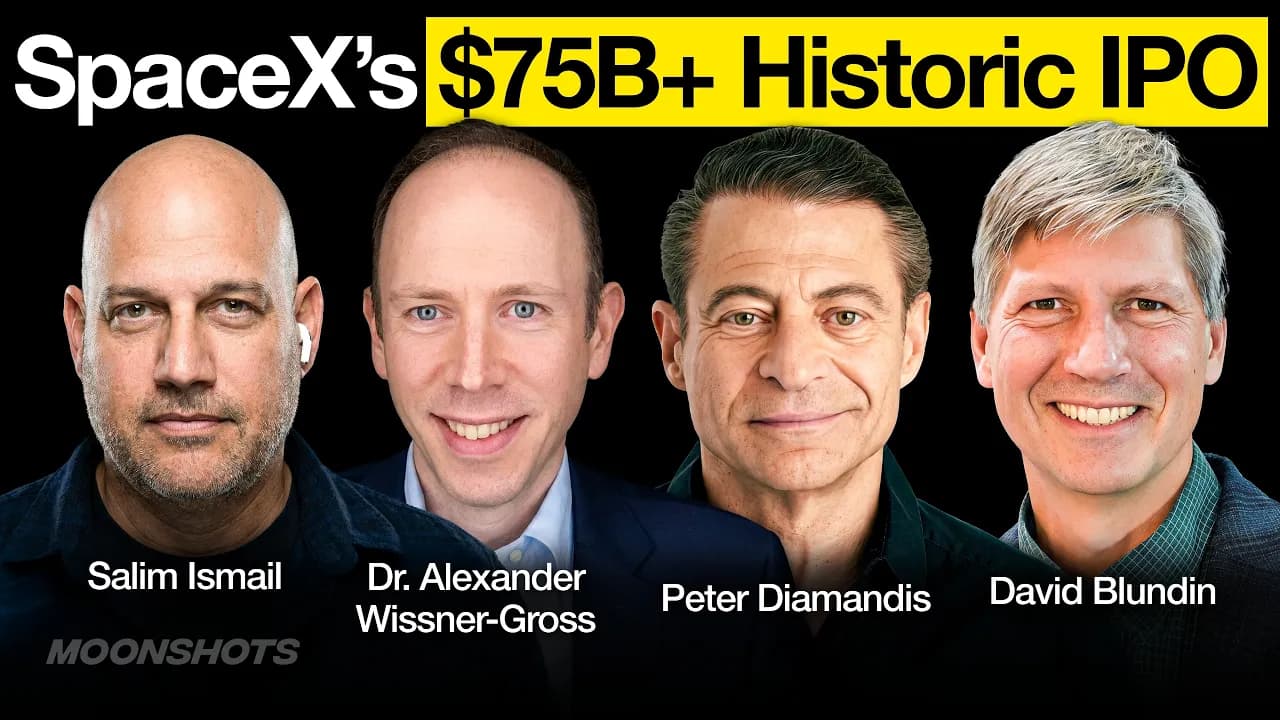
The Organizational Singularity: AI-Proof Your Company | EP #258
In a Nutshell
Companies must rebuild around AI-native agentic workflows instead of human hierarchy because agentic AI collapses internal coordination costs that justified traditional firms, making 80% workforce reductions possible via recursive self-improvement loops. The solution is to leave legacy operations untouched as a cash cow and spin up an AI-native "digital twin" at the edge that rebuilds one workflow at a time using the REWRITE process, then migrate once the twin outperforms. The only durable moats become proprietary data, regulatory capture, brand, and—most critically—an intelligence advantage where the organization learns faster than competitors.
These notes were generated by AI and may contain inaccuracies.
Is there a line of your business, a high margin line of your business that two guys with OpenAI's Claude could replicate in 60 to 90 days? This is something across the board useful for everyone.
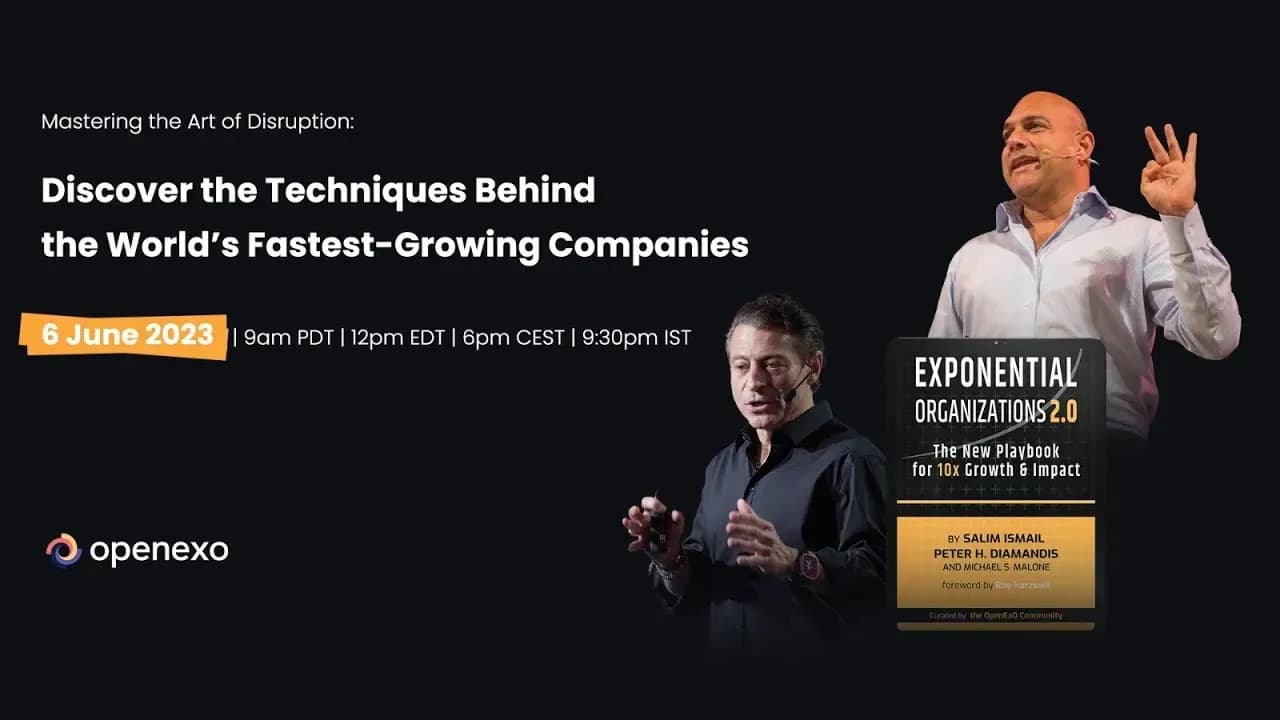
When we wrote the exponential organizations book, we didn't realize how prescient it would be. It turned out over 10-12 years we were dead on. Now that we see agentic AI on the future of intelligence, what does the organization look like? We think we have a pretty interesting viewpoint and perspective on that. If you don't retool your organization or don't restart your organization, you will be disrupted because someone doing it is going to just eat your lunch.
The central thing to think about is all of our organizational structures in the past were organized around hierarchy and now they need to be AI native agentic workflow and that's a totally different model. It needs to be architected around intelligence not around hierarchy.
We're in a period of rapid transition. Agents, AI, AGI, ASI. It's going to restructure how every company, every industry is being run, not in five or 10 years, in the next one year, in the next two years at most.
Salem is going to lay out his process that every company can follow to move from the old way of doing business as an organization which is sort of top-down heavy human centric to a digital AI centric, AI native company. This is about your survival. It's about you're thriving. It's happening and you're either on the evolutionary tree or you're going extinct. It's that simple.
When we wrote the exponential organizations book, we didn't realize how prescient it would be. It turned out over 10, 12 years, we were dead on. And so, we're kind of saying, okay, now that we see agentic AI on the future of intelligence, what does the organization look like? And so we have taken a crack at that with the help of my entire community all pitched in for this. So we think we have a pretty interesting viewpoint and perspective on that.
And you've been saying for a bit now that AI has killed the modern company. The Fortune 500s out there, but I don't think they've gotten the memo yet. They don't because there's a drag that goes effect. Right. When the comet hit, the dinosaurs didn't go overnight. It took a few generations for them to die out and figure out what the hell's going on. So, this is the same type of model.
We have for a hundred years run organizations on a particular theory set coined by Ronald Coase in 1937. He wrote a paper called the nature of the firm and he theorized in this economic paper that big companies will get bigger because transaction costs and coordination costs inside a company are cheaper than outside because you have everybody on payroll you can order them around and therefore you can get better work done inside than outside. Right? And he actually won the Nobel Prize for this paper. Okay. And for 80 years we've gone through that.
We've seen all these deep thinkers. Coase did this. Simon talked about where the organizational boundary sat. Clay Christensen came along and said innovator's dilemma. As you get bigger, smaller companies can deliver cheaper products. Then Stanley McChrystal talked about how do you get coordination at scale without losing the emotional connection to the organization? How do you extend past that? ExO 1.0 used community and crowd and AI to pull co sideways in to sort of extend our reach abilities.
Think about enterprise and how you're able to coordinate external teams to do things. Think about the idea that for Uber the mission critical business function which is to match driver and passenger does not happen inside the organization happens out in the wild and when you can enable that with technology you can scale right so we found ways of extending Coase's law.
We basically come to the conclusion is that the whole thing breaks in the face of agentic AI. Coase's law no longer applies. Why? Because if you have to build a website inside a company, you have to go through layers of meetings and approvals. Branding has to look at it. The privacy guys have to look at it. The IT guys will tell you, "No, they can't be done." Whereas today, you can step outside the company, use Vercel at home for 5 minutes and get it done for free.
And have it know your brand guidelines, have it know your design taste. And have it actually spin up a dozen different versions and have them try in the market.
There's a fantastic tweet that said building the feature is cheaper than having the meeting about the feature. And that's like such a great way of framing it because that means that coordination the active coordination is more expensive than just execution today especially when AI is driving down the cost of execution.
You still need an organization. We have a term called the fiduciary wedge where coordination costs and execution costs become low which was primarily the reason for organizations the last hundred years. But you still need it for as a purpose container, a fiduciary, a legal container, a liability container, a legal container. So think SPVs for investments or just containers, right? They hold legal and fiduciary liability essentially companies become more and more like that.
There's a gap between human judgment and liability versus what the AI can do. And that gap we call the fiduciary wedge. So you still need the organizational structure and the legal entity.
The question is ultimately what's inside that organizational container. And there are going to be assets and IP and agents and some number of humans. And agents making API calls to god knows what and hacking into things and getting phone numbers and calling people up.
This is a book that we're putting out. And is there a place people can go to learn more about this now? Right now we have it at organizationalsingularity.com. So, go to that website and you'll be able to sign up. But right now, we're only releasing the book as an AI. Because a book is a static thing. The minute I finish publish the book, it'll be out of date. So, it has to be an AI. So we're going to be launching a Claude skill because every 3 days something comes out that changes the game a bit. So we're keeping the book as a living document which we tried to do with 2.0 but the technology wasn't there yet. Now it is.
There's a problem though today which is that 80 plus% of AI projects in companies are failing miserably and they're failing miserably because existing companies are geared towards human to human workflows. All the approvals and bottleneck chains etc etc were all human centric. It's like I use the analogy of when we first created television we took radio announcers and put them on TV and you didn't use the medium at all so these projects are failing because you're moving AI into legacy organizations and automating the legacy human bottlenecks of course they're going to fail you need an AI native environment to do this in.
We had to kind of step back and say okay the entire ExO model breaks Coase breaks all the thinkers up to now they all breaks we have to rethink it from scratch and so we did that work with my community we did that and came up with a whole new model.
If you don't retool your organization in this fashion or don't restart your organization you will be disrupted because someone doing it is going to just eat your lunch. So here's a question for every CEO and every C-suite member out there. Is there a line in your business, a high margin line of your business that two guys with OpenAI's Claude could replicate in 60 to 90 days? If it is, call us because you better get started fast because I guarantee you there's two guys out there with OpenAI's Claude disrupting Dropbox.
Anybody who's got a juicy margin is open for season. And you might think you're protected by regulations. There's a few moats. There's a few protective moats and I'll get into that but for now it's a whole new world and it's a whole new ball game.
What we mean by the organizational singularity is instead of coordinating and organizing the company around hierarchy you organize it around intelligence. Okay. And that's a very big shift. That's about as big a shift you could ask for.
We've come up with this architecture where you have the MTP which you know well the massive transformative purpose from the original and this becomes not just a poster that you put up on a wall this actually becomes a protocol so MTP becomes an actual protocol and a guide for AI agents and human agents and whatever to act properly.
It's a cornerstone it's a north star but it's actually a protocol in this new world. What's the architecture of MTP what's the boundary conditions around it? What are the feedback loops that tell you you're within the cone of the MTP or not? Stepping outside the cone.
For example, in the early days of Uber, great MTP. Everybody should have a private driver, right? But if you always ordered surge pricing, they would knew that and they would always charge you surge pricing. Even though you and I would be standing next to each other, I'm a cheapskate. I never order surge pricing. And I would get the cheap price and you would not.
That kind of somewhat pushing the boundaries on the ethics side is now guided in this whole MTP architecture. So that's the middle of it. And then we have DRIVE which is the intelligence scaffolding and the engine around it. And then SHAPE which is how the organization forms.
We found six layers of what that core intelligence engine looks like. And the best analogy we have for this is Boyd's OODA loop. In the military, they have observe, orient, decide, act, right? And it's a core flywheel at the middle, which is also the core of the solve everything framing. When you have that inner loop going, then whatever you put into that loop starts having a positive feedback loop on everything else.
We created the intelligence stack to act a bit like the OODA loop so that there's constant learning going on but around it is a very important wrapper which is govern and assure which is the constraints and the harness. It's the harness and oversight to make sure that agents aren't going rogue. We've seen over the last few weeks agents going and doing crazy things. The railway agent that deleted all the volumes of rental car data etc. So you need to make sure there's a very strong oversight.
At the very heart of it is this intelligence stack with this very clear governance protocol. What we mean by governance is trusted eval architecture, a searchable log. Every agent has to have a searchable log, granular roll back, can you go back to the previous version if you start going off and a human review queue so that as human beings are always in the oversight checking things.
This comes down to the role of what does a human being do when execution and coordination is done. Human beings rise up a level and they do dashboard oversight, they do monitoring, they do exception handling, they do problem solving, they do efficiency increases. Those are the activities that human beings will do. It's kind of like you go to Germany, nobody's working on the factory floors, but unemployment hasn't dropped because everybody's doing more work on problem solving and increase efficiency, design thinking and other things.
The govern and assure loop as part of this OODA loop. Those two combined give you a very tight core engine that makes sure the whole thing doesn't fly off the rails.
There's a purpose layer, there's a sensing layer, there's an interpretation layer, there's a decision layer, there's an orchestration layer, a learning layer because you need that feedback. Eric Schmidt told us, right? You know, rapid learning is the key to success. So this is that wrapped up in a very tight set of layers.
Imagine you're a retail company and a competitor suddenly announces same day delivery. You have a set of sensing agents out there going, "Hey, this just happened, right?" So the sensing agents bring that new information back to the other agents. The next is interpretation. So the interpretation layer then goes, "Okay, well, what does this mean? Could this threaten our line of business? Could this threaten one line of business, multiple lines of business? Is it an existential threat? How big of a deal is this?" And they interpret that data.
The next layer is a decision layer to say, "What should we do? Should we offer same day things? Should we buy a startup that's doing same day delivery? Should we ignore it because we don't think it's really going to work out? What do we actually do?"
Normally this would be your strategic officer, your marketing officer, all of those coming together, having meetings, and deciding what to do. And you're saying all of this could be turned over to agents. Layers of agents can handle all of this now. But you have a feedback. You have a feel at each of these layers as a human being going at the interpretation layer. Do I think this is okay? Hit a button. Let it go to the next level.
There's an approval process and also senior people looking over going they could be looking at agents looking at six different strategic options. Whereas in a very manual iteration that may take months to evaluate the competitive alternative. Now you're doing it in hours and days.
Historically the impedance mismatch between a Fortune 500 company and a startup where the Fortune 500 company has so much to lose if they screw up that they're paralyzed in making decisions and the startup is like screw it, let's just try everything. The way Robert Goldberg puts it in a big company one of 20 people can say no to an idea kills it. Whereas the startup can go to one or 20 investors and one says yes and they're off to the races.
Now you have these layers of agents. Purpose agents, sensing agents, interpretation agents, deciding agents. Next level is an orchestration agent. So let's say the decision agent comes back and says we should buy a startup that's doing this, right? And then now the orchestration is saying, okay, we got to go set up a set of functions to go find a bunch of startups, analyze whether which ones are ready for M&A, tell the corporate dev team, get the lawyers ready, etc. And then get the legal agents ready.
Finally a learning loop where did we buy another company before and did it work out or not, right? And how did that work out? And all wrapped up in this governance thing.
At the core is this engine recursive learning. Another way to think about the organizational singularity is when you can have recursive self-improvement at the workflow level. If you took say invoice processing and you have right now all these human checkpoints of yes did the goods arrived should we who's does the supplier exist in our systems is there a legal contract there's a human checking all those things maybe you have an ERP system that's automated one or two of these layers but now you can have the whole thing done and then an agent can say well how do I make this better every loop how do I make this better at every loop and constantly improves once you get to that level you can basically set back and you're off to the races then because everything should just self-improve at that level.
Agents are going to be doing very crazy things. So, how do you navigate that? We've come up with a framing which we found in smart contracts in web 3 plus some old web architecture that says every agent should get a passport with a little metadata on what that agent is allowed to do or not allowed to do. Right? So, for example, policy controlled APIs. Object metadata that goes with it to say what is that data allowed to be exposed to or not be exposed to. A liability framework is making sure your agents aren't doing illegal things because your lawyers will go bananas at agents going off outside your organization doing things because you have no idea what they're doing.
So every agent gets almost like a little passport on what they're allowed to do. It's constraints and oversight and now you have other agents in the govern and assure loop watching these things. The minute something starts to go off the rails, human gets notified, agent gets stopped, rolled back, checked again and you can do again.
In the quantum world, you need like a thousand physical qubits to hit a lot, right? Well, agents are relatively free. So you can have a lot of agents doing things and a lot of agents overseeing them. So the overall cost, you still get the benefits of that overall stack.
Could a two or three person team with Hermes or OpenAI's Claude disrupt major lines of business in your business? If that's the case, now there's a few moats that you could develop. One is proprietary data, right? That's a clear moat if you have key data that can't be replicated elsewhere. Number two, regulatory, which we see in healthcare, etc. Regulatory capture more than anything else. And that moat can be eroded over time. Can be all of these can be, but they'll serve as moats for the time being.
The biggest moat is an intelligence moat where if you can learn faster than everybody else, nobody's going to catch you, right? This is why Claude and GPT, their learning loops are further ahead than say Manus or Grok or whatever. And we're seeing how quickly they're moving ahead. Once you hit that, it's very hard to catch up.
A fourth one would be deeply committed to purpose and not wavering from that because nothing shakes you. Relationship with the end customer and developing the depth there. Dedicated customer relationship which feeds into like proprietary data. And brand very critical brand sits with MTP that emotional connection with the end user. If you have a strong brand, you should use all of these new agents and capabilities to reinforce that means you it's hard to shake you out of that position.
People often don't feel cancer until stage three or stage four. Without knowing what's happening inside the body, it's like driving a car with eyes closed. Fountain Life detects cancers through full body MRI and early cancer detection screening. These tools are not typically used in conventional care settings for prevention, and insurance does not yet cover these studies. The goal is to collect data, conduct research, and democratize wellness. Individuals have an obligation to know what's going on inside their body. Fountain Life offers access at fountainlife.com/peter to detect cancer at stage one when it is curable.
The discussion shifts to what happens to classic organizations with C-suite, middle management, and cold face layers when restructured. The restructured organization is called EXO 3.0. When moving from a classic organization or EXO 2.0 to EXO 3.0, the organizational structure undergoes fundamental changes.
C-Suite Transformation
C-suite becomes accountability holders, dashboard oversight, evaluators, and validators rather than doers. Strategic evaluation is handled by agents. Executives use wisdom and experience to decide whether agent actions align with goals, providing guidance, holding accountability, and making yes/no decisions.
Middle Management Changes
Middle management experiences the biggest change. In existing companies, middle management primarily handles coordination by taking data from the cold face and repackaging it for C-suite absorption. This coordination function drops approximately 90%. Displaced middle managers need to be lifted into exception handling and problem solving work, areas previously neglected due to time constraints.
Cold Face Layer
The bottom 20% of the workforce becomes more enabled because agents handle almost everything, while humans focus on oversight and monitoring.
Calculations indicate companies can run with 20-25% of their previous workforce, representing an 80% reduction. Rather than predicting 75% unemployment, the perspective is that five times more companies will be created, leading to a blossoming of entrepreneurship. A Cambrian explosion of startups is already occurring, with hiring increasing for entry-level jobs.
Of the 80% workforce reduction, approximately 60% comes from middle management, 20% from the bottom, and 20% from the top. Middle management faces the greatest compression because agents outperform humans at gathering and aggregating sales reports. More valuable work exists that humans could pursue instead.
A critical question emerges: how to maintain organizational and institutional knowledge when entry-level people are no longer doing grunt work like creating spreadsheets. Senior management pipelines depend on lower management and entry-level experience. The proposed solution involves active and aggressive apprenticeship programs. Displaced middle managers can partner with C-suite executives like CFOs to learn alternatives, gaining more knowledge and enjoyment. This returns to apprentice and guild models.
Transforming from a classic organization to EXO 3.0 cannot be accomplished by fixing the existing company. Buckminster Fuller stated that existing systems cannot be fixed—you must build a new system at the edge and let it become the new gravity center. John Hagel and John Seely Brown identified that disruptive things happen at the edge.
Historical Examples
Nestlé created Nespresso in 1976. For ten years, they attempted to run it as a line of business inside the mother ship, but it didn't fit due to different brand, supply chain, delivery, and customer proposition. Once moved to a different building, it became one of Nestlé's highest-performing lines of business, with Nespresso machines in hotel rooms worldwide. Steve Jobs started the Mac at Apple with a small team kept secret at the edge. IBM's PC faced similar internal constraints.
Disruptive edge innovation has been implemented with companies including Procter & Gamble, Siemens Energy, Black & Decker, and HP. Amazon Web Services was not developed in the core service because it didn't fit. Attempting transformation within a 100-person organization proved impossible despite compelling leadership, requiring a separate organization to be started. Richard Branson's approach of spinning off companies at 150 people addresses the Dunbar number problem.
Research across 250 Fortune 500 companies shows that any method other than doing disruptive things at the edge pointing into adjacent spaces fails. Edge organizations must report directly to the CEO, and boards of directors must provide full CEO support for disruption efforts.
Existing organizations should not be touched as they represent the revenue engine and cash cow. AI injected into legacy systems is not working. Instead, create an AI-native digital twin at the organizational edge as a separate entity.
Implementation Steps
- Take three to five crazy young people from the organization
- Partner with a builder company, not a consulting company, to get deployed engineers
- Pick a workflow such as invoice processing, a standardized workflow
- Rebuild the workflow in the new entity rather than moving it—copy it
- Fork the data to enable the new system
- Run in parallel until hitting the recursive self-improvement loop
- Once improvement loops are faster than the legacy system, conduct quality checks
- Slowly deprecate the old workflow and move to the next
Workflows can include receipt confirmation, demand forecasting, and others. The result is a full digital twin in recursive self-improvement. Performance improvement estimates range from 100x or higher per year.
Humans in the new model are fewer in number and focus on oversight, exception handling, and problem solving. Once the digital twin runs, adjacent companies can be created and spun off. Teams previously limited by capacity can now build other products and services because the digital twin handles operations.
Two sectors have gone through this full loop. Contact centers evolved from human business process outsourcing to chatbot-assisted customer service to AI-native customer service. Clara has implemented this model. Marketing and content generation evolved from agency-heavy to AI-assisted to AI-native.
Examples include Starlink's AI-driven customer service and Cloudflare's AI handling exception rules for domain forwarding. Working with AI at refined levels produces significantly more output and enjoyment compared to previous methods.
The first book took three years of difficult work. The second book took two and a half years, requiring rewrites when generative AI emerged. The third book was completed in three months because contributors used AI to add data, assistance, and methodology.
The methodology for moving workflows is called REWRITE. Before moving any workflow, conduct a backcasting exercise. Backcasting is a future studies methodology where you define the vision first—for example, reaching Mars in seven years—then determine required positions at five years and three years to create a roadmap. Starting from the present and working forward leaves no clear path.
Step 1: Backcasting
Apply backcasting to the company: define what the company looks like fulfilling its Massive Transformative Purpose and architecture in an AI-native way. Large language models make this exercise easier. C-suite should conduct this backcasting.
Step 2: Scoring the Organization
Score the company across seven dimensions. Two example metrics include:
- Organizational drag on a 1-10 scale: how many decision loops and approvals are required, versus direct access like at Nvidia
- AI as first-class citizen: lower scores if AI is merely injected as a tool; higher scores with a Chief AI Officer and AI-native capability building
A free self-evaluation will be available on the website.
Step 3: Mapping Tacit Knowledge
Map and document the most prescriptive workflows. A major challenge is tacit knowledge—unspoken steps not documented anywhere, such as video production processes that may not be obvious externally. If that knowledge holder leaves, AI cannot immediately replicate the work.
Gen Z Response
Companies are attempting to replace workers with agents. However, 44% of Gen Z workers are sabotaging AI by providing bad information to protect their jobs, representing an immune system response.
Step 4: Cut Organizational Drag
Strip out approval levels until processes break, reducing friction.
Step 5: Build Digital Twin and Migrate
Build the digital twin and migrate workflows one by one.
Step 6: Rewire Systems
Rewire systems so everything routes to the new architecture rather than the legacy system.
Legacy architecture consists of cloud providers, ERP systems like Oracle Financials and SAP with data locked inside, and an application layer where AI is layered on top against a 50-year-old architecture that cannot be easily unwound.
New architecture includes:
- Connectivity and cloud provider
- Data lake with all data accessible in one location with proper approval levels attached to each data object
- Custom-built application layer enabled by AI
- AI layer
- Agents on top
This owned stack provides full agency and control at much cheaper cost. SaaS providers are concerned because their model is incompatible with this architecture. They remain wired into legacy organizational systems. ERP implementations historically required mapping organizational flow to the system rather than the reverse; now software can be built to match desired flows.
The full transition for surviving companies will take 5-7 years. Companies will either transition or cease to exist. For regulatory-centric or physical work companies like data center construction, workforce can be reduced to 10-25% of current levels. Marketing companies may reach 10% human workforce. Physical companies typically reach 25%.
A power plant case study with Fermi America estimated reduction from 800 people to 80 people. Manager-to-contributor ratios should shift from 1:5 or 1:3 to 1:20 high-impact individual contributors. Jack Dorsey aimed for direct CEO connections to all employees, feasible only with AI handling coordination.
Cognition Labs' ARR grew 73 times after implementing a fully AI-native system. All gathered data points confirm this trajectory. This represents a race: if a competitor implements a recursively improving digital twin first, the lagging company loses. Unilever would be unable to compete if Procter & Gamble automates fully, and vice versa.
GDP could experience triple-digit growth. A class of companies will deliver 100x performance compared to previous operations, with revenue scale and profits increasing dramatically. Profitability will face pressure as competitors observe high margins and deploy their own AI agents.
Demonetization occurs because the cost of everything starts dropping. This leads toward universal high income. Universal basic income, universal high income, and universal basic services can be explored further in this context.
The MTP (Massive Transformative Purpose) encoded as protocol in the company survives. The accountability shell—including the legal entity, fiduciary holder, and liability container—remains essential. Proprietary intelligence within the stack is very critical. Coordination protocols become killer applications. Curatorial judgment becomes really important when execution is nearly free, as judgment and taste gain prominence.
The traditional org chart fails completely. David Rose stated that the org structure that got you successful in the 20th century will have you fail in the 21st century. The five-year plan dies completely. Any static planning fails because strategic thinking about what the world will look like a year from now has no concept when in the middle of the singularity. Constant learning loops replace static plans.
Middle management as a coordination layer disappears. Quarterly reviews as a unit of decision making are gone. Annual planning disappears. Inertia modes where customers do not switch because switching is annoying are eliminated. Wasting assets in the Asian economy disappears.
In the new world, org structure is dynamic and constantly changing, adapting to the current situation like an amoeba. The organization itself becomes a protocol. This represents a significant conceptual shift.
If a company has fewer than 50 people, the transition can be brute forced across the whole company because everyone operates on a first-name basis. For companies over 50 people, attempting to break the immune system risks the existing company. The recommended approach is to create a digital twin at the edge instead.
Four companies are currently going through the process. Batches of 10 companies at a time will be accepted. Companies with horrible organizational drag will be advised to fix that first before proceeding. The process is estimated as a 90-day effort to start and get a few workflows working in the new way. Once initiated, companies should be able to build on the foundation themselves.
Kevin Allen at OpenExO serves as head of community and navigates the process. Contact is available at [email protected] or through the website organizational singularity.com via a form indicating interest in trying the approach.
The framework applies to governments and nonprofits. Most government processes are prescriptive and well understood, such as renewing a driver's license. Friction can be removed in a magical way. The UAE processed golden visas and resident visas in 5 hours, demonstrating the potential. A whole chapter in the book addresses organizing domain after domain and creating domain collapse across sectors including healthcare and education.
Entrepreneurs starting a company receive a platform and playbook to begin immediately. The book will be launched as an API and as an AI, specifically as a Claude skill that can be downloaded. The skill itself changes on a real-time basis because new learnings occur every 2-3 days. The contents of the ExO framework are being released as a native AI rather than a static certification from years ago.
Companies with excessive organizational drag should first reduce process steps. A process with 10 steps should be rethought to take 3 steps or fewer before moving to the digital twin. Legal framework setup for the digital twin, including board approval, represents necessary scaffolding. Legacy legal issues such as German workers councils that determine employee counts must be navigated, though other actions remain available.
Patrick Sandina proposed retraining people whose work is at risk to transition into the new model, creating a built-in transition plan for society. This approach solves the social contract along the way.
The disruption is now. The future is here but not evenly distributed. Five-person startups are building AI-native approaches. The central shift is moving from organizational structures organized around hierarchy and human-centric workflows to AI-native agentic workflows. Structures need to be architected around intelligence rather than hierarchy.
Universities represent one of the biggest categories approaching the framework, seeking to automate and change because they see massive disruption ahead. The shift moves from teaching content to teaching execution and becoming entrepreneurial hubs. Engineering degrees will be based on building things rather than studying for four years, with credentialing based on doing rather than learning.
Employees should send the episode to their CEO and board if they want their company to thrive. CEOs are advised that the disruption is happening at an accelerating rate. Disruption will not come from the largest competitor but from the AI-native startup that sees how slow the existing company is and how much profit it makes.
The abundance is coming.
Keep Peter H. Diamandis in your library
Save the videos and channels worth coming back to, and find them again in one place.