How To Make More Money Than You Deserve (My 2027 Framework)
In a Nutshell
The core message is that business vehicle choice—not effort or intelligence—determines how much money you can make. Businesses fall into five categories ranked by difficulty versus earning potential, with "demand supply arbitrage" businesses (like med spas, elder care, and regulated services) offering the highest returns because they exploit temporary supply-demand imbalances or regulatory changes. The key takeaway is to deliberately select the hardest-to-enter vehicles with the strongest moats, since competing against fewer people in higher-barrier businesses yields better odds than grinding in saturated, low-barrier markets.
These notes were generated by AI and may contain inaccuracies.
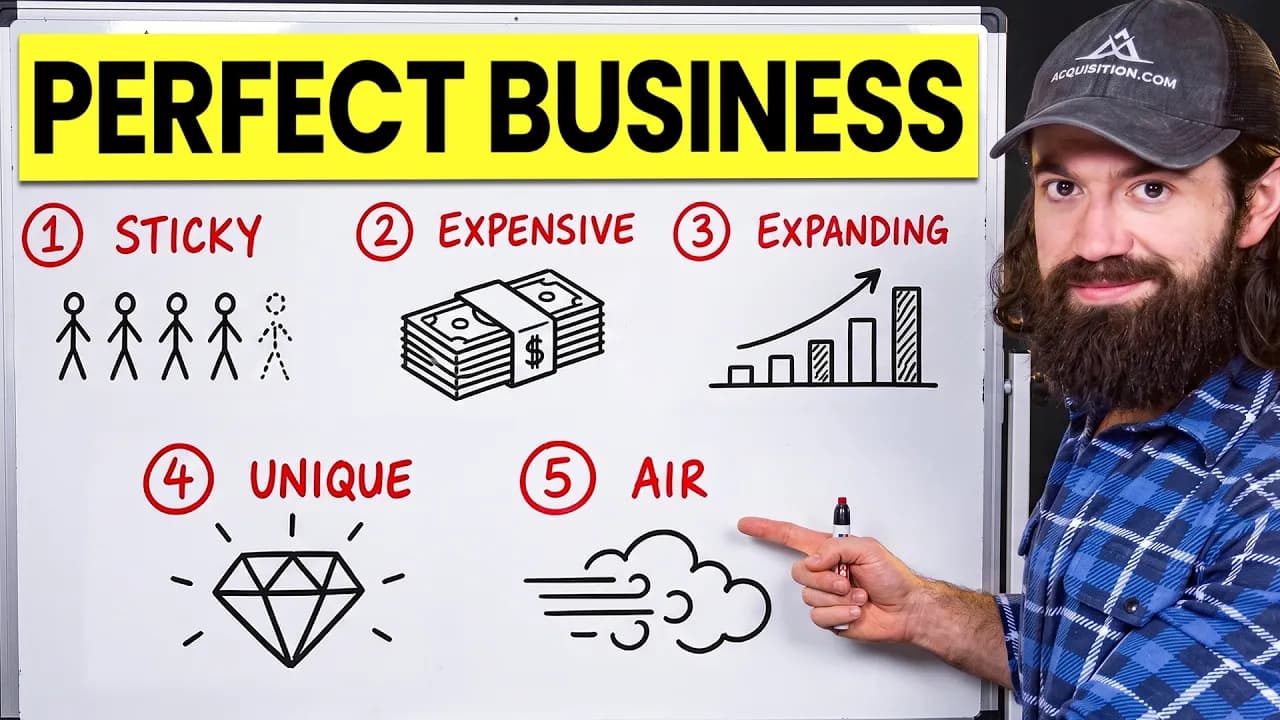
Making more money than you deserve depends primarily on what type of business opportunity you pick rather than how smart you are or how hard you work. After examining over 10,000 businesses across categories including service businesses, software companies, penis pump sellers, and screw manufacturers, all common businesses were grouped into five categories and plotted on a chart based on operational difficulty versus realistic earning potential. This creates the idiot index, which shows that people who aren't particularly smart or hardworking can still make substantial money, sometimes more than they deserve.
Your business vehicle matters more than your effort.
Warren Buffett shared a story about a business school classmate who was smarter and worked harder than him. After graduating, the classmate went into the steel business while Buffett pursued investing. Despite the friend's superior intelligence and work ethic, he made significantly less money. The main reason was the business opportunity vehicle he chose.
These businesses should be avoided. They feature low barriers to entry, which means anyone can enter, resulting in fierce competition, limited scalability and upside, and significant operational drag requiring many people to manage incremental improvements.
Examples include traditional middle-class sit-down restaurants, service-based gyms, SMB agencies, retail selling physical products in person, and event planning.
Even when someone appears successful in these low-vehicle businesses, they would likely achieve greater success applying the same skills to a higher vehicle. Gym Launch worked with service-based gym owners, and the most successful owners who managed 10 locations were told they would make significantly more money applying those skills to a different vehicle. No service-based gym owners are worth a billion dollars, though franchise owners and those owning 100 Planet Fitness locations represent different businesses entirely.
These serve as great starter businesses with more scale and less complexity. One person with the right skill set can typically scale to a top 1% income in the United States, though they rarely become much bigger.
Examples include dropshipping, which can reach $1-2 million annually, light home services like power washing and deck staining, lawnmowing, vending machines, ATMs, wholesaling real estate, Airbnb arbitrage, and affiliate content.
No billionaires exist from Airbnb arbitrage or power washing businesses. These work well if the goal is creating cash flow, learning skills, and building capital, but they lack the potential for creating billion-dollar companies.
Expert dependent businesses allow wealth creation through income, though they're difficult to sell and lack enterprise value. The business depends heavily on the founder, making it more like an enhanced job than a transferable asset.
Examples include online coaching, AI implementation, construction, detox and rehab, surgeons, enterprise level agencies, business opportunities, influencers, and personality-driven brands with podcast ad sponsorships. Joe Rogan secured a $100 billion deal with Spotify, but this represents survivorship bias among countless podcasts.
These businesses allow selling services at high margins with a small team, creating leverage through media or coaching.
Moat built enterprises feature barriers to entry that limit competition and enable billions in earnings, though they require deep skill sets, structural limitations, significant time for compounding, government approval creating regulatory moats, substantial capital, or combinations of these factors.
Examples include true AI requiring skill and money, pharmaceuticals needing government approval, money, time, and skill, specialty manufacturing like aerospace or Nvidia chips, cannabis requiring government approval and startup capital, franchising needing skill, government approval, strong core unit economics, and talent-independent models, roll-ups requiring skill and money, marketplaces like School needing nearly impossible capital and deep skill sets but creating network effects worth billions, SaaS needing deep skill sets though AI makes this easier while increasing competition, consumer packaged goods requiring brand, supply chain, and money, finance including day trading and hedge funds needing substantial money and exceptional skill, banks requiring regulation and enormous capital, and energy, data centers, and telecom needing regulation, capital, and skill.
If everyone can do it, everyone will do it. Very few people can do it, the people who succeed may have much more room to win.
The perspective has shifted from wanting fast money when broke to preferring more hurdles, which means competing with orders of magnitude fewer people. Competing with 20-50 people rather than 5 million provides better odds despite requiring more skill in raising money, hiring teams, and understanding regulations.
These demand supply arbitrage businesses, demand tailwind businesses, or supply constraint businesses are created by supply and demand economics or recent regulatory changes that shift supply and demand dynamics. They create time windows for making substantial money quickly.
Med spas benefit from aging populations with money who don't want to age, seeking longevity and aesthetic services. Wealth advisors also serve aging populations, with sticky business models that compound over time as clients get wealthier. Real estate syndication provides tremendous leverage, where a $1 million investment typically requires 5% commitment, allowing $20 million funds to leverage three times for $60 million in real estate purchases, with the syndicator earning 20% of economics.
Regulatory changes create opportunities like the cannabis boom, Botox when first legalized 20 years ago, and current JLP1s. Elder care and assisted living face supply shortages relative to aging populations. Debt collection allows high earnings for those who can market effectively. Businesses with moral dirt or that don't sound good at cocktail parties face less competition.
Commercial cleaning offers sticky recurring revenue and good multiples. Fire safety inspection is government-mandated for all commercial buildings. Parking lots and garages require more cash but perform well. Cash advance businesses like payday loans involve math and regulation. Crematoriums and funeral homes have fixed demand that increases with aging populations, with cost inelastic spending from insurance proceeds. Elevator maintenance represents another regulated opportunity.
The question isn't simply what business to start, but what business vehicle gives the best chance of reaching desired outcomes. High income requires different vehicles than cash flow, which differs from enterprise value requiring scalable, transferable, defensible businesses. Creating billions requires massive markets with strong moats. Working 60 hours weekly on a restaurant yields different value than 60 hours on software.
Only one out of many companies can become a billion dollar company. Choose the opportunity vehicle, choose the boat that you're going to get in, and then row as hard as you possibly can and do so much work that it'll be unreasonable that you're not successful.
Keep Alex Hormozi in your library
Save the videos and channels worth coming back to, and find them again in one place.