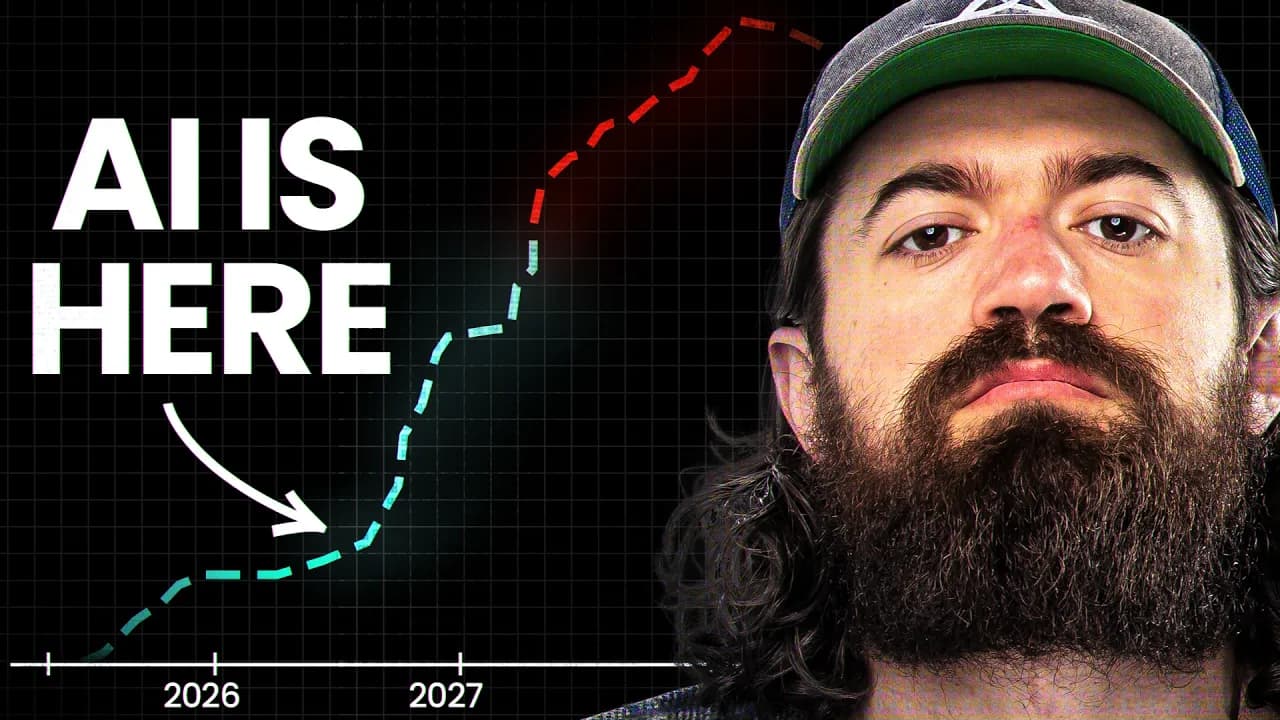
How to Use AI in Your Business in 2026
In a Nutshell
Businesses don't need to become "AI companies"—treat AI like the internet as a tool to make operations better, cheaper, faster, and less risky, overlaying it on proven processes rather than half-built solutions. Start automating today by replicating YouTube tutorials with AI prompts, dedicating time to soup-to-nuts workflows (e.g., AI SDRs trained like humans, content generation with proof, self-testing ads), and replacing gut intuition with pattern recognition from real data. Grab the free 10-stage roadmap to $100M+ at acquisition.com/roadmap, applicable to any business type, with examples like our $250M revenue firm and cases saving millions (PayPal fraud, JP Morgan contracts).
These notes were generated by AI and may contain inaccuracies.
Last year, my company did over $250 million in aggregate revenue. I've been in business for over a decade and a half. We use AI to make our business better, cheaper, faster, and less risky for our customers. I'll walk through real examples from every department.
Making Business Better
Business turns raw attention into profit, like a manufacturing belt. Misconception: businesses must become an AI business—not true. Analogy: almost every business uses the internet without being an internet business; AI is just another tool.
Mistakes businesses make:
- Assuming they must become tech companies. Being tech-forward is like having a webpage—early adopters got disproportionate returns, but it's standard now.
- Assuming a tech nerd will handle it.
Advantage of cloud to dirt knowledge: vertical integration from high-level strategy (people, communication, marketing) to granular details (connecting APIs). Owners understand what's possible across the business; tech experts have limited context and default to commoditized automations.
True improvements come from overlaying business acumen on technical acumen. I dislike technology but see it as a necessary evil.
Watch YouTube videos on automating specific tasks, take the link/transcript, prompt AI: "Help build this," follow directions. When stuck, screenshot and ask AI "What do I do now?" Repeat.
From marketing: we have an AI SDR matching our human team. Mistake: installing half-built AI, comparing to optimized human processes (optimized over 6-20 years), concluding AI fails. Do apples-to-apples: apply same training/SOP effort to AI.
Sales AI agencies struggle because implementing sales requires knowing more than tech/sales—must adapt to specific businesses.
Example: We've mastered customer acquisition via checkout page, webinar, in-person, phone sales. AI setter isn't drag-and-drop like transplanting a sales guy—they'd suck initially without training.
Worse if no good sales process exists. Don't run AI on every opt-in without human-equivalent process. AI makes existing good processes easier/faster; doesn't replace strategy.
Exact 10-stage roadmap from zero to $100M+ (completed multiple times, <1% of companies finish). Breaks down stages by headcount across 8 business functions: constraints/symptoms and steps to graduate. Works for software, physical products, service businesses, brick-and-mortar. Free at acquisition.com/roadmap—enter info, get it instantly.
Humans won't change: persuasion, interests remain same. Don't advertise using AI—no one cares; they care about faster, cheaper, better, risk-free outcomes.
Reducing Risk with AI
- PayPal: Reduced fraud team massively, cut fraud losses $700M in one year via AI pattern recognition.
- JP Morgan's COiN: Saved 350,000 lawyer hours; processed 12,000 credit agreements in seconds.
- Clara: Replaced 700 customer service agents, saved $40M/year.
- Our book launch: 5 agents handled ~120,000 support tickets (e.g., "Where's free stuff?"), resolved 90% without humans.
Find a dedicated time (weekends, evenings, early mornings, midday) to automate one workflow soup-to-nuts, click-to-close.
People resist because afraid of AI. Automate your own workflows to free time for higher value.
Replace magic/mysticism/gut/intuition with pattern recognition: you've seen stimuli, had reinforcement cycles (e.g., "looks cool" from generalized patterns).
Approach with observable lens: list behaviors for outcomes. Even "think of cool YouTube idea":
- Bot checks calendar.
- Record/transcribe calls.
- Prompt: top 5 interesting situations/decisions from last week into document.
Creates true stories/narratives from real events—no fabrication.
Big issue: proof. Consumer side: less sensitive. B2B: matters.
AI avatar in B2B fails without proof (just GPT words). Must be backed by real achievements (e.g., scaled e-com, trading, real estate).
Consumer: beautiful AI avatar on skincare gives visual proof via appearance (psychology unchanged).
B2B: proof still key.
Internet is here as AI (25-30 years later). Businesses don't need to become AI businesses or advertise AI use—like not advertising internet, CRM, or training.
People care about outcomes and repeat buys.
You're not too busy—prioritize over less important tasks.
(Free roadmap plug repeated.)
Internet = connection; webpage = calling card.
AI interacts with anything human touches. Examples for small businesses (marketing):
- Generate ideas.
- Script/package: headlines, thumbnails, topics.
- Auto-test thumbnails it generates, build skill on winners.
- Trend research: formats, hooks (verbal/visual), cross-reference with past content/brand for Venn diagram—generate 10 options.
Ads: self-licking ice cream cones—content auto-overlaid with CTA, launches daily ad campaign with yesterday's content.
Endless statics from datasets (e.g., community wins tab → 6 high-converting visual templates → ads for Vantage, our $1M+ community).
Sales: enrich leads, quick personalized responses (automated voice note, dynamic image/text via DM on Instagram), dynamic AI-to-AI scheduling (faster speed-to-contact).
18 months of huge opportunity for wealth creation from nothing via army of autonomous agents.
Works across board: legal team—one general counsel runs deals/lawsuits through agents (first response, second response, cease and desist).
Keep Alex Hormozi in your library
Save the videos and channels worth coming back to, and find them again in one place.