How to Win With AI in 2026
In a Nutshell
AI is advancing rapidly, making workflow-based thinking essential: break jobs into granular tasks, automate them with AI agents, and prioritize training AI like employees for 100x speed and 1/100th cost over role-based hiring. Adopt a barbell strategy—go fully AI-first for high-risk/high-reward startups disrupting incumbents, or low-risk bets on unchanging human needs like health, food, and entertainment—while leveraging slow human adaptation for massive margins. Actionable steps: list daily tasks, feed them to AI for automation plans, use screenshots as an AI tutor, and join communities like ACQ Vantage; free 10-stage roadmap at acquisition.com/roadmap.
These notes were generated by AI and may contain inaccuracies.
Wake up. AI is here. OpenClaw moment happened over President's Day weekend; it started a month earlier and was acquired for a billion dollars by OpenAI. If you're not paying attention, you will be left behind. Not here to fearmonger, but to prepare for the biggest shift on Main Street, not just tech businesses. News flash: AI will never be worse than it is right now. Assuming any rate of improvement over any reasonable time period, learning how to use AI should become your number one priority, number two priority, number three priority, and number 10 priority.
This video shares ways to think about AI and use cases deployable today to make significant changes in your business, start one, or safeguard your role in a larger business. Also for my team. Never been a better time to start an AI-first business to disrupt existing markets because incumbents are busy running businesses rather than learning AI and using terms like AI-first without being AI-first. Starting out gives you time advantage. Every AI skill stacked gives disproportionate leverage over competitors.
Started companies (not public) with revenue per employee in the millions per year per head from day one because big org charts make it hard to adopt new, uncomfortable tech and have hard conversations like automating roles. Encourage raising the bar: people who meet it stay, others don't. Harsh reality.
Effectively, there's zero net job creation in the private sector.
Jerome Pal said this recently: zero jobs growth in private sector despite good economy because people are automating jobs away. Motivates action because it won't happen slowly—it will happen quickly.
In game theory, the most flexible system survives—like business Darwinism. Adaptable people survive, not strongest or smartest. Change with the environment by learning tools. Get over fear of AI. Risk more by not adopting than fearing rare downsides (e.g., AI safety, credit card issues—like saying 'I got hacked, never use internet again').
Why don't more adopt? Complacency and short-term cost of learning, like training an employee. Short-term thinkers lose to long-term thinkers.
It takes about 20 hours to become proficient in any new skill. But people delay the first hour decades.
Spend a weekend figuring out agents: by end, build something, understanding increases more than from fear-mongering articles.
Stop role-based thinking; start workflow-based thinking. For every hire, list 4-10 things they do, ask if each can be a workflow instead of headcount. Old: hire editor. New: break into 5 workflows for video creation.
Organizations organize humans, not inputs/outputs. Ideal: like manufacturing—raw inputs + special sauce = valuable output. Service business: raw talent + training/skills in aggregate > individuals.
E.g., writer + reader + recorder + editor + ad buyer = advertising agency. Current structure organizes human communication/hierarchy. Instead, linearize tasks into workflows. Don't automate people; automate one task at a time from their 10 tasks. If employee, automate your own job or miss out.
Friend spun up division to put his larger business out of business. Dedicate 20% time to automate yourself—control it or someone else will.
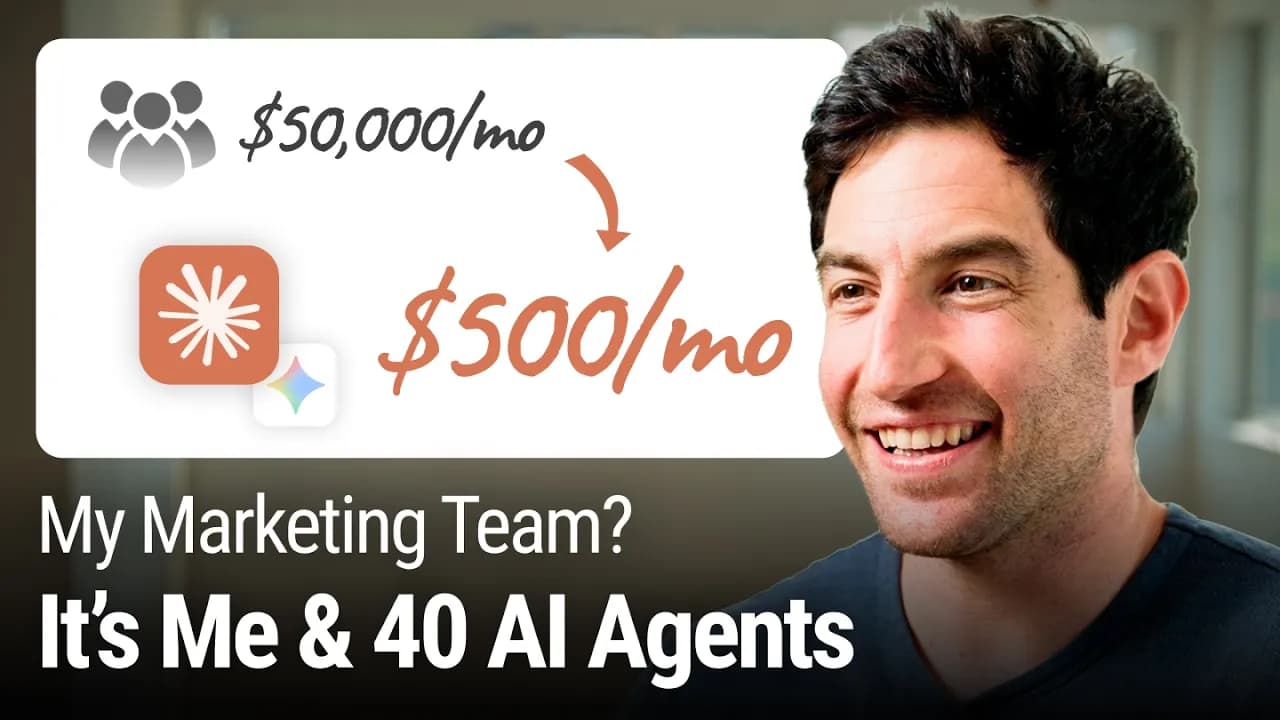
Medium-term: BYOS or BYOA (bring your own software/agents). Tremendous earning power at employee level. Approach business as their entire marketing department—e.g., Anthropic has one person in marketing leveraging agents.
Not person doing ton of stuff; agents trained on their way. Get same output as full department. Valuable as contractor/agency, embedded with equity, or higher cash pay. Titlism (titles) in private market won't survive.
Fall off: not training AI like new employee. Bad first output ≠ fire them; train more. AI learns via reinforcement like humans: good outcome = more, bad = less. Humans build 'taste' by recognizing/communicating patterns + rewards. Computers excel at pattern recognition.
Train computers like humans (most bad at both). Use observable behaviors: remove emotional/ephemeral words (charisma, lighter), define exactly what you want.
People don't define 'good looks like,' expect guessing. Define precisely to train better—AI does work at 100x speed, no complaints, 1/100th cost.
Example: 'Write email copy.' Sounds like AI slop because trained on internet. Instead: 12 unbreakable rules + 16 writing samples = 5x better. Repeat 100x = perfect training. With person: 100 cycles take 1.5 years; AI: 100 minutes (they forget less).
AI laggards ('no one replaces humans') easier to beat—like fax machines or finger-counting. Companies without websites make money but less. Humans + superior tech beat humans + inferior tech, from Stone Age to Titanium Age.
Competing against humans + tools: confident. Day machines alone compete, lose (chess, Go). Pushback on AI like autopilot: emotional, not functional.
10-stage roadmap from zero to 100M+ (done multiple times across software, physical products, services, brick-and-mortar). Breaks down by 8 functions, constraints/symptoms, steps to graduate. Free at acquisition.com/roadmap.
In infinite AI labor/intelligence world (cost → zero except energy), last valuable human work: taking risk. Money exists; labor won't have value. Robot with infinite intelligence/strength/speed works for electricity cost.
Every company becomes tech company (e.g., social media, internet, email, phone). GDP per headcount up via skills + technology. Infinite labor/intelligence → GDP explosion, more companies, roles automated → business bloom.
Barbell strategy:
- High-risk/high-reward: fully AI-first/native/forward. Hard team conversations; automate roles. Startups without legacy will beat you.
- Low-risk: bets unchanging (Jeff Bezos frame). Humans have bodies: health, fitness, consumables, food, supplements. More leisure → entertainment booms (grows as GDP %; cheap). Make AI full-motion picture, viral videos → $100-200M all margin.
Porn adopts tech first: AI avatars (army of 100), no drama/filming, render videos, chatbot chats trained on 10k convos—people pay. Humans need housing, food, entertainment.
Hell-in-handbasket: if apocalypse, doesn't matter. Hope for best, prepare for worst; all-weather approach best for success.
Brian Johnson (Blueprint, longevity): people trained entire lives to swim, think they can in all weather, get better/better
You get to become a better and better swimmer, from a pool or lap pool to a lake, to swimming off the coast, to free ocean swimming from border country to the next border country. But the change ahead is a phase shift: you're swimming, then the water boils, evaporates into gas, and no matter how good you are, flapping your arms doesn't work because the fundamental physics of the environment has changed. This is the change we're on the precipice of.
This is not doom and gloom—it's tremendous opportunity because humans are slow to adapt. If you're watching this, you're already ahead of most people, who just exist with their heads in the dirt. Many over age 50 say, "I'm too old for this," yet they hold all the money. They'll quickly realize it's going somewhere else because they didn't adapt, creating a big opportunity.
Huge opportunities also exist in automating portions of work for regular businesses. Humans' slow adaptation means their price sensitivity lags: if people are used to paying $2,000 a month for something, embedded in that price is typical labor cost. Charge $2,000 while your cost drops from $500 to $50 or $5 a month. The margins are tremendous, and operational leverage skyrockets—one person can now bring in millions in revenue. Scaling becomes easier as coordination costs between humans drop dramatically.
Write down a list of everything you do every day at the most granular level: respond to emails, respond to Slack messages, make content, make ads, run ads. Break out individual tasks—don't chunk them up. "Running ads" includes making campaigns, setting budgets, analyzing results, making creative, writing copy, testing landing pages, testing headlines.
For each task, put it into AI and say, "Help me automate this. What steps would you take?" It gives a list. Take the first step and do it. If stuck, screenshot your screen, put it in AI, and say, "What do I do now?" It tells you. Screenshot the next screen and repeat. Everyone has an AI tutor at their fingertips but isn't using it.
This is the type of stuff actively worked on inside the ACQ Vantage community for million-dollar-plus business owners, discussing daily. They have an AI product trained for years, an AI salesman trained, and more kept behind closed doors to capitalize on opportunities. Check it out via the link below.
Peace and blessings be upon you and your bloodline. I wish you the absolute best and hope you are in the permanent upper class and not permanent underclass in the world that comes.
Keep Alex Hormozi in your library
Save the videos and channels worth coming back to, and find them again in one place.