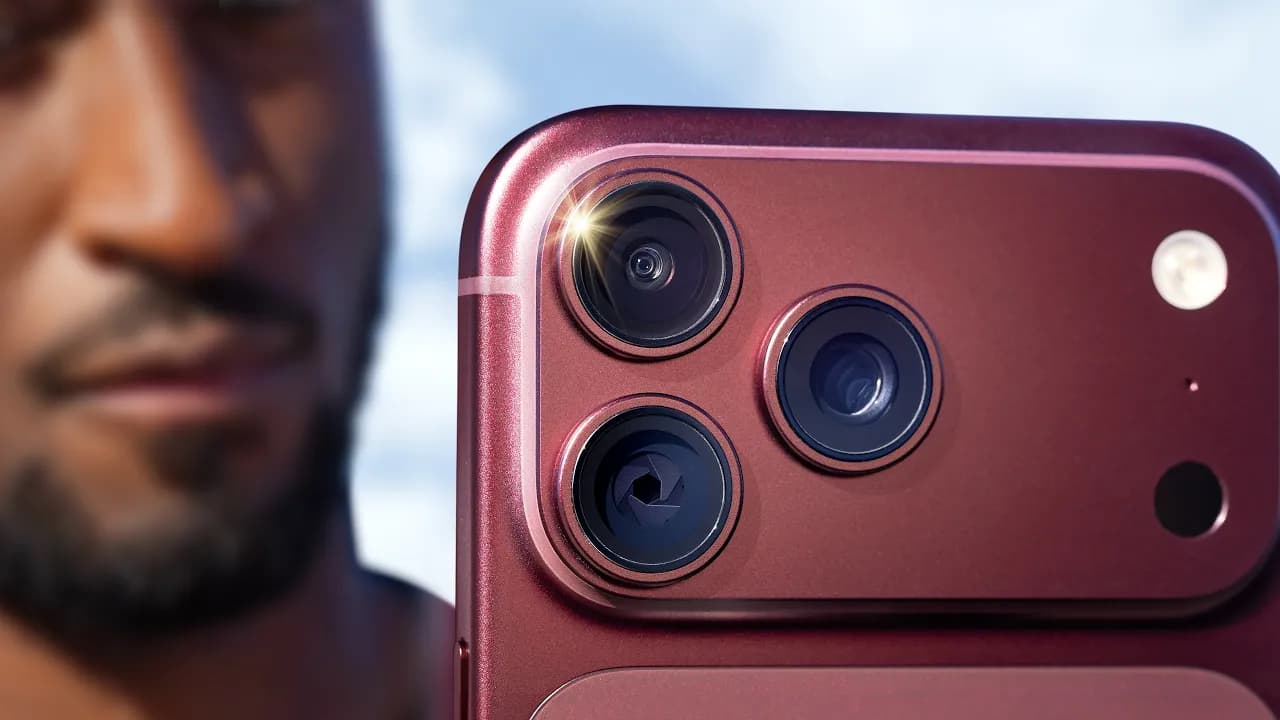
I shrunk down into an M5 chip
These notes were generated by AI and may contain inaccuracies.
Every year, Apple unveils the latest version of their computer chips: M1, M2, M3, M4, and now M5. Graphics show impossibly big numbers of transistors on a chip in a handheld device. To appreciate billions of transistors in a pocket-sized device, shrink down in scale, opposite to scale-of-the-universe videos. No generative AI used; created with Blender. Shrink by 100 times (two orders of magnitude) each finger snap.
At 6'3" (2 m tall), gadgets fit in hands. 100x smaller: size of a single key on keyboard. MacBook Pro keyboard deck size of apartment building. 8 terabytes RAM and storage. M5 chip powers it, size of single 1948 transistor. Progress in 75 years from room-sized computers.
Technology improves due to hard work by brilliant minds, leading to Moore's law: number of transistors on a microchip roughly doubles every 2 years, true since semiconductor industry start.
200 micrometers tall, twice as thick as human hair. Sheet of paper ~100 micrometers thick. Glass screen protector thicker than realized. 1948 transistor now height of tallest building. 1968 transistor: 20 years later, Moore's law doubles transistors 10 times, halving size 10 times. 1968 computers for governments/research labs, room-sized, cost hundreds of thousands to millions, pre-internet.
2 micrometers tall, invisible to human eye. Human hair like 25-story cliff. Grain of rice size of Mount Rainier. Live in vinyl record groove. 1 mm water droplet like massive lake. Bacteria scale. Physics strange: air molecules too large for lungs, visible light wavelength as tall as self, world blurry/wavy. By 1980s, manufactured functional electronics at this size. Moore's law continues. By 2003: laptops mainstream, Wi-Fi standard, Windows XP most used desktop OS.
20 nanometers tall. Individual transistor from 2026 M5 MacBook Pro size of garage (not 100% accurate, Apple doesn't share exact architecture). Smallest parts smaller than self. See individual atoms (marble-sized). 3nm transistors made via photolithography: light projected through microscope onto atoms like developing photo.
Uncertain how much longer Moore's law applies at atomic level, but appreciate it now.
Epic Spaceman helped with video; he's visualized this scale before.
Hi, Marcus. Yeah, it really is. Even when you can stand on them, I still struggle to get my head around how many transistors there are here, considering this is just a tiny cutout section. The full chip is 32,000 times bigger than this.
Visualize from 3 nanometer transistors (scale of DNA/atoms) to micrometer scale (2000s, '90s, '80s) computers, to earliest deck-of-cards transistors. Grain of rice massive at that scale.
World's first electronic computer: ENIAC (1946), light bulb-sized vacuum tubes (triodes), room-sized. If transistors that big today, iPhone's 19 billion transistors would need size of New Jersey (270 miles long), not city block or Central Park or Manhattan.
If modern transistor size of Toyota Prius, iPhone size of planet Earth.
Progress shrunk US state-sized computer to pocket. Numbers hard to appreciate on keynote slides. In cosmic scale, Milky Way has over 100 billion stars, hundreds of billions of galaxies in observable universe. Check Epic Spaceman channel for more scale videos; his recent ones inspired this. His latest dives into how transistors work at this scale. Subscribe there.
Keep Marques Brownlee in your library
Save the videos and channels worth coming back to, and find them again in one place.