I Told Everyone We'd Figure Out Life After Work. I Was Wrong.
In a Nutshell
Post-work society is collapsing because work has been the central organizing principle of Western civilization, providing structure, meaning, and status that cannot be easily replaced. Physical realism offers a solution by prioritizing care for the human animal through sleep, exercise, nutrition, social connection, and time in nature—the actual biological requirements capitalism substitutes with pale replacements like social media and self-improvement. The speaker rejects Nietzsche's individualistic "superman" ideal and optimistic nihilism, arguing instead that meaning comes from integration into social circles and reciprocal love, not philosophical self-creation.
These notes were generated by AI and may contain inaccuracies.
The discussion centers on post-nihilism and physical realism in the context of the post-work economy. The speaker developed these concepts while exploring three main dimensions of post-work life: economic security through family income, political power structures, and philosophical questions around meaning, purpose, and justification for existence.
The rigid, neoliberal, Protestant capitalist work ethic has served as the dominant philosophy for the past 150 to 200 years. A new philosophical model is required to address post-work realities, as traditional frameworks no longer apply when work's central role diminishes.
The first iteration of these ideas was called "living with the body first," which emphasized prioritizing physical needs as a guide for living. This concept was discussed frequently on the Substack platform. Brian Johnson with his "Don't Die" movement exemplifies this approach by focusing on measurable physical needs including sleep, exercise, hydration, nutrition, and behaviors to adopt or avoid.
A common objection suggests that following bodily desires would lead to giving the body heroin due to addiction. The response clarifies that this interpretation represents a robotic, immediate-dopamine-response approach, not the intended meaning. The philosophy does not advocate harmful adaptations. Another objection questions who decides what is harmful, but the response dismisses this as missing the point, using the example that getting adequate sleep is objectively beneficial regardless of philosophical debates about necessity.
The speaker mentions an amicable separation from his wife, noting they remain friends and continue co-parenting their dogs. This personal context is shared to explain why he will continue referring to her as his wife for some time due to her long-held role, while technically acknowledging his single status.
Mandy, the speaker's dog, exemplifies living with the body first by naturally pursuing what makes her comfortable without overthinking sleep or food needs. The speaker provides an environment that enables natural behavior, suggesting humans can learn from dogs' instinctive approach to physical needs.
Proper nutrition, diet, exercise, and sleep form the "golden triad" of physical wellbeing. The speaker references Dr. Roger Walsh's framework of TLCs (Therapeutic Lifestyle Changes), which includes eight daily or weekly practices that promote happiness: rest and relaxation, time with friends, time in nature, exercise, entertainment, acts of service or giving, and spirituality. The speaker notes uncertainty about whether there are seven or eight components.
While some religious individuals suggest turning to Jesus, Muhammad, or Buddha would solve all problems, the speaker notes this approach does not work for many people. Religious conversion cannot replace the hard work of developing a comprehensive intellectual framework. This realization drove the evolution toward post-nihilism and physical realism.
Throughout history, privileged classes have existed who did not need to work for a living. The speaker initially believed people would naturally find solutions for meaning and purpose in post-work scenarios, but later recognized this assumption was overly optimistic and required a more rigorous framework.
Physical realism acknowledges that humans are animals and prioritizes taking care of the animal body first. This philosophy interprets the body as a sacred structure requiring proper care. The speaker notes religious objections claiming humans are divine vessels where only the soul matters, but counters that physical realism prioritizes the body as the foundation.
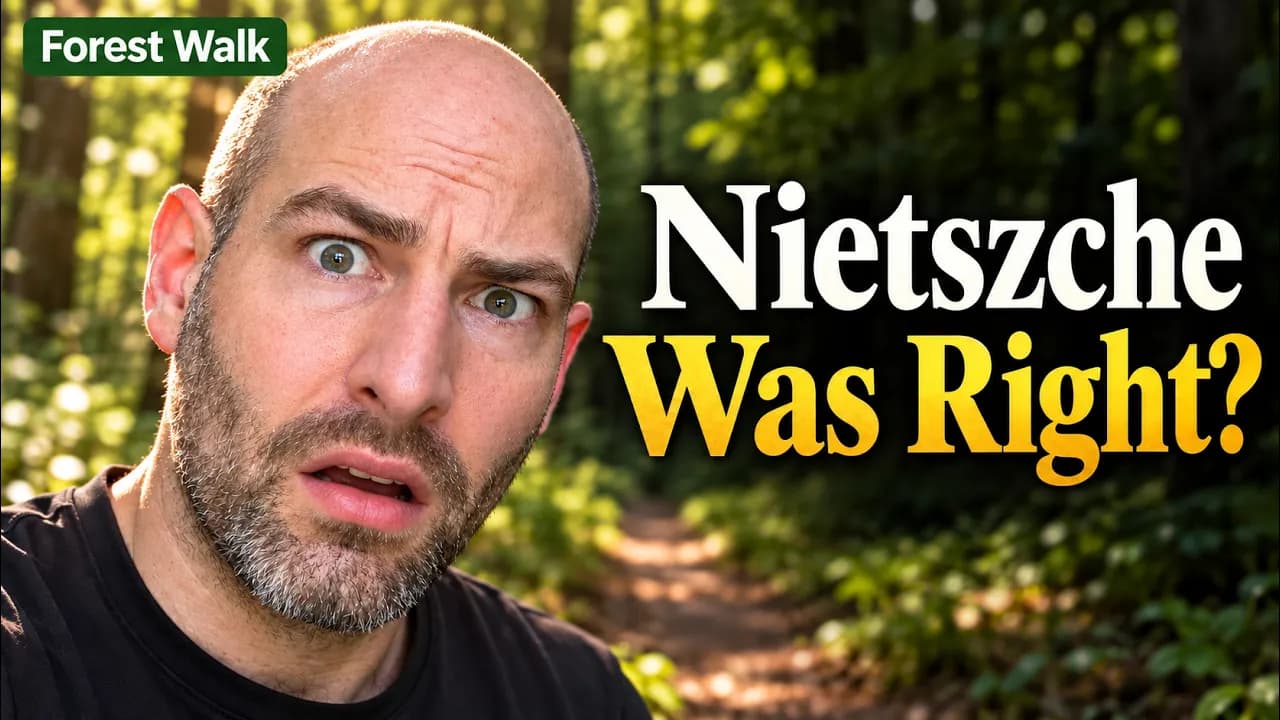
The speaker spends significant time in forests because evolutionary evidence indicates humans are descended from tree-climbing hominins, explaining shoulder mobility that allows reaching straight up—a capability most mammals lack. The forest represents humanity's natural habitat, with soil microbes and tree compounds affecting stress levels and immune function.
The speaker provides a personal example of feeling unwell but recognizing that going into the forest would improve wellbeing, demonstrating physical realism in action. This represents understanding what evidence indicates about human needs and acting accordingly.
The original philosophy included "radical harmony"—being radically aligned with one's true animal self. However, this term seemed like New Age marketing jargon and did not gain traction. Physical realism was adopted as a more philosophical orientation distinct from wellness cults or spiritual teacher perspectives.
At a bonfire party, Mandy rolled in deer droppings, demonstrating physical realism from a dog's perspective—her instinct to use strong smells as camouflage represents an evolutionary adaptation, even if unpleasant to humans.
When writing "The Post-Work Economy," the final chapter titled "Life After Work" led to rigorous examination of what work actually provides. This analysis revealed that work offers structure, daily organization, pathways to competence, and means of gaining respect and status. The speaker realized his initial assumption that people would easily figure out post-work life was incorrect.
Western civilization has built infrastructure, lifestyles, calendars, technologies, laws, and cities around the concept of work. Zoning laws, residential suburbs, calendars, and phones all serve business needs. If work disappears, the central organizational principle holding Western civilization together begins to dissolve—not just in terms of income or political influence, but as the existential basis for how people live.
Zoo psychosis describes animals in captivity that develop madness due to poor environments, manifesting as repetitive pacing in lions and bears or feather-plucking in birds. Humans suffer from the same condition, which the speaker identifies as the root cause of the loneliness crisis, obesity crisis, and mental health crisis. This represents collective zoo psychosis rather than individual pathology.
The nihilistic crisis represents a disintegration of meaning, comparable to what another YouTuber calls a "crisis of meaning." Western society has reached nihilism's philosophical and social endpoint, eliminating existential meaning at the highest level and replacing it with worship of money, objects, nothing, or the self.
The metaphysical void created by nihilism gets filled with debt, capitalism, or self-improvement. The speaker uses the example of "improving appearance" as symptomatic of the meaning crisis. Coercive attempts to eliminate innate needs for abstract and sublime metaphysical meanings fail, similar to how Lysenko's rejection of Darwinian evolution and Western science in favor of forced adaptation theories led to widespread famine.
Capitalism replaces biological needs for meaning, purpose, structure, connection, and nature with gym time, Facebook, Twitter, Instagram, and TikTok. These represent pale substitutes for actual biological requirements but are promoted because they can be sold.
The speaker expresses skepticism toward Nietzsche, noting that many who idolize him fail to recognize they are venerating someone who was psychologically and physically weak. Nietzsche went mad and became paralyzed after witnessing a horse being whipped, demonstrating he was not a strong person who practiced what he preached.
First, Nietzsche wrapped his philosophy in ornate, obscure language that encouraged the deep thinking he was trying to discourage. His core message was to "touch the ground of reality"—stop reading, stop online arguments, get down to business, touch real people, touch grass, hug children, play with dogs, get dirty, and stop thinking.
Second, Nietzsche's Apollonian versus Dionysian framework was flawed in suggesting people should ignore rationality (Apollonian) in favor of living in the body and pursuing pleasure (Dionysian). Both must exist; the speaker notes that peak experiences and flow states (Dionysian elements) are beneficial but cannot occur daily due to hedonic adaptation.
Third, and most seriously, Nietzsche's "superman" narrative violates physical reality by suggesting the goal is rising above the "herd" to stand alone on the hill. This contradicts the reality that humans are primarily social animals by nature.
The fourth error involves the delusion that humans are free to create their own meaning. Physical realism states that most meaning derives from biology—specifically from integration into social circles and the reciprocal love between people. Attempting to withdraw from social needs through philosophy results in anger, depression, and loneliness.
Post-nihilism recognizes these limitations and moves toward a more mature foundation. Instead of pursuing pure Dionysianism, it aims for physical realism—returning to reality through frameworks like Roger Walsh's TLCs. This represents a more realistic approach, informed by 150 additional years of neuroscience, biology, medicine, evolutionary theory, and genetics unavailable to Nietzsche.
Keep David Shapiro in your library
Save the videos and channels worth coming back to, and find them again in one place.