I hate to admit this
In a Nutshell
AI automation and post-work economies will eliminate the financial necessity that currently forces most people into compliance-based identities. This shift exposes "slave morality"—where self-worth derives from serving others and meeting external obligations—as an outdated framework that can be rejected once material security exists. The result is a transition to self-determined values and identity unbound by productivity demands or institutional control.
These notes were generated by AI and may contain inaccuracies.
Mandy Rowe would be taken to the vet if bitten by a snake. The previous video cut out due to using video enhancement, so this recording avoids that feature. The topic draws inspiration from the "Gobby & Dobby" channel and centers on how artificial intelligence, automation, and the post-work economy will force an existential update on many people's mental models of the world.
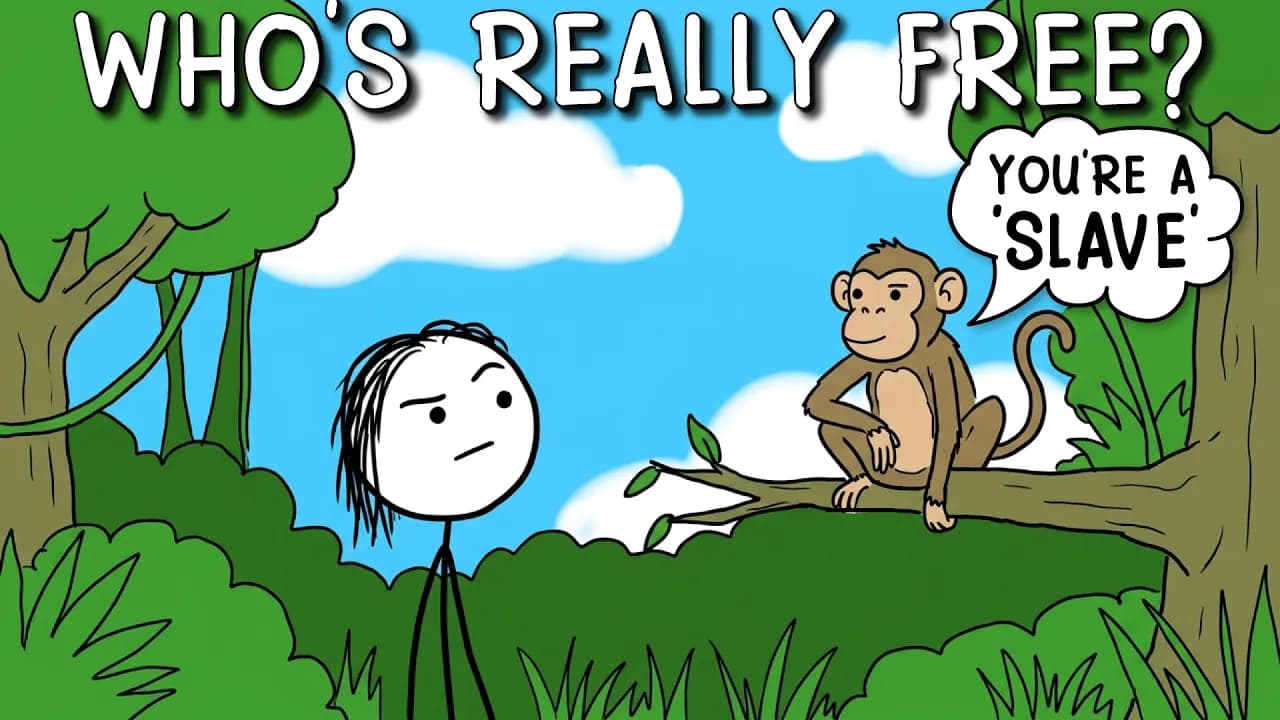
A Twitter exchange crystallized the core idea: defining one's identity entirely by service to others constitutes "slave morality." This term originates from Nietzsche's distinction between slave morality and master morality. Slave ethics bases identity on serving others and adopting external values rather than setting one's own values and determining what is meaningful.
Recording at 1:30 pm on a Wednesday, the speaker notes that the "Panopticon" community expects productivity at that hour. Two elderly men playing golf appeared to feel they were "getting away with something" or missing work, reflecting the internalized voice that people owe their time to companies or society and must earn their living.
The speaker works independently and sets their own schedule, questioning who dictates that one must be at work or earn money. These values originate from society but do not need to be accepted or internalized. The speaker recognizes this as projection: imposing one's own compliance-based framework onto others.
In the absence of financial security, individuals must comply with external demands to meet basic needs. AI, automation, robotics, and the post-work economy threaten this compliance structure. Slave morality builds moral identity around compliance; once financial security removes the threat of job loss or dependency, individuals can achieve "complete financial independence"—defined as the ability to support oneself without any person, entity, or institution able to take that security away.
In a hypothetical post-work scenario where everyone receives passive income through universal basic income, universal basic capital, citizen dividends, or sovereign wealth funds—estimated at $60,000 to $70,000 annually without working—material security would exist across multiple dimensions. The required shift involves discarding slave-moral programming and recognizing that one owes nothing to anyone, breaking free from frameworks based on obligation and service.
The speaker maintains criticism of Nietzsche as a philosopher but acknowledges the validity of this particular concept, noting Nietzsche did not originate it. Mandy, a Carolina Retriever-Husky mix, exhibits independence and stubbornness shaped by evolutionary pressures, unlike superintelligence or machines that lack such pressures. This distinction addresses criticisms about controlling superintelligence by highlighting fundamental differences between biological and artificial systems.
Keep David Shapiro in your library
Save the videos and channels worth coming back to, and find them again in one place.