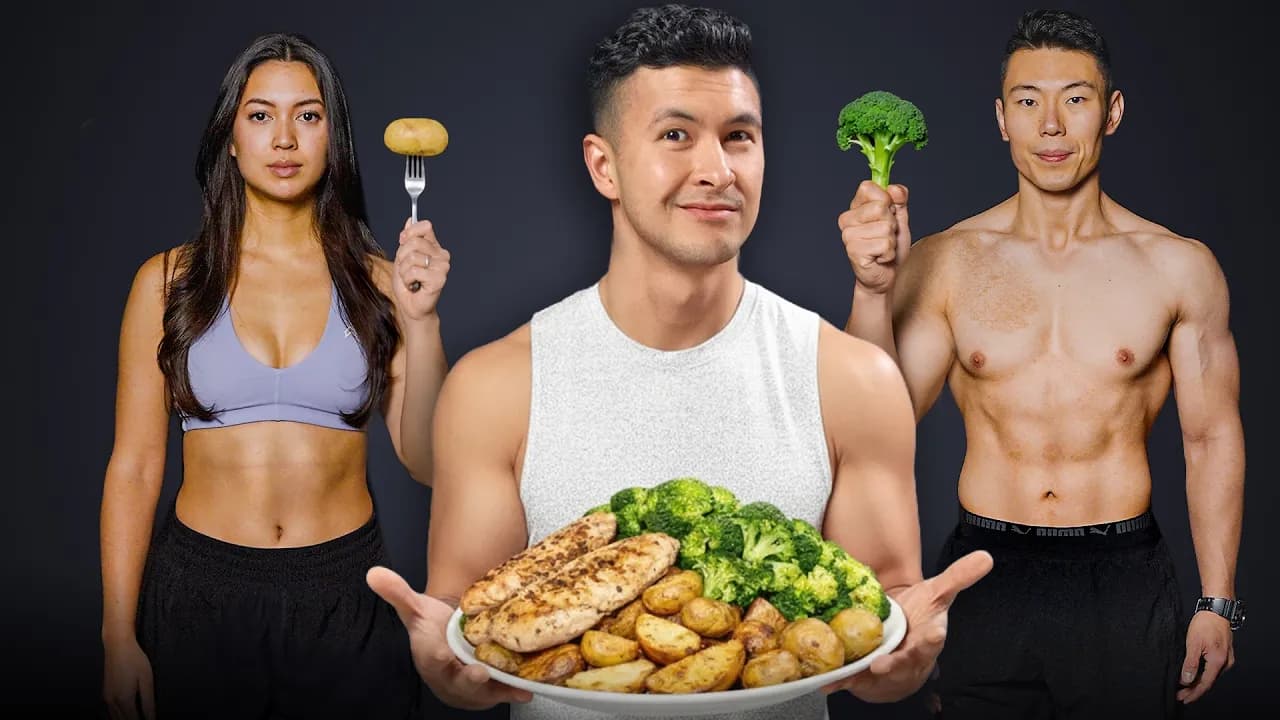
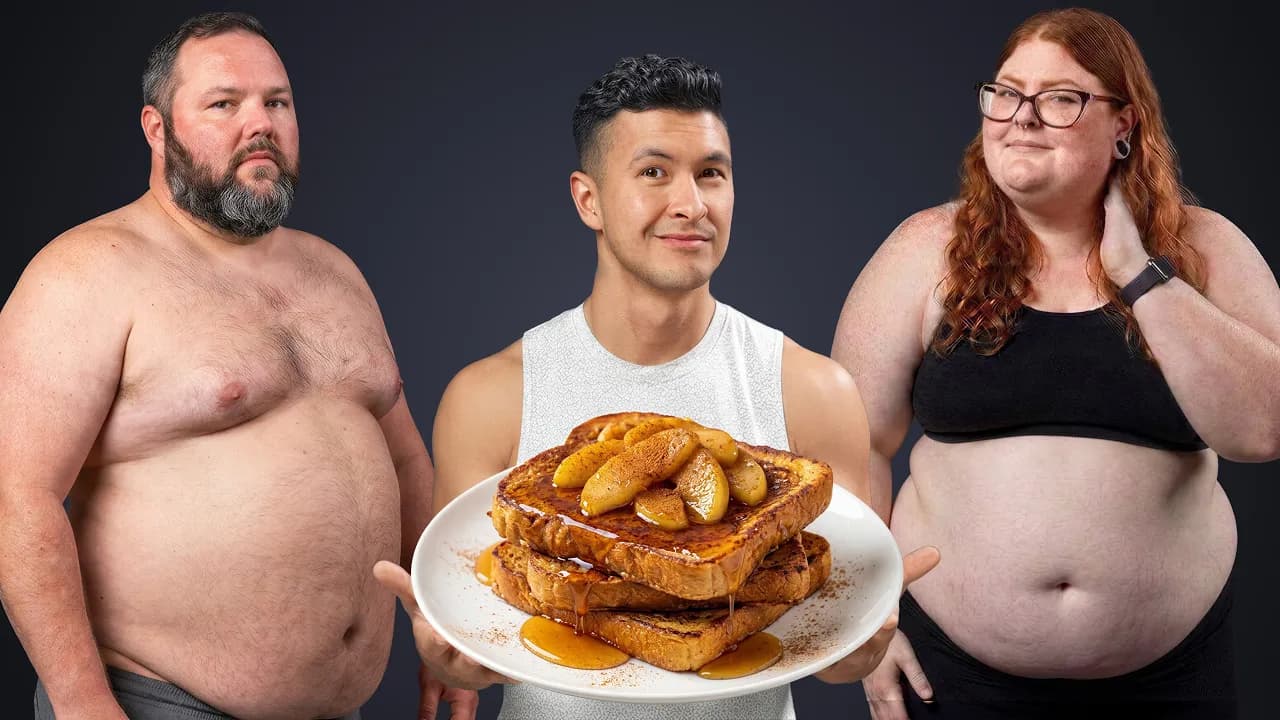
If You Love Eating But Want Abs, Do This For 30 Days
In a Nutshell
Two participants followed a 30-day bowl-only eating plan requiring every meal to be filled to the top with protein, high-volume vegetables, and one measured serving of fat. This approach leveraged stomach stretch receptors, carbonated drinks, and broth to create fullness on fewer calories. Manson lost 10 lbs of fat (24.7% → 20.7% body fat) and Melody lost 8 lbs of fat (32.5% → 29.7% body fat) while preserving muscle through high protein intake.
These notes were generated by AI and may contain inaccuracies.
Manson is one of the strongest guys in his gym but hates cooking and has never been able to stick to a diet. His day one body fat is 24.7%. Melody has been lifting weights for 5 years and thought she was eating just 2,000 calories per day, but actually eats 3,000 calories per day. According to her DEXA scan, her day one body fat is 32.5%.
Rule number one: each participant gets their own designated bowl. They can only eat from their assigned bowl. The bowls are intentionally massive to fit more food, with Manson getting a slightly bigger one to account for his larger size.
Rule number two: every meal must have at least one food from each of three food groups - a protein source, a volume food, and one serving of fat which is the only food being measured. No snacking between meals. Calorie-free sauces, sweeteners, and seasonings are all fair game.
Rule number three: every meal must fill the bowl to the very top.
Every ingredient was chosen for one specific reason. 200 calories of pork compared to chicken breast shows chicken breast provides over double the food. 200 calories from volume foods allow getting way more food for far fewer calories, with half of them not even fitting on a plate. Fats are the only food limited to one measured serving per meal.
Stomach walls are filled with stretch receptors that sense how much the stomach has been stretched and tell the brain how full it should be after eating. More stretch equals more fullness. This is the whole idea behind gastric bypass surgery, where doctors make the stomach smaller so it stretches more from less food, leading to an average of 12 to 18 lbs of fat loss in the first 3 months.
Manson was eating the same three foods every single meal - plenty of strawberries, plenty of shrimp, two eggs. Melody was mixing up her meals every day and constantly experimenting in the kitchen. Manson was missing out on a ton of key micronutrients.
Sweet and savory breakfast bowl: high volume vegetables including microwave pumpkin and sauteed mushrooms, scrambled egg whites for lean protein, two soft-boiled eggs as fat source, topped with Sriracha.
Chicken cucumber salad for lunch: slice one whole cucumber, add lemon and seasonings, Greek yogurt and half fat mayo for creaminess, chicken breast for protein, and lettuce for more volume.
Asian option with tuna, carrots, and kimchi.
Low calorie konjac noodle stir-fry for dinner.
Sugar-free Jell-O Greek yogurt fruit bowl for dessert.
Melody noticed improvements: "Normally at night, I have a really hard time breathing because it just gets super stuffy. And I noticed that's gone down a little bit. And I also feel a little bit lighter as well, not like physically lighter in weight, but feel like it's easier to move. Maybe just because the food has been so clean."
Melody struggled with finishing her bowl: "Basically finished the whole tub. Seeds, three servings in one container. Got jello. No. Is this full enough? I really wonder how Manson is doing because his bowl is a lot bigger than mine. I just finished the last meal of the day and I did not want to keep eating. Mentally, I'm very tired of this already."
Week one strategy: every single meal must include at least one diet soda or carbonated beverage. Carbonation works because when drinking anything carbonated, small bubbles fill up the stomach with air causing it to expand. Research found a big increase in fullness from carbonation that lasted almost a full hour after drinking.
Melody noted: "I'm already having a hard time finishing my meals. And adding on the extra drink is making me so full. It's a game changer. It's filling, but it tastes so good, too."
Melody struggled with family dinners: "I feel like I want to avoid going to these family dinners. It just feels awkward when you have to bring your own food is just watching people eat."
Manson was settling into his new routine and forcing himself to start exploring vegetables: "Finally, today I'm eating something new. This is pumpkin. Actually, the seasoning saved the world."
Melody was 5 lbs down. Manson had lost 6 lbs but was concerned: "I'm really happy about the weight loss because I'm going to get married next year and I want to look nice, but I'm worried. I'm losing weight way too fast and I don't want to lose the muscle and the strength in the gym."
A doubly labeled water test was conducted on Manson to estimate exactly how many calories he's burning and eating. Two measures to prevent muscle loss: every meal must include at least one protein source, with foods chosen that provide the most protein for the fewest calories, and they can eat as much as fits inside the bowl. Both participants have been following and tracking workouts using the Built with Science app, with strength increasing as a result.
Week three strategy: one meal must include broth that can be drank before the meal or be part of the meal. Research showed subjects consumed 20% fewer calories on days when they started with low calorie bone broth soup before eating.
Manson attempted making soup: "Today I will be attempting to make soup. I have some broccoli, carrots, noodles, and some chicken breast right here. And also, I have some bone broth. I'm not sure what I'm doing, but I will try."
After adding soup, weights stayed the same for 4 days. Bone broth is very low in calories but very high in sodium. Participants likely saw a temporary spike in water retention. Theory was that they would continue losing fat despite the scale not moving.
Manson became sick of eating the same foods: "My body keep on telling me to uh eat some beef, eat some rice, is eat some fried chicken, even though I'm full all day. I don't think I can continue eating chicken breast stream after this 30 days."
Melody was craving chocolate during her menstrual cycle: "It's that time of the month for every lady out there. You'll get it. I am craving chocolate. I'm hungrier. I'm feeling bloated. I'm just a lot more fatigued than I normally would be. I just want some chocolate."
Melody was missing barbecue food: "I'm praying to God that I can have a steak. So if that comes true, God is real."
Final strategy: swap big forks and spoons with little baby spoons and baby forks to slow down eating. The more time spent eating a meal, the more full and satisfied after eating.
Melody noted: "I don't know if this is actually slowing me down or just making the meal harder to eat. It's like semi frustrating, but also you don't get much."
Manson stated: "Before I eat three meals a day, and now I cut to two because I'm not able to finish it is super helpful and super annoying."
After 21 days, fat loss was visible through cheeks and jawline for Melody. She wore a short sleeve that wasn't crazy oversized to the gym for the first time, feeling somewhat comfortable.
Manson's mother was proud he was eating vegetables. He forced himself to try cooking despite not being a big fan.
Manson wanted potatoes and rice and beef. Melody was surprised at how not filling rice was: "I was very surprised at how not filling rice was. I could eat a whole bowl of rice and chicken and still be hungry after like 20 minutes. But eating squash and all these veggies and chicken, I was full halfway through. It's very sustainable for me."
Participants ranked the most helpful elements: small spoon and fork, shrimp, and carbonated drinks.
Manson estimated eating 2,600-2,900 calories per day following the diet.
Melody lost just over 8 lbs on the scale, pretty much all fat. Body fat percentage went from 32.5% down to 29.7% - a 3% drop in 30 days.
Manson lost 10 lbs on the scale, with 10.2 lbs being fat. Body fat percentage went from 24.7% to 20.7%.
Keep Jeremy Ethier in your library
Save the videos and channels worth coming back to, and find them again in one place.