Inside Theranos with ex-Employee Tyler Shultz
In a Nutshell
Tyler Shultz was one of the first Theranos whistleblowers who discovered the company's blood-testing technology didn't work, yet faced extreme retaliation including legal threats from David Boies, surveillance by private investigators, and family pressure when he tried to expose the fraud. He documented systematic regulatory deception, quality control failures, and patient endangerment, then spent $400,000 in legal fees to defend himself while being isolated and gaslit by his own grandfather, who remained on the Theranos board. The case reveals how whistleblowers need protected reporting channels, legal counsel, and institutional courage to overcome powerful fraudsters who weaponize NDAs, lawyers, and family relationships to silence truth-tellers.
These notes were generated by AI and may contain inaccuracies.
Tyler Shultz was one of the first whistleblowers in the Theranos fraud story. He is the grandson of George Shultz, former Secretary of State who served on the Theranos board. Tyler joined the company fresh out of Stanford and began noticing irregularities that led to threats, lawsuits, and gaslighting from the company. His story is detailed in John Carreyrou's book Bad Blood.
Tyler describes his experience as having two distinct parts: his time as an employee at Theranos, and the events that occurred after his resignation. On his last day at the company, he believed the story was over, but it was only the beginning of the next chapter.
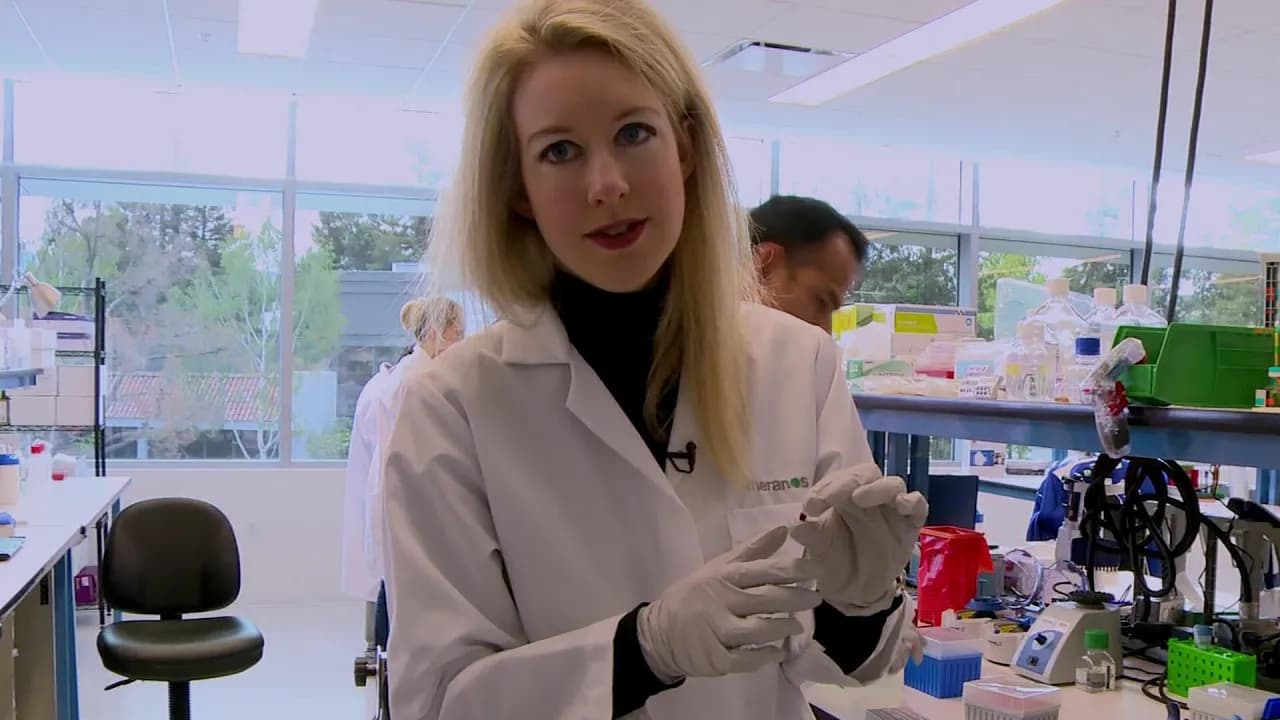
Tyler met Elizabeth Holmes while he was a junior at Stanford. His grandfather George Shultz lived on campus, and one day received a call inviting him to meet "this brilliant woman" at his grandfather's house. Elizabeth was wearing her signature black turtleneck modeled after Steve Jobs. Tyler was struck by her piercing blue eyes, deep hypnotic voice, and charismatic ability to make people feel like the most important person in the world. She presented Theranos' vision of performing any central laboratory test with a single drop of blood, anywhere with electricity access - battlefields, medevac helicopters, operating rooms, patients' homes, Walgreens, and Safeways.
Elizabeth urged Tyler to switch his major from mechanical engineering to biology. He spent two quarters as a bio major at Stanford before graduating. He interned at Theranos between his junior and senior year, then returned as a full-time employee after graduation.
During his internship, Tyler worked in a research lab engineering antibodies for blood tests, far downstream from the actual device development. The biggest red flag was that colleagues who had been there for 3-5 years had never seen the product. The company operated with extreme secrecy - locked doors, barricades, overreaching NDAs, and prohibitions on discussing work with coworkers, justified by claims of protecting trade secrets from Chinese spies and competitors like Quest and LabCorp.
On Tyler's last day as an intern, a colleague he had befriended (they never discussed work due to strict policies) gave him a warning: "You shouldn't come back here. You should go somewhere else and learn how to do real science." Tyler was taken aback since he believed he was doing real science and brushed off the comment.
Tyler describes how Theranos intentionally created impediments to communication at every handoff point in the development process. His team developed antibodies but was not allowed to talk to the team that would use those antibodies to develop tests. This siloed approach made effective scientific work impossible, as "you can't do science that way."
Many top employees refused to work under these conditions. The company was skilled at hiring talent but poor at retaining it, with people leaving within weeks - another red flag Tyler didn't fully recognize due to his youth and inexperience.
Tyler returned as a full-time employee on Tuesday, the day after Theranos launched their product with a ribbon-cutting ceremony at Walgreens in Palo Alto. On his first day, the manager of the assay validation team (called the "Eliza lab" for enzyme-linked immunosorbent assay) quit after a screaming match with Sunny Balwani and Elizabeth Holmes, reportedly found crying in the parking lot.
The team was informed that despite launching the product, they had zero tests validated on the Theranos platform. Patients at Walgreens received traditional needle blood draws, not finger pricks, and samples were sent to other labs or tested on third-party Siemens or Roche equipment rather than Theranos devices.
Despite these revelations on his first day, Tyler remained optimistic. The company held a celebratory all-hands meeting that same day after 11 years in stealth mode. Tyler believed he would work at Theranos for his entire 30-year career.
The assay validation team experienced extreme turnover, with people "dropping like flies." The team operated 24/7, with Sunny conducting walkthroughs at 3 AM to ensure staff were working. The lab housing the devices was named "Normandy," referencing the D-Day invasion as a metaphor for Theranos "storming the beaches of healthcare."
Within days or weeks of launch, the first test (HBA1C, a relatively easy test) was validated on the Theranos platform. Sunny sent an email scrapping all experiments and moving research teams to validation, describing it as being on "the front lines."
Tyler always had a bad feeling about Sunny Balwani, describing him as having "the personality of gravel" - abrasive and hard to be around. Even Tyler's grandparents, who became close to Elizabeth and invited her to family events, never wanted to invite Sunny unless absolutely necessary.
Text messages revealed in lawsuits show Sunny's mob-boss-like communication style. When searching for whistleblower sources, he texted about narrowing it down to five people and "nailing this." After identifying Tyler, he wrote about "knocking legs off one at a time."
Elizabeth maintained an angelic public persona as the "darling of healthcare" and "youngest self-made female billionaire," while Sunny handled the bullying and harsh management internally. Elizabeth wanted to run the company like Apple under Steve Jobs, though Tyler notes Apple was tough but nothing like Theranos' culture of "threats, bullying, and lies and gaslighting."
Elizabeth created an alternate reality where credible people like George Shultz served as validation - if George Shultz believed in the company, others followed. Within the company, she built a culture of fear over 11 years where anyone questioning Elizabeth was fired, sometimes sued, with company-wide emails sent about lawsuits as warnings to others.
By the time Tyler and others joined, every person working with the device knew it couldn't test 300 things from a single drop of blood and wasn't giving accurate results, but nobody spoke up due to the established feedback loop of punishment.
Many employees were too afraid to even give notice when leaving. One colleague bought a house in another state, worked a full Friday, left his badge on his desk, and was gone by Monday without giving notice. Despite having valuable expertise during a good economic period, people stayed due to mortgages, spouses, student debt, children, and visa dependencies.
Theranos notably gave almost no stock options to employees, unlike typical startups, which Tyler identifies as another red flag.
Tyler was prohibited from discussing work details even with his grandfather on the board. He felt unable to contact regulators without a fake email and name, and was too afraid to even call a lawyer due to NDAs and the culture of fear. He sought sanity checks from trusted colleagues and managers within the company, who confirmed the technology didn't work, but friends outside dismissed his complaints as typical first-job dissatisfaction.
Tyler's parents believed him and advised him to quietly leave while maintaining relationships, prioritizing his safety in exiting the situation.
Tyler received advice from colleagues suggesting he should quietly leave Theranos by telling Elizabeth he wanted to pursue a PhD to maintain his relationship with her. He chose not to follow this advice.
Several critical technical and operational issues were identified with the Theranos technology. The Theranos device could only test for one thing at a time, making it impractical for use in settings like medevac helicopters where additional equipment would be required. By the time Tyler left, only seven tests had been validated, not the 300 tests Elizabeth claimed were operational.
When regulators arrived to provide CLEA certification for the central lab, the door to Normandy was locked and employees were instructed not to enter or exit that room. Regulators were only shown the Jurassic Park lab containing Siemens and Roche equipment, while the board was told this equipment was used only for validation purposes. Shell corporations were created to purchase third-party equipment to conceal the extent of testing done on non-Theranos devices.
During an audit conducted by the New York State Department of Health, Theranos ran tests on both their device and third-party equipment but only reported results from the third-party equipment. In some cases, results differed by more than 300%. This demonstrated that management knowingly provided incorrect medical information to patients while ensuring correct results were shown to regulators.
When quality controls failed in the lab, Sunny would pressure employees to run patient samples despite these failures. This pattern showed management was willing to charge patients for incorrect medical information rather than halt testing.
Tyler described feeling like he was living in the Twilight Zone, where obvious problems were being ignored due to fear. He noted that this was not an ethical dilemma involving competing values, but rather a clear distinction between right and wrong that everyone recognized but was afraid to address.
The syphilis validation study revealed the test was fundamentally flawed. When testing known positive patients, only 65% sensitivity was achieved initially, improving to 80% on retesting. Testing assumed negative samples among employees resulted in over 20% testing positive for syphilis. This demonstrated both low sensitivity and low specificity, indicating the test did not work. Despite these failures, a medical doctor signed off on the test as safe and effective for patient use.
After witnessing the syphilis test validation, Tyler began systematically raising concerns through multiple channels. He contacted the New York State Department of Health, spoke with colleagues, managers, a vice president, the president and COO, the CEO, and a board member. At every level, he was either ignored, gaslit, bullied, or threatened.
Tyler researched the laws governing central laboratories and concluded Theranos had broken regulations. When he approached a vice president about the audit violations, the executive was more concerned about who else knew about the cheating than about the violations themselves. The vice president acknowledged the audit was not conducted correctly but dismissed it as unimportant.
Tyler contacted the New York State Department of Health without initially revealing his employer. After providing specific details about the company, tests, and dates, his complaint was directed to the laboratory investigative unit for anonymous processing. He never received a response. The Wall Street Journal later discovered the complaint had been forwarded to the Center for Medicare and Medicaid Services as a federal rather than state issue, where it was apparently lost.
After Elizabeth repeatedly postponed in-person meetings, she suggested Tyler put his concerns in an email. He documented specific observations with supporting data and proposed solutions, framing himself as a team member working toward the company's long-term goals. The email concluded with an apology if it seemed attacking and expressed dedication to the company's vision.
Elizabeth forwarded Tyler's email to Sunny, who responded with a lengthy email written entirely in red text, much of it capitalized and bolded. Sunny called Tyler arrogant, ignorant, patronizing, and reckless, claiming he had no understanding of basic math, science, or statistics. Sunny stated that anyone with a different last name would have been held accountable in the strongest possible way.
As part of his response, Sunny used an analogy about counting M&M's, suggesting Tyler didn't understand that having six people count rather than one would provide an average. Tyler's initial draft response was "I understand how to count M&M's. My point is that I would rather have one adult count the M&M's than six four-year-olds," highlighting that statistical methods cannot compensate for fundamentally flawed data.
Tyler ultimately sent a brief resignation email giving two weeks' notice, offering to leave earlier if preferred. He had previously spoken with his grandfather about his concerns, bringing data and analysis to his house, but his grandfather did not understand the technical issues presented.
When shown validation plots for vitamin D testing, Tyler's grandfather interpreted data points above the correct result line as positive indicators rather than understanding they represented inaccurate measurements. His grandfather's response was that Tyler should sort out these questions with Elizabeth directly.
Tyler had discussed the secretive environment at Theranos with his grandfather, who viewed the extreme secrecy positively and compared it to working at the CIA. His grandfather had established a trust fund for his great-grandchildren consisting entirely of Theranos stock, which at peak valuation of $75 per share was worth over $200 million. Elizabeth was aware of this financial arrangement and likely hoped it would influence Tyler's perspective.
Throughout the process, Tyler maintained he wanted the company to succeed and would have been delighted to be proven wrong. He systematically attempted to disprove his own concerns by speaking with colleagues and regulators, which ultimately strengthened his conviction that the facts supported his position.
The dynamic at family gatherings changed after Tyler began working at Theranos full-time. During Christmas gatherings, Elizabeth's statements about his performance and the company's progress became painful to hear once he understood the reality behind the claims. She would praise Tyler's work compared to PhDs and emphasize his leadership potential, which he recognized as manipulation.
Family members began questioning the timeline of Theranos' nationwide rollout, noting that after three years the technology was still not available in locations like Portland. Elizabeth consistently provided excuses about going above regulatory requirements and having submitted extensive FDA documentation, though Tyler noted that presubmission meetings with the FDA could be scheduled based on ideas alone and did not represent meaningful regulatory engagement.
After the family lunch or dinner, some of Tyler's aunts and uncles expressed admiration for his opportunity to work at Theranos. Tyler openly contradicted this, stating "That place is a complete disaster. Nothing works. This is never going to happen." He was unable to hold back after watching Elizabeth continually lie to his family. Tyler could see Elizabeth trying to gaslight him in real time and eventually stated "No, this is a complete fraud."
Tyler received mixed advice from family members. Some suggested he should quietly leave since it wasn't his place to raise issues with his grandfather, allowing the company to take its natural course. Others advised that he should absolutely talk to his grandfather and try to do more.
Tyler never reached out to past employees or knew who had worked there previously. Company history wasn't public at the time, and he wouldn't have known about board member Avi Tavanian. Former employees were discouraged from talking to current employees, making such outreach too risky.
The chief scientist of Theranos took his own life between Tyler's internship and full-time employment. Tyler was there around the time it happened but never heard about it or the scientist's name until learning about it later from the Wall Street Journal reporter.
Tyler doesn't remember employees accusing Elizabeth of faking her voice during his time there, though he noticed her voice would occasionally slip up an octave when laughing. People who knew her in college and early Theranos days report a stark difference in her voice from the company's early days to its peak.
Elizabeth was described as a master at planting seeds for lies years in advance. A key example was her statement in Tyler's grandfather's living room that Theranos would remain private forever due to benefits of not being public. She knew an IPO was impossible due to scrutiny and transparency requirements, so she preemptively eliminated the possibility before raising nearly a billion dollars in funding.
Tim Draper was an early investor who put in $500,000 as an angel investment, not from his fund. Silicon Valley VCs largely avoided Theranos due to their investment processes. Vinod Khosla of Khosla Ventures visited the company, ran their process, and decided not to invest. Similar experiences were reported from partners at Sequoia and Google Ventures.
Tyler and the interviewers discussed how Elizabeth manipulated the press's desire for female founders. The world was craving a female Steve Jobs, and Elizabeth positioned herself perfectly with quotes like "there's a special place in hell for women who don't help other women" and becoming the youngest self-made female billionaire.
The interviewers noted that Elizabeth may have made it harder for subsequent female founders, who now face greater scrutiny. Tyler argued that Elizabeth's formula for success relied on being a woman to manipulate old white men into investing, and that Sunny would have failed if trying to raise the same $700 million round.
Tyler stated that Elizabeth relied on being a woman to commit the fraud and raise money in ways a man couldn't have achieved. He noted she used her femininity on the way up and then tried to use it as an excuse on the way down, claiming it was a witch hunt because she was a woman.
Elizabeth had previously stated she would never have a boyfriend, get married, or have children due to devotion to Theranos. Tyler suggested she had children strategically around sentencing time. During her trial, she made a public show of being a new mother with two babies. She also did a New York Times op-ed featuring photos of her children, which Tyler viewed as using her kids like props similar to her black turtleneck.
Tyler believes Elizabeth has some pathology that allows her to rationalize decisions others couldn't. He describes it as similar to sociopathy or psychopathy, though he doesn't know the exact diagnosis.
Elizabeth's security detail, including the code name "Eagle One," was part of the show even at a $1 billion valuation. Security would open every door for her and use code names unnecessarily. She and Sunny employed cloak-and-dagger tactics like arriving and leaving restaurants at different times, though Sunny drove a flashy Lamborghini with a vanity license plate.
On Tyler's last day, he received a blistering email and assumed he would leave immediately. His temporary manager informed him that Elizabeth and Sunny felt it was more appropriate for him to leave that day. Tyler spent time organizing his lab notebook and explaining his work before being called to HR at 3:00 PM.
The head of HR had a "faked pained look" and stated Elizabeth and Sunny thought it was better if Tyler left. She presented another NDA for him to sign, which he signed without reading. The document was a termination certificate reiterating confidentiality obligations extending indefinitely into the future.
By coincidence, Tyler's wife found the Theranos folder containing the NDA while cleaning before this podcast. The document was printed on Theranos confidential paper and contained standard confidentiality language.
Tyler had forwarded some documents to his personal email, including a final intern presentation he wanted to practice at home and links to third-party published papers from Google Scholar. These led to accusations that he breached his contract by taking confidential information.
The most significant document Tyler removed was the email he sent to Elizabeth about his concerns. Unable to email it to himself, he printed it at Theranos. The printer malfunctioned and produced 12+ copies totaling 200-300 pages, causing Tyler to panic while standing over the printer waiting for them to finish printing.
Tyler Shultz printed copies of an email exchange on his very last day at Theranos. The printer would not stop, and he was nervous that someone would question the ream of paper. He knew there were cameras at every door and in the parking lot. Once printing stopped, he took the paper and stuck it under his shirt, intentionally wearing a sweatshirt despite never wearing them normally. He walked out of the building with the emails under his shirt and put them in the trunk of his car.
According to the book Bad Blood, the HR person stated there would be a security person to escort Tyler out to his car, but no security person was available so Tyler saw himself out. This detail matters because Theranos later characterized his last day as leaving in an absolute storm. When Tyler asked if he could retrieve his personal books on kinetics from his desk, he was told security would mail them to him instead.
Security was supposed to escort Tyler out of the building, but after waiting, the HR person said security was busy and asked if Tyler could walk himself out. Tyler asked if he could grab his books on the way, but was told no. He left without an escort, chatted with a security person at the front desk for about two minutes in a cordial conversation, then walked out.
Before Tyler reached his car, his mother called and said "Stop whatever it is you're about to do." Tyler responded that it was too late because he had literally just walked out the door and they would not let him back in. His mother had just gotten off the phone with his grandfather, who said Elizabeth told him that Tyler had vocalized a vendetta against her and that if he tried to execute this vendetta, he would lose.
Tyler drove to his grandfather's office on the Stanford campus. His grandfather said Elizabeth told him Tyler quit in a very dramatic and inappropriate way, and that she was trying to meet with him to calm him down but he was refusing to meet with her. Tyler explained this was not true - he had been trying to schedule a meeting with Elizabeth but she had been avoiding him. He described spending his day transferring his lab notebook peacefully and talking to people in the break room peacefully. He emphasized that he walked himself out of the building because they felt he did not need a security escort.
Tyler showed his grandfather the email exchange, including the entire thread with Sunny's responses. The email is notable because Sunny put his responses inline with Tyler's, making it read like a conversation rather than separate back-and-forth messages. Tyler pointed out specific sentences where his concerns were not being addressed, and Sunny was essentially calling him stupid. Tyler stated: "I can be stupid and my concern can still be valid."
After reading the email, Tyler's grandfather said it looked like Theranos had given a substantive answer with a lot of words. Tyler pointed out specific sentences where his concerns were not addressed. The grandfather had been on the phone with Elizabeth all day. Elizabeth claimed Tyler was completely wrong, that they were going above and beyond regulatory requirements, that they did 100% of testing on Theranos devices, and that they were only doing finger pricks. The grandfather said Elizabeth was trying to convince him Tyler was stupid, but she could not do that. However, she could convince him Tyler was wrong, and the grandfather believed Tyler was wrong.
Tyler noted that the email would show Elizabeth had lied about the way he quit, demonstrating he was professional and classy in giving his two weeks notice. However, at that point it was impossible for his grandfather to see Elizabeth doing any wrongdoing. The grandfather told Tyler to move on to the next thing and that the chapter was over.
Tyler met his colleague Erica Chung for a beer at Antonio's Nut House. Erica was frustrated after hearing about Tyler's day and had many of the same concerns. She wanted to raise the same concerns and write a similar email, but her manager warned her not to do it. The manager said if she did this, she would be on their radar and once on their radar, she would be there forever, which was not somewhere she wanted to be.
Tyler told Erica he could not guarantee his grandfather would do anything but could guarantee he would listen to her. Tyler's grandfather had invited him for dinner that night, and Tyler offered to bring Erica as a guest. The grandfather agreed to have Erica join them for dinner.
By the time Erica arrived for dinner, Tyler's grandfather had become almost angry at them. Tyler felt bad because he had promised Erica his grandfather would listen to her, but instead the grandfather shut her down. The grandfather told them they were young and did not know what they were looking at, and that Elizabeth had assured him about all these things.
During the dinner, Tyler's grandfather said the Theranos devices were currently being used in medevac helicopters in Afghanistan. He told Tyler and Erica they were dead wrong because these devices were being used on battlefields. When asked why Jim Mattis, the military board member, did not correct this claim, Tyler explained that Mattis never addressed this piece of it.
A quote was discovered in drafts of Theranos marketing materials attributed to Jim Mattis that Tyler does not believe Mattis ever said. The quote stated: "We have been using Theranos for two years with incredible success. One of the most challenging parts of my job is contacting families of fallen soldiers. I write multiple next of kin letters every day. And so it is very evident to me the impact that Theranos has had on survival rates. We're able to take these small machines to the front line on helicopters and planes, test, get extremely accurate results, and begin stabilization immediately. As a result, we have a 98% survival rate, up 30% from 68%. That's a dramatic improvement in the quality of care that we can provide the courageous men and women of our armed forces, which means a lot more soldiers are going home to their families."
Jim Mattis was the only board member who testified in Elizabeth's criminal trial for the government. Tyler notes that while Mattis has a great reputation and was taken advantage of, this does not absolve the board of guilt they should have. Mattis was a four-star general at the time and later became Secretary of Defense.
Tyler told his grandfather directly that the devices were not working within the walls of Theranos, so there was no chance they were working in a helicopter. He stated that when Elizabeth tells excuses about why the technology is not rolled out nationwide and keeps saying it is coming but it never does, those excuses are lies and the real reason is that it does not work. The grandfather just responded "Okay."
Outside Tyler's grandfather's house, Erica asked to see a copy of the email exchange. She read the first two paragraphs, closed her eyes, and said she could not read it because she was too tired. The next day, Erica quit and had a face-to-face discussion with Sunny on her last day rather than sending an email.
The day after leaving Theranos, Tyler felt a huge weight had been lifted. He walked on the Stanford campus, saw friends, went to the bookstore to buy a book, and sat in the sun reading. He drove to Los Altos to see his mom, and they bought and planted an avocado tree in the backyard, spending the day digging a hole.
Tyler wanted to work in a lab at Stanford with a professor he had taken a class from during undergrad. When he worked at Theranos, he was trying to set that up as his next step. The professor initially advised him to stick it out at Theranos for a full year because it was his first job and leaving after a few months could look bad. After Tyler quit, he reapproached the professor who then welcomed him into the lab.
Tyler worked in the Stanford lab for about three months through the summer. Then a former manager from Theranos recruited him to a team she was building at Roche, a big biotech company. Tyler was doing enzymology work at Roche and felt he had left Theranos behind him.
At Thanksgiving, Tyler learned Elizabeth was invited to their Thanksgiving dinner. It was a very intimate setting with just Tyler and his parents, Elizabeth and her parents, and Tyler's grandparents. Tyler's parents did not want to go because they were mad at his grandparents for inviting Elizabeth, but Tyler insisted they show up because not attending would let Elizabeth win by pushing them out of their own family.
Theranos had moved into their new building on Page Mill Road. They had started in the old Facebook building where Tyler worked, then moved to the new sparkling building. Elizabeth bragged about every window being bulletproof in the new building. She had previously claimed Mark Zuckerberg's glass office was bulletproof because he treated employees so badly he was afraid one would shoot him.
Elizabeth stood up and gave a toast at Thanksgiving dinner. In Tyler's memory, she was staring straight into his soul with glowing eyes. The transcript cuts off at the beginning of describing what Elizabeth said in her toast.
Elizabeth told the Schultz family she loved and appreciated every single member, and Tyler felt like she was specifically addressing him. What was intended as an olive branch felt like the killer is in the house type of vibe. Tyler's hand shook uncontrollably when raising his wine glass as he felt angry, scared, and incredibly frustrated all at the same time.
The next major development occurred when a Wall Street Journal reporter reached out to Tyler's current manager, who was also his former manager at Theranos. She showed Tyler the LinkedIn message during a meeting at RO. The reporter had previously won a Pulitzer Prize for exposing Medicare fraud. After a month passed without responding, Tyler decided to contact the reporter.
Tyler justified reaching out by explaining that his goal was to help the reporter ask good questions. If Theranos had all the right answers, that would be fine. He wanted to hold Elizabeth accountable and ensure patients were not being hurt, noting instances where patients were sent to the emergency room due to high potassium levels.
Tyler wanted his grandfather to have an opportunity to address the issues while he was alive. His grandfather was 95 years old at the time. Tyler believed his grandfather, who served in the Nixon administration during Watergate and the Reagan administration during the Iran Contra scandal, would make things right if given the chance.
Tyler initially agreed to speak to the reporter on deep background, meaning the reporter could use the information to guide reporting but could not directly quote anything or use Tyler's name. It wasn't until a year and a half later that Tyler went on the record.
Tyler knew the reporter was talking to Ian Gibbons's widow and someone above his pay grade. He learned that Adam Rosendorff, a former lab director, had been the first source for the Wall Street Journal but had backed out after Tyler agreed to become a source. Adam never went on record and his name appears as the pseudonym Alan Beam in the book Bad Blood.
Tyler met the reporter at a bar in Mountain View a few weeks later. The reporter commented on how nervous Tyler appeared and said Theranos was just a startup, not the CIA. Tyler felt the reporter might be underestimating Elizabeth.
Tyler drove 25 minutes to have dinner with his parents. His dad had just gotten off the phone with Tyler's grandfather and asked if Tyler had talked to the Wall Street Journal reporter. When Tyler confirmed he had, his dad was furious, warning that Theranos would destroy his life.
After the Wall Street Journal reached out to Elizabeth for comment, Theranos went into full attack mode. Elizabeth and Sunny exchanged texts where Sunny said they had narrowed it down to five people, and Elizabeth responded that it was Tyler. Sunny used language about nailing this motherfucker and taking his legs out one at a time.
Theranos figured out Tyler was the source because the concerns the Wall Street Journal wanted to publish matched exactly the concerns Tyler had raised during his time there. Tyler had sent an email to Elizabeth containing a specific number showing that for some tests, the coefficient of variation could be as high as 42.9% for TSH.
Tyler called his grandfather, who said Elizabeth had told him Tyler was giving trade secrets to the Wall Street Journal. His grandfather wanted Tyler to sign a one-page non-disclosure agreement to help Theranos protect their trade secrets. Tyler did not confirm or deny speaking to the reporter during this call.
Before going to his grandfather's house, Tyler told a housemate about the situation. The housemate advised him to lie and collect information rather than tell the truth immediately. He also recommended talking to a lawyer first. Tyler was too scared to call a lawyer because he thought it was precluded by his Theranos NDAs.
Tyler called the Wall Street Journal reporter to confirm he had not revealed Tyler as a source. The reporter forwarded the email sent to Elizabeth, which contained approximately 10 questions. Tyler felt comforted because there was nothing in the email that could exclusively have come from him except for the 42.9% coefficient of variation number.
Tyler went to his grandfather's house and lied, saying he had not spoken to the Wall Street Journal. His grandfather mentioned that Elizabeth told him the reporter was using complete sentences out of an email Tyler had sent. Tyler confidently denied this because he had seen the reporter's email and knew it contained no complete sentences from his communication.
When Tyler agreed to sign the one-page NDA, his grandfather revealed that two Theranos lawyers from Boies Schiller were already in the house. Tyler had been very specific about wanting to talk without lawyers present, and his grandfather had agreed to this condition.
Tyler arrived at his grandparents' house to find Theranos lawyers already present, having arrived before him and well before his grandparents. Elizabeth Holmes had arranged for the lawyers to be there without informing Tyler, and his grandfather may have been coached or coerced into not disclosing their presence. The lawyers were waiting with far more than the single-page NDA Tyler had agreed to sign.
Instead of the promised one-page NDA, the lawyers presented Tyler with a temporary restraining order, a strongly worded letter signed by David Boies, and a notice to appear in court on Friday morning. The meeting occurred on a Wednesday night. Tyler's legal counsel later noted procedural irregularities with the TRO, as there was no specific complaint filed with the court.
The lawyers demanded Tyler sign the documents and admit he was a source for the Wall Street Journal. They claimed it took them only five minutes to identify him as a source. They also demanded names of other sources. Tyler refused both requests, stating he would not identify sources and had no responsibility to do so. His grandfather defended him, stating his grandson was "not a rat."
During the deposition, Tyler's grandfather described the lawyers as "a wild animal who assaulted his grandson." Tyler's step-grandmother became visibly upset and angry at how the lawyers were treating Tyler. When Tyler asked if the lawyers were making her uncomfortable, she confirmed they were. Tyler told the lawyers to end the conversation, but they continued pressing him until his grandfather stood up and ordered them to leave his house.
After the lawyers left, Tyler's grandfather suggested inviting Elizabeth Holmes over or calling her. They called Holmes, and Tyler's grandfather told her to send different lawyers the next day with the promised one-page NDA. Tyler's grandfather blamed the lawyers, believing they had gone rogue and that Elizabeth was innocent. Tyler found this view completely delusional.
The same two lawyers returned the next morning with an affidavit rather than an NDA. The affidavit stated Tyler had not spoken to the Wall Street Journal and required him to list names of people who had, under penalty of perjury. Tyler refused to sign, citing his concern about committing perjury. His grandfather negotiated with the lawyers, eventually removing the naming-names requirement.
Tyler still refused to sign because the notice to appear in court remained in effect. His grandfather wrote in pencil at the bottom of the affidavit: "Theranos will not sue Tyler for two years." When Tyler objected that two years was insufficient, his grandfather crossed it out and wrote "forever." The lawyers agreed to this handwritten addition.
Tyler insisted on having his own lawyer review the documents before signing. His grandfather had his estate attorney review the affidavit. The estate attorney, after learning David Boies was representing Theranos, immediately recognized the seriousness of the situation. Boies was known as a top corporate litigator who had represented Bill Gates, the Clintons, and later Harvey Weinstein.
Tyler assembled a legal team including an IP attorney, criminal defense lawyer, litigator, defamation lawyer, and whistleblowing attorneys. His goal was to stay out of court. He spent approximately $400,000 to $500,000 in legal fees. Theranos hired private investigators who followed Tyler, with the apparent goal of intimidation rather than information gathering.
The fundamental issue was whether Tyler had disclosed trade secrets to the Wall Street Journal. Tyler maintained that fraud is not a trade secret. Theranos attempted to get him to sign affidavits retracting his statements to the Journal. Tyler's parents were pressured by his grandfather to convince Tyler to sign, with his grandfather claiming Tyler was being unreasonable in refusing.
While pressuring Tyler, Theranos simultaneously applied intense legal pressure on John Carreyrou and the Wall Street Journal. Rupert Murdoch, owner of the Wall Street Journal, was also an investor in Theranos. Despite this conflict, Carreyrou's editor and Murdoch supported the investigation.
Rupert Murdoch invested approximately $125 million into Theranos about a year before the scandal broke. When questioned about the extensive security detail surrounding Elizabeth Holmes, Murdoch remarked that as an actual billionaire, he didn't require such extensive security measures.
The period before the Wall Street Journal article was published marked Tyler's lowest point. After cutting off communication with John Carreyrou, Tyler became paralyzed by fear that former colleagues would text him about statements he made in 2013, potentially leading to subpoenas. He worried Theranos would use evidence of him sharing trade secrets against him.
Tyler learned that evidence cannot be destroyed but new evidence can be avoided. He systematically blocked every phone number in his contacts one by one. This approach was designed to prevent new communications that could be subpoenaed while preserving existing evidence.
Tyler stopped seeing friends entirely because even simple questions like "How are you doing?" triggered severe stress responses. He was not married at this point and described the period as extremely lonely. The only communication method he used was Snapchat, which he chose because messages disappear and because conversations on Snapchat tend to be more superficial than phone calls or text messages.
Tyler returned to his Stanford laboratory and found the work therapeutic, allowing him to focus on something other than the Theranos situation. He was working extensive hours in the lab and with legal counsel while severely limiting sleep and social interaction.
Tyler began using Tinder for dates as a distraction from his situation. During this period, he kept a knife next to his bed due to fear and paranoia. His mental health deteriorated significantly.
After Tyler's parents hired a lawyer to communicate with his legal team, someone broke into the lawyer's car during a wedding and stole her briefcase containing all their documents and notes. While officially considered a coincidence, Tyler found it suspicious given the pattern of surveillance and intimidation.
Tyler experienced extreme paranoia, believing Sunny Balwani might attempt to kill him personally. He would hear rustling outside his window and experience heart rates reaching 180 beats per minute while lying in bed, convinced "tonight's the night." He was unable to confide in his roommates about the situation.
Tyler's legal counsel warned him not to be surprised if the FBI showed up at his house to search for documents or laptops. They advised him to let them in if they arrived, as he had already provided them with everything necessary. The legal team also warned him about potential honey traps, advising him not to trust attractive women who approached him in bars.
Tyler could not speak directly to his parents and instead communicated through lawyers because his grandfather was providing them with misinformation. This arrangement meant conversations occurred with multiple lawyers present, which Tyler found fundamentally different from confiding directly in his parents.
The period of isolation lasted approximately four months, from Thanksgiving to May, when the confrontation occurred in his grandfather's living room. The Wall Street Journal article was finally published in October, spanning roughly May through October.
When the first Wall Street Journal article was published late one evening, Tyler was initially disappointed, feeling the publication had "pulled a lot of punches" and hadn't gone far enough. He feared Elizabeth Holmes would successfully fight back. However, he later realized the Journal had planned a series of articles rather than a single publication.
Following the Wall Street Journal reporting, CMS and FDA conducted inspections that found laboratory practices put patient health in immediate jeopardy. Elizabeth Holmes was banned from operating a laboratory or serving as CEO for two years. Regulators discovered documented evidence of quality control failures followed by patient sample processing, which Theranos had recorded rather than deleted.
Tyler recalled discussions during his time at Theranos about maintaining two sets of books - one for internal purposes and another for regulators. The fact that regulators found incriminating evidence suggests either this system wasn't implemented or employees chose to reveal the actual records.
Once the articles began appearing, Theranos largely moved on from targeting Tyler, apparently recognizing they had larger concerns. However, Tyler continued to feel bullied through other means.
Nearly a year after the articles began, the Theranos board released a statement giving Elizabeth Holmes 100% support. Tyler was particularly disturbed that his grandfather remained on the board and supported this position despite being presented with evidence contradicting his previous statements.
David Boies was forced to confirm that inspectors were never shown the laboratory containing Theranos devices, validating Tyler's earlier claim that had been dismissed as implausible. Tyler felt this proved he had been gaslit about events he witnessed.
Even a year after the articles began, Tyler discovered he was still being followed by private investigators when Theranos lawyers contacted him about a lunch meeting with John Carreyrou that had occurred two days earlier.
In response to the board's continued support statement, Tyler crafted a letter confronting his grandfather about his support for Elizabeth Holmes. He presented three possible explanations: being in love with her, being motivated by financial interests worth hundreds of millions in stock options, or being too old to comprehend the situation. Tyler offered to help his grandfather exit the board gracefully.
Tyler's grandfather responded by stating that Elizabeth would unveil the technology at an AAC conference in a couple of weeks and it would "blow everybody away." He spoke in broad terms about healthcare innovation needs without addressing specific fraud allegations.
Tyler decided to stop worrying about protecting his grandfather and focus on his own well-being. He felt Theranos was using his grandfather as a shield, betting he wouldn't speak out because it would make his grandfather look bad.
Tyler's legal team strongly opposed him going on the record, warning it would invite David Boies to sue him for defamation. His parents begged him not to proceed, fearing he had barely escaped the first legal confrontation.
Tyler explained to his parents that either they could work together to go on the record in a controlled way, or he would eventually be triggered and speak out uncontrollably. After initially agreeing not to go public, a subsequent trigger led him to call John Carreyrou and offer to go on the record without consulting his parents or lawyers first.
In his book "Bad Blood," John Carreyrou wrote that Tyler had steadfastly refused to sign any documents presented by David Boies. Carreyrou acknowledged that without Tyler's courage and his parents' $400,000 in legal fees, the first article might never have been published. He expressed guilt for putting Tyler through the ordeal.
Tyler focused on his Stanford laboratory work, eventually spinning out technology into a startup. He was named to Forbes' 30 Under 30 in healthcare and attended a conference in Boston where he reconnected with a former housemate from his Theranos period.
Tyler met his wife at a week-long conference in Boston where they had previously been best friends for years. During that conference, they started dating and by the time he returned home, he was dating his best friend. They are now married and have a child. The experience of reconnecting with his wife was transformative because she only knew him from before his time at Theranos, and being with her helped reawaken a part of himself that had been suppressed.
Tyler describes being clinically depressed during his time at Theranos without realizing it at the time. Spending that week in Boston with his future wife helped him become the person he was before Theranos, and he describes this as a beautiful happy ending to his experience.
Tyler notes that pretty much every year or even every month since he went on the record with his story with the Wall Street Journal, his life has gotten better month over month. He expresses gratitude for this trajectory, recognizing it's not the typical experience for most whistleblowers.
Tyler does extensive public speaking about his experience and has learned that there are "shades of Theranos everywhere." After every speaking event, people approach him to share that they've experienced something extremely similar, just at a different scale or in a different way.
He emphasizes the importance of people hearing these stories and recognizing what tools are available to them. One tool he wishes he had known about was protected government whistleblowing channels. These include the SEC's whistleblower program, a new Department of Justice channel, an IRS program, and the False Claims Act.
Tyler specifically highlights the SEC's whistleblower program, where whistleblowers can recover 10 to 30% of what the SEC recovers if there's a settlement in the lawsuit. While it's valuable that whistleblowers can get paid for the disruption to their lives, Tyler finds it almost more important that the program has created an industry where lawyers will work for free on contingency.
This means people who may never collect a reward can still benefit from free legal counsel from these types of lawyers. His number one piece of advice for anyone in a similar situation is to talk to a lawyer, noting that it's very possible to talk to a lawyer for free, which often removes the biggest barrier to seeking legal advice.
For founders, Tyler recommends being very conscious and intentional about building culture. At Theranos, Elizabeth built a culture of fear over 10 years, and at other startups, founders need to do the exact opposite. He notes that Theranos took every opportunity to reinforce their culture of fear, so other organizations should take every opportunity to do the opposite.
He advises that whether the issue is a big fraud or something very small, companies need to take it seriously and test their internal tools. Many companies have internal whistleblowing tools that employees should use and get used to before seeing giant fraud. He recommends starting with small stuff and taking it seriously.
Tyler encourages people to "flex that ethical muscle" and get used to doing the right thing when they see it. He notes that often in our lives we see some transgression and don't do anything about it. A good place to start is recognizing when that's happening - when something made you uncomfortable and you didn't do anything. Then ask what you can do next time and try to do that.
Through this process, you'll learn what types of resources are available and who your support network is. He also thinks it's a great way for companies to show they're actually accountable to their core values.
Tyler notes that many startups don't even have defined core values. He cites data from the Association for Certified Fraud Examiners showing that companies that just have defined core values pay less fines. By the act of defining core values and communicating them to employees, organizations end up incurring fewer fines.
He recommends going through the exercise of defining core values, then using instances where those core values are challenged as moments to show employees that leadership is accountable to those values and that they should be important to everyone.
Tyler believes that if you're intentional about building culture for 10 years, you can end up with a really great culture where you're not just avoiding big fraud, but it's actually like a superpower. It allows companies to see problems before they grow into huge issues that can threaten the company's existence.
He describes it as allowing organizations to "see around corners" and hear what employees are thinking but not actually saying.
Tyler explains that most founders don't set out to be unethical, but it's a very slow chipping away because people can always rationalize doing something they think will increase shareholder value, or because their board nudged them, or because of pressure from big investors.
If you exercise the ethical muscle regularly, that slow chipping away gets counterbalanced. Having core values gives something to hold yourself accountable to and helps you see when you're starting to make decisions that don't align with those values. It's like setting goalposts so you're cognizant when moral slippage starts to happen.
Tyler reflects that he met Elizabeth when he was 20 years old and is now 33, making this a decade-plus long saga that was covered in two podcast episodes. He hopes to write a book someday to communicate more intentionally about his experience at Theranos to help whistleblowers and help companies build things the right way.
He notes there are lessons for boards, investors, media, employees, and executives - the list goes on and on. He sees this as one of the ways he can contribute, though he's currently very busy being a new dad and will have more time once his child goes to daycare.
Tyler hopes his story connects with founders and people who work at startups in any capacity, and that the next generation of startups can do better.
Keep Y Combinator in your library
Save the videos and channels worth coming back to, and find them again in one place.